

The puppy blues: it's real, it's common, and it passes
Alastair Greenway
BVM&S MRCVS
If you have just typed something like "do I still want my puppy" or "I regret getting a kitten" into a search bar, and you feel a bit sick for having done it, please read the next sentence before anything else. What you are feeling has a name, roughly half of new owners feel some version of it, and for almost everyone it passes. You are not a bad owner. You are a tired one, at the hardest part.
This is the small hours for a lot of people. The house smells of wee, your hands are covered in scratches, you have not slept properly in days, and the animal you were so excited about is asleep at last while you sit there wondering what you have done to your calm, ordinary life. That feeling is real, and it deserves a straight answer rather than either a lecture about gratitude or a cheery "enjoy every moment". So let us talk about it honestly.
What the puppy blues actually is
The puppy blues (and yes, it happens with kittens too) is the low, overwhelmed, sometimes-regretful feeling that can arrive in the first days and weeks with a new pet. It is the gap between the fantasy you were sold, the cuddly companion, the walks in the park, and the relentless reality of a small animal that bites, cries, toilets on the floor, and needs you constantly.
It shows up in a handful of recognisable ways, and it helps to name them, because naming a feeling takes some of its power away:
- Anxiety. A constant low hum of "am I doing this right", or a racing heart every time the pup cries.
- Regret. The thought you feel most ashamed of: "I wish I hadn't done this", or "I want my old life back".
- Feeling trapped. The realisation that you cannot just pop out, sleep in, or go away for the weekend, and that this is your responsibility now for years.
- Tearfulness and irritability. Crying over small things, snapping at the people around you, feeling permanently frayed.
- A strange lack of the bond you expected. Wondering why you do not feel the rush of love everyone promised, and feeling like a fraud for it.
If you recognise several of those, you are in very ordinary company. Feeling them does not mean you have made a mistake, and it does not mean you do not love your pet. It usually means you are exhausted and grieving the freedom you had, both at once.
The evidence that this is normal
For a long time nobody measured this, so owners suffered in private and assumed they were uniquely bad at it. That has changed. Researchers have now developed and validated a proper instrument for it, the Puppy Blues Scale, published in npj Mental Health Research in 2024, which confirms that these feelings are a real, measurable and common experience rather than a personal failing.
The headline finding is the reassuring one. A large share of new owners, on the order of around half, report some degree of these feelings, and the pattern over time is consistent: the difficulty tends to peak early, in the first days and weeks, and then eases as things settle. That shape matters. It means that the worst of how you feel right now is very likely the worst it will get, and that the trajectory from here is usually upward.
UK research points the same way from a different angle. The RVC's Pandemic Puppies work found that a substantial proportion of new owners, around a third, said the reality was harder than they had expected. You were not naive. New pets are genuinely, objectively hard, and a lot of people are quietly finding it hard right alongside you.
Why it hits now, and why it is not a character flaw
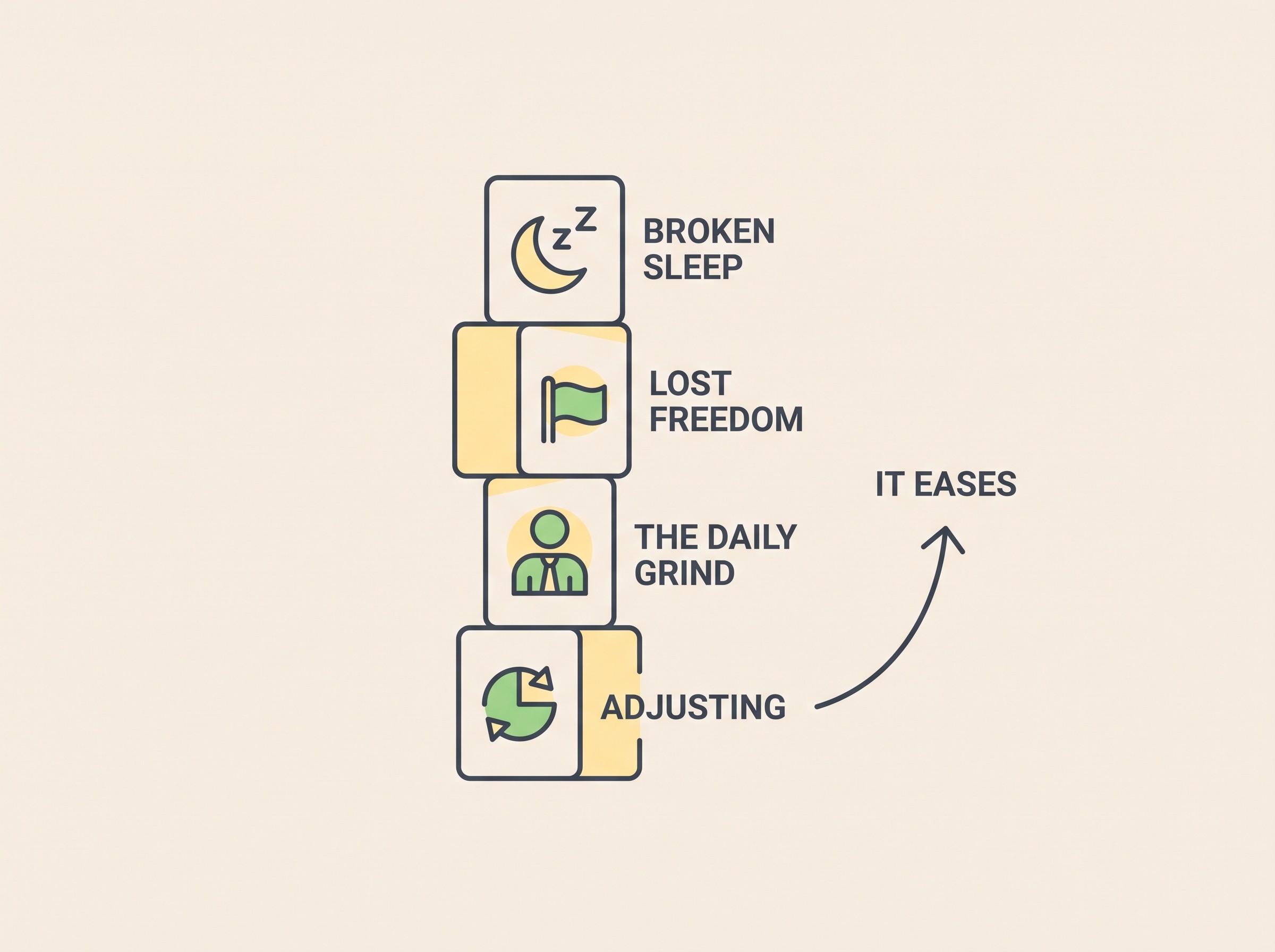
Understanding the machinery of the puppy blues helps, because it reframes the feeling from "something is wrong with me" to "of course I feel like this, look at what is happening". A few forces usually stack up together:
Sleep deprivation. This is the big one, and it is easy to underestimate. Broken sleep, night after night, does to your mood and your patience exactly what it would do to anyone's. Much of what feels like despair is, at least in part, simple sleep debt, and it lifts as the nights improve. The sleep piece is worth reading in its own right (Sleep, crates and settling in).
Loss of freedom and routine. You have handed over control of your days to a small animal. The spontaneity, the lie-ins, the going out without a plan, all of it is on hold. Feeling the loss of that is not selfishness, it is a normal response to a genuine change.
The relentless grind. The biting, the toileting accidents, the constant supervision. None of it is dramatic on its own, but the sheer unending drip of it wears people down. The land-shark biting phase in particular pushes many owners to the edge (Teething and biting), as does the house-training slog (House-training that actually works).
Sometimes, a genuine mismatch. Honesty matters here. Occasionally the low feeling is partly information: a high-energy working breed in a small flat, or a lively kitten when you were hoping for a lap cat, is a harder fit, and some of the overwhelm is your instinct telling you the practical demands are steep. That is not a reason for shame either. It is a reason to get the right support and, if needed, the right training help, so the fit becomes workable.
None of these is a character flaw. They are the predictable result of a big, sudden, sleep-stealing life change. You would think less of a friend who sailed through it effortlessly, not more of yourself for struggling.
What genuinely helps
There is no single fix, and anyone who offers you one is selling something. But there are things that reliably take the edge off while time does the rest.
Sort the sleep first. Almost everything feels survivable on more sleep and unbearable on less. Tag-team the nights with someone else if you can, nap when the pet naps, and treat protecting your own sleep as a real priority, not a luxury. The settling-in article has the practical detail.
Drop your expectations of yourself, hard. You do not need a perfectly trained pet in a month. You do not need to enjoy every moment. The bar for these weeks is: everyone is fed, mostly safe, and getting through. That is enough. Aiming for "good enough" instead of "perfect" is one of the most protective things you can do for your own head.
Build a little routine. Even a loose daily rhythm, roughly when they eat, sleep, toilet and play, gives you back a sense of control and makes the pet calmer too. Predictability helps both of you.
Collect small wins. The first dry night, the first time they settle without crying, the first proper cuddle. Notice them out loud. Progress in the first weeks is real but slow, and it is easy to miss if you only look at how far there is to go.
Do not do it alone. This is the one that isolated owners skip, and it matters most. Talk to people who are in it or have been through it. Our community has a corner for exactly this, where people say the unsayable ("I regretted it in week two and now I adore her") and mean it. Reading that other people felt what you feel, and came out the other side, does more than almost anything (join the New Puppy & Kitten community).
The self-check, and when to reach for more
We have built a gentle Puppy blues self-check as part of this space. It is worth being completely clear about what it is and what it is not. It is a normalising gauge, a way of seeing where you sit and being told, kindly and specifically, "this is common and it tends to pass". It is not a mental-health diagnostic, it cannot tell you whether you have depression or anxiety as a clinical condition, and it is not a substitute for a real person. Use it as a mirror and a reassurance, not as a verdict (try the Puppy blues self-check).
That distinction leads to the honest bit we will not skip. For most people, the puppy blues is ordinary early exhaustion and it lifts. But low mood is not always just the puppy. If your low feeling is deeper than tiredness, if it is not lifting as the weeks pass, if you cannot enjoy anything at all, if you are not eating or sleeping even when the pet allows it, or if you are having thoughts of harming yourself, please treat that as its own thing and reach for real human support. Your GP is a good first door. The Samaritans are there any time, day or night, on 116 123 in the UK and Ireland, and they are not only for crises. And if you are ever worried that you might harm yourself or your pet, please tell someone today, a person you trust or one of those services, rather than carrying it alone.
Asking for help there is not an overreaction and it is not a failure. It is the same good instinct that made you research how to look after your pet, turned towards looking after you.
What happens next
Here is the honest reassurance, and it is the reason this article exists. For the great majority of people, the puppy blues lifts as the pet settles, the nights lengthen, the biting fades and the routine beds in. The bond that felt strangely absent tends to arrive quietly, not as a lightning bolt but as a slow realisation, one ordinary morning, that you would not give them back for anything. That is the usual ending to this story, and it is very likely to be yours.
You do not have to force the love, and you do not have to feel grateful on demand. You just have to get through the next stretch, and let it change on its own, which it will.
The one thing to do right now is the smallest possible thing: protect tonight's sleep however you can, and, if you would find it easier than you think, say out loud to one other person, or in the community, the thing you have been ashamed to think. It passes faster when you are not carrying it alone.
References
- The Puppy Blues Scale (2024). npj Mental Health Research.
- Royal Veterinary College Pandemic Puppies research (2020 onwards).
- AVSAB (2008). Position Statement on Puppy Socialization. American Veterinary Society of Animal Behavior. [context on early behavioural grind and support needs]
- Samaritans. Freephone 116 123 (UK and Ireland), available 24 hours.
Keep track of how your pet is doing
The owners who cope best are the ones who notice changes early. A simple health log shows you what is working, and what is not, before the next vet visit.
Start tracking, freeYou're not doing this alone
Compare treatment journeys and talk to owners managing new puppy & kitten. Free to join.
Join PetsLikeMine