

Wind, gurgling and the rumbling tummy: when flatulence is normal and when it is a clue
Alastair Greenway
BVM&S MRCVS
Some wind is completely normal. If your dog clears a room now and then, or your cat produces the occasional silent surprise, that on its own is not a sign anything is wrong. Most flatulence is a nuisance rather than a disease, and a good deal of it can be dialled down with a few sensible changes. But wind sits one short step away from the part of the gut where digestion can go wrong, so it pays to know the harmless kind from the kind that is trying to tell you something.
Where the gas actually comes from
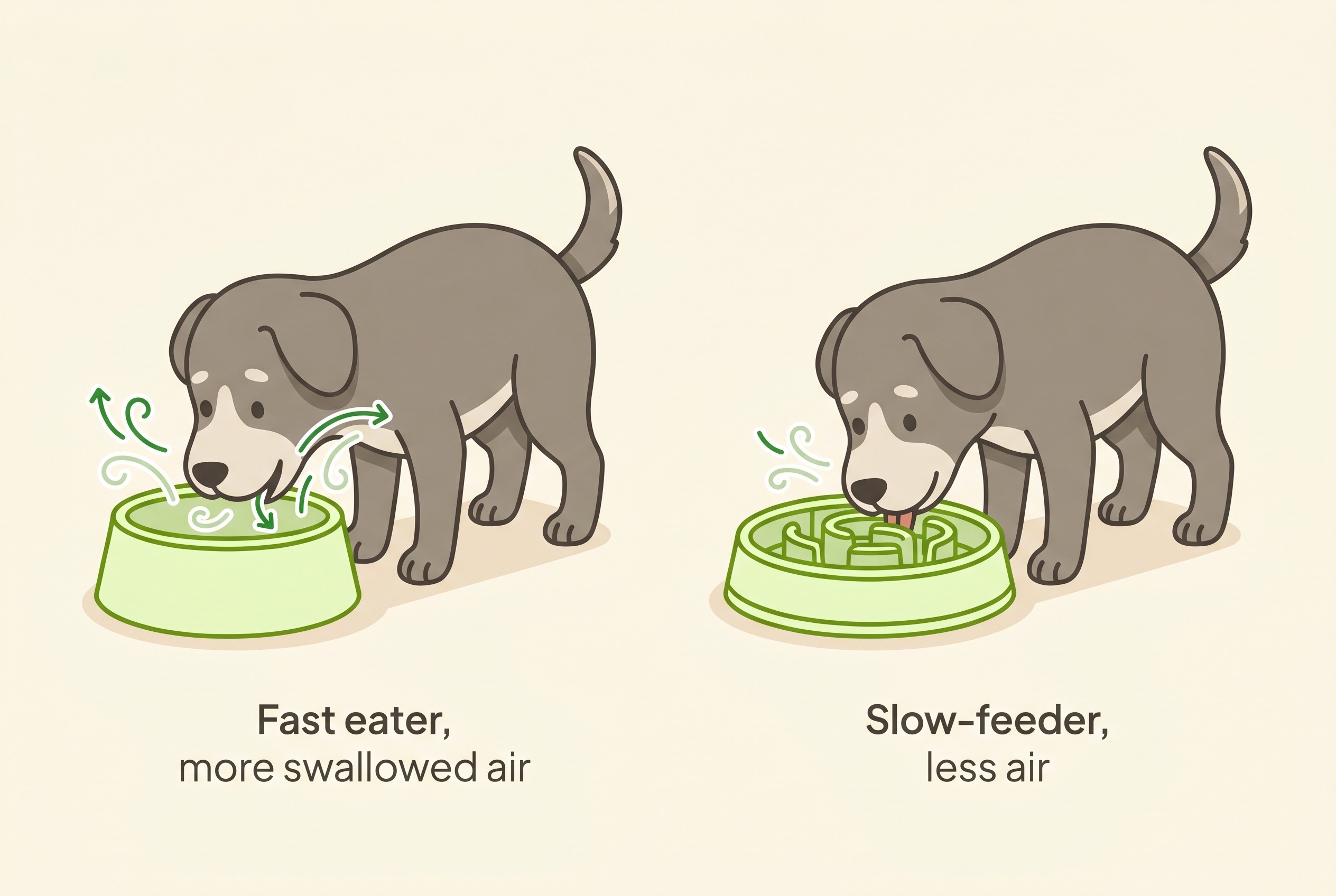
There are only two real sources of wind, and holding both in mind explains nearly everything that follows. The first is swallowed air, called aerophagia: air gulped down while eating, drinking or panting passes through the gut, and it is mostly nitrogen and oxygen. The second is fermentation, gas made when bacteria in the large intestine break down food the small intestine did not fully digest and absorb, mainly fermentable fibre and indigestible carbohydrate, producing hydrogen, carbon dioxide and, in some individuals, methane (Collins et al., 2001; Giffard et al., 2001).
That split matters because the two have different fixes. Swallowed air is a mechanical, behavioural problem, the territory of the fast eater and the flat-faced breed. Fermentation is a dietary and digestive one. Almost everything useful you can do about wind comes back to deciding which of those two you are dealing with.
One more fact reassures owners most, and it is counter-intuitive: the volume of wind and the smell of wind are largely separate problems. The canine work shows it directly. When flatulence was measured in dogs minute by minute, hydrogen sulphide turned out to be the principal driver of how bad the wind smelled, the rated unpleasantness tracking the hydrogen sulphide concentration closely, and a trained odour judge could detect a fart once that single trace gas crept above about one part per million (Collins et al., 2001). The same principle is well established in people, where the great majority of the volume of flatus is made up of essentially odourless gases and the smell comes from a tiny fraction of volatile sulphur compounds (research in human gastroenterology). So a genuinely eye-watering fart is mostly a sulphur problem, not necessarily a sign of more gas, and certainly not by itself a sign of disease.
I will not hand you a "normal" number of farts per day, because for dogs there simply is not one, and for cats there is essentially no research at all. In people, who have been studied in far more detail, the spread is wide, with healthy adults passing wind something like ten times a day and up to roughly twenty (Tomlin et al., 1991), and there is no reason to think dogs are tidier than we are. The useful question is never a count. It is whether the wind is new, persistent, worsening, or arriving in company with other signs.
Windier pets, and the reasons behind it
Some pets really are windier than others, and the biggest single reason is air-swallowing, which is more common than owners realise. In a study that filmed dogs swallowing under X-ray, 40% of those assessed had pathological aerophagia, and a flat face was an independent predictor of it: 45.8% of the air-swallowing dogs were brachycephalic, against 13.8% of those that were not (Grobman et al., 2024). A dog that inhales its dinner, or competes for food in a multi-dog house, takes down more air with every mouthful, and that air has to come out somewhere.
The flat-faced breeds deserve a careful word, because it is not just a joke about windy French bulldogs. In these dogs the air-swallowing comes from the same obstructed, effortful breathing that defines brachycephalic obstructive airway syndrome (BOAS): a dog that has to fight for every breath swallows air as it goes. They commonly have gut signs alongside the breathing, too. In one referral series, 97.3% of brachycephalic dogs presented for upper-airway problems had abnormalities in the stomach and upper intestine when their guts were examined by endoscopy (Poncet et al., 2005). So in a flat-faced dog, persistent wind, gulping, snorting, bringing food back up and noisy breathing can be the visible tip of BOAS. That is a welfare conversation, and sometimes a surgical one, worth having with your vet rather than a quirk to laugh off.
The diet story, straight
The other big lever is what is being fermented in the colon, and that is mostly about food. Highly fermentable fibres and poorly digestible carbohydrates feed the gas-making bacteria. The classic culprits are the oligosaccharides in soya and other legumes, dairy in animals low on the enzyme needed to handle milk sugar, and sudden diet changes. A more digestible food, one absorbed in the small intestine rather than reaching the colon largely intact, tends to leave the bacteria less to work on and so produces less fermentation gas.
I want to be straight about how far that goes, because the internet tends to oversell it. In a controlled canine study, at the oligosaccharide levels tested, neither the protein source nor an added enzyme actually changed the measured amount of flatulence, although the odour-producing metabolites in the faeces did differ by protein source (Yamka et al., 2006). So "try a different, more digestible food and see how the wind responds" is sound advice. "Switch off soya and the wind will vanish" is over-promising, and you should be wary of any product or page that guarantees it.
The cleanest, best-evidenced piece of diet advice is simply to change food slowly. In healthy puppies, an abrupt switch produced a 10.2% rate of diarrhoea and worse stool quality, while a gradual seven-day transition produced no diarrhoea at all and lowered a marker of protein fermentation in the gut (Liao et al., 2023). A change phased over roughly seven to ten days, longer for a sensitive pet, is commonly advised and consistent with WSAVA guidance, and it heads off a lot of wind and loose stool for the price of a little patience. The mechanics of a diet change, and a sensible home approach to a mild upset, belong to tummy upset home care.
A short toolkit worth trying at home, with the ceiling on each:
- Slow a gulper down. A slow-feeder or puzzle bowl, smaller and more frequent meals, and separate bowls in a competitive household all cut swallowed air. This follows directly from the aerophagia data, though formal trials of the bowls themselves are lacking, so treat it as sensible rather than proven (Grobman et al., 2024).
- Trial a more digestible diet, changed slowly (Liao et al., 2023; Yamka et al., 2006). To do this in a structured way, the Diet-Trial Companion lets you log the swap and track the response rather than relying on memory.
- Cut the table scraps, dairy and bin-raiding that load the colon with fermentable material. Scavenging and "garbage gut" live in dietary indiscretion.
- On the smell specifically, one piece of evidence is useful and slightly surprising. A combination of activated charcoal, Yucca schidigera and zinc acetate cut the proportion of bad or unbearable-smelling episodes by 86% in dogs, but did not reduce the amount of gas at all (Giffard et al., 2001). These over-the-counter de-odorisers make wind less offensive, not less plentiful, and they treat no underlying disease. They are fine for a well dog that is simply a bit whiffy. They are the wrong move if any of the red flags below are present, because all they do then is mask a signal you want to be able to read.
- Probiotics are popular, but the evidence for reducing flatulence specifically is thin, so I would not over-sell them. The wider microbiome question is handled in living with chronic enteropathy.
A word on the "wind tablet" question, since owners often ask: human anti-foaming products such as simeticone are sometimes suggested for dogs, but there is no good evidence they help with routine canine flatulence, and they are not a substitute for sorting out the feeding or for a vet check when one is due.
Gurgles that are just the gut working
Worth a moment on the loud rumbling, the borborygmi, because it frightens people more than it should. Those gurgles are simply the sound of a normal gut moving gas and fluid along, and an empty tummy, a recent meal or a little swallowed air all make them louder. In a bright, well pet with normal stools they are almost always nothing at all. They earn a mention to your vet only when they are persistent and arrive with discomfort, loose stool, weight loss or a poor appetite, because then they can reflect the same maldigestion as the wind, rather than ordinary plumbing.
When wind is a clue, not just a nuisance
Isolated wind in a bright, well, normal-weight pet with normal stools is almost always benign. Wind becomes a clinical clue when it is persistent and excessive and comes with one or more of: loose, soft, greasy or foul stool; weight loss; a ravenous appetite alongside that weight loss; a poor coat; or that persistent, uncomfortable rumbling. That cluster points towards maldigestion or malabsorption, food fermenting in the colon because it was never properly absorbed upstream, and at that point you are looking at a work-up, not a feeding tweak.
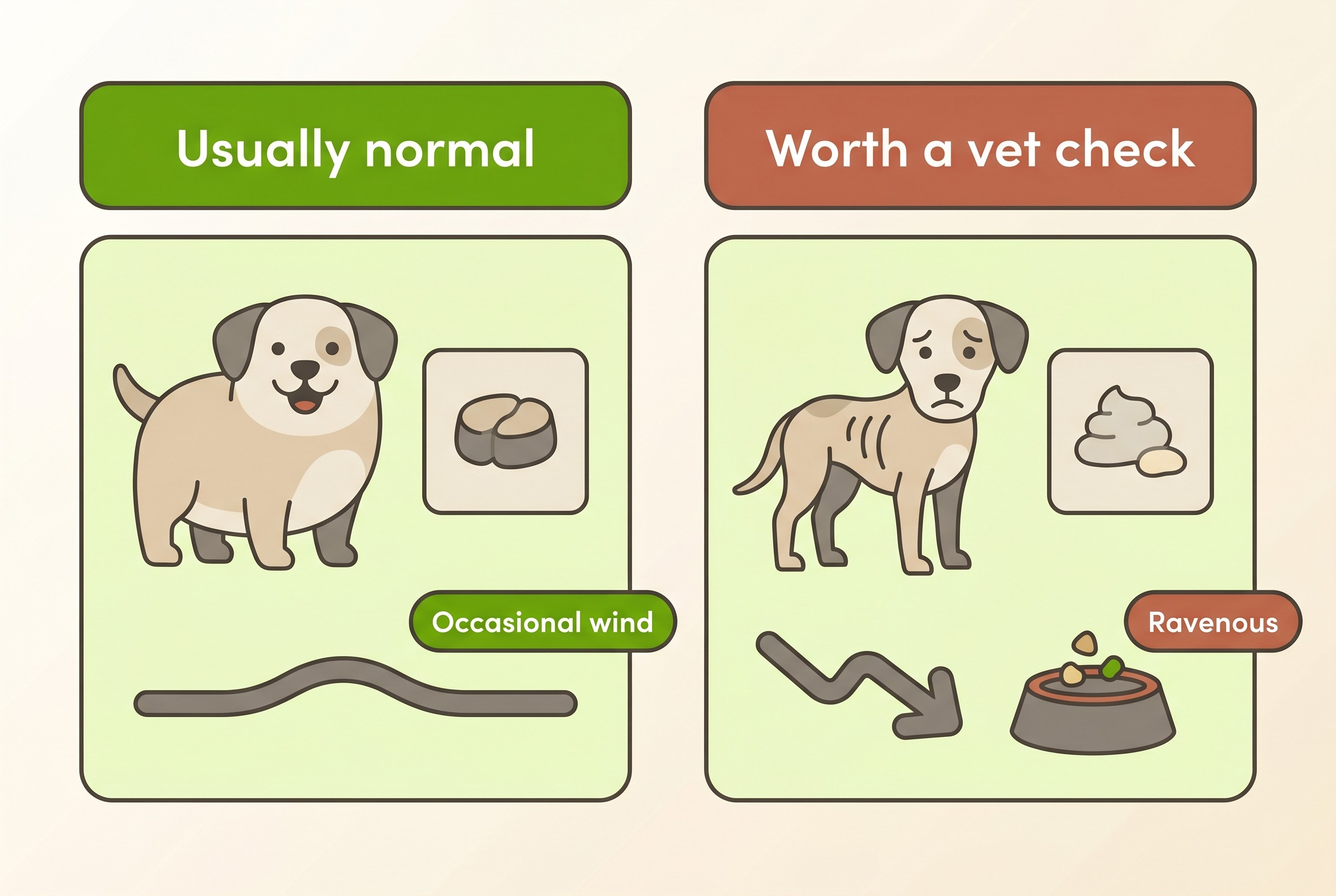
The standout diagnosis to recognise here is exocrine pancreatic insufficiency, or EPI. Severe flatulence and a rumbling gut are listed among its classic signs, alongside the textbook combination of a ravenous appetite with steady weight loss and large, pale, greasy, foul stools (Merck Veterinary Manual). A dog that is windy and eating well and still losing weight does not need a slow-feeder bowl, it needs a blood test. What EPI is, how the simple blood test that diagnoses it works, and how it is managed all live in EPI explained.
Two others belong in the same breath. Chronic enteropathy, the modern name for ongoing small-bowel disease, can produce increased wind alongside loose stool, weight loss and a poor coat; its framework is in chronic enteropathy explained. And giardia earns a mention, because its classic stool is soft, pale, greasy and notably smelly from malabsorption, with extra gas in the picture; it is common, frustrating and easily missed (Merck Veterinary Manual), and the detail sits in worms and giardia diarrhoea.
This is exactly where logging beats worrying. Because the clue is wind plus a change in the stool, the Faecal Score Tracker earns its keep here: scoring and photographing the stool over a week or two is how you tell a benign windy patch from a developing problem, and it hands your vet a pattern rather than a vague impression. Note the weight and appetite alongside it, as set out in describing symptoms to your vet.
The line that is never just gas
One firm boundary before I let you relax again. A swollen, hard, distressed belly with repeated unproductive retching, especially in a big deep-chested dog, is not wind. That is a suspected gastric dilatation and volvulus, the condition many owners know as bloat, and it is a true surgical emergency: the right response is to go to a vet straight away, not to read on. Likewise, sudden, severe or painful wind with vomiting, collapse or a tense abdomen is never "just gas". All of that lives in digestive emergencies, and if you are unsure how worried to be right now, the Vomiting & Diarrhoea Triage will help you decide between wait-and-watch and go-now. I can be this reassuring about ordinary wind precisely because that line is drawn clearly.
So for the great majority of windy pets the plan is a cheerful one: slow the meals, change food gradually to something more digestible, ease off the scraps and dairy, and give it a few weeks. The one thing to keep half an eye on is the company the wind keeps. If it turns persistent and is joined by loose or greasy stools, weight loss or a hungry-but-thinning pet, log it, take the record to your vet, and follow the EPI, chronic enteropathy or giardia trail rather than reaching for another smell-masking additive. Knowing which kind of wind you are dealing with is most of the battle, and now you do.
References
- Collins, S. B., Perez-Camargo, G., Gettinby, G., Butterwick, R. F., Batt, R. M., & Giffard, C. J. (2001). Development of a technique for the in vivo assessment of flatulence in dogs. American Journal of Veterinary Research, 62(7), 1014-1019.
- Giffard, C. J., Collins, S. B., Stoodley, N. C., Butterwick, R. F., & Batt, R. M. (2001). Administration of charcoal, Yucca schidigera, and zinc acetate to reduce malodorous flatulence in dogs. Journal of the American Veterinary Medical Association, 218(6), 892-896.
- Grobman, M., Reinero, C., Lee-Fowler, T., & Lever, T. E. (2024). Incidence and characterization of aerophagia in dogs using videofluoroscopic swallow studies. Journal of Veterinary Internal Medicine, 38(3), 1449-1457.
- Liao, P., Yang, K., Huang, H., Xin, Z., Jian, S., Wen, C., He, S., Zhang, L., & Deng, B. (2023). Abrupt dietary change and gradual dietary transition impact diarrheal symptoms, fecal fermentation characteristics, microbiota, and metabolic profile in healthy puppies. Animals, 13(8), 1300.
- Merck Veterinary Manual. Exocrine pancreatic insufficiency in dogs and cats; Giardiasis in animals. Merck & Co.
- Poncet, C. M., Dupre, G. P., Freiche, V. G., Estrada, M. M., Poubanne, Y. A., & Bouvy, B. M. (2005). Prevalence of gastrointestinal tract lesions in 73 brachycephalic dogs with upper respiratory syndrome. Journal of Small Animal Practice, 46(6), 273-279.
- Tomlin, J., Lowis, C., & Read, N. W. (1991). Investigation of normal flatus production in healthy volunteers. Gut, 32(6), 665-669.
- Yamka, R. M., Harmon, D. L., Schoenherr, W. D., Khoo, C., Gross, K. L., Davidson, S. J., & Joshi, D. K. (2006). In vivo measurement of flatulence and nutrient digestibility in dogs fed poultry by-product meal, conventional soybean meal, and low-oligosaccharide low-phytate soybean meal. American Journal of Veterinary Research, 67(1), 88-94.
Keep track of how your pet is doing
The owners who cope best are the ones who notice changes early. A simple health log shows you what is working, and what is not, before the next vet visit.
Start tracking, freeYou're not doing this alone
Compare treatment journeys and talk to owners managing digestive health. Free to join.
Join PetsLikeMine