

Noisy Breathing: When It's Just a Snore, and When It's Dangerous
Alastair Greenway
BVM&S MRCVS
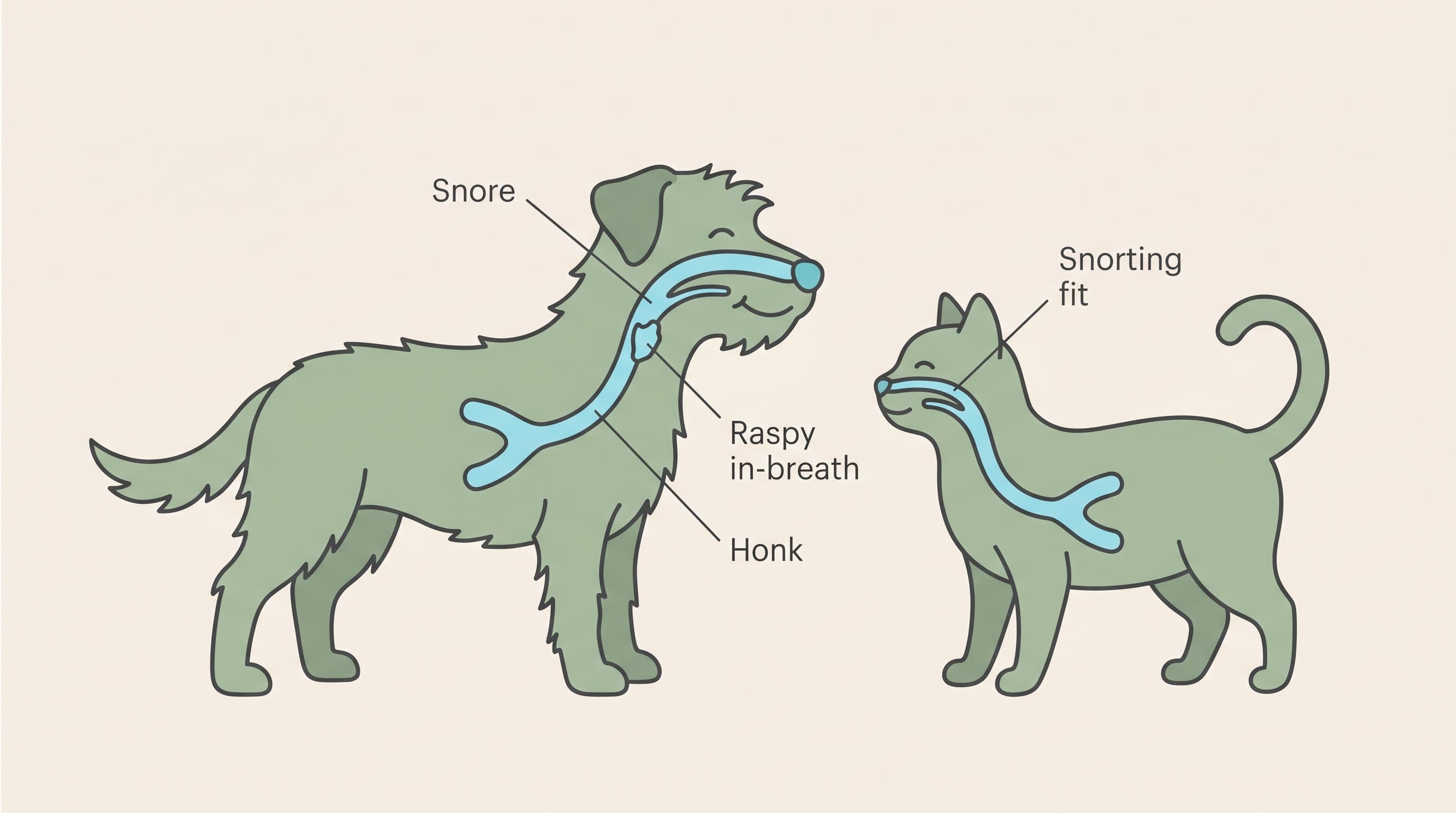
A noise on the breath can mean almost nothing or quite a lot, and from the noise alone it's genuinely hard to tell which. Maybe it's a snore that's louder than it used to be, a snort, a raspy catch on the in-breath, or a sudden honking fit that stops you in your tracks. The honest answer to how worried to be is that it depends on the noise. Some breathing noises are a quirk you can live with. Others are the airway quietly telling you it's in trouble.
What I want to give you is a way to sort one from the other. A breathing noise is air being forced through a passage that has narrowed somewhere, and the useful thing is that the type of noise points to where the narrowing is, and the where points to the likely cause and how urgent it is (MSD Veterinary Manual, n.d.). So this is a same-symptom, different-urgency sort: the main noises, what each usually means, and the override signs that turn any noise into a "ring the vet now". I won't work up each condition here, because each has its own home in this space. The job of this page is to help you read the noise and know which door to go through next.
First, the override: when the noise doesn't matter, the effort does
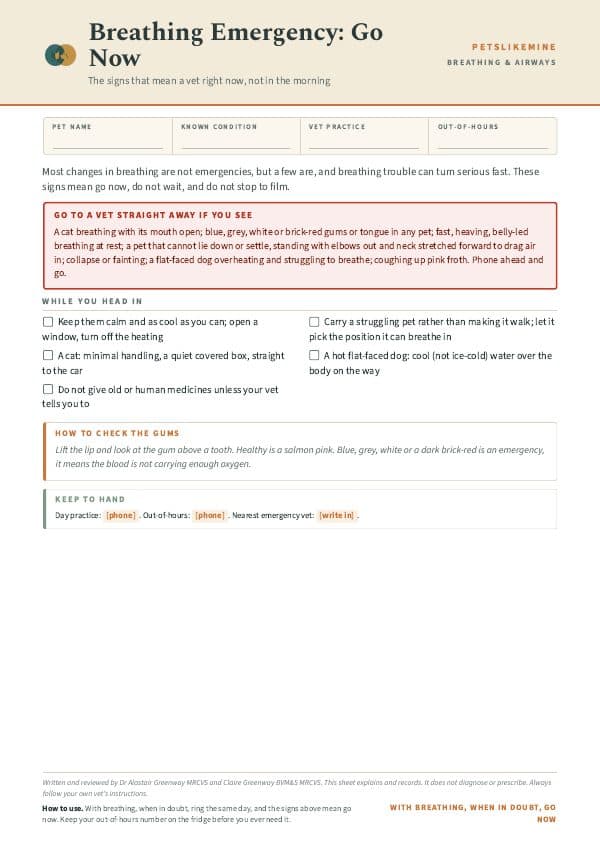
Before we sort the noises, one rule sits above all of them. Whatever the noise sounds like, certain signs mean your pet is genuinely struggling for air, and they mean go to a vet now, not after you've finished reading.
The override signs are: open-mouth breathing in a cat, gums that look grey, dark pink or blue rather than a healthy salmon pink, visible effort to breathe (the chest and belly heaving, the sides working hard), and a pet that can't settle or lie down and instead stands or sits with its head and neck stretched out trying to draw air, which vets call orthopnoea (MSD Veterinary Manual, n.d.). Add to that any collapse or fainting, and any noise that has appeared or sharply worsened in hot weather. None of these wait for an appointment.
Cats deserve a line of their own, because this one catches people out. A cat almost never breathes through an open mouth unless it is fighting for oxygen. A cat in respiratory distress may pant noisily with its mouth open, lower its head and stretch its body forward, and breathe noticeably fast, and any cat showing breathing difficulty is at high risk of dying if the problem isn't treated promptly (Cornell Feline Health Center, n.d.). So an open-mouthed or noisy, laboured cat is a red-alert emergency, not a noise to sort at leisure. If that's what you're seeing, please stop reading and go. Don't stop to film.
With none of those override signs present, and your pet otherwise bright and breathing comfortably between the noises, you've got time to work out which noise you're dealing with. For the full urgency sort, the is my pet's breathing an emergency guide is the hub, and the breathing triage tool will walk you through it, with a breathing emergency red flags sheet you can keep on the fridge.
The snore and snort: stertor
The most common noise, and usually the least alarming, is a low-pitched snore or snort. Vets call this stertor. It's a snoring-like sound you can hear on the in-breath, the out-breath, or both, and the low pitch comes from soft, floppy tissue vibrating as air passes it: the soft palate at the back of the throat, or the walls of the throat and nose (MSD Veterinary Manual, n.d.; Merck Veterinary Manual, n.d.). So stertor localises high up, to the nose, throat and soft palate.
In a flat-faced dog, a pug, a French bulldog, an English bulldog, stertor is the classic awake-snorer sound, and most of it comes from an elongated, thickened soft palate crowded into a short skull. Let me be candid and warm at once, because this is where a lot of owners get told their dog's snoring is "just the breed". A brachycephalic dog has a fairly normal amount of soft tissue packed into a shortened face, so that snoring and snorting is usually the sound of a narrowed airway working harder. It's effort, not character, and that isn't a reason to feel guilty or a judgement on you. It's simply worth knowing the sound means something, because noticing it is the kind thing to do. To put the breed risk in perspective, pugs in one large UK study had around 54 times the odds of brachycephalic obstructive airway syndrome (BOAS) compared with other dogs (O'Neill et al., 2022).
I won't unpack flat-faced breathing in full here, because it has its own front door. If your dog is a brachycephalic breed and you're working out whether the snoring is normal-for-them or a problem worth acting on, flat-faced dog breathing: normal or dangerous is written for exactly that, without blame and with the red flags spelled out.
The raspy in-breath: stridor
Now the noise I want you to take more seriously. Stridor is a higher-pitched, harsher sound, classically worse on the in-breath (Merck Veterinary Manual, n.d.). Where stertor is a soft snore, stridor is a tighter, rougher, almost strained catch as the air is drawn in, and it usually comes from the larynx, the voice box at the top of the windpipe. As a rough rule, narrowing in the upper airway above the chest makes its noise on the in-breath, whereas narrowing lower down, inside the chest, tends to make noise on the out-breath (MSD Veterinary Manual, n.d.).
Stridor is the more sinister of the two noises, because laryngeal disorders are characterised by stridor and can lead to death if they aren't treated (Merck Veterinary Manual, n.d.). The condition behind it I most want you to know about is laryngeal paralysis. The picture is fairly specific: an older, larger dog, very often a Labrador, whose breathing has become noisy or raspy, whose bark has changed or sounds hoarse, and who tires more easily than they used to (Cornell Riney Canine Health Center, n.d.b).
Hold onto one particular tell with stridor, because it can turn from a nuisance into an emergency quickly: laryngeal paralysis can become a medical emergency if the breathing suddenly worsens with excitement, stress, exercise, or hot and humid weather (Cornell Riney Canine Health Center, n.d.b). A dog that's been raspy for weeks can tip into a crisis on the first warm day of summer, which is exactly why a raspy older dog and a heatwave are a combination to respect. And laryngeal paralysis is often not an isolated voice-box problem at all, but the first sign of a slowly progressive, whole-body nerve condition called GOLPP, geriatric onset laryngeal paralysis polyneuropathy, so the larynx is just the part that shows first (Cornell Riney Canine Health Center, n.d.b; Michigan State University College of Veterinary Medicine, n.d.). I'll leave that whole-body picture to the pieces that own it. If a raspy in-breath in an older big dog sounds like what you're hearing, go to laryngeal paralysis explained next, and treat any sudden worsening in heat or excitement as an emergency.
The honk: collapsing trachea
The third noise is unmistakable once you've heard it: a harsh, dry, honking cough that genuinely sounds like a goose (Cornell Riney Canine Health Center, n.d.a). This is the hallmark of a collapsing trachea, where the windpipe is too floppy and partly flattens as the dog breathes. It's typically a toy or small-breed dog of middle age or older, the Yorkshire terriers, Pomeranians and toy poodles of the world (Cornell Riney Canine Health Center, n.d.a).
The honk is set off and worsened by stress, excitement, activity, heat and humidity, inhaled irritants like smoke, and, importantly, pressure on the neck, which is to say a collar pulling on the windpipe (Cornell Riney Canine Health Center, n.d.a). That last point is the one daily change worth making the moment you suspect this: swap the collar for a harness, so the lead pulls on the chest and not the windpipe. It costs you nothing and takes the pressure off the very part that's collapsing. If you're hearing a goose-honk, collapsing trachea explained is your next stop. One caution: a collapsing trachea can also progress to severe signs, a wheeze on the in-breath, real difficulty breathing, blue gums or tongue, or fainting, and those tip it straight back into the override emergency list above (Cornell Riney Canine Health Center, n.d.a).
The snorting fit: reverse sneezing (usually the reassuring one)
The last noise is the one that frightens owners the most and matters the least. Reverse sneezing is a sudden, repeated, loud series of forceful snorts inward, where the dog often stands with elbows out and head extended, sounding as though it's trying to inhale a sneeze. It looks alarming, as if they're choking, but it's a harmless reflex in the back of the nose and throat: irritation there sets off rapid inward inhalations with the glottis closed, the exact mirror image of a normal sneeze (Cornell Riney Canine Health Center, n.d.c).
The prognosis is excellent. Episodes are usually sporadic and mild, they resolve on their own within a minute or so, and no treatment is needed (Cornell Riney Canine Health Center, n.d.c). It's set off by excitement, pulling against the lead, eating or drinking too fast, and irritants like dust or allergens (Cornell Riney Canine Health Center, n.d.c). The practical tell that separates a reverse-sneezing fit from a collapsing-trachea honk is this: reverse sneezing comes in brief, self-resolving bursts that the dog is completely normal between, whereas a honk is a recurring cough from the windpipe that keeps coming back over days and weeks (Cornell Riney Canine Health Center, n.d.a; Cornell Riney Canine Health Center, n.d.c). The two can sound surprisingly alike, which is why a short clip on your phone usually settles which it is.
I'm giving you only the headline here, because reverse sneezing has its own home with the full reassurance, the in-the-moment help, and the warning sign for the rare times it isn't just reverse sneezing. Read reverse sneezing explained for that, and don't let "it's probably benign" blind you to a fit that won't stop, gums going blue, a fit in a cat (in whom it is much less common and more often points to something in the nose), or one-sided nasal discharge or bleeding, all of which are a different story.
At rest or only on exercise? A quick gauge of how worried to be
One more dimension places the noise on the worry scale. Noise that only shows up on exertion, excitement or a hot day is a milder picture than noise you can hear when your pet is calm and resting (Cornell Riney Canine Health Center, n.d.b; Michigan State University College of Veterinary Medicine, n.d.). A noise that has newly appeared, or markedly worsened, while your pet lies quietly, or that comes with visible effort at rest, is the more worrying end and deserves a prompt vet visit rather than a wait-and-see. With upper-airway problems like laryngeal paralysis, the noise often starts as something you only hear on a walk or a warm day, then creeps into the resting picture as things progress, so a noise that used to need exercise to bring it out and now plays at rest is telling you something has moved on.
There's a simple number worth tracking alongside the noise: the resting breathing rate, counted while your pet sleeps. In dogs and cats with stable, well-managed heart disease, it sits reliably under about 30 breaths a minute (Porciello et al., 2016). That threshold was validated for heart-failure monitoring, so I'll be straight that it isn't a bespoke airway number, but it works well as a general resting-tachypnoea signal too: a sleeping rate over about 30 that's climbing over days warrants a vet, and over about 40 is urgent. It's easy to log with the breathing rate tracker or the Breath Camera. And if the noise is actually a cough, whether it comes from the heart or the airway is its own important question, weighed in cough: heart or lungs.
Filming it, and which door to take
Breathing noises are slippery. They come and go, and they have a maddening habit of vanishing the moment you walk into the consulting room, so a vet often has to build the picture from your description of a sound you can't quite imitate. The single most useful thing you can do before the appointment is film it: catch a clip on your phone with your pet calm and the chest and flank in view so the effort shows too, and note when it happens, at rest or after exercise, in the heat, when excited, and whether it's worse on the in-breath or the out-breath. That short video, plus a resting-rate count, tells your vet far more than any amount of describing it down the phone, and it can be the thing that separates a benign reverse sneeze from a honk that needs working up.
Most of all, let the noise route you rather than rush you. A low snore in a flat-faced dog, a goose-honk in a little terrier, a raspy in-breath in an older Labrador and a brief snorting fit are four different stories with four different next steps, and you've now got the map to tell them apart. Pick the door that matches what you're hearing, and if any of the override signs show up along the way, that map folds away and you simply go.
References
- Cornell University College of Veterinary Medicine, Riney Canine Health Center. (n.d.a). Tracheal Collapse. Retrieved from
- Cornell University College of Veterinary Medicine, Riney Canine Health Center. (n.d.b). Laryngeal Paralysis. Retrieved from
- Cornell University College of Veterinary Medicine, Riney Canine Health Center. (n.d.c). Reverse Sneezing. Retrieved from
- Cornell University College of Veterinary Medicine, Cornell Feline Health Center. (n.d.). Dyspnea (Difficulty Breathing). Retrieved from
- Merck Veterinary Manual. (n.d.). Laryngeal Disorders in Animals and Clinical Signs of Respiratory Disease in Animals. Retrieved from
- Michigan State University College of Veterinary Medicine. (n.d.). Geriatric Onset Laryngeal Paralysis Polyneuropathy (GOLPP). Retrieved from
- MSD Veterinary Manual. (n.d.). Clinical Signs of Respiratory Disease in Animals. Retrieved from
- O'Neill, D. G., Sahota, J., Brodbelt, D. C., Church, D. B., Packer, R. M. A., & Pegram, C. (2022). Health of Pug dogs in the UK: disorder predispositions and protections. Canine Medicine and Genetics, 9, 4.
- Porciello, F., Rishniw, M., Ljungvall, I., Ferasin, L., Häggström, J., & Ohad, D. G. (2016). Sleeping and resting respiratory rates in dogs and cats with medically-controlled left-sided congestive heart failure. The Veterinary Journal, 207, 164–168.
Free downloads
Companion worksheets to put what you've read into practice. Free PDFs, print at home.
Keep track of how your pet is doing
The owners who cope best are the ones who notice changes early. A simple health log shows you what is working, and what is not, before the next vet visit.
Start tracking, freeYou're not doing this alone
Compare treatment journeys and talk to owners managing breathing & airways. Free to join.
Join PetsLikeMine