

Collapsing Trachea Explained: The Goose-Honk Cough
Alastair Greenway
BVM&S MRCVS
A small dog, often a little older, suddenly produces a cough so dry and harsh it genuinely sounds like a goose honking. It tends to land at the worst moments: when the doorbell goes, when they get over-excited, when they pull on the lead, or after a drink of water. The first time you hear it, the instinct is to wonder whether they are choking, and that is usually the sound that brings people to a page like this.
Let me settle that worry and help you understand what you are hearing, because for most dogs this is a recognisable, manageable problem rather than the emergency it can sound like. The condition is called tracheal collapse, and that goose-honk cough is its signature. This article covers what is happening inside that little windpipe, why these particular dogs get it, what genuinely helps day to day, and the handful of signs that mean it has become something to act on quickly.
What is actually happening
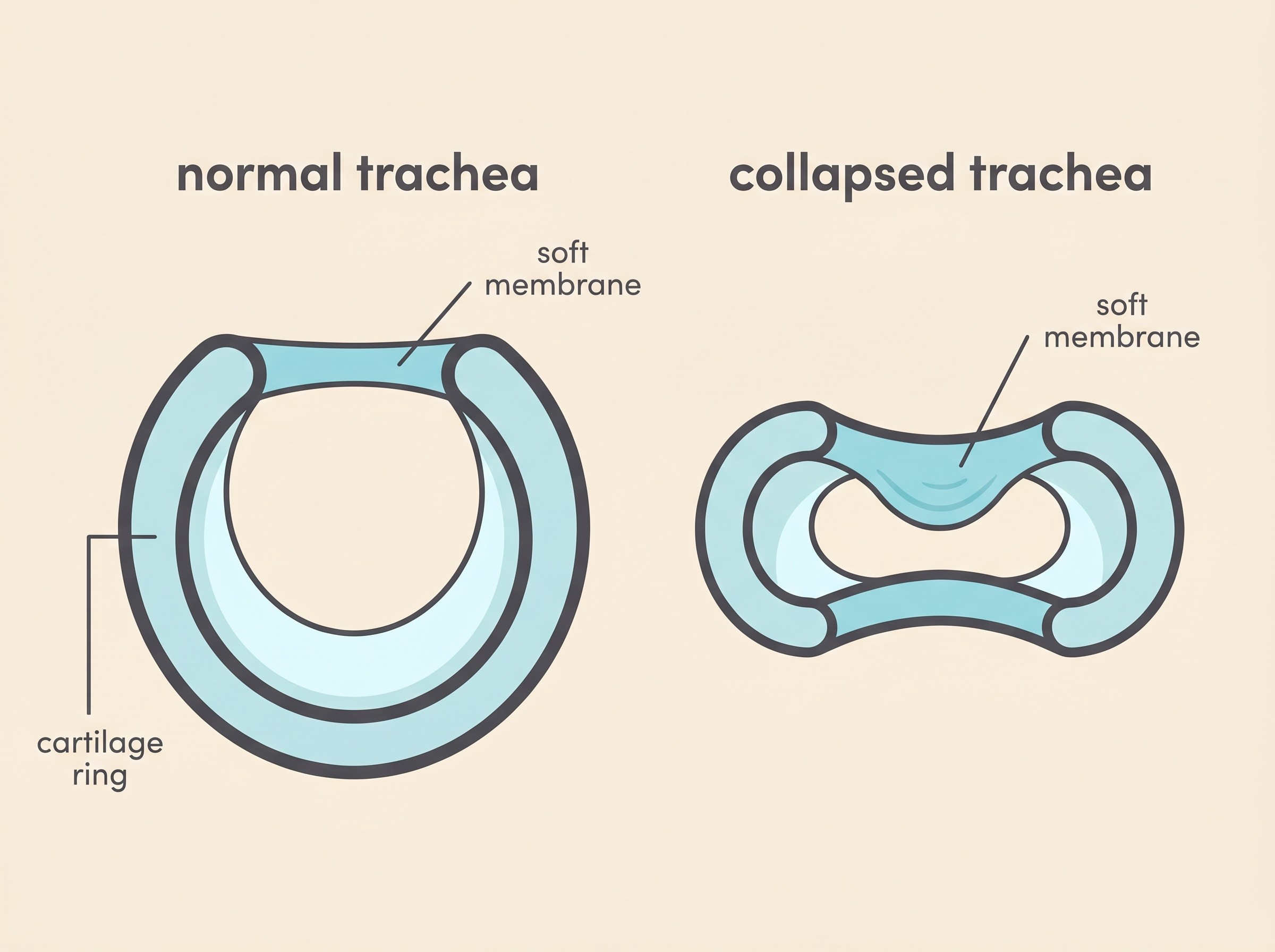
Your dog's windpipe, the trachea, is the tube that carries air from the throat to the lungs. To stay open against the pressure of every breath, it is built around a stack of stiff, C-shaped rings of cartilage, with a soft membrane bridging the gap at the top, a bit like the roof of a tunnel (Cornell University, 2024; American College of Veterinary Surgeons, n.d.). In a healthy windpipe those rings hold their shape and the airway stays round and open.
In tracheal collapse, that cartilage gradually weakens and loses its rigidity. The rings flatten, and the soft membrane at the top sags into the airway, so the round tube becomes a squashed, oval slot, like a drinking straw you have pinched between two fingers (American College of Veterinary Surgeons, n.d.; Cornell University, 2024). Air still gets through, but it rushes past walls that are too close together, and that turbulence is what produces the harsh, honking noise. We do not fully understand why the cartilage softens, and an inherited weakness, present from birth in these small breeds, is strongly suspected (Cornell University, 2024; Tappin, 2016).
One further detail explains a great deal, and it is why the cough comes and goes with the moment. The collapse is dynamic: the narrowing changes with each breath as the pressures inside and outside the windpipe swing back and forth. The section in the neck tends to be squeezed shut as your dog breathes in, while the section down inside the chest tends to collapse as they breathe out (Tappin, 2016). That is why a hard breath, a burst of excitement or a tug on the collar can make it abruptly worse, and why a single still x-ray can miss it, because the picture is frozen at one instant of a moving problem (Tappin, 2016).
Naming the cough, and what sets it off
The hallmark of tracheal collapse is a persistent, dry, harsh cough that really does sound like a goose honking (Cornell University, 2024; Tappin, 2016). It is not a wet, productive cough and does not usually bring anything up. Owners describe it as a honk, a foghorn, sometimes a seal.
It is classically triggered by very specific things, and recognising them is half the diagnosis: excitement or stress, exercise, eating or drinking, heat and humidity, inhaled irritants (tobacco smoke is the big one), and, tellingly, pressure on the neck, such as a pull on the collar or being picked up around the throat (Cornell University, 2024; American College of Veterinary Surgeons, n.d.). If your dog honks the moment they lean into their collar, or get worked up at the window, that pattern points fairly clearly at the windpipe.
Which dogs, and at what age
Tracheal collapse is overwhelmingly a small and toy-breed problem. The classic names are Yorkshire terriers, Pomeranians, Chihuahuas, toy and miniature poodles, Maltese, Shih Tzus, Lhasa apsos and pugs, with the Yorkshire terrier the textbook breed (Cornell University, 2024; Merck Veterinary Manual, n.d.). It is uncommon in large dogs, though not unheard of (Merck Veterinary Manual, n.d.).
It usually shows up in middle-aged to older dogs, often from around six years onward, although younger dogs are certainly affected (Cornell University, 2024; American College of Veterinary Surgeons, n.d.). A large modern study of 110 small-breed dogs put the average age at around 11 years, with more than nine in ten over the age of eight, and Maltese, Pomeranians and poodles topping the list (Kim et al., 2024). So if you have an older toy-breed dog with a new honking cough, you are squarely in the picture this condition paints. None of this confirms the diagnosis on its own, but the more boxes your dog ticks, the more your vet will reach for this explanation.
Is it serious?
There is genuine reassurance to offer here. On its own, tracheal collapse is usually a chronic, manageable nuisance rather than an emergency, and most affected dogs go on to do well for years (Tappin, 2016; American College of Veterinary Surgeons, n.d.). This is not a diagnosis that means your dog's good life is over.
The numbers back that up. In the foundational UK survey of 100 dogs, conservative medical management resolved the signs long-term, for more than a year, in 71% of cases, with only a small minority ever needing surgery (White and Williams, 1994). More recent sources echo this: the American College of Veterinary Surgeons notes medical management may work for up to 70% of dogs, particularly those with milder collapse (American College of Veterinary Surgeons, n.d.), and a 2024 cohort of 110 dogs found signs improved in 86.6% with weight reduction, environmental changes and medication (Kim et al., 2024). In short, the large majority, somewhere around 70 to 90%, improve with good medical management.
I do want to keep this balanced rather than blithe. Tracheal collapse is typically slowly progressive and lifelong: a condition you control rather than cure, and a small number of dogs go on to develop severe disease or frightening breathing crises that need more than home management can offer (Tappin, 2016). The choice between carrying on with medication and considering a stent or surgery is a real and sometimes difficult one, with its own frank guide in stent or medication. What you do not have to do today is assume the worst.
The three home levers that do the heavy lifting
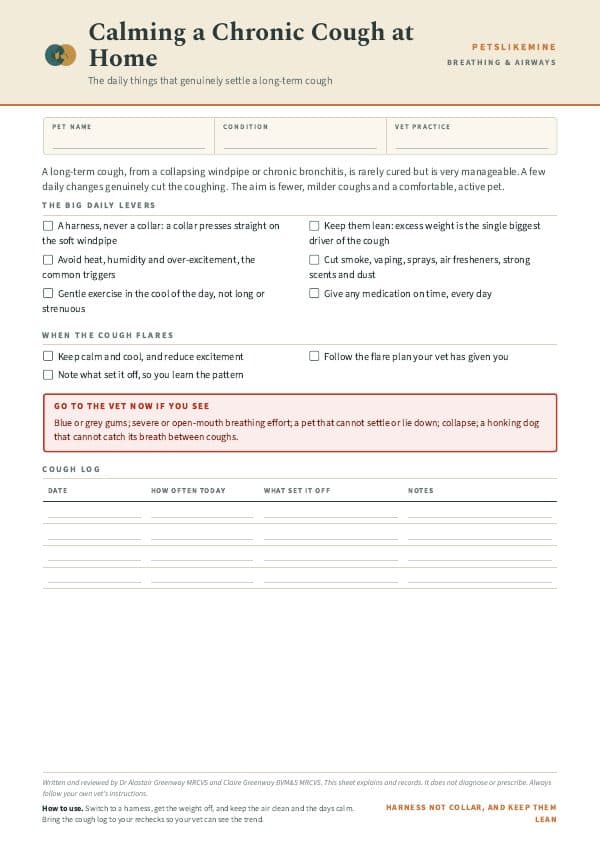
Three changes make most of the day-to-day difference, and I will name them clearly so you can start straight away. The practical how-to of each lives in calming a chronic cough at home, so I will not turn this page into the full manual.
The first, and the single most load-bearing daily change, is a harness, never a neck collar. A collar presses straight down on an already floppy windpipe and sets off exactly the cough you are trying to avoid, whereas a well-fitted body harness spreads the pressure across the chest and leaves the throat alone. Both Cornell and the American College of Veterinary Surgeons advise switching to a harness as standard aftercare (Cornell University, 2024; American College of Veterinary Surgeons, n.d.).
The second is weight. Tracheal collapse turns up far more often in dogs carrying too much of it, and the extra fat around the neck and chest, with the reduced exercise tolerance that comes with it, makes everything worse (Merck Veterinary Manual, n.d.; Cornell University, 2024). Losing it is the highest-yield thing within your control, and I say that with no judgement, because keeping a small dog lean is genuinely hard. It is the shared lever across so many of these conditions, and your vet, or the Weight Management space, can help you set a sensible target.
The third is avoiding triggers, above all inhaled irritants. Tobacco smoke is the worst offender and was specifically linked to the onset of signs in the original survey (White and Williams, 1994; Tappin, 2016), so a smoke-free home is one of the kindest things you can do. Heat, humidity and over-excitement are the other big provocateurs, and learning your dog's flashpoints heads off a lot of coughing before it starts. The Airway Diary lets you log coughs against what was happening at the time, so the pattern becomes visible, and the chronic cough home management download pulls the daily routine onto one page.
How it is diagnosed and treated, in brief
Your vet builds the diagnosis from the signalment and that classic history, then confirms it with imaging that can catch the moving airway: x-rays taken on both the in-breath and the out-breath, fluoroscopy (a moving x-ray), or a camera passed into the windpipe (tracheobronchoscopy), which can also grade severity (Tappin, 2016). Grading runs one to four by how much the airway is narrowed, from roughly a quarter closed at grade one to near-complete collapse at grade four (American College of Veterinary Surgeons, n.d.). Usefully, recent research found the grade on imaging does not reliably predict how bad the cough is (Kim et al., 2024), so a dog with an alarming x-ray can be comfortable, and the reverse holds too.
Treatment is medical first for almost everyone: the three levers above plus medications your vet may prescribe, such as cough suppressants, anti-inflammatories and sometimes bronchodilators or sedatives (Merck Veterinary Manual, n.d.; Tappin, 2016). Stenting or surgery is reserved for the minority who do not respond or who are in respiratory distress (Tappin, 2016). I am keeping the drug and stent detail light here, because that medical-versus-stent decision is a substantial topic that gets the care it deserves in stent or medication.
A cough that travels in company
Tracheal collapse rarely arrives alone in these small older dogs. It commonly travels with chronic bronchitis and with heart disease, particularly degenerative mitral valve disease (Merck Veterinary Manual, n.d.; Kim et al., 2024). In that 2024 cohort, over half the dogs also had mitral valve disease (Kim et al., 2024), and obesity, heart disease and other lung disease all tend to make the cough worse (Merck Veterinary Manual, n.d.).
This matters for a practical reason. When a small old dog coughs, it is not always obvious whether the noise comes from the floppy windpipe, an inflamed set of airways, the heart, or some combination of all three, and these need quite different help. That is the question worked through in cough: heart or lungs?, which sets out the tells that point one way or the other and the simple home measurement that helps your vet most. If your dog's cough does not fit the tidy honking-on-excitement pattern, or comes with tiring easily or breathlessness, that is the page to read next. The often-coexisting bronchitis has its own explainer in canine chronic bronchitis.
When it is not just a nuisance
For all the reassurance, I will not let the comfort blind you to the moments that count. A dog in real respiratory distress is an emergency, now. The signs to act on without delay are severe effort to breathe, gums that look grey or blue rather than a healthy pink, an inability to settle or lie down, and collapse (Tappin, 2016). A severe collapse, or an ordinary flare tipped over the edge by heat or excitement, can occasionally become a genuine breathing crisis, and that is a vet visit you make straight away rather than sleep on.
If you are ever unsure which side of that line your dog is on, the breathing triage tool helps you sort an emergency from something that can wait for a booked appointment, and the in-the-moment plan for a sudden bad spell is laid out in cough flare: when to act. Keeping those routes in your back pocket means you can relax about the everyday honking while knowing exactly what to do on a bad day.
Three changes you can begin this afternoon: lose the collar, work on the waistline, and clear the air your dog breathes. Make those, and watch the triggers.
References
- American College of Veterinary Surgeons. (n.d.). Tracheal Collapse. Retrieved June 2026 from
- Cornell University College of Veterinary Medicine, Riney Canine Health Center. (2024). Tracheal Collapse. Retrieved June 2026 from
- Kim, M.-R., Kim, S.-H., Ryu, M.-O., Youn, H.-Y., Choi, J.-H., and Seo, K.-W. (2024). A retrospective study of tracheal collapse in small-breed dogs: 110 cases (2022-2024). Frontiers in Veterinary Science, 11, 1448249.
- Merck Veterinary Manual. (n.d.). Tracheal Collapse in Dogs (pet-owner version). Retrieved June 2026 from
- Tappin, S. W. (2016). Canine tracheal collapse. Journal of Small Animal Practice, 57(1), 9-17.
- White, R. A. S., and Williams, J. M. (1994). Tracheal collapse in the dog - is there really a role for surgery? A survey of 100 cases. Journal of Small Animal Practice, 35(4), 191-196.
Free downloads
Companion worksheets to put what you've read into practice. Free PDFs, print at home.
Keep track of how your pet is doing
The owners who cope best are the ones who notice changes early. A simple health log shows you what is working, and what is not, before the next vet visit.
Start tracking, freeYou're not doing this alone
Compare treatment journeys and talk to owners managing breathing & airways. Free to join.
Join PetsLikeMine