

Stent or Medication? How to Think About the Tracheal Collapse Decision
Alastair Greenway
BVM&S MRCVS
The diagnosis is probably already made by the time you reach a page like this. Your small dog has a collapsing windpipe, the honking cough has a name, and someone, a vet, a forum, a worried part of your own head at two in the morning, has used the word stent. Now you're trying to work out whether you carry on with tablets and a harness, or head towards a procedure that puts a piece of metal scaffolding inside your dog's airway for the rest of their life.
For most dogs with tracheal collapse, this is not a choice you have to make at all. Medical management is first-line, it works well for the large majority, and stenting or surgery is reserved for the minority who don't respond or are genuinely struggling to breathe (American College of Veterinary Surgeons, n.d.; Tappin, 2016). The most likely truth, then, is that your dog sits in the group who do well on medication for years, and the stent question, for now, is one you can hold lightly.
This article assumes you already know what tracheal collapse is. If you don't, the anchor piece on collapsing trachea explained covers the floppy windpipe, the dynamic collapse, the goose-honk and the breeds, and I won't re-tread any of it. What I'll do here is the one thing that piece leaves to me: give you a clear, numerate way to weigh medication against a stent, so you walk into your vet's room an informed partner rather than a frightened passenger.
What medical management actually achieves
Before you weigh a stent against medication, it helps to know what medication delivers, because the answer is: a great deal.
In the foundational UK survey of 100 dogs, conservative medical management gave long-term resolution of the signs, for more than a year, in 71% of cases, with a further 4% managed by upper-airway surgery (White and Williams, 1994). The American College of Veterinary Surgeons puts the same figure plainly: medical management may work for up to 70% of dogs, particularly those with mild collapse (American College of Veterinary Surgeons, n.d.). A modern cohort of 110 small-breed dogs did better still, with 86.6% improving on weight reduction, environmental changes and medication (Kim et al., 2024). So the spread you'll see quoted, around 70 to 90% improve with good medical management, is fair: roughly seven in ten is the classic figure, the high-eighties a modern best case, and the milder the collapse the better the odds.
That word management is doing real work, though. Medication is not a tablet you give instead of changing how your dog lives. It works best alongside the daily levers, and in many dogs the levers do more than the drugs. The toolkit your vet draws on looks like this (Cornell University, n.d.; Today's Veterinary Practice, 2022):
- Cough suppressants, the opioids butorphanol, codeine, or hydrocodone where it's available, to break the cough that irritates the airway that triggers more coughing.
- Anti-inflammatory corticosteroids, often a short course or a low-dose or inhaled steroid, to settle the inflammation feeding that cycle.
- Sedatives or anxiolytics, because a frightened, panting dog coughs harder, and breaking the panic-cough spiral genuinely helps.
- Bronchodilators such as theophylline or terbutaline, where there's concurrent lower-airway disease.
- Treating the company it keeps, the heart disease, the infections, the obesity that so often travel with a collapsing trachea in an older toy-breed dog.
Newer additions like maropitant, gabapentin and amitriptyline are being used for the cough too, though without controlled trials behind them yet (Today's Veterinary Practice, 2022). Notice what isn't on that list, though: a cure. There is no cure for tracheal collapse (Cornell University, n.d.). The cartilage doesn't reform. What good medical management buys is control, often excellent control, of a chronic condition, and for most dogs that is plenty.
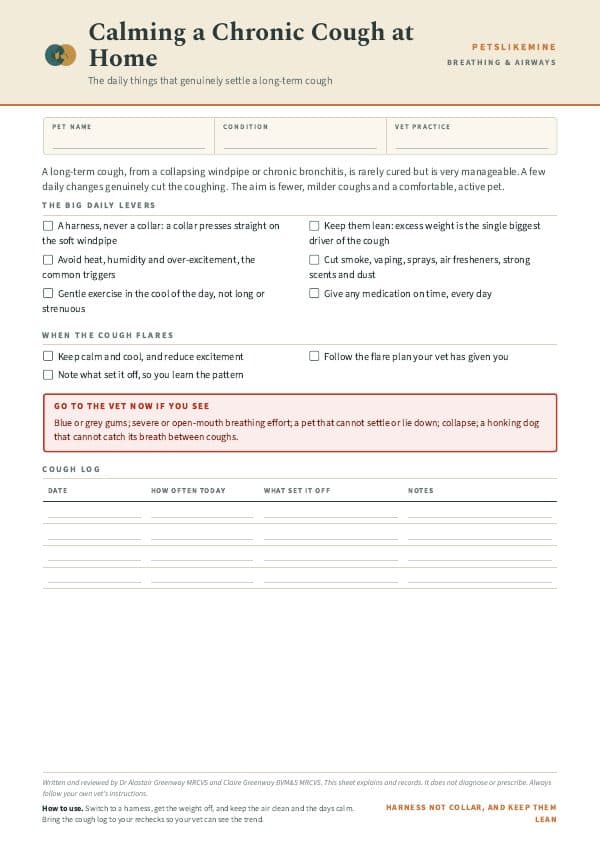
Two of those levers sit upstream of every drug, and they're the things to maximise before anyone reaches for a stent. The first is weight, the single biggest modifiable factor, and losing it is the highest-yield thing within your control, said with no judgement at all, because keeping a little dog lean is genuinely hard. The second is a harness, never a collar, because a collar presses straight down on a windpipe already struggling to hold its shape. The full how-to for both, plus avoiding heat, smoke and over-excitement, lives in calming a chronic cough at home and the chronic cough home management download, with the Weight Management space for the weight method. I name them here only because they're the foundation a stent should never be a shortcut around.
When a stent comes onto the table
So when does the conversation genuinely change?
A stent, or surgery, is for the dog with severe, uncontrolled signs despite real medical management, or one having breathing crises where quality of life is suffering (American College of Veterinary Surgeons, n.d.; Tappin, 2016). It's an escalation, not a default, and the word real is load-bearing. A dog still coughing on a collar, three kilos overweight, in a smoky house, hasn't failed medical management. They haven't had it yet. The pivot is this: a dog comfortable between coughs, exercising, sleeping and eating well on medication is in the group who do well and doesn't need a stent, while a dog with worsening distress, exercise and heat intolerance, and a cough that no longer responds despite genuine weight loss and proper medication, is the one to refer for assessment (Tappin, 2016).
It's worth knowing that a stent is not the only surgical route, so the choice is never a stark medication-or-stent binary. Where the floppy part of the windpipe sits in the neck, some dogs are instead fitted with external ring prostheses, supportive rings placed around the outside of the trachea through an operation, and the long-term results can be very good: in a series of 54 dogs, 98% survived to discharge, the goose-honk resolved in 96%, and 86% were alive at three years (Suematsu et al., 2019). The internal stent comes into its own when the collapse extends down into the chest. Reaching that intrathoracic stretch with external rings means opening the chest, a far bigger operation, whereas a self-expanding mesh stent can be threaded the whole length of the windpipe without surgery at all, which is the main reason stents are usually preferred once the collapse runs into the thorax (Tappin, 2016; Tinga et al., 2015). Your vet works out which part is collapsing, and how badly, by imaging the moving airway with fluoroscopy or bronchoscopy. None of it is a decision to make from a single still x-ray.
This is also why I'd nudge you to log the trend rather than react to one bad night. A collapsing trachea has good days and frightening ones, and a single bad evening is a poor basis for a permanent decision. The Airway Diary lets you track the cough and exercise tolerance over weeks, so the conversation with your vet is driven by a trajectory you can both see, not by the worst thing that happened last Tuesday.
What a stent can do for the right dog
I want to give the stent its due, because in the right dog it can be transformative.
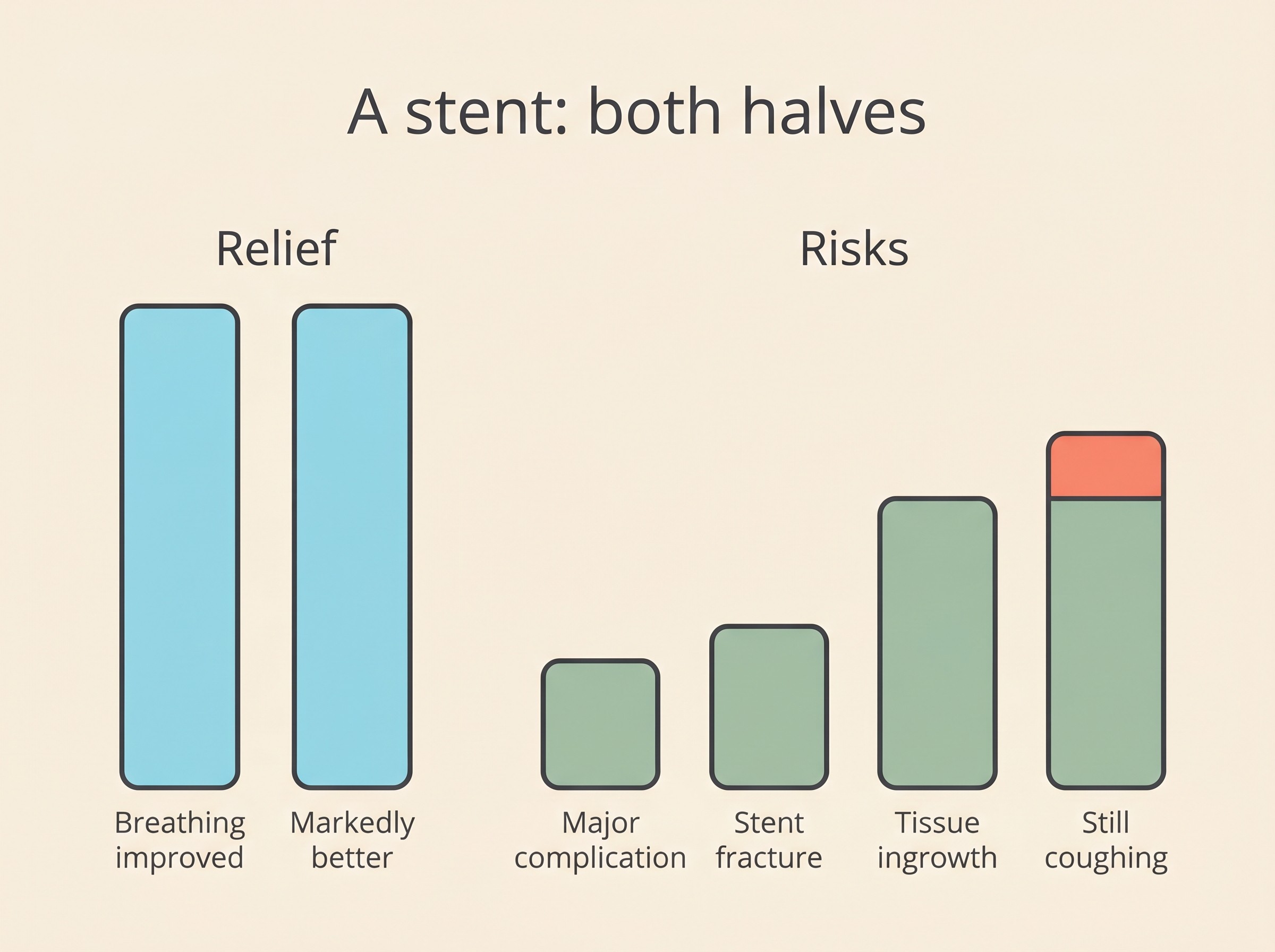
In the largest single-centre series, 75 dogs receiving endoluminal stents, 93% survived to hospital discharge, median survival was 1,005 days, close to two and three-quarter years, and at final follow-up 89% were improved for the goose-honk and raspy breathing and 84% for the breathlessness (Weisse et al., 2019). The American College of Veterinary Surgeons puts the owner-facing version even more brightly: 95% are immediately improved and 90% markedly improved at their follow-up visit (American College of Veterinary Surgeons, n.d.). For a dog who was suffocating on a bad day, that is not a small thing. When a dog is genuinely out of medical road, a stent can hand back months to years of comfortable breathing, and those owners are, by and large, very glad they did it.
So if your vet is raising a stent, it isn't a counsel of despair. It's a real intervention with a real track record of relief. The caution I'm about to add isn't meant to talk you out of it, only to make sure you see both halves of the picture, because the bright numbers are only one of them.
Weighing the real risks
Here's the half the brochures tend to underplay, and it's the heart of a clear-eyed decision. A stent is permanent metal in a living, moving, coughing airway, and complications are common, not rare.
In that same 75-dog series, 47% had a major complication over follow-up, stent fracture and tissue growing through the mesh the most common (Weisse et al., 2019). The best pooled figures come from a 2024 systematic review and meta-analysis of 15 studies, and they're worth reading slowly (Robin et al., 2024): stent fracture in about 12% of dogs, the stent migrating out of position in 5%, the collapse relapsing or progressing in 10%, granulation tissue growing into the airway in 20%, and tracheobronchial infection in 24%. Each is a reason a stented dog may be back at the vet, sometimes for a second stent inside the first.
And then the figure that surprises owners most, the one I make a point of saying out loud: a stent does not abolish the cough. In that meta-analysis, a late cough was still present in about 75% of dogs, and a clinically relevant late cough in 52% (Robin et al., 2024). More than half of stented dogs are still coughing in a way that matters. The stent relieves the obstruction and the breathing crisis; it does not turn a coughing dog into a quiet one. Most keep coughing, usually less, and an owner who expected silence can feel let down by a procedure that actually worked.
There's a harder line still, and I won't soften it. A small but real number of dogs are worse off, or die, soon after stenting. In the 75-dog series, 5 of 75, about 7%, did not survive to discharge (Weisse et al., 2019). A companion study of 52 dogs recorded a 25% stent-fracture rate over time and, separately, 5 dogs that died within 30 days of the procedure (Violette et al., 2019). And lest this read as a reason to simply pick the operation instead, a head-to-head comparison of external rings against stents found major complications in 42% of ring dogs and 43% of stent dogs, so neither route is the safe one (Tinga et al., 2015). That early-complication and early-mortality risk is precisely why a stent is held back for dogs out of other options. When medication is still working, the maths simply doesn't favour taking it on.
The bottom line, and how to time the conversation
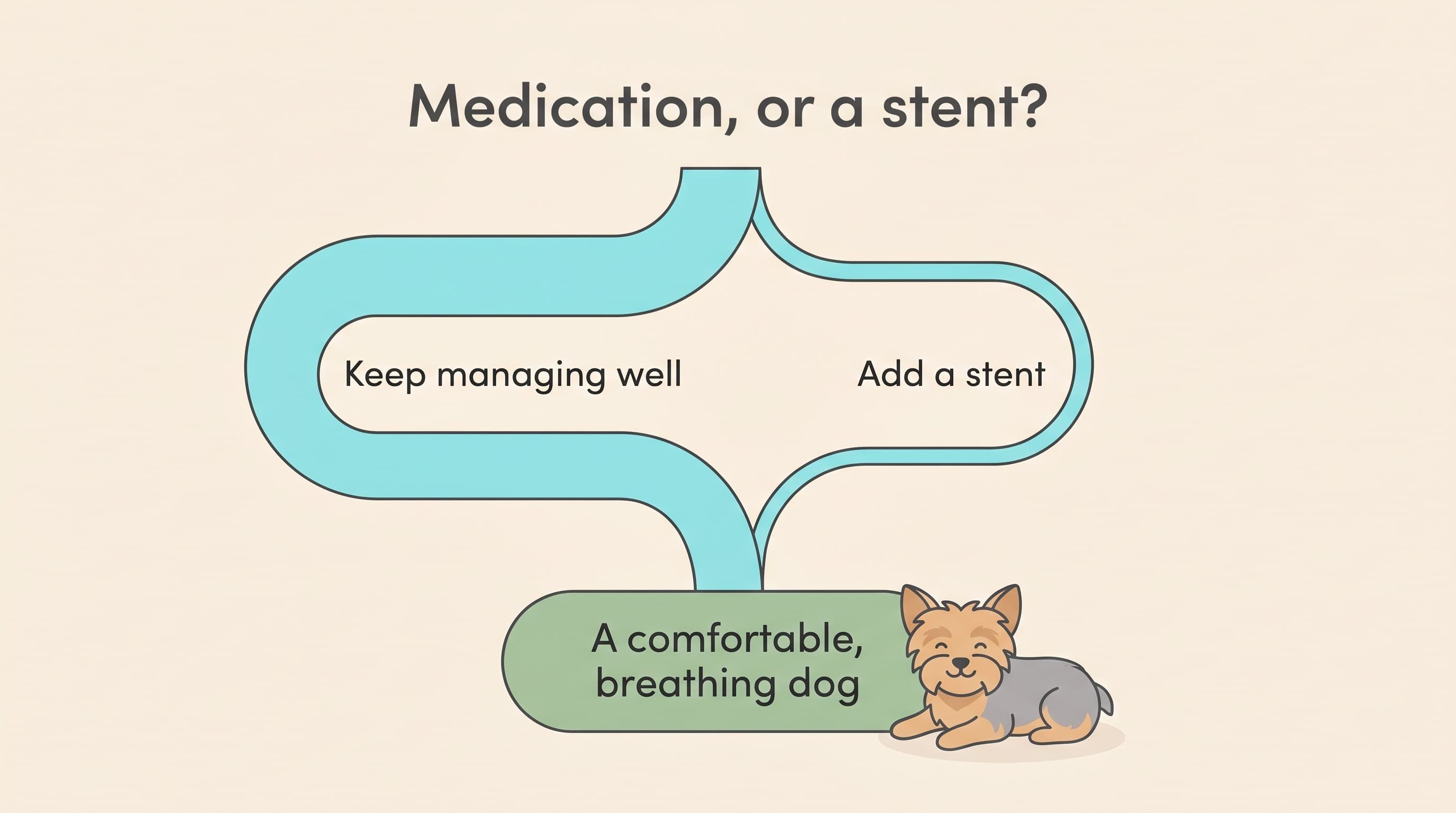
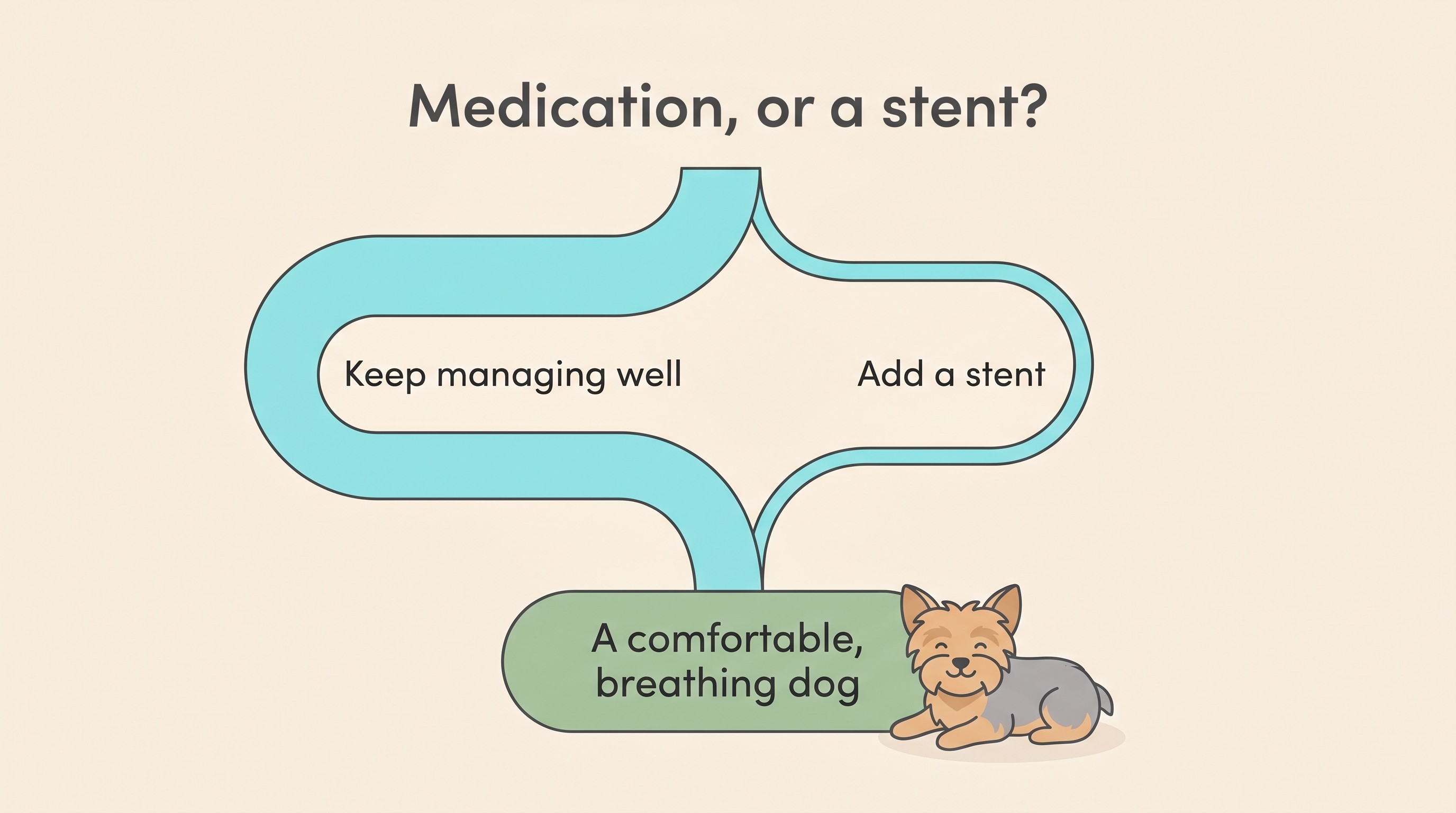
A stent is palliative, not a cure, and medication continues either way. Tracheal collapse is chronic, progressive and irreversible, there is no cure (Cornell University, n.d.), and a stent relieves the obstruction without returning the windpipe to normal, so daily medical management still needs to continue for life even after a stent goes in (American College of Veterinary Surgeons, n.d.; Today's Veterinary Practice, 2022). So the question isn't fix versus no-fix. It's keep managing well versus add a palliative rescue to a severe airway, while still managing well on top.
For most dogs, then, the answer is to keep doing the unglamorous things and keep doing them properly: get the weight off, lose the collar for good, clear the air, treat the heart or bronchitis travelling alongside, and use the cough medications as your vet directs. That's where seven to nine dogs in ten find their comfortable years (White and Williams, 1994; Kim et al., 2024). The stent conversation belongs to the dog whose trajectory is heading the wrong way despite all of that, and the clearest single trigger is a genuine breathing crisis, which is its own emergency and its own article in cough flare: when to act. If you can't tell whether a bad spell has crossed into a crisis, the breathing triage tool will help you sort now from later.
Track the trend, not the night. Log the cough and exercise tolerance over weeks in the Airway Diary, maximise every lever before you escalate, and let a clear, downward trajectory, not one frightening evening, be what carries you and your vet into the stent conversation. Most small dogs with a collapsing windpipe never need to have it. For the few who do, it's a real and sometimes life-changing option, gone into with both eyes open. Either way, the next time you sit across from your vet, you'll be the partner in the room who already understands the choice.
References
- American College of Veterinary Surgeons. (n.d.). Tracheal Collapse. Retrieved June 2026 from
- Cornell University College of Veterinary Medicine, Riney Canine Health Center. (n.d.). Tracheal Collapse. Retrieved June 2026 from
- Kim, M.-R., Kim, S.-H., Ryu, M.-O., Youn, H.-Y., Choi, J.-H., and Seo, K.-W. (2024). A retrospective study of tracheal collapse in small-breed dogs: 110 cases (2022-2024). Frontiers in Veterinary Science, 11, 1448249.
- Robin, T., Robin, E., and Le Boedec, K. (2024). A systematic review and meta-analysis of prevalence of complications after tracheal stenting in dogs. Journal of Veterinary Internal Medicine, 38(4), 2034-2044.
- Suematsu, M., Suematsu, H., Minamoto, T., Hashidate, H., Iwai, T., Kakizaki, T., and Iwata, E. (2019). Long-term outcomes of 54 dogs with tracheal collapse treated with a continuous extraluminal tracheal prosthesis. Veterinary Surgery, 48(5), 825-834.
- Tappin, S. W. (2016). Canine tracheal collapse. Journal of Small Animal Practice, 57(1), 9-17.
- Tinga, S., Thieman Mankin, K. M., Peycke, L. E., and Cohen, N. D. (2015). Comparison of outcome after use of extra-luminal rings and intra-luminal stents for treatment of tracheal collapse in dogs. Veterinary Surgery, 44(7), 858-865.
- Today's Veterinary Practice. (2022). Tracheal Collapse. Retrieved June 2026 from
- Violette, N. P., Weisse, C., Berent, A. C., and Lamb, K. E. (2019). Correlations among tracheal dimensions, tracheal stent dimensions, and major complications after endoluminal stenting of tracheal collapse syndrome in dogs. Journal of Veterinary Internal Medicine, 33(5), 2209-2216.
- Weisse, C., Berent, A., Violette, N., McDougall, R., and Lamb, K. (2019). Short-, intermediate-, and long-term results for endoluminal stent placement in dogs with tracheal collapse. Journal of the American Veterinary Medical Association, 254(3), 380-392.
- White, R. A. S., and Williams, J. M. (1994). Tracheal collapse in the dog - is there really a role for surgery? A survey of 100 cases. Journal of Small Animal Practice, 35(4), 191-196.
Free downloads
Companion worksheets to put what you've read into practice. Free PDFs, print at home.
Keep track of how your pet is doing
The owners who cope best are the ones who notice changes early. A simple health log shows you what is working, and what is not, before the next vet visit.
Start tracking, freeYou're not doing this alone
Compare treatment journeys and talk to owners managing breathing & airways. Free to join.
Join PetsLikeMine