

Calming a Chronic Cough at Home: The Daily Things That Genuinely Help
Alastair Greenway
BVM&S MRCVS
A dog with a collapsing windpipe, or a long-term cough of some other airway kind, usually comes home from the consult with a diagnosis explained and a tablet or two to give. Then the honking cough carries on punctuating the evening anyway, and the obvious question is what else there is to do.
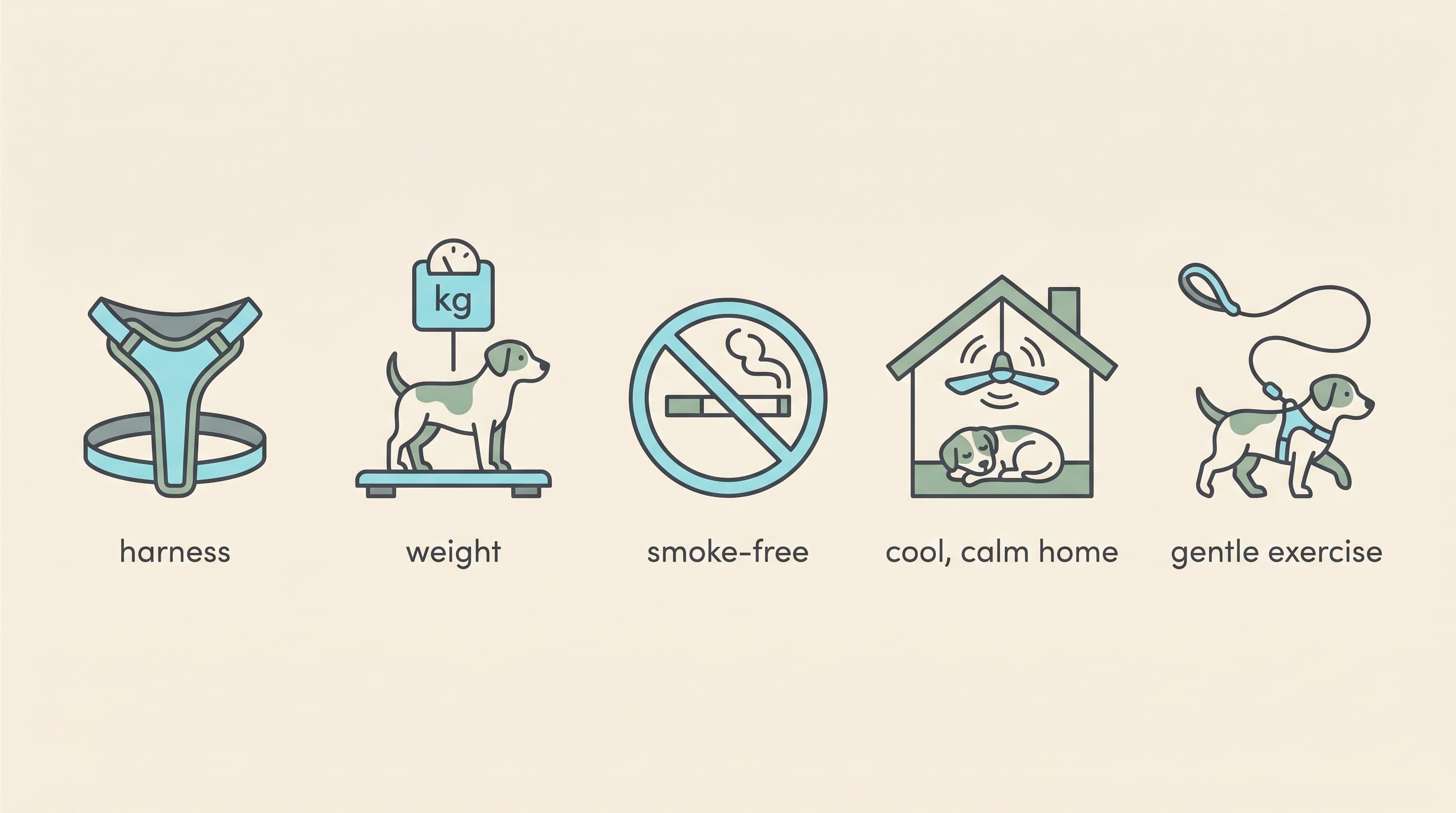
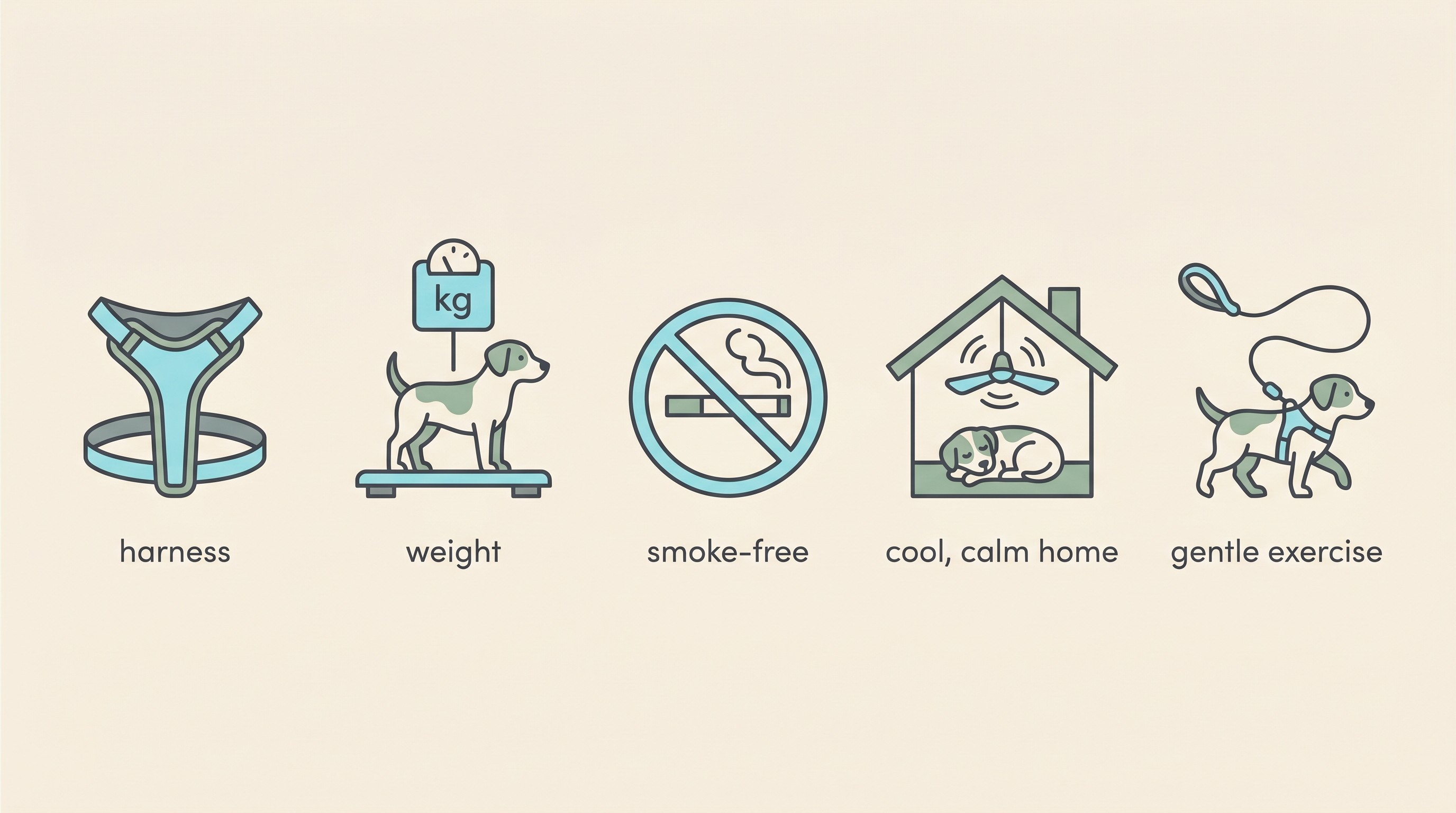
I'll be straight from the start, because it's the most useful thing I can say. The tablets matter, but they work best as the partner to a handful of daily changes, not as a substitute for them. Across every authoritative source I trust, the management of a chronic airway cough is the same package: weight control, a body harness instead of a collar, keeping irritants and triggers out of the air, a calm and cool home, gentle exercise, and then medication on top (American College of Veterinary Surgeons, 2026; Cornell University, 2026; Tappin, 2016). Most dogs are managed this way and do well, and these measures carry on for life even if a dog later needs surgery (Tappin, 2016; American College of Veterinary Surgeons, 2026). So think of the home levers as the floor the medicine stands on.
I'm not going to re-explain what tracheal collapse is. The softened windpipe rings and the goose-honk have their own home in collapsing trachea explained, and weighing up a stent versus tablets lives in stent or medication. This is the practical how-to: the things you change around the house and on the walk that quietly add up.
Start with the harness, and here's the evidence for it
If you change one thing today, change this. Swap the collar for a body harness, and clip the lead to the harness, not to anything round the neck.
A lead clipped to a collar presses straight down on the throat and the already-floppy windpipe, and that pressure on the neck is one of the classic things that sets a cough off (Cornell University, 2026). It's why the universal management advice, from the surgeons to the institutions, is a body harness and not a neck lead or leash (American College of Veterinary Surgeons, 2026; Deweese and Tobias, 2014).
What persuades owners is that this isn't just sensible-sounding advice, it's measurable. A 2025 controlled study measured the pressure inside the eye, a fair proxy for how much force a neck collar transmits into the structures of the neck. Standing still in a collar raised that pressure in flat-faced dogs, and exercising in a collar raised it in every dog regardless of skull shape, while a harness raised it in nobody, standing or moving (Bailey, Packer and Wills, 2025). It measured eye pressure rather than windpipe pressure directly, so I'd describe it as a clean demonstration that a collar really does load the neck and a harness really doesn't, rather than a direct windpipe measurement. For a dog whose windpipe is the problem, that is exactly the load you want gone.
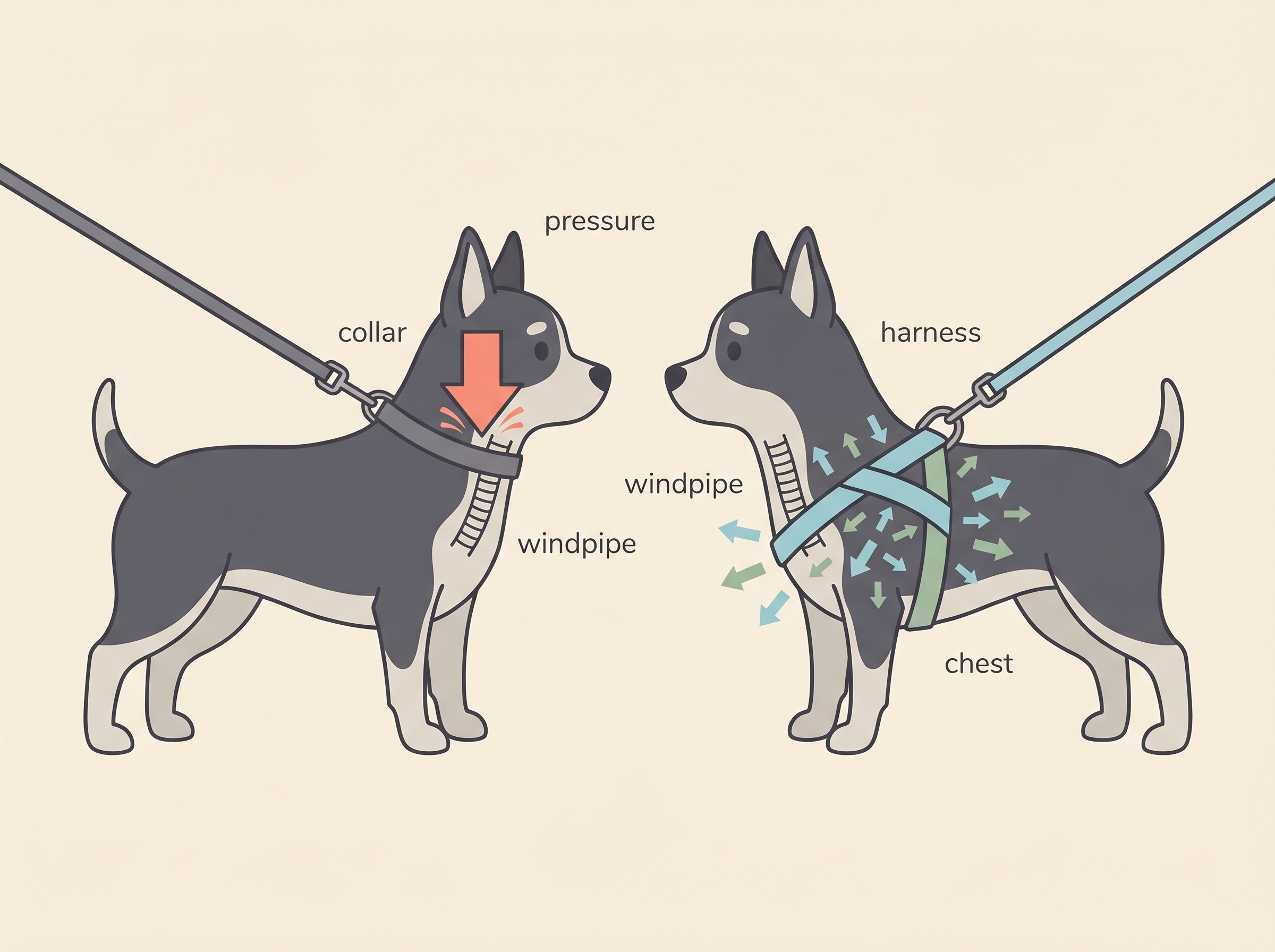
In practice, aim for a well-fitted Y-shaped or padded harness that sits across the breastbone and chest, not across the throat. Check you can slip two fingers under the straps, that nothing rides up against the windpipe when your dog pulls, and that the chest piece does not creep up the neck on the walk. A back-clip or front-clip harness is fine; the point is simply that the lead never loads the neck again.
Weight: the biggest lever there is, and the hardest
If the harness is the quickest win, weight is the biggest one. I'll say it plainly, then say the kind part, because both are true.
Most dogs with this problem are carrying too much. In a 2024 study of 110 small-breed dogs with tracheal collapse, 97.2% had a body condition score of four or more out of nine, averaging 5.44, so the large majority were overweight or frankly obese, and a higher score was significantly linked to worse collapse inside the chest (Kim et al., 2024). The older guidance is just as blunt: in overweight dogs, weight loss is critical, can produce dramatic improvement, and is the single most important part of long-term management (Merck Veterinary Manual, 2026; Deweese and Tobias, 2014). The mechanics are simple. Less fat around the chest and neck means an airway that copes far better with every breath, and a dog that does not have to work so hard to move air in the first place.
Now the hard part, because I'd rather tell you this than pretend it's easy. In that same group, among the dogs put on lifestyle measures alone, only 2 of 26 managed meaningful weight loss in the weeks after diagnosis, and the authors note plainly that owners find it genuinely challenging to slim their pets down (Kim et al., 2024). So please don't read "lose the weight" as a tut. It's hard, and it's worth doing precisely because it's the kindest, most powerful thing in your hands. The way through is small and supported: measure the food with a scoop or scales rather than eyeballing it, weigh the treats into the daily ration instead of adding them on top, and book regular weigh-ins so progress is tracked rather than guessed. The how-to of a proper weight-loss plan, the diet and the calorie maths, belongs to our Weight Management home, and it is well worth leaning on.
Clear the air, starting with smoke
Every authoritative source names inhaled irritants as triggers to remove, and smoke heads the list (Cornell University, 2026; American College of Veterinary Surgeons, 2026). The surgeons put it well: dogs should be kept away from smoke and other environmental pollution, and a cough can even be set off by irritants brought in on clothes and hair (American College of Veterinary Surgeons, 2026). So it isn't only about not smoking in the room. Smoke residue carried in on a coat or a jumper counts too.
This one is more than precaution. Two epidemiological studies in pet dogs link second-hand tobacco smoke to airway cancer: passive smoking was associated with canine lung cancer, the risk concentrated in short and medium-nosed breeds (Reif et al., 1992), and environmental tobacco smoke with cancer of the nose and sinuses in long-nosed dogs (Reif, Bruns and Lower, 1998). Those are cancer-risk studies, not collapsing-trachea cough studies, so I won't overstate them, but they back up what the cough guidance already says: a smoke-free home helps the canine airway. The same logic covers the other particulates, so go easy on aerosols, strong sprays, scented plug-ins, dusty rooms and open fires, all of which add to the load a sensitive airway has to clear (Deweese and Tobias, 2014).
Keep it cool, keep it calm
Heat and humidity are explicit triggers, and these dogs overheat easily, so a cool, low-humidity home does real work (Cornell University, 2026). The practical version: a cooling mat and a fan on warm days, the cool of the morning and evening rather than the afternoon, and, oddly, a humidifier in winter, because the dry air from central heating can irritate an airway just as much (American College of Veterinary Surgeons, 2026). A cool, settled home doesn't only cut the day-to-day coughing, it lowers the chance of a cough tipping into a proper breathing struggle on a hot day.
Excitement, stress and frantic activity belong on the same list (Merck Veterinary Manual, 2026; Cornell University, 2026). The flashpoints are predictable once you watch for them: the doorbell and visitors, big greetings at the door, the lead coming out, over-the-top play. None of these need to vanish from your dog's life, they just need taking down a notch. Keep homecomings low-key, head off the doorbell frenzy before it builds, and steer play towards the gentle end. There is a reason calm helps so directly, and it is worth understanding.
Break the cough-makes-more-cough cycle
A coughing fit isn't a neutral event that simply passes. Coughing itself irritates and inflames the airway, which provokes yet more coughing, so an episode can feed itself and spiral (Deweese and Tobias, 2014; American College of Veterinary Surgeons, 2026). That is the mechanism behind everything on this page. Interrupt the spiral early, by calming the dog, cooling the air, removing whatever set it off and giving the cough medication exactly as your vet directed, and you stop a small cough becoming a big one. This is precisely why the daily levers reduce flares: they keep the airway from getting wound up in the first place.
I'm deliberately not writing the crisis playbook here. That has its own home in cough flare: when to act, the page to read now and keep bookmarked. The one safety line to carry today: if your dog is making a real effort to breathe at rest, the gums look blue or grey, or they can't settle, that's not a flare to manage at home, that's the vet now. For sorting that in the moment, the breathing triage tool walks you through it.
Exercise: controlled, not cancelled
It would be easy to read all this and conclude that the safest thing is to stop walking your dog. Don't. Exercise needs to be controlled, not forbidden (Merck Veterinary Manual, 2026; Kim et al., 2024). A lean, fit dog copes with a wobbly windpipe far better than an unfit one, and you can't take the weight off without some movement (Kim et al., 2024). So the goal isn't less life, it's gentler life: harness-led, in the cool of the day, on the flat where you can, and stopped before your dog gets hot, over-excited or starts to cough. Several short, calm outings beat one long charge about. That is how you square the two things that sound contradictory, "rest the airway" and "keep them lean".
Track the cough, so you actually know what's working
One thing most owners are never told is genuinely useful here. The grade of collapse on the imaging does not predict how bad the cough is. In the 2024 study, where the collapse sat and how severe it looked on fluoroscopy did not correlate with how much the dog actually coughed (Kim et al., 2024). So you can't assume a change is helping just because it sounds like it should. The only reliable way to know whether the harness, the weight loss or the smoke-free room is really working is to measure the cough over time.
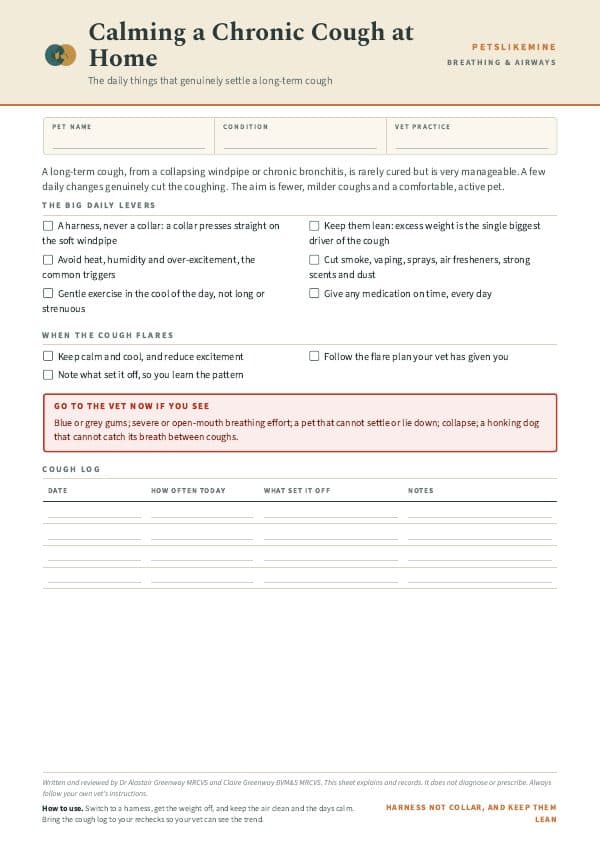
That is exactly what the Airway Episode and Exertion Diary is for. Log how often your dog coughs, what set it off, how much exercise they managed and any medication given, and over a few weeks the pattern speaks for itself. It also flags heat risk, which folds neatly into the cool-and-calm lever. Suddenly "is the harness actually making a difference?" stops being a hunch and becomes something you and your vet can see together. If you'd rather work from paper, the chronic cough home management download covers the same ground.
What to expect
Let me finish with the truth about where this is heading, because false promises help nobody. The realistic target, with the levers and the medication working together, is fewer and gentler coughs and a comfortable, active dog, not, usually, a cough-free one.
The numbers bear that out, and they're encouraging without being oversold. In the 2024 group, after treatment the cough disappeared entirely in 10.0%, reduced but persisted in 76.7%, and was similar or worse in 13.3%, with the overall signs improving in 86.6% of dogs (Kim et al., 2024). The foundational UK survey found that conservative management gave a long-term resolution of signs in 71% of dogs (White and Williams, 1994). So most dogs improve, often a lot, and go on to good lives, while most still cough sometimes, and that is a result worth aiming for, not a failure.
If the cough does start winning despite all of this, that's your signal to loop back to your vet and to the next pages along: the stent or medication decision if the medical path is running out of road, and living with a breathing condition for the longer view on a life with a chronic cough. For today, though, you have five levers and a way to measure them. Start with the harness, keep chipping at the weight, and let the diary show you what's working.
References
- American College of Veterinary Surgeons. (2026). Tracheal Collapse. Retrieved from
- Bailey, M. E., Packer, M. J., and Wills, A. P. (2025). Effect of a collar and harness on intraocular pressure and respiration rate of brachycephalic and dolichocephalic dogs. Veterinary Medicine and Science, 11(3), e70384.
- Cornell University College of Veterinary Medicine, Riney Canine Health Center. (2026). Tracheal collapse. Retrieved from
- Deweese, M. D., and Tobias, K. M. (2014). Tracheal Collapse in Dogs. Clinician's Brief. Retrieved from
- Kim, M-R., Kim, S-H., Ryu, M-O., Youn, H-Y., Choi, J-H., and Seo, K-W. (2024). A retrospective study of tracheal collapse in small-breed dogs: 110 cases (2022-2024). Frontiers in Veterinary Science, 11, 1448249.
- Merck Veterinary Manual (pet-owner version). (2026). Tracheal Collapse in Dogs. Retrieved from
- Reif, J. S., Dunn, K., Ogilvie, G. K., and Harris, C. K. (1992). Passive smoking and canine lung cancer risk. American Journal of Epidemiology, 135(3), 234-239.
- Reif, J. S., Bruns, C., and Lower, K. S. (1998). Cancer of the nasal cavity and paranasal sinuses and exposure to environmental tobacco smoke in pet dogs. American Journal of Epidemiology, 147(5), 488-492.
- Tappin, S. W. (2016). Canine tracheal collapse. Journal of Small Animal Practice, 57(1), 9-17.
- White, R. A. S., and Williams, J. M. (1994). Tracheal collapse in the dog: is there really a role for surgery? A survey of 100 cases. Journal of Small Animal Practice, 35(4), 191-196.
Free downloads
Companion worksheets to put what you've read into practice. Free PDFs, print at home.
Keep track of how your pet is doing
The owners who cope best are the ones who notice changes early. A simple health log shows you what is working, and what is not, before the next vet visit.
Start tracking, freeYou're not doing this alone
Compare treatment journeys and talk to owners managing breathing & airways. Free to join.
Join PetsLikeMine