

Living With a Breathing Condition: The Daily Playbook
Alastair Greenway
BVM&S MRCVS
Feline asthma, a flat-faced dog's BOAS, a collapsing windpipe, laryngeal paralysis: these are conditions you don't cure and send home, you live alongside. The appointment is done, you've got the name for it, and somewhere in the conversation the words "lifelong" or "manage it" came up. What nobody quite has time to give you in a ten-minute consult is the rest of it: the hundred small things you actually do, day after day, that decide how good your pet's life is between vet visits.
That's what this page is for. I'm not going to re-teach you the disease here, because each condition has its own home in this space that goes properly deep. What I want to give you instead is the part the conditions share. Treating all of them, I've learned one genuinely useful thing: a small handful of daily levers help almost every breathing-compromised pet, whatever the diagnosis. They're not drugs, they're not surgery, they're things you control, and most are free or close to it. Pulled together, day in day out, they do real work.
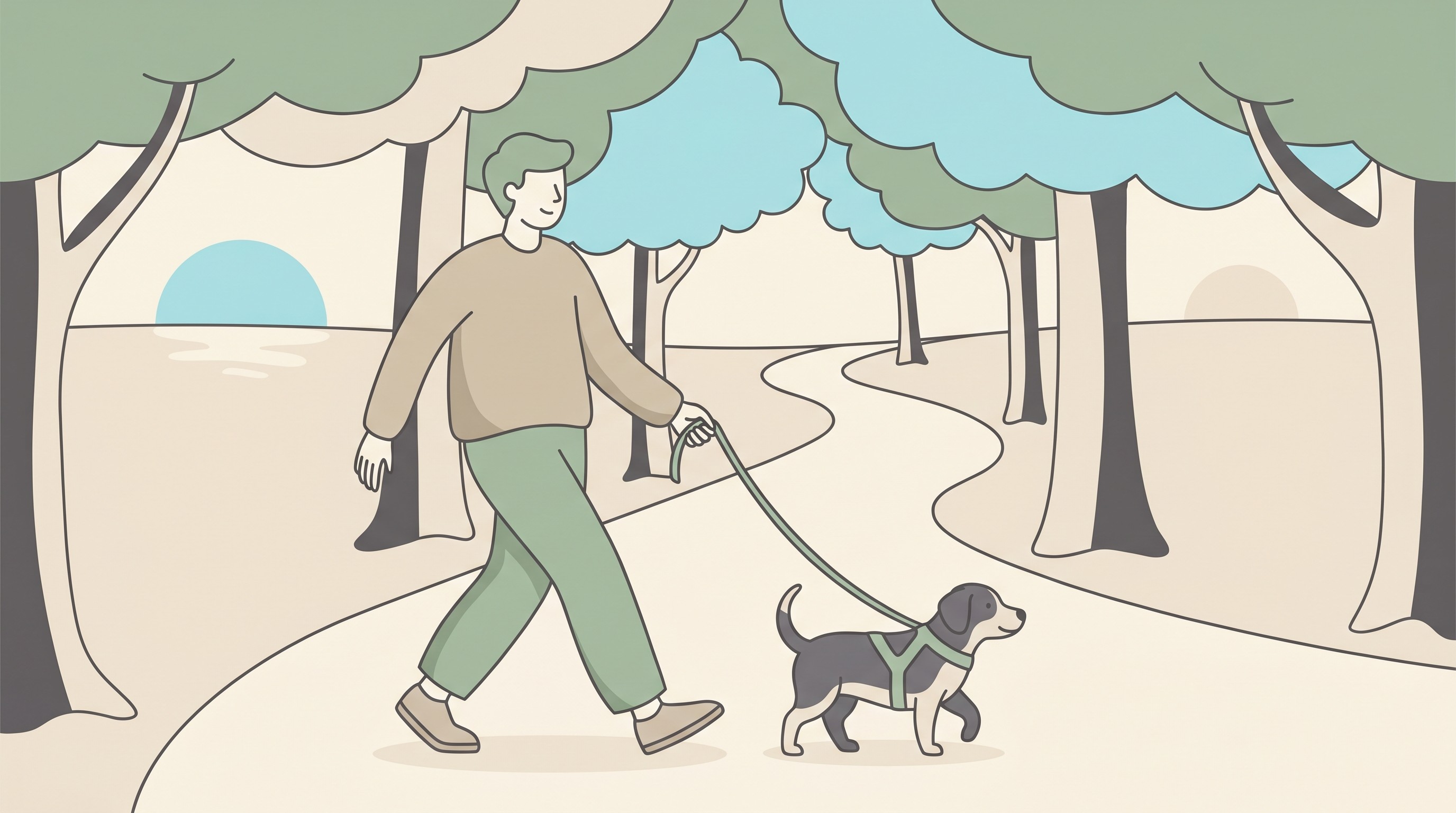
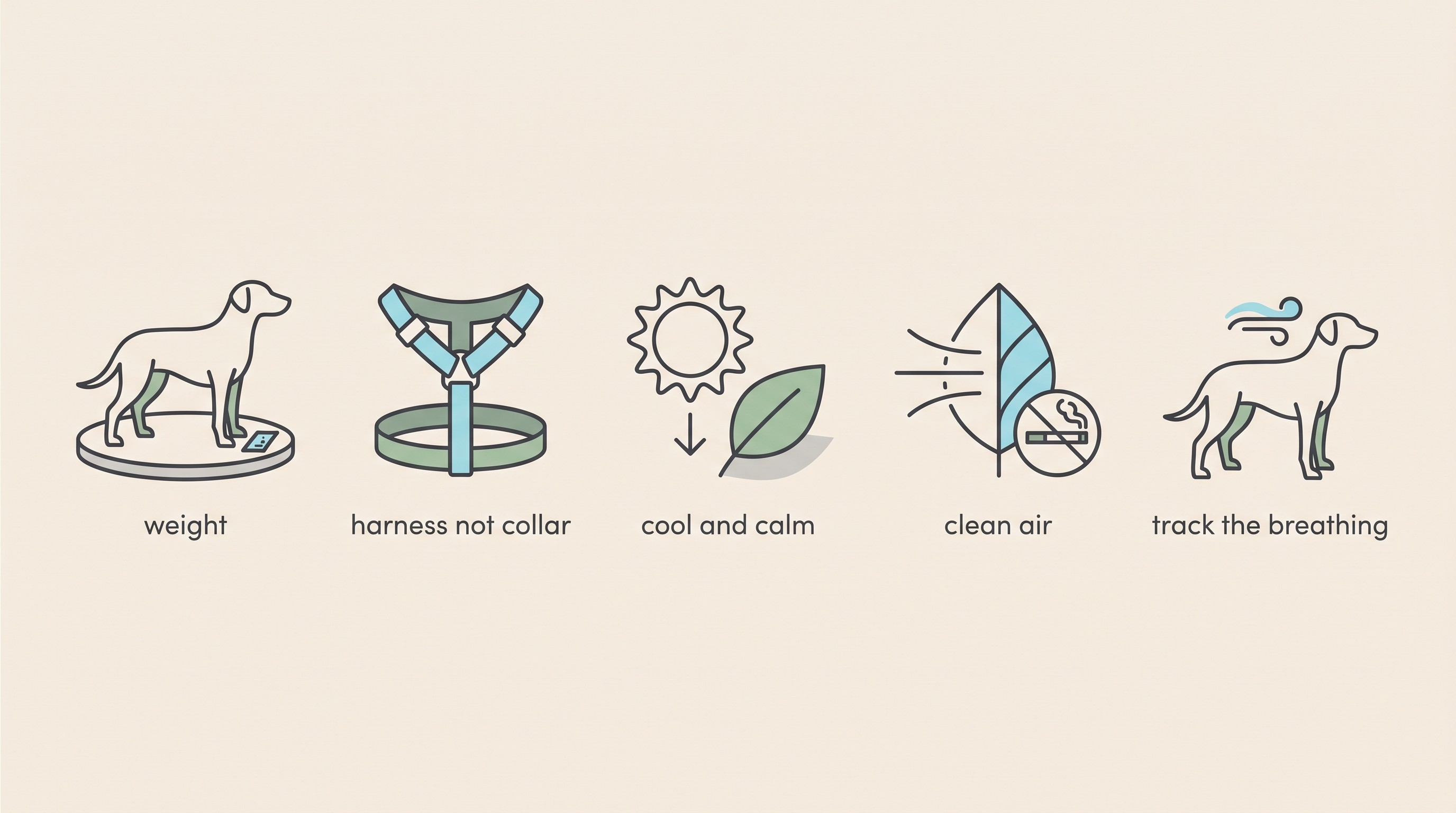
There are five of them. I'll take each in turn, then put the safety floor underneath the whole thing, because none of these levers ever override an emergency.
Lever 1: weight is the biggest one
If you do only one thing on this list, make it this. Carrying extra weight makes nearly every airway condition worse, and taking it off is the single highest-yield change most owners can make.
The reason is more direct than people expect. Fat isn't just padding on the outside. In a dog that has crept up the scale, adipose tissue is laid down in the structures that surround the airway itself, the tongue and the soft palate among them, further crowding a passage that may already be tight (Today's Veterinary Practice, 2024). In flat-faced dogs, a high body condition score is a robust, independent risk factor for BOAS and its severity, and the Cambridge BOAS researchers advise getting an overweight dog lean before surgery is even considered (Liu et al., 2017; University of Cambridge BOAS Research Group, 2024). In collapsing trachea, a strict weight-loss regime can produce striking improvement in clinical signs and sits at the core of the medical management that controls signs in roughly 70% of dogs (Tappin, 2016; American College of Veterinary Surgeons, 2024). For an asthmatic cat or a dog with laryngeal paralysis, the logic is the same: a leaner body asks less of the lungs and lowers the demand for air.
I'll be straight that this is the hardest lever to pull, and I'd never make you feel bad about a pet who has crept up a kilo or two. It happens to careful owners. But it's the one with the biggest pay-off, and you don't have to work it out alone: the how of it, the diet, the portions, the realistic targets, lives in our Weight Management home.
Lever 2: a harness, not a collar
This is the easiest win on the whole list, and for any airway-compromised dog it's close to non-negotiable. A collar presses straight on the windpipe, which is precisely where a narrowed or floppy airway can least afford the pressure. It can set off a bout of coughing, and over time that repeated pressure is implicated in irritating the trachea and worsening collapse.
We now have hard numbers on the cost of a collar. A 2025 controlled study measured it directly and found that simply wearing a collar, even standing still, significantly raised both intraocular pressure and respiration rate in flat-faced dogs, and on exercise raised eye pressure in every dog tested, while a harness raised eye pressure in none of them (Bailey et al., 2025). That stationary jump in respiration rate tells the airway story plainly: a collar makes a flat-faced dog work harder to breathe before it has taken a single step. It's why the surgeons' college, Cornell and the collapsing-trachea literature all say the same thing, switch to a body harness rather than a neck lead (American College of Veterinary Surgeons, 2024; Cornell Riney Canine Health Center, 2024; Tappin, 2016).
A harness isn't a cure, and I won't pretend otherwise, but it's one easy, free change that helps every single day. The detail, which style of harness, how to fit a Y-front so it doesn't rub or restrict the shoulder, the handle option that helps support a wobbly GOLPP dog, is worth getting right, so I've handed all of it to harness, not collar, which goes deep where this page stays broad.
Lever 3: keep cool and calm, and pace the exercise
Heat, humidity, exercise and excitement all do the same thing: they raise the demand for air. A healthy pet meets that demand easily. A pet with a compromised airway can't, and in the worst cases the gap is what tips a stable animal into a breathing crisis.
For flat-faced dogs this is genuinely a matter of life and death. They can't pant efficiently to cool themselves, so heat plus exercise plus excitement is a lethal combination, and a mild, humid day with a walk on it can be enough. UK primary-care data shows just how skewed the risk is: compared with a Labrador, the odds of heat-related illness run far higher in flat-faced breeds, with bulldogs around fourteen times, French bulldogs around six times and pugs around three times the risk (Hall et al., 2020). Dogs with laryngeal paralysis spiral into the same panicked overheating for the same airflow reason, and flares of collapsing trachea and feline asthma are reliably set off by heat, excitement and stress.
So the lever is this. Walk in the cool of the day, never the middle of it. Keep exercise gentle and short rather than long and exciting. Manage the big-greeting, doorbell-and-visitors moments that wind a dog up. Keep the home cool and airy, and never, ever the warm car. If you log in our Airway Episode & Exertion Diary, it carries a real-time heat-risk indicator so you can see at a glance when today is a stay-home day. The full heatstroke playbook, the cool-first first aid and the emergency response, belongs to flat-faced dog heatstroke, and the laryngeal paralysis heat angle to its own page; this is just the daily habit that keeps you out of trouble in the first place.
Lever 4: clean the air at home
Airborne irritants quietly drive airway inflammation and trigger flares right across these conditions. The feline asthma research names the usual suspects explicitly, and the list is worth reading slowly because so much of it is ordinary household stuff: tobacco smoke and vaping, dusty or scented cat litter, aerosol sprays and air fresheners, household cleaning vapours, fireplace and candle smoke, dust, pollen and mould (Cornell Feline Health Center, 2024; International Cat Care, 2024). The collapsing-trachea and brachycephalic guidance, quite independently, lands on the same advice: avoid cigarette smoke and airborne irritants, and keep dogs out of hot, stuffy, humid rooms (Cornell Riney Canine Health Center, 2024).
The practical version: stop smoking and vaping indoors, ditch the plug-ins, sprays and strong cleaners, switch a cat to a low-dust unscented litter, keep dust down, ventilate, and consider a HEPA air filter for the room your pet sleeps in. One limit, though, and it saves a lot of frustration: you very rarely find a single guilty trigger you can banish for good. It's the cumulative load that matters, and lightening it generally is more achievable than hunting one culprit. The room-by-room audit is its own piece, home for easy breathing, and the specifically feline trigger hunt sits with feline asthma triggers.
Lever 5: track the breathing
This is the lever that catches a slide before it becomes a crisis, and it costs nothing but a quiet minute. Counting your pet's breaths while they sleep or rest is, in my view, the single most useful home-monitoring habit there is.
Here's the number to know. Healthy dogs and cats, and pets with stable, well-controlled disease, keep their sleeping or resting rate comfortably under about 30 breaths a minute. In the research, healthy adult dogs average well under that, with a mean sleeping rate in the low teens and almost none above the low twenties (Rishniw et al., 2012), and even dogs with early, pre-failure heart disease rarely cross 30 at rest (Ohad et al., 2013). A rate that sits at 30 or more, and especially one creeping up over several days, is the warning sign worth acting on (Porciello et al., 2016). I do need to be clear about where that 30 line comes from: it's best validated in heart disease, specifically left-sided congestive heart failure, and we use it here as a general "resting breathing is too fast" signal. The under-30-is-normal half is solid ground, and a UK owner-facing source frames it the same way, a normal resting rate sitting in the low 20s and a reason to ring the vet once it's consistently above 30 or climbing from your pet's own baseline (Vetmedin UK, 2024). The 40-and-it's-urgent line you'll sometimes see, ours included, is a sensible "that's clearly too fast, ring now" escalation rather than a separately proven threshold, and I'd rather you knew that.
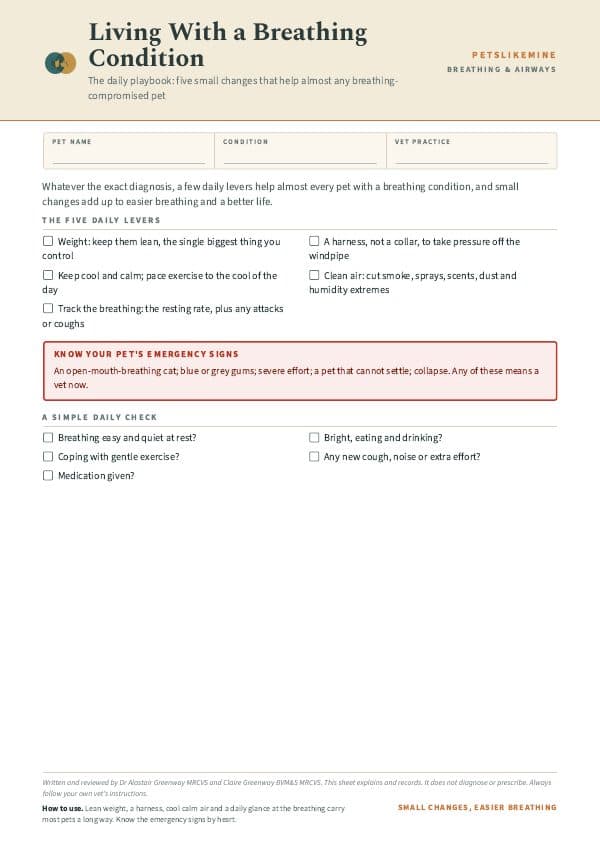
The method is simple. Wait until your pet is genuinely at rest or asleep, not panting and not purring, watch the chest, and count one full in-and-out as a single breath, for thirty seconds doubled or a full minute. Do it now and then while things are good, so you know your pet's own normal, because the trend matters more than any single reading. Our tap-to-count resting respiratory rate tracker does the counting for you and remembers the line, and the Airway Episode & Exertion Diary lets you log the coughs, attacks, exercise tolerance and inhaler use alongside it, so a pattern shows up before you'd otherwise have spotted it. There's a printable daily playbook too, if a fridge-door version helps.
The safety floor: know your pet's emergency signs
The five levers are the daily, steady-state work. They never override the red flags, and these are the lines that always mean go straight to the vet, do not wait, do not stop to film.
A cat breathing with its mouth open is the cardinal one. Cats almost never breathe through an open mouth unless they are in serious trouble, and the stress of being handled can tip a struggling cat over the edge, so the right response is minimal handling and straight to an emergency vet (Lynch, 2016). Grey, blue or dark gums in any pet mean a severe lack of oxygen and can come just before a respiratory arrest (Merck Veterinary Manual, 2024). So does severe or laboured effort, a pet whose breathing has visibly become a whole-body heave through the chest and belly, a pet that cannot lie down or settle, outright collapse, or coughing up pink froth (Merck Veterinary Manual, 2024). The distress postures to recognise, a dog standing with its elbows pushed out and its neck stretched forward, or a cat crouched low on all fours with its chest lifted and neck extended, are both an animal fighting for air (Merck Veterinary Manual, 2024).
I won't re-run the full triage here, because is my pet's breathing an emergency and the breathing triage tool are built to sort exactly this in seconds. The point on this page is only that the daily playbook sits on top of those red flags, never instead of them.
The long view
Let me leave you somewhere truthful and, I think, genuinely reassuring. These are conditions to manage and live well with, not countdowns. Most pets do well for a long time when the daily levers are pulled and the medication or surgery is doing its job. Well-controlled asthmatic cats live full, normal lives; the disease is incurable but, in the plain words of the Cornell specialists, generally manageable (Cornell Feline Health Center, 2024). Most dogs with a collapsing trachea are kept comfortable for years on good medical management (Tappin, 2016; American College of Veterinary Surgeons, 2024). Flat-faced dogs, with attentive care, have good lives, even though the underlying conformation is not something surgery can fully cure (University of Cambridge BOAS Research Group, 2024).
I won't pretend none of them progresses, because some do, and there will be pets reading over this page whose harder days are ahead. When that time comes, when breathing gets harder is there, written plainly, and you won't be facing it alone; this is the part of the space where owners walking the same road find each other.
References
- American College of Veterinary Surgeons. (2024). Tracheal Collapse (Small Animal Topic). Retrieved from
- Bailey, M. E., Packer, M. J., & Wills, A. P. (2025). Effect of a collar and harness on intraocular pressure and respiration rate of brachycephalic and dolichocephalic dogs. Veterinary Medicine and Science, 11(3), e70384.
- Cornell Feline Health Center. (2024). Feline Asthma: A Risky Business for Many Cats. Cornell University College of Veterinary Medicine. Retrieved from
- Cornell Riney Canine Health Center. (2024). Tracheal Collapse. Cornell University College of Veterinary Medicine. Retrieved from
- Hall, E. J., Carter, A. J., & O'Neill, D. G. (2020). Incidence and risk factors for heat-related illness (heatstroke) in UK dogs under primary veterinary care in 2016. Scientific Reports, 10, 9128.
- International Cat Care. (2024). Asthma and chronic bronchitis in cats. Retrieved from
- Liu, N.-C., Troconis, E. L., Kalmar, L., Price, D. J., Wright, H. E., Adams, V. J., Sargan, D. R., & Ladlow, J. F. (2017). Conformational risk factors of brachycephalic obstructive airway syndrome (BOAS) in pugs, French bulldogs, and bulldogs. PLOS ONE, 12(8), e0181928.
- Lynch, A.-M. (2016). Approaching the dyspnoeic cat in the middle of the night. Veterinary Ireland Journal, Small Animal, January 2016. Retrieved from
- Merck Veterinary Manual. (2024). Clinical Signs of Respiratory Disease in Animals. Retrieved from
- Ohad, D. G., Rishniw, M., Ljungvall, I., Porciello, F., & Häggström, J. (2013). Sleeping and resting respiratory rates in dogs with subclinical heart disease. Journal of the American Veterinary Medical Association, 243(6), 839-843.
- Porciello, F., Rishniw, M., Ljungvall, I., Ferasin, L., Häggström, J., & Ohad, D. G. (2016). Sleeping and resting respiratory rates in dogs and cats with medically-controlled left-sided congestive heart failure. The Veterinary Journal, 207, 164-168.
- Rishniw, M., Ljungvall, I., Porciello, F., Häggström, J., & Ohad, D. G. (2012). Sleeping respiratory rates in apparently healthy adult dogs. Research in Veterinary Science, 93(2), 965-969.
- Tappin, S. W. (2016). Canine tracheal collapse. Journal of Small Animal Practice, 57(1), 9-17.
- Today's Veterinary Practice. (2024). An Overview of Brachycephalic Obstructive Airway Syndrome. Retrieved from
- University of Cambridge BOAS Research Group. (2024). Management & Treatment of BOAS. Department of Veterinary Medicine, University of Cambridge. Retrieved from
- Vetmedin UK. (2024). Resting Respiratory Rate: owner guidance. Boehringer Ingelheim. Retrieved from
Free downloads
Companion worksheets to put what you've read into practice. Free PDFs, print at home.
Keep track of how your pet is doing
The owners who cope best are the ones who notice changes early. A simple health log shows you what is working, and what is not, before the next vet visit.
Start tracking, freeYou're not doing this alone
Compare treatment journeys and talk to owners managing breathing & airways. Free to join.
Join PetsLikeMine