

Is My Pet's Breathing an Emergency?
Alastair Greenway
BVM&S MRCVS
Breathing is the one symptom where the order you do things in actually matters, so start with the question that decides everything else: is this an emergency right now? Four signs say yes, and any one of them means you stop and phone a vet straight away: a cat breathing with its mouth open, gums that look blue, grey or purple, a pet that can't lie down or settle, and severe, obvious effort to breathe. Don't wait for morning, don't stop to film it, phone ahead and go.
If none of those is happening, you have a little room to read what you're seeing and sort it into one of four outcomes: go now, be seen today, book routine, or reassure and watch. This is the front door of the whole space, so rather than re-explain each condition I'll point you to the right room as we go.
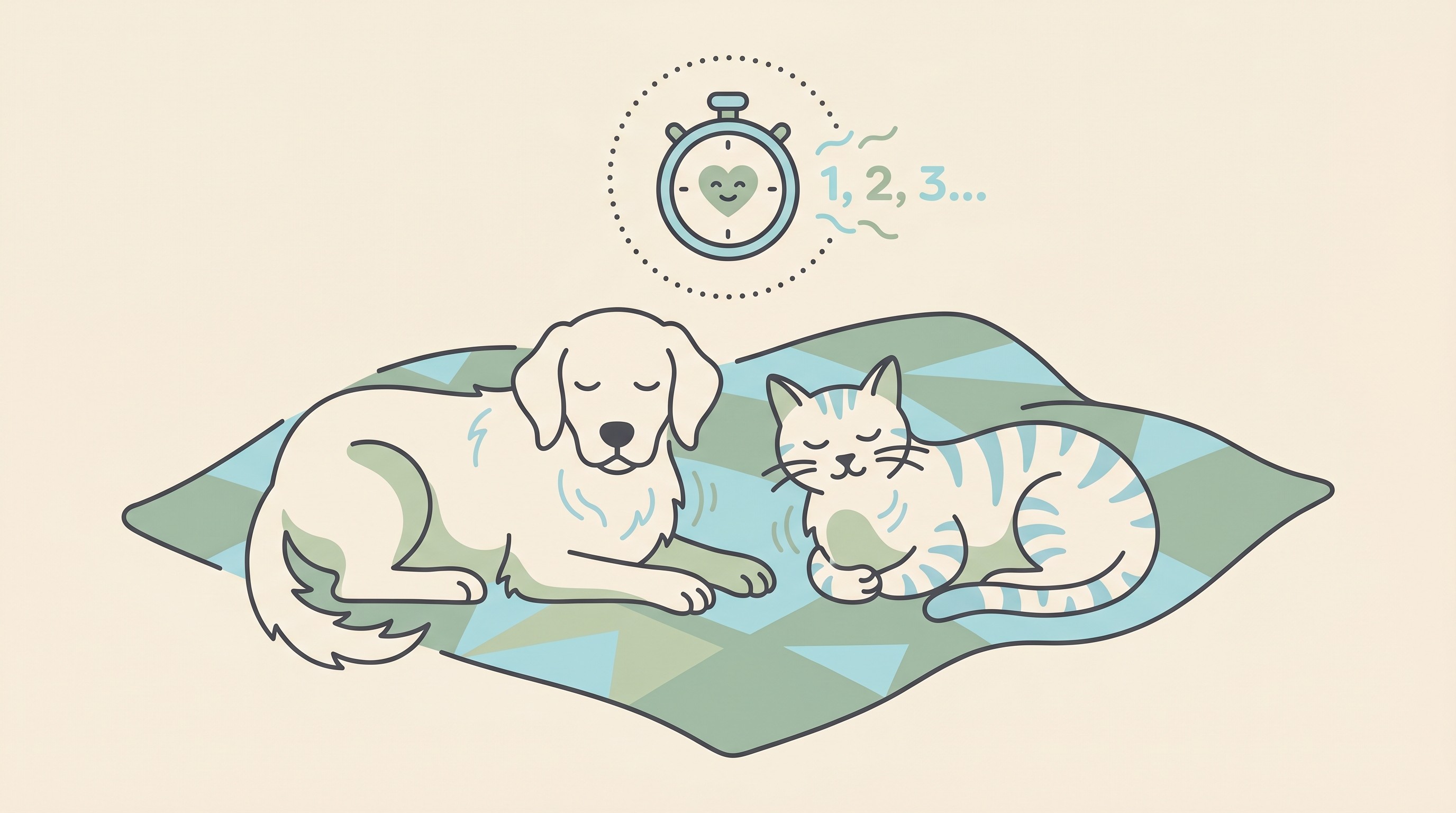
The four signs that mean go now
These jump the queue. If you see any one of them, the assessment is over and the answer is the vet.
An open mouth on a cat. This is the cardinal feline warning and it deserves to be first. Cats breathe through their noses and very rarely open their mouths to breathe, so a cat panting or breathing with its mouth open, when it hasn't just been frightened or genuinely overheated, is in real trouble (Cornell Feline Health Center, n.d.). Cornell describes the look exactly: open-mouth panting with the head held low and the body stretched forward, sometimes a gagging, about-to-be-sick expression, and advises that "any time there's a question about an animal's ability to breathe comfortably, get it to a veterinarian right away" (Cornell Feline Health Center, n.d.). A dog panting after a walk or on a warm day is ordinary. A cat doing anything like it, at rest, is not. If that is your cat, please go now and read the rest later.
Blue, grey or purple gums. Lift the lip and look. Healthy gums are bubble-gum pink. A bluish, grey or muddy purple tint, called cyanosis, means the blood is badly short of oxygen, and the MSD Veterinary Manual lists this "gray, dark pink, or blue discoloration (cyanosis)" among signs that "reflect major impairment of pulmonary function and might precede respiratory arrest" (Tonozzi, n.d.). There's a caveat that changes how you use this sign, though: cyanosis is a late one. Oxygen has to fall a long way before gums actually change colour, so normal pink gums do not mean all is well, and you should never wait for a colour change to make up your mind. Effort and rate warn you sooner.
Can't settle, can't lie down. A comfortable pet can rest. A pet that keeps standing up, won't lie on its side, or holds its head and neck stretched out is doing that on purpose, to keep its airway as open as possible. A struggling dog tends to stand with its elbows pushed out from its body, its weight shifted back and its head and neck extended; a struggling cat crouches on all four feet with its chest slightly lifted and is reluctant to lie down (Tonozzi, n.d.). If your pet can't get comfortable enough to breathe, treat it as an emergency, even if the rate itself doesn't look dramatic.
Severe effort, especially belly-breathing. Watch the whole body, not just the speed. Easy breathing is quiet and led by the chest, and you can barely see it. Laboured breathing pulls the belly noticeably in and out with each breath and exaggerates the chest movement, often with an open mouth and that stretched-out posture (Tonozzi, n.d.; Cornell Feline Health Center, n.d.). When the abdomen is visibly doing the work, the effort has crossed a line. Effort matters as much as speed.
Telling a fast rate apart from a laboured one
A racing breathing rate is frightening, but on its own it isn't always an emergency, and knowing the difference saves you a lot of midnight panic. Vets separate two things. Tachypnoea simply means fast breathing, and it can be perfectly normal after exercise, in the heat, or when a pet is anxious. Dyspnoea means laboured, difficult breathing, genuine distress (Tonozzi, n.d.). A fast rate at rest, or any sign of real effort, is the worry. A fast rate just after a run, a fright or on a hot day usually isn't, and often settles within ten or fifteen minutes of calm and cool.
That makes the resting rate the one practical skill worth having, and it's the instrument behind most of the sorting below. While your pet is asleep or settled and properly calm, never just after exercise, watch the chest, count one full breath each time it rises and falls, count for 30 seconds and double it (VCA Animal Hospitals, n.d.). A normal dog or cat sits between about 15 and 30 breaths a minute (VCA Animal Hospitals, n.d.), so the rule of thumb to carry is this: normal is under about 30 breaths a minute at rest, 30 or more is worth watching, and 40 or more needs a call to the vet. A rate that is creeping up over several days is just as telling as a single high count, which is exactly why it helps to know your own pet's usual number before anything goes wrong.
One thing I owe you about that 30 threshold: it is best validated for heart disease, not pulled from thin air. In a study of dogs and cats with stable, medically-controlled heart failure, the median sleeping rate was around 20 breaths a minute and almost every animal stayed under 30, which is what makes a home rate climbing to 30 or above such a reliable warning that something has changed (Porciello et al., 2016). We lean on it here as a general resting-tachypnoea signal too, which is fair and useful, but I'd rather you knew where the number comes from than treat it as gospel for every cause. The easiest way to keep an eye on it is the breathing rate tracker, which lets you tap along with each breath and saves the trend so a slow climb is obvious.
Sorting what you see into four outcomes
Emergency, go now. Any of the four signs above, or a very high resting rate (around 40 or more) that is climbing, collapse, or pink froth at the mouth or nose. Phone the vet on your way and go. "Now" means now, not after you have filmed it or waited to see if it passes.
Urgent, be seen today. Breathing mildly faster or a little more laboured at rest while your pet is otherwise reasonably comfortable, a resting rate sitting around or just over 30, a new soft cough alongside a touch of lethargy or a smaller appetite, or a flat-faced dog working harder than usual on a warm day. No blue-light dash, but ring your practice and ask for a same-day slot rather than leaving it.
Routine, book it. A mild, stable change that plainly isn't distressing your pet: an occasional cough in a bright animal who is eating normally and keeping up on walks, a long-standing snore that hasn't changed, exercise that's a touch less than it used to be. Worth a proper look at an ordinary appointment, and worth starting to count the resting rate so you have a baseline.
Reassure and watch. Some things that look alarming usually aren't. A sudden burst of violent, snorting, gasping that stops within a minute and leaves your dog completely normal afterwards is very often reverse sneezing, which looks far worse than it is. Because there is a rare exception that mimics it, the tell that separates harmless reverse sneezing from a genuine problem is worth knowing, so see reverse sneezing explained rather than letting the reassurance blind you to it.
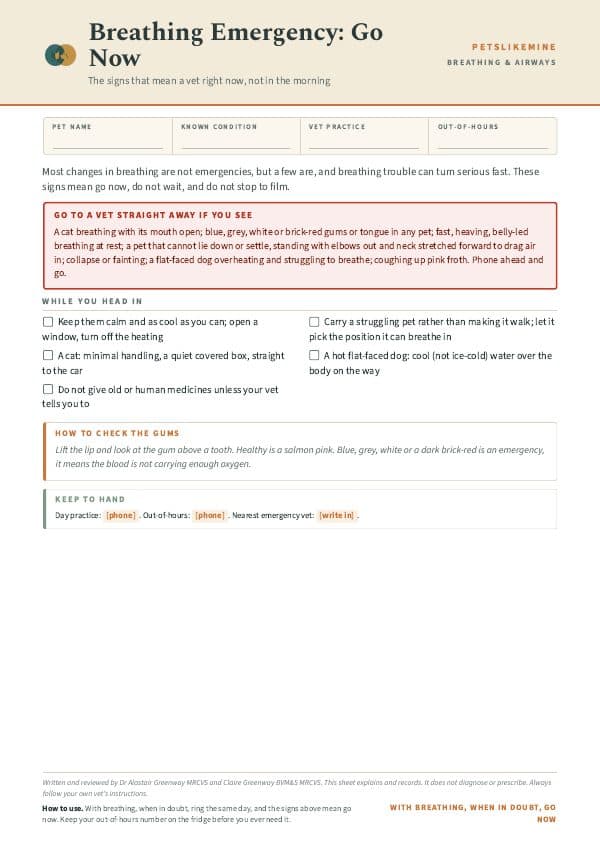
If you'd rather have the sorting done with you, the breathing triage tool walks through these same questions and gives you a disposition, and the printable breathing emergency red-flags one-pager is worth sticking on the fridge before you ever need it.
Coughs and noises have their own front doors
Two of the commonest breathing worries each get their own page, because each is a whole question in itself and doesn't fit neatly into a single triage box. If the main thing is a cough, the genuinely useful question is whether it comes from the heart or the airways, because the two need very different help and one number, the resting rate, separates them more than you'd expect: take that to cough: heart or lungs?. If the main thing is a new or worsening breathing noise, a snore, snort, raspy in-breath or honk, the type of noise points to where the problem sits, and which kinds are dangerous is its own sorting job, covered in noisy breathing: when it's dangerous.
Flat-faced dogs in the heat: a jump-the-queue rule
If you have a pug, French bulldog, English bulldog or another flat-faced breed, one situation deserves its own line, because it kills fast and sneaks up on owners who think they have time: a flat-faced dog breathing hard, especially in any warmth or after exertion, should be treated as urgent.
The reason is mechanical, not a failing on anyone's part. Dogs cool themselves mainly by panting, and a flat-faced dog's crowded airway simply can't move enough air to do the job. The numbers make the point starkly. Brachycephalic dogs carry around 2.1 times the odds of heat-related illness compared with longer-nosed dogs, with English bulldogs at roughly 14 times, French bulldogs around 6.5 times and pugs around 3.2 times the odds of a Labrador, and roughly 14% of UK heat-illness events prove fatal (Hall et al., 2020a). Most of these cases are not dogs left in hot cars at all: in a companion study of the same population, exercise in warm weather triggered about three-quarters of events (Hall et al., 2020b). For a sense of how loaded these airways already are even on a cool day, pugs have something like 54 times the odds of obstructive airway disease of other dogs (O'Neill et al., 2022). That's plain biology, not breed-blame, and noticing it early is the kind thing to do.
So the rule is simple: a flat-faced dog working hard plus any heat or exertion equals urgent. Stop the activity, get them into shade, cool them with cool, not ice-cold, water and some airflow, and then get to the vet even if they seem to recover, because they can deteriorate again an hour or two later. The full life-saving playbook, the one worth reading before summer rather than during it, is in flat-faced dogs and heatstroke.
Getting there safely
On the way, keep your pet as calm and as cool as you can. Stress makes breathing worse, so the gentler and quieter you are, the better, and calling the practice while you travel means they are ready and waiting when you arrive (PDSA, n.d.). In a distressed animal the priority is oxygen and minimal handling: extensive fussing, examining or forcing into a carrier should wait, because the struggle itself can tip a fragile patient over, and that is especially true of cats, who hide trouble until they are very unwell (Sharp, n.d.; Cornell Feline Health Center, n.d.). If your cat is panicking as much as it is struggling, that distress is itself a reason to go, not to keep trying to settle it at home. For a flat-faced dog or a cat mid-flare, cool and calm is your holding measure, but the destination is still the vet, now.
The one thing not to do is reach for the human medicine cupboard. Ibuprofen is toxic to both cats and dogs and should never be given (PDSA, n.d.), and paracetamol is extremely toxic to cats, with no safe dose at all, so even part of a tablet can be fatal (International Cat Care, n.d.). Whatever the breathing problem turns out to be, nothing from your own bathroom shelf will help it and several things will make it very much worse.
Why breathing is the one thing not to sit on
Most worries in pet health give you a little time to think. Breathing is the exception. When oxygen falls, the brain and heart are damaged within minutes, and these are precisely the signs that "might precede respiratory arrest," which is why "watch and wait overnight" is the wrong instinct with genuine respiratory distress (Tonozzi, n.d.). There is rarely a prize for waiting and frequently a price.
That isn't meant to frighten you. It's meant to give you permission: to phone out of hours, to feel slightly silly if it turns out to be nothing, to trust the wobble in your gut over the worry of being a nuisance. Vets would far rather see a comfortable pet and send you home reassured than meet one an hour too late. So while things are calm tonight, count the resting rate with the breathing rate tracker, so you know your own pet's normal and any change stands out a mile. Breathing is the one thing where, when in doubt, you pick up the phone.
References
- Cornell Feline Health Center. (n.d.). Dyspnea (Difficulty Breathing). Cornell University College of Veterinary Medicine. Retrieved from
- Hall, E. J., Carter, A. J., & O'Neill, D. G. (2020a). Incidence and risk factors for heat-related illness (heatstroke) in UK dogs under primary veterinary care in 2016. Scientific Reports, 10, 9128.
- Hall, E. J., Carter, A. J., & O'Neill, D. G. (2020b). Dogs don't die just in hot cars: exertional heat-related illness (heatstroke) is a greater threat to UK dogs. Animals, 10(8), 1324.
- International Cat Care. (n.d.). Paracetamol poisoning in cats. Retrieved from
- O'Neill, D. G., Sahota, J., Brodbelt, D. C., Church, D. B., Packer, R. M. A., & Pegram, C. (2022). Health of Pug dogs in the UK: disorder predispositions and protections. Canine Medicine and Genetics, 9, 4.
- PDSA. (n.d.). Ibuprofen poisoning in dogs and cats. People's Dispensary for Sick Animals. Retrieved from
- PDSA. (n.d.). First aid for pets struggling to breathe. People's Dispensary for Sick Animals. Retrieved from
- Porciello, F., Rishniw, M., Ljungvall, I., Ferasin, L., Haggstrom, J., & Ohad, D. G. (2016). Sleeping and resting respiratory rates in dogs and cats with medically-controlled left-sided congestive heart failure. The Veterinary Journal, 207, 164-168.
- Sharp, C. R. (n.d.). Approach to Respiratory Distress in Dogs and Cats. Today's Veterinary Practice. Retrieved from
- Tonozzi, C. C. (n.d.). Clinical Signs of Respiratory Disease in Animals. Merck/MSD Veterinary Manual. Retrieved from
- VCA Animal Hospitals. (n.d.). Home Breathing Rate Evaluation. Retrieved from
Free downloads
Companion worksheets to put what you've read into practice. Free PDFs, print at home.
Keep track of how your pet is doing
The owners who cope best are the ones who notice changes early. A simple health log shows you what is working, and what is not, before the next vet visit.
Start tracking, freeYou're not doing this alone
Compare treatment journeys and talk to owners managing breathing & airways. Free to join.
Join PetsLikeMine