

Reverse Sneezing in Dogs and Cats: Alarming to Watch, Usually Harmless
Alastair Greenway
BVM&S MRCVS
It nearly always happens the same way. Your dog is pottering about, or has just got excited at the door, and suddenly freezes, stretches its neck out and starts making a horrible rapid snorting, gasping noise, as though it's trying to inhale the whole room and can't. It looks for all the world like choking. Your stomach drops, and then, after twenty or thirty seconds, it simply stops and the dog trots off as if nothing happened. What you almost certainly saw has a name: a reverse sneeze, and in a well dog it is far less frightening than it looks.
This page does two things. It settles your nerves and explains what's going on, and then it gives you the warning sign that separates a benign reverse sneeze from one worth checking. The cheerful blog posts tend to skip that second part, so here it is plainly: reverse sneezing is a sign, not a diagnosis, and while it's usually nothing, it isn't always.
What a reverse sneeze actually is
Start with a normal sneeze: something tickles the nose, and the body blasts air outward to clear it. A reverse sneeze, sometimes called paroxysmal respiration, is the mirror image. The air is pulled sharply inward through the nose while the glottis (the opening into the windpipe) is held closed, so instead of a clean expulsion you get a loud, repeated, snorting inhalation (Cornell University Riney Canine Health Center, n.d.; VCA Animal Hospitals, n.d.). That closed glottis is exactly why it sounds so dramatic and exactly why it isn't choking: the airway to the lungs is being protected, not blocked.
The cause is a bit of irritation right at the back of the nose, in the nasopharynx, the patch above the soft palate. It's best understood as a mechanosensitive aspiration reflex: irritation there sets off a brief spasm of the pharyngeal and soft-palate muscles that narrows the airway, and the dog answers with a burst of forceful inward breaths to try to clear it (Talavera et al., 2022; Gelatos et al., 2022). The exact wiring isn't fully worked out, so vets say "thought to be" rather than state it as fact, but it's a self-limiting reflex spasm and the dog comes to no harm from the spasm itself.
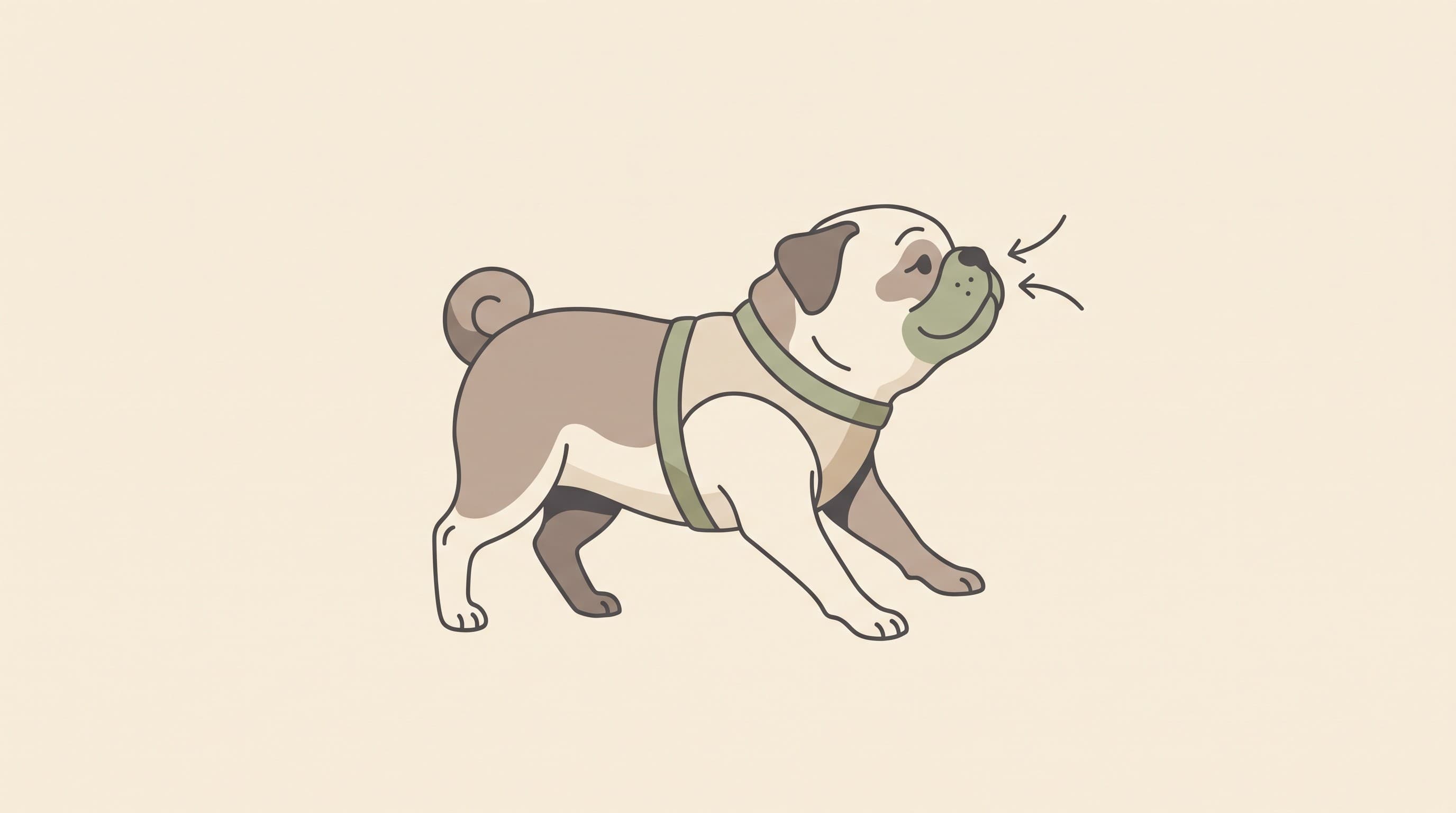
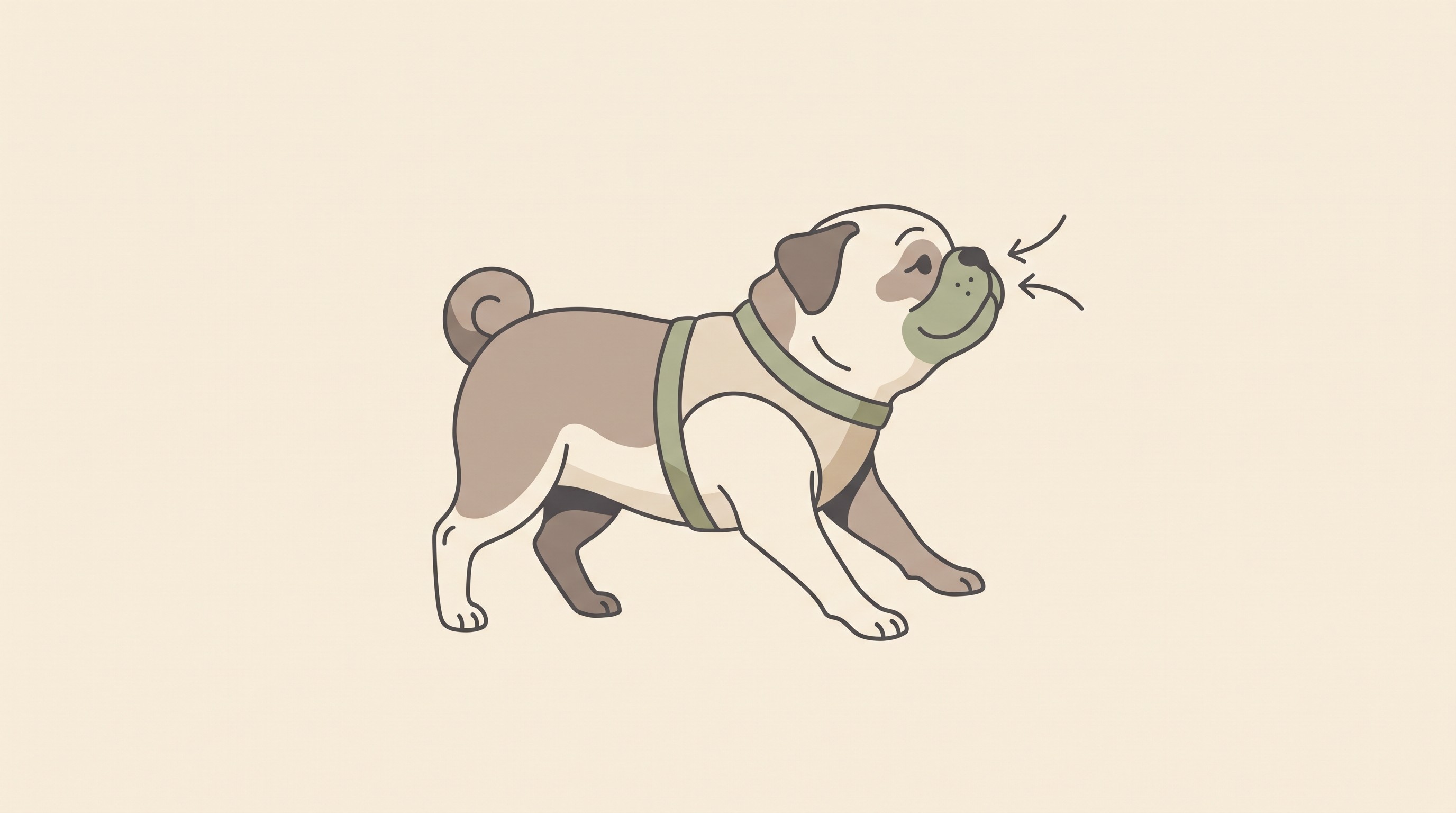
Posture gives the game away. A reverse-sneezing dog stops dead, extends its neck, often tips its head slightly back, plants its elbows out, flares its nostrils and keeps its mouth shut while it snorts the air in (Talavera et al., 2022; Cornell University Riney Canine Health Center, n.d.). An episode usually runs from a few seconds up to about a minute and stops on its own (VCA Animal Hospitals, n.d.). A genuinely choking or coughing dog, by contrast, pushes air outward, often with its mouth open, and may panic or paw at its face. Mouth shut and snorting inward is reassuring. Mouth open and distressed is not.
What sets it off
Once you know the triggers, the whole thing demystifies itself. The usual provocations are excitement (the front door, visitors, the lead coming out), a tug on a collar, eating or drinking too fast, and inhaled irritants such as dust, pollen, grass seeds, smoke, perfume, air fresheners and carpet or cleaning sprays (VCA Animal Hospitals, n.d.; American Kennel Club, 2024; Cornell University Riney Canine Health Center, n.d.). If your dog reverse sneezes mostly when it's thrilled to see you, or just after a drink, that's a very ordinary story, and it hands you a simple lever. Cutting the irritant load at home, fewer sprays and scents and less dust, and swapping a neck collar for a harness so there's no pull on the throat, can take the edge off how often it happens.
Reverse sneezing can turn up at any age and affects both sexes equally, but it's reported more often in small dogs (often quoted as under about fifteen kilos) and in flat-faced, brachycephalic breeds (Cornell University Riney Canine Health Center, n.d.). The likely reason in flat-faced dogs is anatomical: the elongated soft palate and crowded nasopharyngeal turbinates that come with a shortened skull give the soft palate more to catch on, and Cambridge's BOAS researchers note that reverse sneezing in these dogs is likely linked to the elongated soft palate irritating the throat (University of Cambridge BOAS Research Group, n.d.). One caveat: good sources don't fully agree on the typical patient. Cornell links reverse sneezing to small and brachycephalic dogs, while VCA describes dogs with narrower, longer noses as more commonly affected (VCA Animal Hospitals, n.d.). The safe read is "most often in small and flat-faced dogs," with no reliable figure for how common it is overall. If your dog is a pug, Frenchie or bulldog that snores and snorts at rest too, the piece on whether flat-faced breathing is normal or dangerous is written for you.
How to help in the moment
Most episodes end before you've finished worrying about them, so you often don't need to do anything. If you'd like to try to shorten one, the gentle measures vets suggest all work the same way, by prompting a swallow, which tends to break the spasm: stay calm (your anxiety travels straight down the lead), gently stroke the throat, briefly cover the nostrils for a second or two, lightly blow in the face, or offer a drink or something to lick (VCA Animal Hospitals, n.d.; American Kennel Club, 2024; Cornell University Riney Canine Health Center, n.d.). Treat these as soothing nudges, not essential first aid. What you should not do is prise the mouth open or go fishing down the throat, because there's nothing lodged there to pull out and you risk being bitten by a startled dog.
The tell: when it isn't just a reverse sneeze
This is the part I care about most, and the reason this page exists. Reverse sneezing is a marker of irritation at the back of the nose, and that irritation usually has no sinister cause, but sometimes it does. The most sobering evidence comes from the only published case series on this, which followed thirty dogs that reverse sneezed and looked for why. Only two of the thirty, around 7 per cent, were truly idiopathic with nothing found. The rest had an identifiable cause: most often inflammatory airway disease (in well over half), then anatomical problems such as an elongated soft palate, a collapsing windpipe or pharyngeal collapse, and in a few a foreign body, and the snorting carried on despite treatment in most of the dogs that were followed up (Talavera et al., 2022). That was a population whose owners were worried enough to investigate, not every dog that ever snorts, so the everyday reverse sneeze in a bright, well dog is still almost always nothing, and in many small-breed dogs it is genuinely idiopathic and does not progress (Gelatos et al., 2022). But it means the reassurance has to come with a tell attached.
So treat a one-off or occasional reverse sneeze in an otherwise-well dog as the non-event it almost always is. But it's worth a vet visit, and it might not be a simple reverse sneeze, if any of these are in the picture (Talavera et al., 2022; Gelatos et al., 2022; Merck Veterinary Manual, n.d.):
- Episodes that don't stop, keep going well past a minute, or come back-to-back without let-up.
- Nasal discharge, especially if it's one-sided, thick or bloody, or changes character over time. This is the load-bearing one: an acute discharge from a single nostril points towards a foreign body, and a chronic discharge that starts one-sided and becomes two-sided, or shifts from clear or pus-like to bloody, raises the possibility of a tumour or a fungal infection (Merck Veterinary Manual, n.d.).
- Bleeding from the nose, facial pain, pawing at the face, facial swelling, or loss of pigment on the nose (the last leans towards a fungal disease, aspergillosis) (Gelatos et al., 2022; Merck Veterinary Manual, n.d.).
- Weight loss, low energy, or being unwell alongside the snorting.
These point away from a benign reflex and towards rhinitis, a nasal or nasopharyngeal foreign body, nasal mites, fungal disease or a growth (Gelatos et al., 2022; Merck Veterinary Manual, n.d.). I'm only naming them and routing you on, because the full work-up for a snotty or bloody nose belongs in nasal disease and a snotty nose.
One thing to be completely clear about. If your pet is in real respiratory distress, breathing hard and fast at rest, with blue or grey gums, or, in a cat, breathing with its mouth open, that is not a reverse-sneeze problem and it is not something to sit and watch. That is an emergency and needs a vet now. Telling genuine distress from a passing fright is exactly what is my pet's breathing an emergency and the breathing triage tool are for, and if you're unsure which side you're on, treat it as the emergency. And if it's the type of noise that's confusing you, the snort against the snore against the goose-honk of a collapsing windpipe, noisy breathing and when it's dangerous sorts the sounds out.
Cats are a slightly different story
Cats reverse sneeze and snort too, but it's less common, and that changes how I read it. When a cat makes a snorting or rasping noise (vets call the low rattly version stertor), I want to think harder about an underlying cause than I would in a small dog. Disease at the back of a cat's nose can show up precisely as reverse sneezing, gagging or difficulty swallowing, and the usual culprits are inflammatory polyps, growths such as lymphoma, foreign bodies, a narrowing of the nasopharynx and infection (Reed and Gunn-Moore, 2012). A young cat with a snorting, snuffly noise is especially worth a look, because nasopharyngeal polyps tend to crop up in cats under about a year, growing from the middle ear down the Eustachian tube to the back of the throat and making a distinctive snorting sound, often with nasal discharge or a head tilt (VCA Animal Hospitals, n.d.). And a nosebleed in a cat can come from high blood pressure, the kind that tags along with kidney disease or an overactive thyroid, so feline epistaxis is always worth taking seriously (Reed and Gunn-Moore, 2012). The short version is the same as for dogs but with the dial turned up: a snort deserves a closer look, and an open-mouth-breathing cat is always an emergency.
What to do from here
If your dog had a single dramatic snorting fit, looked utterly fine before and after, and ticks none of the red flags, then genuinely, relax and carry on. But if the episodes are frequent, persistent, getting worse, new in an older pet, or paired with any of the tells above, the single most useful thing you can do is film one on your phone. Your vet almost never gets to see a reverse sneeze happen, and a ten-second clip turns a vague description into a clear picture, often answering the question on the spot. From there they might trial a treatment for allergies or nasal mites, or, if it persists, look up the nose and behind the soft palate to rule out a foreign body, a polyp or a mass (Talavera et al., 2022; Cornell University Riney Canine Health Center, n.d.). The reassurance you came for is real. It just travels best with a camera in your pocket and one eye on the tell.
References
- American Kennel Club. (2024, May 7). What Happens When a Dog Reverse Sneezes? (J. Klein, Chief Veterinary Officer). Retrieved from
- Cornell University College of Veterinary Medicine, Riney Canine Health Center. (n.d.). Reverse Sneezing. Retrieved from
- Gelatos, M., Colopy, S. A., Waller, K., and Pritchard, J. C. (2022). Reverse sneezing as a clinical manifestation of nasopharyngeal-oropharyngeal fistula in a dog. The Canadian Veterinary Journal, 63(11), 1119-1123.
- Merck Veterinary Manual. (n.d.). Rhinitis and Sinusitis in Dogs and Cats. Retrieved from
- Reed, N., and Gunn-Moore, D. (2012). Nasopharyngeal disease in cats: 1. Diagnostic investigation. Journal of Feline Medicine and Surgery, 14(5), 306-315.
- Talavera, J., Sebastián, P., Santarelli, G., Barrales, I., and Fernández del Palacio, M. J. (2022). Reverse Sneezing in Dogs: Observational Study in 30 Cases. Veterinary Sciences, 9(12), 665.
- University of Cambridge, Department of Veterinary Medicine, BOAS Research Group. (n.d.). Recognition and Diagnosis (BOAS). Retrieved from
- VCA Animal Hospitals. (n.d.). Reverse Sneeze in Dogs (M. Weir, K. Williams, and E. Ward). Retrieved from
- VCA Animal Hospitals. (n.d.). Nasopharyngeal Polyps in Cats (K. Williams and E. Ward). Retrieved from
Keep track of how your pet is doing
The owners who cope best are the ones who notice changes early. A simple health log shows you what is working, and what is not, before the next vet visit.
Start tracking, freeYou're not doing this alone
Compare treatment journeys and talk to owners managing breathing & airways. Free to join.
Join PetsLikeMine