

Flat-Faced Dog Breathing: Normal, or Dangerous?
Alastair Greenway
BVM&S MRCVS
You know the soundtrack already. The soft snore from the dog bed that everyone finds adorable. The little snort when they get excited at the door. The snuffle on a walk, the gulping and gurgling after a drink, the way they flop down propped against a cushion with their chin in the air. If you've got a pug, a French bulldog or an English bulldog, you've probably been told a hundred times that all of this is "just the breed". And so you've stopped really hearing it.
Let me be straight with you, gently. A lot of what gets waved away as breed charm is actually the sound of a dog working hard to breathe. That isn't a telling-off, and it isn't your fault. You didn't design the skull, and you love the dog you've got. But noticing the difference between a happy snuffle and an airway under strain is one of the kindest things you can do for them, and that's the whole point of this page. I'm not here to make you feel bad. I'm here to help you tell normal from dangerous.
Why the noise matters
The flat face that makes these breeds so appealing comes from a shortened skull, but the soft tissue inside, the soft palate, the tongue, the lining of the nose and throat, hasn't shrunk to match. So a normal amount of soft tissue is packed into a much smaller space, and the airway it passes through is crowded and narrow. When air has to squeeze through a tighter pipe it gets turbulent and noisy, and the dog has to work harder to move it. That is what you are hearing. The medical name for the whole picture is brachycephalic obstructive airway syndrome, or BOAS, and it is a real, recognised, often progressive disorder, not a quirk (Cornell Riney Canine Health Center, n.d.). I'll keep the anatomy light because the mechanism and the way it builds over time deserves its own piece, but that's the headline: the noise is the airway telling you it's working harder.
How common is this, really? More common than most owners are ever told, and the breed risk is genuinely extreme rather than a figure of speech. In a large UK VetCompass study from the Royal Veterinary College comparing pugs against the wider dog population, BOAS came out as the single highest-risk disorder for the breed, with pugs around 54 times more likely to be affected than other dogs (O'Neill et al., 2022). French bulldogs and bulldogs sit alongside them at very high risk: French bulldogs are roughly 30 times more likely to have BOAS and around 42 times more likely to have narrowed nostrils than other breeds (O'Neill et al., 2021). To be clear, "54 times more likely" is a comparison of risk, not a claim that 54% of pugs have it, but the direction is unmistakable, and the same research group concluded that the pug "can no longer be considered a typical dog from a health perspective" (O'Neill et al., 2022). If your flat-faced dog makes a lot of noise, you are very much not alone, and your instinct that it might mean something is a good one.
You're not imagining it, and you're not the only one
Half-noticing your dog's breathing for a while, then talking yourself out of worrying, is the single most common thing owners of these breeds do, and researchers have measured it. In one landmark UK study, over half of the owners whose dogs were clearly affected, 58% of them, reported that their dog did not have a breathing problem at all, even while describing frequent, severe signs (Packer et al., 2012). It isn't that these owners didn't care. It's that the signs had been reframed as normal.
Bigger surveys since have found the same pattern, and shown where it comes from. Snoring, snorting, noisy and laboured breathing, and even disturbed sleep, are widely regarded as normal "for the breed", and some owners go further and read these signs as endearing personality traits, a dog that's relaxed, lazy or snuggly. In a survey of more than two thousand UK owners, this normalisation was striking enough that roughly one in seven said nothing would put them off owning the breed at all (Royal Veterinary College, 2024).
I don't share that to embarrass anyone. I share it because it explains why so many of these dogs reach us later than they should. The signs are easy to miss precisely because they're constant, and because everyone around you keeps calling them cute. Noticing is not disloyalty to your dog. It's the opposite.
Signs it's effort, not character
So what actually separates a contented snuffle from an airway under strain? Here is the recognise-it list. The more of these you can tick, the more it's worth a proper look.
- Loud or laboured breathing at rest, not just on exertion. A dog that's audible while lying quietly is moving air against resistance (Cornell Riney Canine Health Center, n.d.).
- Snorting, snuffling and snoring as a regular feature of daily life and sleep (Cornell Riney Canine Health Center, n.d.).
- Sleeping propped up, with the head raised, in odd positions, or with a favourite chin-up perch, and sleeping poorly or waking to reposition and breathe. This isn't a quirk either: flat-faced dogs are far more prone to genuine sleep-disordered breathing, the canine version of the broken, oxygen-starved sleep people with sleep apnoea have, and the more severe the BOAS and the heavier the dog, the worse it gets (Niinikoski et al., 2024).
- Gagging, retching or bringing up froth or food, often around eating, drinking or excitement. The airway and the gullet are both crowded in these dogs, so the signs overlap (Cornell Riney Canine Health Center, n.d.).
- Tiring quickly, slowing down or wanting to stop on walks, or simply being less keen to play than you'd expect (Cornell Riney Canine Health Center, n.d.).
- Struggling, getting noisier or overheating in warm weather, where a longer-nosed dog would cope easily (O'Neill et al., 2015).
None of these on its own is a diagnosis, and a single contented snore on a hot afternoon is not a crisis. But this is the cluster that makes a vet think "this airway is working too hard", and if it describes your dog, it's worth acting on rather than absorbing into the background. The shift that matters is when the effort is there at rest, when it's stealing sleep, or when gentle activity or mild warmth tips your dog into distress.
Red flags: when it's an emergency now
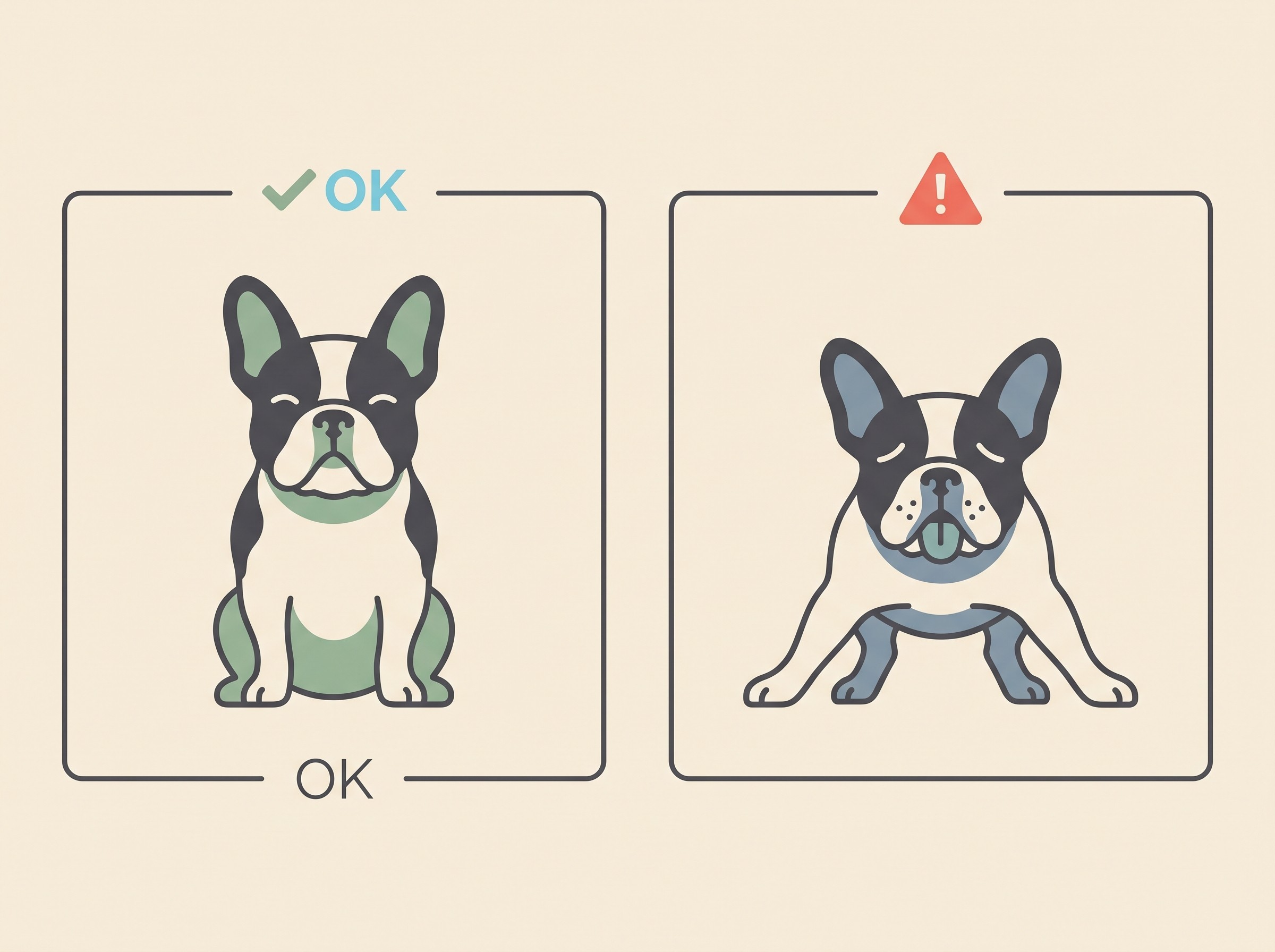
Most BOAS is a slow-burning, manageable problem. But it can tip into a genuine emergency, and a flat-faced dog has less spare capacity to fall back on, so I won't soften this part. If you see any of the following, this is a vet now, not a wait-and-see, not a "let's see how the morning goes":
- Blue, grey or purple gums or tongue. This is called cyanosis, and it means the blood isn't carrying enough oxygen. It is a sign of severe oxygen shortage and a true emergency (Cornell Riney Canine Health Center, n.d.; Merck Veterinary Manual, n.d.).
- Collapse or fainting, or any sudden loss of strength or consciousness (Cornell Riney Canine Health Center, n.d.).
- Frantic, open-mouthed, panicky breathing the dog can't settle from, often with the elbows pushed out and the neck stretched forward to drag air in. That posture is the body fighting for air (Merck Veterinary Manual, n.d.).
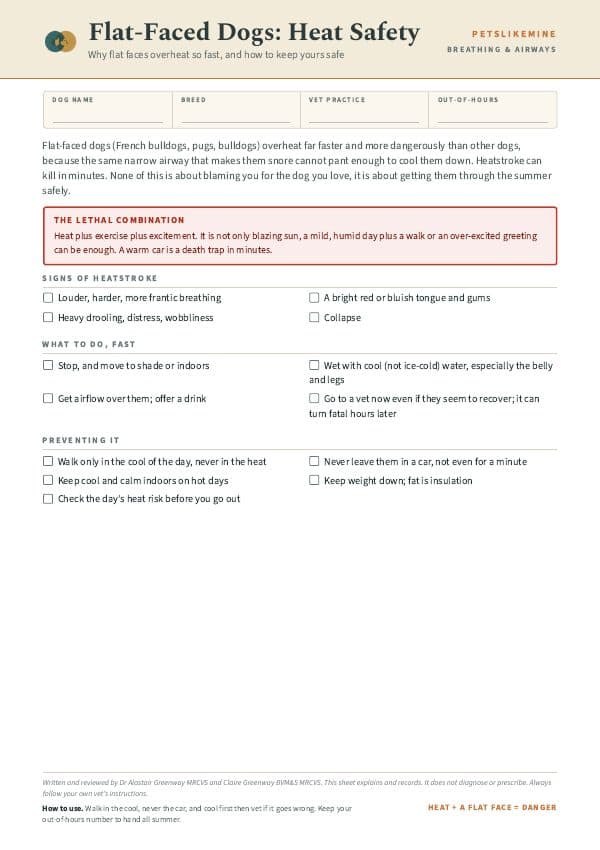
- Any flat-faced dog that is overheating and in distress. A brachycephalic airway can't pant efficiently to cool down, so heat, exercise and excitement together are a dangerous combination, and these dogs can overheat on a mild, humid day rather than only in a hot car. Across UK dogs, heat-related illness is far more often triggered by exertion than by parked vehicles, with around three-quarters of cases linked to activity (Hall et al., 2020), and changes in breathing are the most common feature when it happens (Hall et al., 2021). The full prevention and first-aid plan, including the cool-first-then-vet rule that genuinely saves lives, lives in flat-faced dogs and heatstroke, and it's worth reading before the weather turns.
Not sure which box a given moment falls into? Our breathing triage tool walks you through it in a few questions and tells you whether this is an emergency, a same-day call, or something to book at leisure. And the one-page flat-faced heat-safety guide is worth printing for the fridge before summer.
How vets put a number on it
If the recognise-it list rang a few bells but nothing's an emergency, the next sensible step is to find out how affected your dog actually is, because "a bit noisy" and "significantly obstructed" need different plans. Vets do this with the Respiratory Function Grading Scheme, run jointly by the Kennel Club and the University of Cambridge. A specially trained vet listens to your dog's breathing at rest, then again after a short lead-walk or trot of about three minutes, and grades the result from 0, meaning clinically unaffected with no signs of BOAS, up to 3, meaning clinically affected with severe signs (Royal Kennel Club, n.d.; University of Cambridge BOAS Research Group, n.d.). The scheme formally assesses bulldogs, French bulldogs and pugs, and is becoming a fixture of responsible breeding and showing (Royal Kennel Club, n.d.).
That objective grade is genuinely useful: it sorts mild from severe, guides whether to intervene, and gives you a baseline to track over time. I won't run through the protocol here because grading at home and what each grade means covers it properly, and our BOAS self-assessment gives you an indicative version, a guided walk test plus a recovery breathing-rate check, that you can do at home before booking the real thing. Think of the home check as a useful pointer, not the official score.
The hopeful part, and what helps most
I've been frank about the risk, so let me give the good news its due, because there's a lot of it. A great deal can be done for these dogs, and much of the highest-yield help is in your hands rather than the surgeon's.
The single biggest lever you control is keeping your dog lean. The evidence here is solid: BOAS risk rises with a thicker neck girth, and being overweight makes the obstruction measurably worse (Packer et al., 2015), and excess weight also appears to worsen the broken, sleep-disordered breathing many of these dogs have at night (Niinikoski et al., 2024). Excess weight crowds an already-crowded airway, so trimming it back is the most powerful day-to-day thing most owners can do, and it costs nothing. I say that without a shred of judgement, because keeping a food-motivated, exercise-limited flat-faced dog slim is genuinely hard, and it's worth getting help with from your vet or our Weight Management space.
Two more daily changes earn their place. Walk your dog on a harness, not a collar, so nothing presses straight onto an already-narrow windpipe. And in warm weather, keep them cool, calm and rested, and pick the cool ends of the day for activity. None of this is dramatic, but together it takes real load off the airway. The everyday-management bundle goes deeper on all of it.
And for dogs that are genuinely struggling, surgery is a real option, not a last resort. For many graded, symptomatic dogs it meaningfully improves breathing and quality of life, and earlier tends to work better than waiting until secondary changes have set in (Cornell Riney Canine Health Center, n.d.). It isn't a magic fix and it isn't right for every dog, which is exactly why it deserves a careful, candid weighing rather than a paragraph here. The surgery decision guide lays out who benefits, what it can and can't change, the recovery and the realistic UK cost, so you can make that call with your vet rather than for them.
So where does this leave you, tonight, with the dog snoring beside you? Not at the edge of a cliff. You've done the hard part already, which is hearing the breathing instead of tuning it out. The kind next step is small: spend a week watching how your dog breathes at rest and how fast they recover after a gentle potter, try the home BOAS check, and book a grading or a vet visit if the recognise-it list fits.
References
- Cornell University College of Veterinary Medicine, Riney Canine Health Center. (n.d.). Brachycephalic Obstructive Airway Syndrome (BOAS). Retrieved June 2026, from
- Hall, E. J., Carter, A. J., & O'Neill, D. G. (2020). Dogs Don't Die Just in Hot Cars: Exertional Heat-Related Illness (Heatstroke) Is a Greater Threat to UK Dogs. Animals, 10(8), 1324.
- Hall, E. J., Carter, A. J., Bradbury, J., Barfield, D., & O'Neill, D. G. (2021). Proposing the VetCompass clinical grading tool for heat-related illness in dogs. Scientific Reports, 11, 6828.
- Merck Veterinary Manual. (n.d.). Clinical Signs of Respiratory Disease in Animals. Retrieved June 2026, from
- Niinikoski, I., Himanen, S.-L., Tenhunen, M., Lilja-Maula, L., & Rajamäki, M. M. (2024). Evaluation of risk factors for sleep-disordered breathing in dogs. Journal of Veterinary Internal Medicine, 38(2), 1135-1145.
- O'Neill, D. G., Jackson, C., Guy, J. H., Church, D. B., McGreevy, P. D., Thomson, P. C., & Brodbelt, D. C. (2015). Epidemiological associations between brachycephaly and upper respiratory tract disorders in dogs attending veterinary practices in England. Canine Genetics and Epidemiology, 2, 10.
- O'Neill, D. G., Packer, R. M. A., Francis, P., Church, D. B., Brodbelt, D. C., & Pegram, C. (2021). French Bulldogs differ to other dogs in the UK in propensity for many common disorders: a VetCompass study. Canine Medicine and Genetics, 8, 13.
- O'Neill, D. G., Sahota, J., Brodbelt, D. C., Church, D. B., Packer, R. M. A., & Pegram, C. (2022). Health of Pug dogs in the UK: disorder predispositions and protections. Canine Medicine and Genetics, 9, 4.
- Packer, R. M. A., Hendricks, A., & Burn, C. C. (2012). Do dog owners perceive the clinical signs related to conformational inherited disorders as 'normal' for the breed? A potential constraint to improving canine welfare. Animal Welfare, 21(S1), 81-93.
- Packer, R. M. A., Hendricks, A., Tivers, M. S., & Burn, C. C. (2015). Impact of Facial Conformation on Canine Health: Brachycephalic Obstructive Airway Syndrome. PLOS ONE, 10(10), e0137496.
- Royal Kennel Club & University of Cambridge. (n.d.). Respiratory Function Grading Scheme (RFGS). Retrieved June 2026, from
- Royal Veterinary College. (2024). New research from the RVC identifies impact of owner perceptions on brachycephalic dog welfare reforms. RVC Animal Welfare Science and Ethics news. Retrieved June 2026, from
- University of Cambridge, Department of Veterinary Medicine, BOAS Research Group. (n.d.). BOAS Functional Grading Scheme: Resources. Retrieved June 2026, from
Free downloads
Companion worksheets to put what you've read into practice. Free PDFs, print at home.
Keep track of how your pet is doing
The owners who cope best are the ones who notice changes early. A simple health log shows you what is working, and what is not, before the next vet visit.
Start tracking, freeYou're not doing this alone
Compare treatment journeys and talk to owners managing breathing & airways. Free to join.
Join PetsLikeMine