

BOAS Surgery: Should We Operate, or Not?
Alastair Greenway
BVM&S MRCVS
Operate, or not. That is the question this piece is built around, and it's one of the harder ones in flat-faced medicine. Maybe your vet raised surgery after listening to your dog breathe, or maybe you've watched your Frenchie snore through the night and snuffle through every walk and gone looking yourself. Either way it's a big, irreversible, expensive call, and it deserves a clear way of thinking rather than a gut lurch.
So let me take the weight off straight away. There is rarely a single right answer here, and there is more than one road to a good life: surgery genuinely helps a lot of dogs, and some do very well without it. My job isn't to tell you what to do, because I can't put my hands on your dog's airway from here. It's to give you a clear way to think about it, so that when you sit down with your vet or a surgeon you're an informed partner rather than a frightened passenger. This piece stays focused on the single biggest question, operate or not. If you want the anatomy of brachycephalic obstructive airway syndrome (BOAS) and why it tends to worsen over time, that lives in BOAS explained.
What surgery actually does
Here is the frame I want you to hold, because a lot of online advice goes soft exactly here. Surgery for BOAS is, for most dogs, a real and lasting improvement. It is not, for most dogs, a complete cure.
We have good evidence for both halves of that. In the largest UK referral series to follow dogs objectively over the long term, the improvements in airway function measured shortly after surgery were still there years later: at a median of around four and a half years no dog had slipped back to a severe grade, 94% of owners felt surgery had improved their dog's quality of life, and 97% said they would recommend it (Johnson et al., 2026). Let that reassure you. The full picture matters more than the reassurance, though: in that same group, only 55% of owners believed their dog no longer had any breathing problem at all, and 39% felt some breathing issue had persisted (Johnson et al., 2026). Other series agree, with objective airway scores falling substantially after surgery while many dogs remain at least mildly affected (Liu et al., 2017a). So the truthful headline is a real, durable improvement for most, and a full cure for a minority. What you're realistically buying is a dog that breathes more easily, copes better, and is far less likely to deteriorate, which for most families is exactly what they were hoping for.
What surgery can fix, and what it can't
BOAS surgery doesn't treat the breed. It targets specific physical blockages, one at a time, and usually does three things. A wedge of tissue is removed to open up the pinched nostrils, the stenotic nares (Cornell University, n.d.). The over-long soft palate, the flap at the back of the throat that partly curtains the airway, is shortened or thinned, a procedure your surgeon may call a staphylectomy or a folded-flap palatoplasty (Wallace, 2024). And if the little pouches in the voice box have been sucked inside-out by years of effort, the everted laryngeal saccules, those are trimmed away (Wallace, 2024). Where a dog's tonsils are enlarged or themselves everted, some surgeons remove those in the same anaesthetic too (Merck Veterinary Manual, n.d.). These are the parts surgery can genuinely change.
What it can't change matters just as much. Surgery cannot reshape the skull, and it cannot fix a windpipe that is congenitally too narrow, a hypoplastic trachea, for which there is no surgical correction (Cornell University, n.d.). And one late change shifts the whole picture: advanced laryngeal collapse, where the cartilages of the voice box themselves give way after years of strain. A dog at that stage has a less favourable outlook with or without surgery (Cornell University, n.d.), and in the Cambridge data laryngeal collapse was the single strongest predictor of a poorer surgical result, raising the odds of a worse outcome roughly six-fold (Liu et al., 2017a). That is why vets lean towards acting before the airway fails. How that collapse develops is covered in BOAS explained.
Who benefits, and the truth about timing
You will read everywhere that earlier surgery is better, and as general guidance that's sound. Cornell and the major manuals advise that the prognosis is best in younger dogs, with better outcomes in dogs operated under two years of age, the logic being that relieving the obstruction sooner may slow the slide towards laryngeal collapse (Cornell University, n.d.; Merck Veterinary Manual, n.d.). That is the mainstream view, and I broadly hold it. There is a wrinkle, though: in one Cambridge study of fifty graded dogs, younger age at surgery was actually linked with a slightly worse measured outcome (Liu et al., 2017a), almost certainly because the youngest dogs sent to a specialist centre tend to be the most severely affected to begin with, so it's their severity, not their youth, driving the result. The takeaway isn't a precise operate-by-such-an-age rule, because no clean rule exists. It's a principle: a clearly affected dog generally does better operated before secondary laryngeal collapse sets in, and the call on exact timing belongs with the surgeon who has assessed your dog.
There is also a sharper timing argument, and this one isn't subtle. Operating electively is far safer than operating on a dog already in a breathing crisis: the risk of respiratory complications is roughly thirty times higher when surgery is done in emergency distress than electively (Wallace, 2024). That single number is the strongest reason to make this decision calmly, on your own timeline, rather than in the back of a car on the hottest day of the year. It is also why deciding before a heat-related emergency, rather than after one, can matter so much, an angle covered fully in flat-faced dog heatstroke.
The risks, told straight
No surgery conversation should skip the risks. Flat-faced dogs carry a higher anaesthetic risk than other dogs, full stop: in one matched study, complications after anaesthesia occurred in around 14% of brachycephalic dogs against under 4% of similar non-brachycephalic dogs (Gruenheid et al., 2018). That is precisely why these cases belong with a team experienced in brachycephalic airways and watchful recovery, not treated as routine. The most important window is the first day or two afterwards, when airway swelling can briefly make the breathing worse before it gets better, occasionally enough to need a temporary tracheostomy, a small breathing tube placed in the windpipe while things settle, with the swelling usually easing within two to three days (Wallace, 2024). The commonest serious complications are upper-airway obstruction and aspiration pneumonia, which across studies can affect up to around a quarter of dogs (Wallace, 2024).
Now the counterweight, because that list reads more frightening than the real-world odds. In large series the chance of a dog dying around the time of surgery is low: one study of 423 dogs reported an overall mortality of 2.6%, alongside owner satisfaction of 97% and improved breathing in about 72% (Carabalona et al., 2022). The risk of death did climb with age, by close to 30% for each additional year (Carabalona et al., 2022), another quiet nudge towards not putting the decision off indefinitely in a dog who needs it. I'm keeping the week-by-week recovery brief here because it has its own home: the swelling window, the home care and the recovery red flags are all in BOAS surgery recovery.
The lever that changes the maths: weight
If one thing within your gift improves both halves of this decision, it's getting your dog to a lean weight, and I'll say this warmly, because no owner needs shaming over it.
Excess weight worsens BOAS itself, and it worsens the anaesthetic risk too. In the anaesthesia data, the odds of a complication fell by about 2% for every extra kilogram of lean body weight (Gruenheid et al., 2018), the researchers' way of saying that heavier-but-leaner dogs did better, so the problem is the fat, not the size. Body condition has also been flagged as a risk factor for BOAS severity itself in the Cambridge conformation work (Liu et al., 2017b). The upshot is hopeful: bringing a dog to a trim weight before surgery makes the anaesthetic safer and the breathing better on the day, and for a mild dog it can be enough on its own to tip the balance away from the operating table. The daily how-to sits with the everyday playbook in living with a brachycephalic dog, and the deeper weight-loss programme with the Weight Management home.
When watching and managing is the right call
Here is the half of this decision the surgery pages tend to skip: not every flat-faced dog needs an operation. For a dog with mild or only occasional signs, conservative management is a legitimate path: keep them lean, walk them in a harness rather than a collar, steer well clear of heat and over-exertion, and keep daily life calm (Cornell University, n.d.; Merck Veterinary Manual, n.d.). The milder the dog, the more reasonable this is, and choosing it isn't doing nothing. It's medicine. But it isn't a decision you make once and forget: BOAS can progress, so the deal with the conservative route is that you keep watching, and worsening noise, effort or exercise tolerance earns a fresh assessment. The flip side holds too: a moderately or severely affected dog, the grade 2 or grade 3 dog, usually does better with surgery, and managing that dog conservatively is a much harder case to make.
How do you know which kind of dog you have? That brings us to grading.
Grading drives the decision
The decision is anchored on a formal grade. The Respiratory Function Grading Scheme (RFGS), run jointly by the Royal Kennel Club and the University of Cambridge, scores a dog from 0 to 3 after a three-minute brisk exercise test carried out by a specially trained vet (Royal Kennel Club & University of Cambridge, n.d.). Broadly, a grade 0 to 1 dog is clinically unaffected and is generally managed and monitored, while a grade 2 to 3 dog is clinically affected and is the one for whom surgery is most clearly on the table (Royal Kennel Club & University of Cambridge, n.d.). The one thing you can't do is generate that official number yourself at home, because it needs the trained assessor and the exercise test.
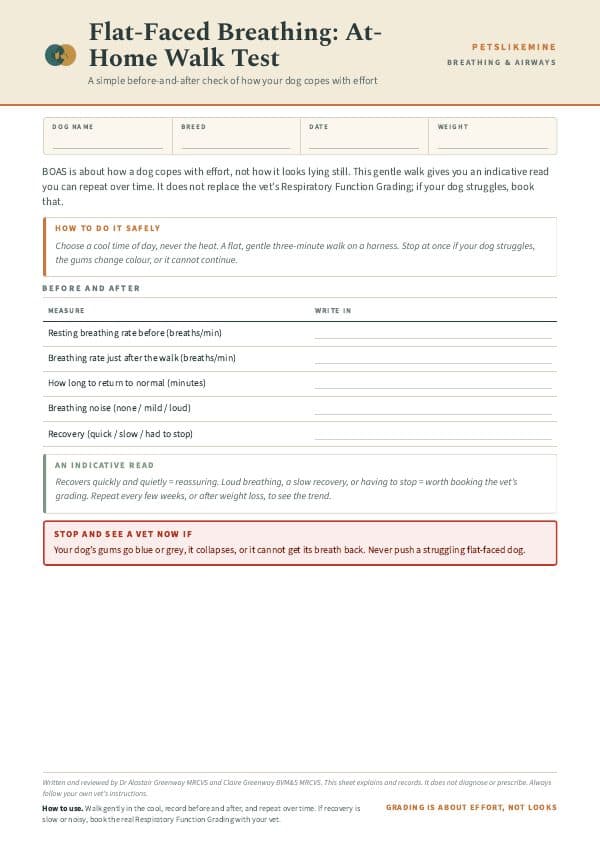
What you can do is get an indicative read on where your dog probably sits, using our BOAS self-assessment, a guided walk test plus a recovery breathing-rate check, and the printable BOAS walk-test score sheet to take with you. The full meaning of each grade and the at-home check lives in BOAS grading at home. For this decision, just hold the grade as the single most useful input: it sorts the manage-and-watch dogs from the ones for whom surgery is worth a serious discussion.
What it costs in the UK
Cost is a real and legitimate part of this, not a moral failing, so let me give you realistic numbers and be clear they're estimates.
A practical UK figure for BOAS surgery is roughly £2,000 to £3,000, varying by how much needs doing and by the centre (triangulated from UK practice pricing, 2026). The genuine spread is wider than that headline: some first-opinion practices offer fixed surgical packages from around £1,000, while fuller referral packages can reach £3,000 or more (triangulated from UK practice pricing, 2026). A sedated airway exam or CT scan is often advised first to see exactly what needs doing, which adds to the bill but means the operation is planned rather than guessed. Whatever figure you're quoted, check whether your insurance covers it, and read the small print on pre-existing-condition exclusions, since a dog already showing signs may find this counted against it.
The questions to take to the surgeon
So how do you arrive at a decision with confidence rather than dread? You go to the consultation armed, and you ask. A good surgeon will welcome every one of these. Which components does my dog actually need doing, nostrils, palate, saccules, and on what assessment, a sedated exam, a CT, a formal grade? Is there any sign of laryngeal collapse, given how much that changes the outlook? How experienced is your team specifically with brachycephalic anaesthesia and recovery, and what's the plan for that critical first day or two? What realistic improvement should I expect, and what will still need managing afterwards? And what is the all-in cost, including any imaging?
Those questions turn a frightening, abstract choice into a concrete conversation about your dog. Whichever way it lands, surgery now or watchful management with a fresh look if things change, you'll be deciding from understanding rather than fear. If you do go ahead, the next part of the road is already mapped in BOAS surgery recovery, and the daily, lifelong levers, the harness, the lean weight, the cool, are in living with a brachycephalic dog.
References
- Carabalona, J. P. R., Le Boedec, K., & Poncet, C. M. (2022). Complications, prognostic factors, and long-term outcomes for dogs with brachycephalic obstructive airway syndrome that underwent H-pharyngoplasty and ala-vestibuloplasty: 423 cases (2011-2017). Journal of the American Veterinary Medical Association, 260(S1), S65-S73.
- Cornell University College of Veterinary Medicine, Riney Canine Health Center. (n.d.). Brachycephalic Obstructive Airway Syndrome (BOAS). Retrieved June 2026 from
- Gruenheid, M., Aarnes, T. K., McLoughlin, M. A., Simpson, E. M., Mathys, D. A., Mollenkopf, D. F., & Wittum, T. E. (2018). Risk of anesthesia-related complications in brachycephalic dogs. Journal of the American Veterinary Medical Association, 253(3), 301-306.
- Johnson, D. A., Liu, N-C., & Ladlow, J. F. (2026). Comparison of short- and long-term objective respiratory outcomes after surgery for brachycephalic obstructive airway syndrome. Veterinary Surgery, 55(1), 59-68.
- Liu, N-C., Oechtering, G. U., Adams, V. J., Kalmar, L., Sargan, D. R., & Ladlow, J. F. (2017a). Outcomes and prognostic factors of surgical treatments for brachycephalic obstructive airway syndrome in 3 breeds. Veterinary Surgery, 46(2), 271-280.
- Liu, N-C., Troconis, E. L., Kalmar, L., Price, D. J., Wright, H. E., Adams, V. J., Sargan, D. R., & Ladlow, J. F. (2017b). Conformational risk factors of brachycephalic obstructive airway syndrome (BOAS) in pugs, French bulldogs, and bulldogs. PLOS ONE, 12(8), e0181928.
- Merck Veterinary Manual. (n.d.). Brachycephalic Airway Syndrome in Dogs. Retrieved June 2026 from
- Royal Kennel Club & University of Cambridge. (n.d.). Respiratory Function Grading Scheme (RFGS). Retrieved June 2026 from and https://www.vet.cam.ac.uk/boas/resources-1
- Wallace, M. L. (2024). Surgical management of brachycephalic obstructive airway syndrome: An update on options and outcomes. Veterinary Surgery, 53(7), 1173-1184. (companion practitioner guide: Today's Veterinary Practice, 2026, https://todaysveterinarypractice.com/soft-tissue-surgery/guide-to-brachycephalic-obstructive-airway-syndrome-surgery/)
Free downloads
Companion worksheets to put what you've read into practice. Free PDFs, print at home.
Keep track of how your pet is doing
The owners who cope best are the ones who notice changes early. A simple health log shows you what is working, and what is not, before the next vet visit.
Start tracking, freeYou're not doing this alone
Compare treatment journeys and talk to owners managing breathing & airways. Free to join.
Join PetsLikeMine