

How Bad Is My Dog's BOAS? Grading Explained, and What You Can Check at Home
Alastair Greenway
BVM&S MRCVS
The snoring, the snorting and the way your Frenchie flops down after a short walk aren't "just the breed", and the penny has dropped: this is effort, your dog working harder to breathe than they should have to. The first question is settled. The harder one is what brings you here now. How bad is it, and is there anything you can check yourself?
That's a good instinct. I'll explain how vets actually grade brachycephalic obstructive airway syndrome, what the grades mean for what happens next, and what you genuinely can and can't tell at home. I'll be straight throughout, because there's a lot of confident nonsense online about "rating your dog's breathing" from a video, and the real picture is more useful than the tidy one. If you're still on the earlier question, whether this is a problem at all, my guide to whether a flat-faced dog's breathing is normal or dangerous is the better front door, and it carries the full red-flag list. This article assumes you already suspect something and want to know how far along it is.
Why bother grading at all
A grade sorts mild from severe, and it earns its keep three ways. It tells you and your vet whether to act or watch. It gives you a baseline, so if things change over the next year or two you'll know rather than guess. And it turns a vague worry into a plan, because the management genuinely splits by severity: a dog at the milder end is usually managed with monitoring and rechecks, keeping the weight off and the heat at bay, while a dog at the more affected end is where weight loss and, for many, surgery enter the conversation (The Royal Kennel Club & University of Cambridge, n.d.; The Kennel Club, 2024). I'll hand the whole operate-or-not question to the dedicated guide on the BOAS surgery decision, because it deserves the room. The point for now is that the grade is the fork in the road.
The official grade: the Respiratory Function Grading Scheme
In the UK the proper grade comes from the Respiratory Function Grading Scheme, or RFGS, run jointly by the Royal Kennel Club and the University of Cambridge. It runs from grade 0 to grade 3 (The Royal Kennel Club & University of Cambridge, n.d.).
- Grade 0 means clinically unaffected: free of the respiratory signs of BOAS.
- Grade 1 means clinically unaffected but with some respiratory noise, the kind that's audible but isn't yet costing the dog on exercise.
- Grade 2 means clinically affected with moderate signs that should be monitored and managed.
- Grade 3 means clinically affected with severe signs, and at this grade breeding is not recommended (The Royal Kennel Club & University of Cambridge, n.d.).
Now the part that catches owners out: the grade is not assigned from watching the dog lie on the table. It's assigned by a specially trained vet who listens to the larynx with a stethoscope, both before and immediately after a standardised burst of exercise, a three-minute trot at a quick pace (The Royal Kennel Club & University of Cambridge, n.d.; Riggs et al., 2019). The exercise is the whole point: many affected dogs sound almost normal sitting still and only show their true colours once they've been made to work.
We're not guessing about how much that matters. When researchers validated the test against an objective laboratory measure, the sensitivity of a clinical examination for picking up moderate-to-severe BOAS climbed from 56.7% at rest, to 70% after a five-minute walk, to 93.3% after a three-minute trot (Riggs et al., 2019). Examined at rest, the exam missed almost half of the affected dogs. Worked properly first, it caught nearly all of them. In the same study a high-pitched in-breath noise heard after exercise, stridor, was 100% specific for laryngeal collapse, so when the assessor hears it after the trot it reliably points to the larynx, the more serious end of the disease (Riggs et al., 2019). That is the evidence: you cannot grade this from the sofa.
The scheme covers a defined set of seventeen breeds, with pugs, French bulldogs and bulldogs at the core. A dog can be assessed from twelve months of age, the assessment repeats about every two years, and the cost is modest: a £5 Royal Kennel Club admin fee on top of the assessing vet's charge (The Royal Kennel Club & University of Cambridge, n.d.). A small outlay for a proper baseline, and worth knowing it exists, because a lot of owners never hear about it. The grade is also meaningful well beyond those original three breeds: functional grading has now been characterised across as many as fourteen brachycephalic breeds, with Pekingese and Japanese Chin sitting in the same high-risk tier as pugs, French bulldogs and bulldogs, while some breeds, such as the Maltese and Pomeranian, showed no clinically significant disease (Tomlinson et al., 2026).
One footnote for the curious. That clinical 0-to-3 grade is a proxy for an objective laboratory measurement, whole-body barometric plethysmography, which reads the dog's breathing in a sealed chamber and produces a BOAS Index from 0 to 100%, with a validated cut-off of 0.46 separating the functionally unaffected (grades 0 and 1) from the affected (grades 2 and 3) (Liu et al., 2015; Riggs et al., 2019). You'll almost never be offered that number outside research. I mention it only so you know the grade is anchored to something measurable, not plucked from thin air.
Learning the noise: stertor versus stridor
If there's one piece of vocabulary worth taking away, it's the difference between two breathing noises, because it maps roughly onto how worried to be.
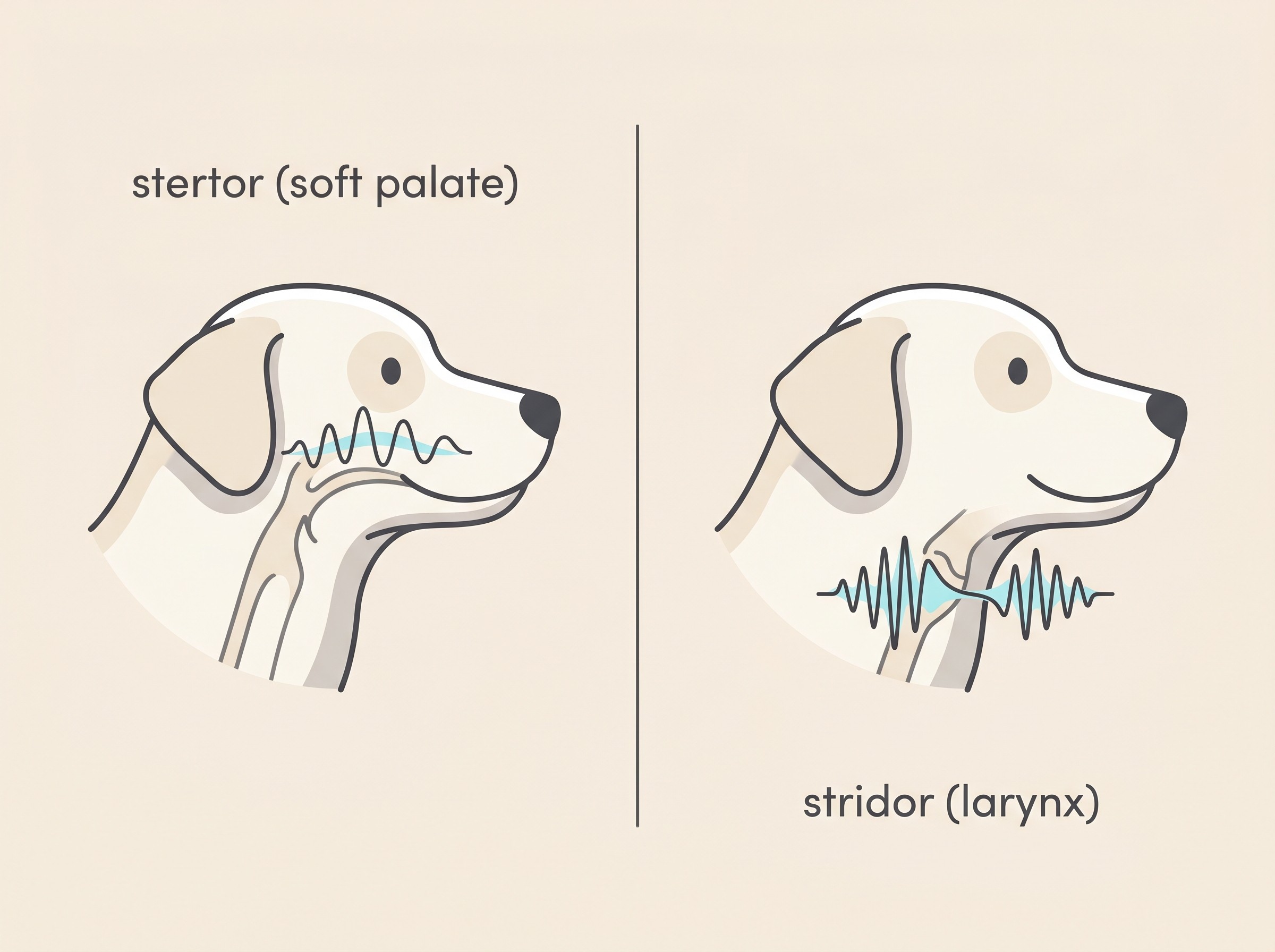
Stertor is a low-pitched snoring or snuffling sound, made by the soft tissue at the back of the nose and throat, the soft palate and pharynx, vibrating as air squeezes past (MSD/Merck Veterinary Manual, n.d.; Cambridge BOAS Research Group, n.d.). Most flat-faced dogs make some. It's the classic snore.
Stridor is more telling. It's a higher-pitched noise, usually on the in-breath, closer to a wheeze than a snore, and it signals that the larynx, the voice box, is involved (MSD/Merck Veterinary Manual, n.d.; Cambridge BOAS Research Group, n.d.). Laryngeal involvement is the more worrying end of the spectrum, and it's exactly the post-exercise stridor the trained assessor listens for. You can learn to tell the two apart with a little attention: the snore-like rumble of stertor versus the higher, harder, almost wheezy catch of stridor on breathing in. I won't unpack why these noises happen, because the BOAS explained guide owns the full mechanism. For grading, knowing that a high in-breath noise matters more than a low snore is enough.
What you genuinely can check at home
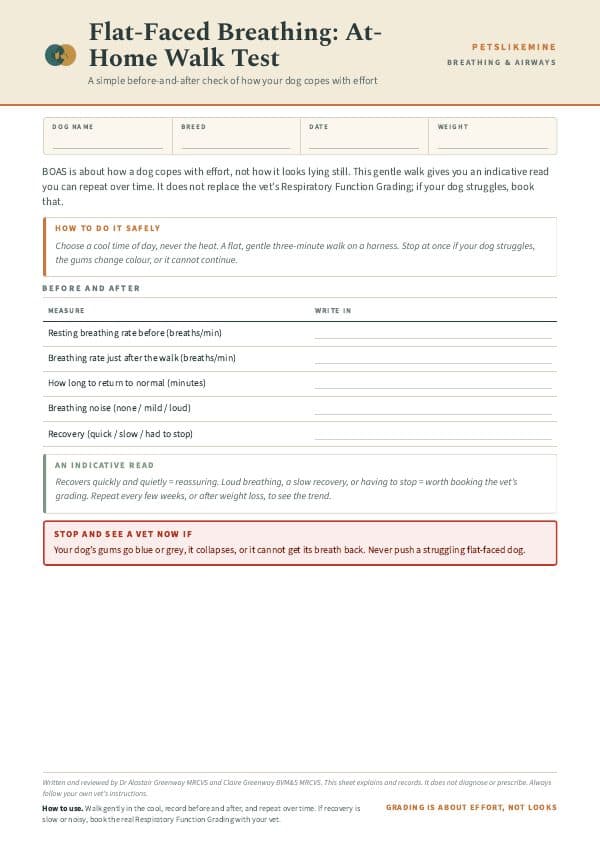
Now the bit you came for. You can't assign the official grade, and I'll explain why not in a moment, but you can do something genuinely useful that beats going on gut feeling. The home check works like the real one, in miniature: it watches how your dog copes with, and recovers from, gentle exercise, rather than taking a single snapshot at rest (Aromaa et al., 2019; Riggs et al., 2019).
In practice, pay structured attention to three things across a short, gentle walk. The noise: does it get louder as they go, and is it a low snore or a higher catch on the in-breath? The effort: are they slowing, stopping, pulling to lie down, gagging, or trying to breathe with their mouth wide open and elbows pushed out? And the recovery: once you stop, how long does the breathing take to settle back to easy and quiet? A dog who recovers in a minute or two is a very different picture from one still labouring ten minutes later. Do the walk in the cool of the day and keep it gentle. The point is to reveal effort, never to push a struggling dog, and if your dog is already labouring before you start, or the weather is warm, this is a day to skip the test and call your vet instead, because heat and exertion together are genuinely dangerous for a flat-faced dog, as the guide to flat-faced dog heatstroke explains.
This is exactly what our BOAS self-assessment tool walks you through: a guided gentle walk test paired with a recovery breathing rate, giving an RFGS-indicative result and, importantly, telling you when what you've seen warrants booking the real thing. The recovery-rate part is easier than it sounds, because you needn't count by eye in the moment. Film a short clip of your dog's chest once you've stopped and let the Breath Camera count the breaths for you. There's also a printable BOAS walk-test score sheet if you'd rather track it on paper over a few weeks.
Why bother, when you could just "tell" how your dog is? Because the research says, plainly, that owners can't, and that's the single biggest reason an objective home check exists. In one study of clinically affected dogs, 58% of owners reported their dog did not have a breathing problem, despite frequent, severe signs (Packer et al., 2012). And in a cohort of young, breeding-age French bulldogs and pugs, only 4 of 95 owners felt their dog's breathing limited daily life, yet 31 of those 95 dogs had moderate-to-severe BOAS on examination, which is why the authors concluded a walk test reflects a dog's real exercise tolerance better than an owner's impression does (Aromaa et al., 2019). That gap between what loving owners see and what's really happening is not a failing on the owner's part. It's how gradual, lifelong, breed-wide effort hides in plain sight, and a structured walk test catches what the eye kindly files under "that's just how she is".
The real limit: indicative, not official
I promised to be straight, so here it is. The home check is genuinely useful, but it is indicative only and does not replace the real assessment.
We can put a number on how careful to be. When researchers compared remote grading, watching dogs over video, against in-person grading, the agreement was only poor-to-moderate, with Cohen's kappa between about 0.37 and 0.48 for experienced assessors and dropping as low as 0.21 for novices, and they concluded remote grades did not reach the reliability needed to stand in for an in-person score (Peng et al., 2025). And that is a trained assessor watching a video, still well ahead of you or me judging our own dog in the garden. So hold the home check as a smoke alarm, not a diagnosis: it flags concern and tells you it's time to book the proper test, where a vet can put a stethoscope on the larynx before and after a measured trot and hear what no camera can. If yours throws up anything beyond mild, a higher in-breath noise, effort that doesn't ease, a recovery that drags, that's your cue to arrange a real RFGS assessment rather than settle on a number yourself.
Acting on the grade
A proper grade tells you what to do next. Grades 0 and 1 sit in the monitoring camp: keep the weight lean, the heat and over-exertion managed, and recheck periodically to catch any drift. Grades 2 and 3 are where weight loss and, for suitable dogs, surgery enter the conversation properly (The Royal Kennel Club & University of Cambridge, n.d.; The Kennel Club, 2024; Cambridge BOAS Research Group, n.d.).
Weight deserves its own line, because it's the lever most within your control. Obesity is the single most common health problem recorded in pugs, affecting around 17% of them (O'Neill et al., 2022), and across fourteen brachycephalic breeds being overweight, a body condition score of six or more out of nine, carried roughly 1.8 times the odds of BOAS, alongside narrowed nostrils and a flatter face as the strongest structural predictors (Tomlinson et al., 2026). Narrowed nostrils in particular are a significant predictor in pugs, French bulldogs and bulldogs alike, and they happen to be the one airway change you can actually see from the outside (Liu et al., 2017). The upshot is hopeful: a graded dog also carrying extra weight has something concrete to pull on, before or alongside any surgery. I'll hand the how-to of daily life, the harness rather than the collar, the weight, the heat and the rest, to the guide on living with a brachycephalic dog, which owns those levers.
Severity really does track with breed, which is why these schemes exist. Pugs are around 54 times more likely to be affected than other dogs: in the largest UK data, BOAS was recorded in 6.6% of pugs against 0.1% of non-pugs (O'Neill et al., 2022), with French bulldogs and bulldogs at very high risk too. None of that is your fault if you already share your home with one of these dogs, and grading is simply the kind, clear-eyed thing to do, because you can't manage what you haven't measured. The breeding question, including the factual point that a grade 3 dog should not be bred from, belongs in the balanced pre-purchase guide, and I'll leave that debate there.
If you do one thing, let it be one careful walk test, done calmly and in the cool, ideally through the BOAS self-assessment. Not to put a label on your dog, but to see them clearly: how they sound, how hard they work, how quickly they recover. Whatever it shows, you'll walk into your vet able to say something far more useful than "he's always snored", and your dog will be the better for it.
References
- Aromaa, M., Lilja-Maula, L., & Rajamäki, M. M. (2019). Assessment of welfare and brachycephalic obstructive airway syndrome signs in young, breeding age French Bulldogs and Pugs, using owner questionnaire, physical examination and walk tests. Animal Welfare, 28(3), 287-298.
- Cambridge BOAS Research Group. (n.d.). Recognition & diagnosis; functional grading (exercise test). University of Cambridge, Department of Veterinary Medicine. Retrieved from
- The Kennel Club. (2024). Kennel Club marks five years of the breathing scheme and collaborates with CVS to engage more vets. Retrieved from
- Liu, N. C., Sargan, D. R., Adams, V. J., & Ladlow, J. F. (2015). Characterisation of brachycephalic obstructive airway syndrome in French bulldogs using whole-body barometric plethysmography. PLOS One, 10(6), e0130741.
- Liu, N. C., Troconis, E. L., Kalmar, L., Price, D. J., Wright, H. E., Adams, V. J., Sargan, D. R., & Ladlow, J. F. (2017). Conformational risk factors of brachycephalic obstructive airway syndrome (BOAS) in pugs, French bulldogs, and bulldogs. PLOS One, 12(8), e0181928.
- MSD/Merck Veterinary Manual. (n.d.). Stertor and stridor; brachycephalic obstructive airway syndrome in dogs and cats. Merck & Co. Retrieved from
- O'Neill, D. G., Sahota, J., Brodbelt, D. C., Church, D. B., Packer, R. M. A., & Pegram, C. (2022). Health of Pug dogs in the UK: disorder predispositions and protections. Canine Medicine and Genetics, 9, 4.
- Packer, R. M. A., Hendricks, A., & Burn, C. C. (2012). Do dog owners perceive the clinical signs related to conformational inherited disorders as 'normal' for the breed? A potential constraint to improving canine welfare. Animal Welfare, 21(S1), 81-93.
- Peng, Z. H., Ham, K. M., Ladlow, J., et al. (2025). Comparison of remote and in-person respiratory function grading of brachycephalic dogs. Veterinary Surgery, 54(3), 573-580.
- Riggs, J., Liu, N. C., Sutton, D. R., Sargan, D., & Ladlow, J. F. (2019). Validation of exercise testing and laryngeal auscultation for grading brachycephalic obstructive airway syndrome in pugs, French bulldogs, and English bulldogs by using whole-body barometric plethysmography. Veterinary Surgery, 48(4), 488-496.
- The Royal Kennel Club & University of Cambridge. (n.d.). Respiratory Function Grading Scheme (RFGS). Retrieved from
- Tomlinson, F., Liu, N. C., Sargan, D. R., & Ladlow, J. F. (2026). A cross-sectional study into the prevalence and conformational risk factors of BOAS across fourteen brachycephalic dog breeds. PLOS One, 21.
Free downloads
Companion worksheets to put what you've read into practice. Free PDFs, print at home.
Keep track of how your pet is doing
The owners who cope best are the ones who notice changes early. A simple health log shows you what is working, and what is not, before the next vet visit.
Start tracking, freeYou're not doing this alone
Compare treatment journeys and talk to owners managing breathing & airways. Free to join.
Join PetsLikeMine