

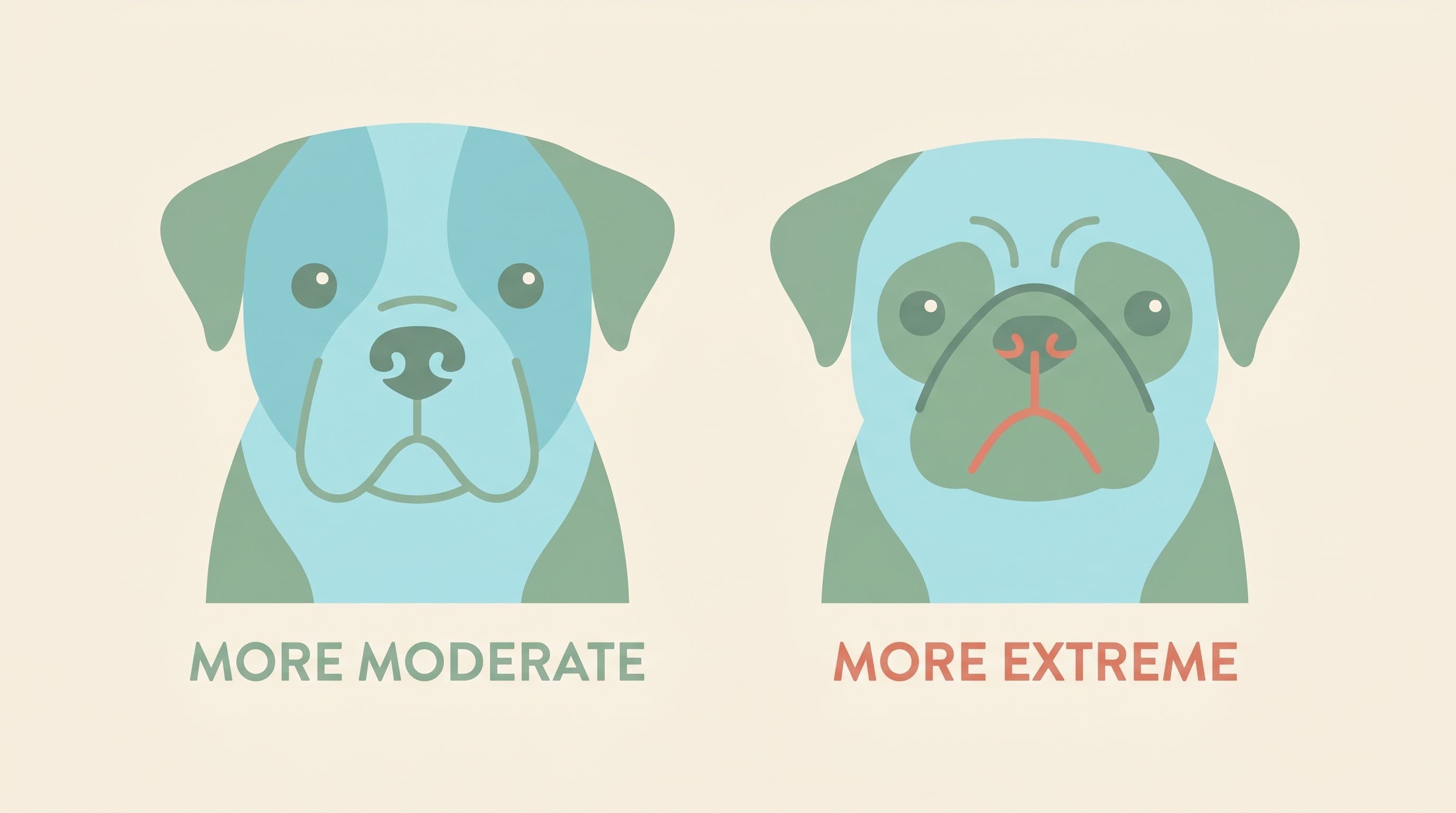
Thinking of Getting a Flat-Faced Dog? An Honest Guide
Alastair Greenway
BVM&S MRCVS
There's a reason these dogs are everywhere. A French bulldog tilting its head at you, a pug leaning its whole weight into your shins, a bulldog snoring like a small engine on the sofa: they are funny, affectionate, devoted little companions, and the people who love them love them fiercely. So let me be clear about something before I say anything else. This is not an article that tells you flat-faced dogs are a mistake, and it is absolutely not aimed at the people who already share their lives with one. If that's you, your dog is lucky to have someone reading up on it.
This page is for the person standing one step back, browsing litters or scrolling a breeder's page, wondering whether to bring one of these dogs home and how to do it well. And here both things are true at once: these are wonderful-natured dogs, and they are a group of breeds carrying real, well-documented breathing risk. Holding those two facts together, rather than picking the one that's more comfortable, is what matters. None of what follows is anti-dog or anti-owner. It's about giving the individual dog you choose the best possible chance at an easy, comfortable life.
The honest picture
The flat face that makes these breeds so appealing is the same feature that crowds their airway. I won't unpack the full anatomy here, because boas-explained does that properly: the short version is that a normal amount of soft tissue is packed into a shortened skull, so the nostrils, the soft palate and the throat all end up narrower than they were built to be. The result is brachycephalic obstructive airway syndrome, BOAS, and it ranges from a dog that snuffles a bit to a dog that genuinely struggles to move air.
Now to the numbers, plainly. When the BOAS research group at Cambridge ran objective breathing tests on the three core breeds, roughly half came out affected: 64.6% of pugs, 58.9% of French bulldogs and 51.2% of bulldogs (Liu et al., 2017). The RVC's VetCompass work, which mines the records of huge numbers of real UK dogs, puts hard odds on it. Pugs had around 54 times the odds of being diagnosed with BOAS compared with dogs that aren't pugs (O'Neill et al., 2022). French bulldogs had nearly 31 times the odds of BOAS and around 42 times the odds of stenotic, that is narrowed, nostrils compared with other dogs (O'Neill et al., 2021).
Read those figures the right way, though, because they cut in two directions. They tell you the risk is real and breed-wide, not a rare stroke of bad luck. But "about half affected" also means it is not every dog, and not every affected dog is severe. The point isn't doom. With this group of breeds you are loading the dice, and how you choose changes how heavily.
It goes beyond breathing, too, and this is the part prospective owners most often haven't heard. The same VetCompass studies looked at the breeds across the board. Pugs were 1.9 times as likely as other dogs to have one or more disorders in a single year and were at higher risk of 23 of the 40 commonest conditions studied, which led the authors to a striking conclusion: the pug "can no longer be considered a typical dog from a health perspective" (O'Neill et al., 2022). The French bulldog work reached a similar place, finding the breed at higher risk of 20 of 43 disorders and concluding it "has diverged substantially from" the wider dog population (O'Neill et al., 2021). The lead researcher, Dr Dan O'Neill, put the welfare case bluntly: "It is time now that we focus on the health of the dog rather than the whims of the owner when we are choosing what type of dog to own" (Royal Veterinary College, 2022). Hear that as a researcher making the case for the dogs, not as a stick to beat any owner with.
How long do they actually live?
You will see frightening lifespan figures attached to these breeds online, and here I have to be careful with you, because the real answer is more interesting than the scary one. UK life-table research did put French bulldog life expectancy at just 4.53 years, against an all-dog average of 11.23 years, with English bulldogs at 7.39 and pugs at 7.65 (Teng et al., 2022). On its own that looks devastating. But the same authors flagged a real problem with their own number. French bulldog registrations exploded over the study window, from 2,771 in 2011 to 39,266 in 2020, so their data was crowded with very young dogs whose deaths naturally land at young ages, and the authors caution that this popularity surge has biased the figure downward (Teng et al., 2022). Quoting "Frenchies live four years" as a flat fact, which plenty of pages do, reads far more into that single number than the researchers themselves do.
A larger, less popularity-skewed dataset gives a fuller picture. Looking at over half a million UK dogs, French and English bulldog median lifespan came out around 9.8 years and pugs around 11.6 (McMillan et al., 2024). So the precise number is genuinely debated. What is not debated is the direction. That same large study found flat-faced (brachycephalic) purebreds reaching the end of life faster than medium-skulled breeds, a median of about 11.2 years against 12.8, with roughly a 40% higher rate of death over the period (McMillan et al., 2024). The fair summary is that these breeds sit at the shorter, riskier end of the range, the exact figure is argued over, and the truthful version is less alarming than the scariest headline while still being a real consideration you should go in knowing.
What the vets are actually asking you to do
The official UK position is not "never buy one of these dogs". It's four words: "Stop and think before buying a flat-faced dog" (UK Brachycephalic Working Group, 2021). That phrase comes from the UK Brachycephalic Working Group, a partnership that pulls together the major UK veterinary and welfare bodies, the BVA, the Kennel Club, the RSPCA, Dogs Trust, the RVC and Cambridge among them, all working to reduce extreme conformation and increase health testing (UK Brachycephalic Working Group, 2022). The vet profession runs the same message through the BVA's #BreedtoBreathe campaign, which also notes, tellingly, that most owners of flat-faced dogs don't recognise their own pet's breed-related breathing problems (British Veterinary Association, n.d.). That last point is exactly why "stop and think" matters: the trouble is easy to mistake for personality.
On the law, let me be precise, because this gets overstated. There is no UK ban on breeding flat-faced dogs. Breeding sits under the Animal Welfare Act 2006 and the 2018 licensing regulations, and DEFRA has indicated that an offence could in principle arise where a breeder "knowingly selects and breeds animals with genetics leading to extreme conformations that cause pain, suffering or distress", but there have been no known prosecutions on that basis and the position has not been tested in court (UK Centre for Animal Law, 2023). Abroad, the direction of travel is visible: a 2022 Norwegian court case found the selective breeding of English bulldogs and Cavalier King Charles spaniels breached that country's animal welfare law, though on appeal the bulldog ruling was overturned as going too far while the Cavalier finding was upheld over a serious neurological condition (Eurogroup for Animals, 2022). Treat that as live debate and a sign of where things are heading, not as "it's illegal here". It isn't.
Loading the dice the other way
Here is the genuinely hopeful part, and it's where your choice does the most work. If you go ahead, the single most useful thing you can do is choose a breeder who has had both parents assessed under the Respiratory Function Grading Scheme, the RFGS, run jointly by the Kennel Club and the University of Cambridge. It's a short, non-invasive breathing test that grades a dog from 0 to 3, and it exists so breeding decisions can be made on how well a dog actually breathes rather than how it looks. The official advice is to breed only from graded dogs, and grade 3 dogs should not be bred from at all: the scheme is explicit, "We do not recommend that you breed from your dog", and it publishes a simple green and red matrix of which grade combinations are sensible and which are not (Royal Kennel Club, n.d.-a). I'll keep the grading detail light here because boas-grading-at-home walks through what the grades mean in full. For choosing a puppy, the thing to hold onto is simple: graded parents, good grades, and steer clear of the most extreme features. Both the pug and French bulldog research teams have called for breeding toward a more moderate shape (O'Neill et al., 2021; O'Neill et al., 2022), and that is the dog to look for.
Questions worth asking a breeder
This is the most practical thing you'll take from this page, so here it is as a checklist you can use word for word. The Kennel Club's own buyer guidance for flat-faced puppies sets out the core questions (Royal Kennel Club, n.d.-b):
- Have the mother and father ever had breathing difficulties, or been treated for any breathing problem? A straight question, and the answer, and how readily it's given, tells you a lot.
- Have both parents been tested under the Respiratory Function Grading Scheme, and what grades did they get? A serious breeder will know, and will show you. Vagueness here is itself an answer.
- Are there dental problems or overcrowded teeth in the line? Shortened jaws often mean crowded mouths.
- Are there skin problems, and how are they managed? Skin folds bring their own issues in these breeds.
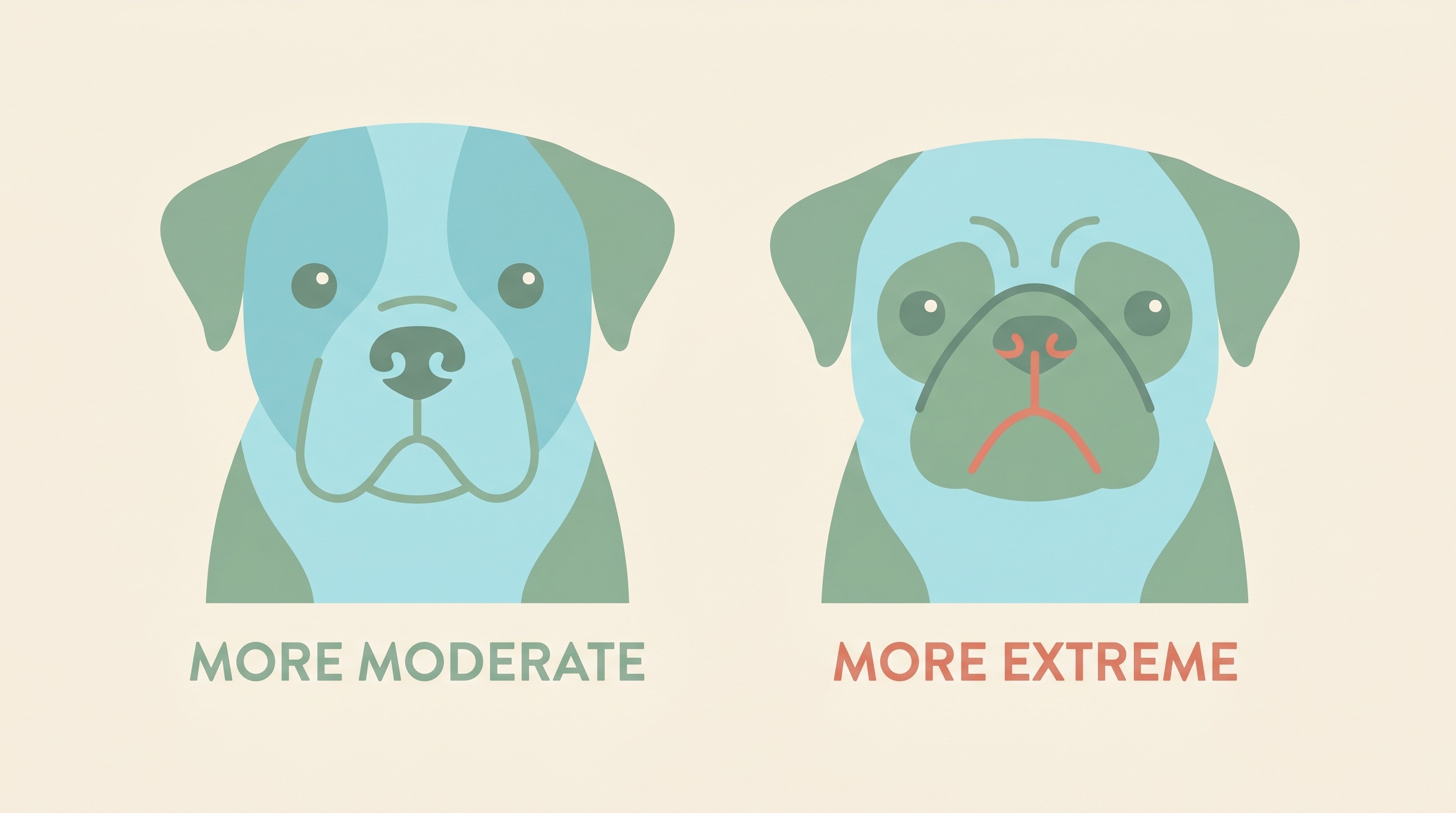
To that official list I'd add one steer of my own on the puppies and parents in front of you: look at the nostrils. You want them open, more of a kidney shape than a pinhole, not tightly pinched shut, which is the Kennel Club's own visual guide too (Royal Kennel Club, n.d.-b). A dog with a visible hint of muzzle and properly open nostrils is starting life with a real advantage over one bred for the flattest, most pinched face. If a breeder is reluctant to talk about any of this, or waves the health concerns away, that tells you exactly what you need to know, and the kind thing for the dog is to walk away.
If the health side gives you pause
Plenty of people arrive here loving the look and leave genuinely uneasy about the breathing, and that's a perfectly reasonable place to land. You have more than one good option, and none of them involves loving these dogs any less. You can give a home to a flat-faced dog already in rescue and in need of one, and breed-specific rescues exist for exactly this. You can deliberately choose a more moderate individual, one with a longer muzzle and open nostrils, over the most extreme in the litter. Or you can choose a different breed altogether and still admire the Frenchies you pass in the park.
If it helps to know you wouldn't be alone in shifting toward the more moderate end, here's a genuinely encouraging finding. When researchers showed the UK public images of less-extreme, typical and super-extreme versions of these breeds, people consistently preferred the less extreme shapes, longer muzzles and smaller eyes, and that held true even among current owners of flat-faced dogs (Youens et al., 2025). The taste for a kinder shape is already out there. It just needs acting on at the point of choosing.
You are part of the answer, not the problem
There is real momentum now. Across roughly a decade of the #BreedtoBreathe campaign and the Working Group's efforts, Kennel Club registrations of the core flat-faced breeds have fallen sharply, with the steepest drop in the last couple of years, and the people who watch these trends, including the Working Group's own chair, put it down to exactly this rising public awareness (VetTimes, 2025). Every prospective owner who asks the breathing questions, who insists on graded parents, who chooses the dog with the open nostrils and the bit of nose, is part of the reason that line is bending.
So if you do bring one of these dogs home, you'll want to keep an eye on its breathing as it grows: our boas-check self-assessment walks you through a simple at-home version of the kind of test the experts use, and it's a good way to understand what RFGS grading involves before you ever sit down with a breeder. And for the day-to-day, living-with-a-brachycephalic-dog covers keeping a flat-faced dog comfortable, while flat-faced-dog-breathing-normal-or-dangerous helps you tell ordinary snuffling from the sound of a dog working too hard. Choose well, go in with your eyes open, and the dog you bring home is a good outcome, for it and for the breed.
References
- British Veterinary Association. (n.d.). Brachycephalic dogs (#BreedtoBreathe). Retrieved from
- Eurogroup for Animals. (2022). Landmark ruling against unethical dog breeding in Norway. Retrieved from
- Liu, N.-C., Troconis, E. L., Kalmar, L., Price, D. J., Wright, H. E., Adams, V. J., Sargan, D. R., & Ladlow, J. F. (2017). Conformational risk factors of brachycephalic obstructive airway syndrome (BOAS) in pugs, French bulldogs, and bulldogs. PLoS ONE, 12(8), e0181928.
- McMillan, K. M., Bielby, J., Williams, C. L., Upjohn, M. M., Casey, R. A., & Christley, R. M. (2024). Longevity of companion dog breeds: those at risk from early death. Scientific Reports, 14, 531.
- O'Neill, D. G., Packer, R. M. A., Francis, P., Church, D. B., Brodbelt, D. C., & Pegram, C. (2021). French Bulldogs differ to other dogs in the UK in propensity for many common disorders: a VetCompass study. Canine Medicine and Genetics, 8, 13.
- O'Neill, D. G., Sahota, J., Brodbelt, D. C., Church, D. B., Packer, R. M. A., & Pegram, C. (2022). Health of Pug dogs in the UK: disorder predispositions and protections. Canine Medicine and Genetics, 9, 4.
- Royal Kennel Club. (n.d.-a). Respiratory Function Grading Scheme. Retrieved from
- Royal Kennel Club. (n.d.-b). Buying a flat-faced puppy. Retrieved from
- Royal Veterinary College. (2022). New research shows Pugs have high health risks and can no longer be considered a 'typical dog' from a health perspective. VetCompass. Retrieved from
- Teng, K. T., Brodbelt, D. C., Pegram, C., Church, D. B., & O'Neill, D. G. (2022). Life tables of annual life expectancy and mortality for companion dogs in the United Kingdom. Scientific Reports, 12, 6415.
- UK Brachycephalic Working Group. (2021). Stop and think before buying a flat-faced dog (consensus statement). Retrieved from
- UK Brachycephalic Working Group. (2022). UK BWG Strategy 2022-2025. Retrieved from
- UK Centre for Animal Law. (2023). Using the law to address harmful conformation in dogs: is a breed-specific breeding ban the answer? Retrieved from
- VetTimes. (2025). Is message finally hitting home? Registrations of brachycephalics including pugs and French bulldogs plummet. Retrieved from
- Youens, E., O'Neill, D. G., Belshaw, Z., Mochizuki, M., Neufuss, J., Tivers, M. S., & Packer, R. M. A. (2025). Beauty versus the beast: the UK public prefers less-extreme body shapes in brachycephalic (flat-faced) dog breeds. Veterinary Record.
Keep track of how your pet is doing
The owners who cope best are the ones who notice changes early. A simple health log shows you what is working, and what is not, before the next vet visit.
Start tracking, freeYou're not doing this alone
Compare treatment journeys and talk to owners managing breathing & airways. Free to join.
Join PetsLikeMine