

BOAS Explained: Why Your Flat-Faced Dog Struggles to Breathe
Alastair Greenway
BVM&S MRCVS
A pug, a French bulldog or an English bulldog comes with a soundtrack: the snore that fills the room, the snort coming back from a warm walk, the head propped up off the floor at night. It's easy to file all of that under "just the breed", and a lot of people do. I'd gently put it a different way. Most of those sounds are a dog working hard to do something that should be effortless, and understanding why is the kindest thing you can do for them.
This article is about the why. Not whether to operate, not how heat affects them, not how bad your particular dog is on a grading scale, those each have their own home and I'll point you to them. What I want to do here is open up the dog's airway and show you what's crowded, what's being dragged shut, and why the problem tends to feed itself. Once you can picture the mechanism, everything else about living with a flat-faced dog makes far more sense.
The short version: a normal amount of tissue in a shortened skull
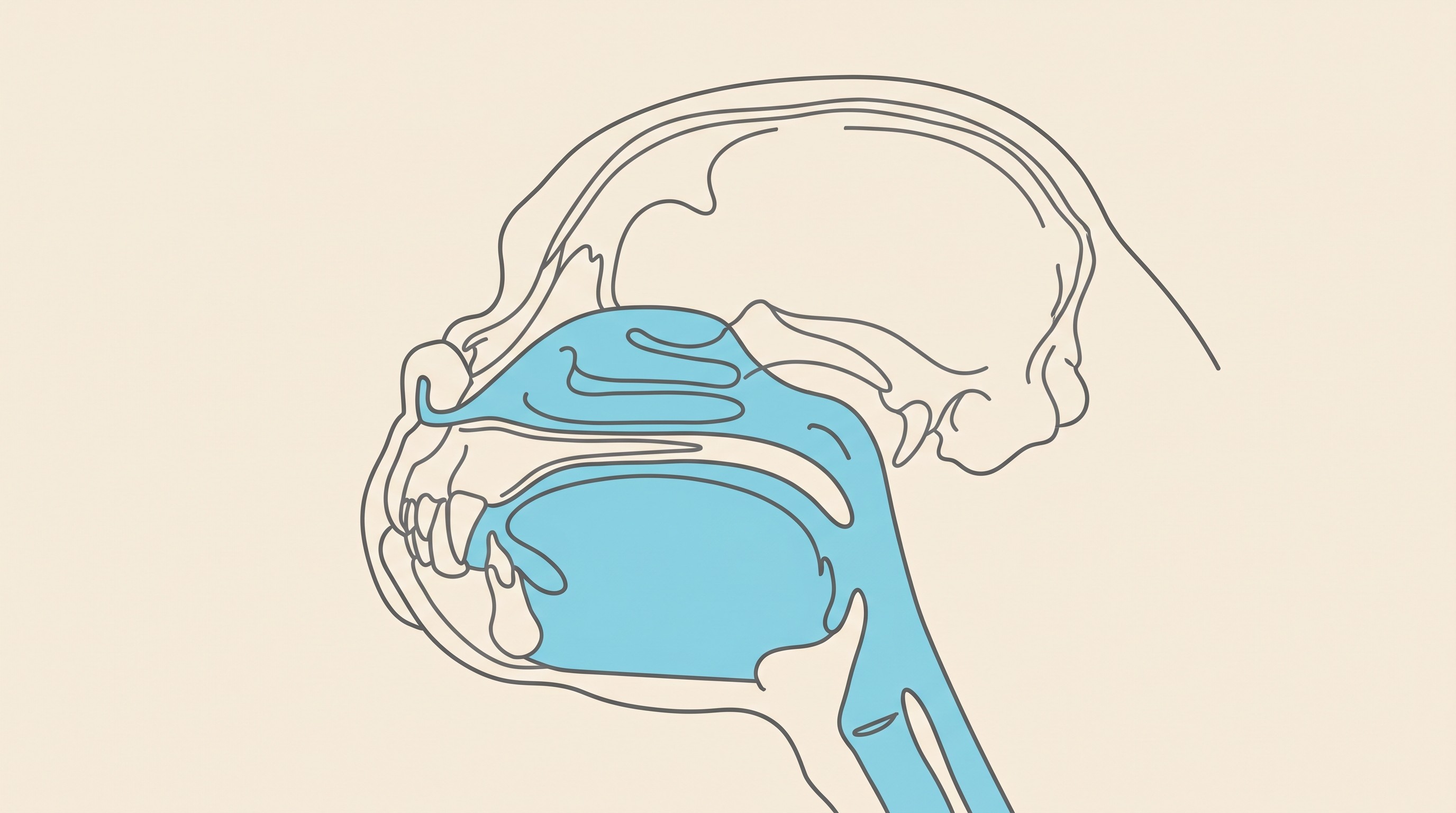
Brachycephalic obstructive airway syndrome, or BOAS, is the name for the whole picture of breathing difficulty in flat-faced dogs. Brachycephalic just means short-headed, and that shortened head is where the trouble starts.
The core idea is worth sitting with, because it explains everything that follows. Generations of selective breeding have shortened the bony muzzle, the skeleton of the face, but there has been no matching reduction in the soft tissue, the palate, the tongue, the lining of the nose, packed inside that skull (Cambridge BOAS Research Group, n.d.; Dupré and Heidenreich, 2016). So you have a roughly normal quantity of soft tissue crammed into a smaller box, and the airway it leaves ends up crowded and partly obstructed at several points at once (Dupré and Heidenreich, 2016). It isn't that your dog has "too much" of anything. The container shrank and the contents didn't.
That multilevel crowding is the difference between BOAS and a single blocked nostril. The air has to get past one tight spot, then another, then another, on its way to the lungs, and the dog feels all of them together (Dupré and Heidenreich, 2016).
The parts that are too tight
Vets split the changes of BOAS into two groups, and the distinction genuinely matters for your dog's future. The first are the primary changes, the features the dog is largely born with, and there are usually four (Cornell Riney Canine Health Center, n.d.; Dupré and Heidenreich, 2016).
The most visible are the nostrils, properly called stenotic nares: congenitally narrowed, sometimes little more than slits, and in many dogs the soft outer wing collapses inward on the in-breath, narrowing the opening further at exactly the moment air is trying to get through (Cornell Riney Canine Health Center, n.d.). Next is the soft palate, the flap at the back of the roof of the mouth, which in a flat-faced dog is frequently too long and too thick for the shortened mouth, so its trailing edge hangs into the throat and flutters as the dog breathes (Dupré and Heidenreich, 2016). That fluttering is a large part of the classic snore. Less visibly, some dogs, English bulldogs especially, are born with a hypoplastic trachea, a windpipe proportionally narrower than it should be for their size (Cornell Riney Canine Health Center, n.d.); and inside the nose the delicate scrolls of bone that warm and filter air, the turbinates, can be overgrown or misshapen so they crowd the nasal passages from within (Cornell Riney Canine Health Center, n.d.).
The low, snuffly, snoring noise these parts make has a name, stertor, and it tells you the obstruction is up at the nose and throat. A higher-pitched noise on the in-breath is stridor, and it points further down at the voice box (Dupré and Heidenreich, 2016). Reading those noises properly belongs to its own guide on noisy breathing and when it's dangerous; here it's enough to know the snore of a flat-faced dog usually comes from these primary, crowded structures.
Why it gets worse on its own
BOAS is not a fixed problem the dog is born with and stuck at. It worsens itself over time, and the mechanism is frustratingly simple.
To pull air past all those narrow points, the dog has to suck harder. Every in-breath generates a high negative pressure inside the airway, a strong vacuum, to drag air through the resistance (Cambridge BOAS Research Group, n.d.). Think of drinking a thick milkshake through a narrow straw: you pull hard, and the straw walls draw inward. The same happens in the airway. That repeated suction, breath after breath, drags the soft tissues further into the passage, the lining swells and overgrows, and over time the cartilages of the voice box themselves weaken and fold inward (Cambridge BOAS Research Group, n.d.; Dupré and Heidenreich, 2016). The harder it is to breathe, the more the airway gets sucked shut, which makes it harder still. It's a loop that feeds on itself.
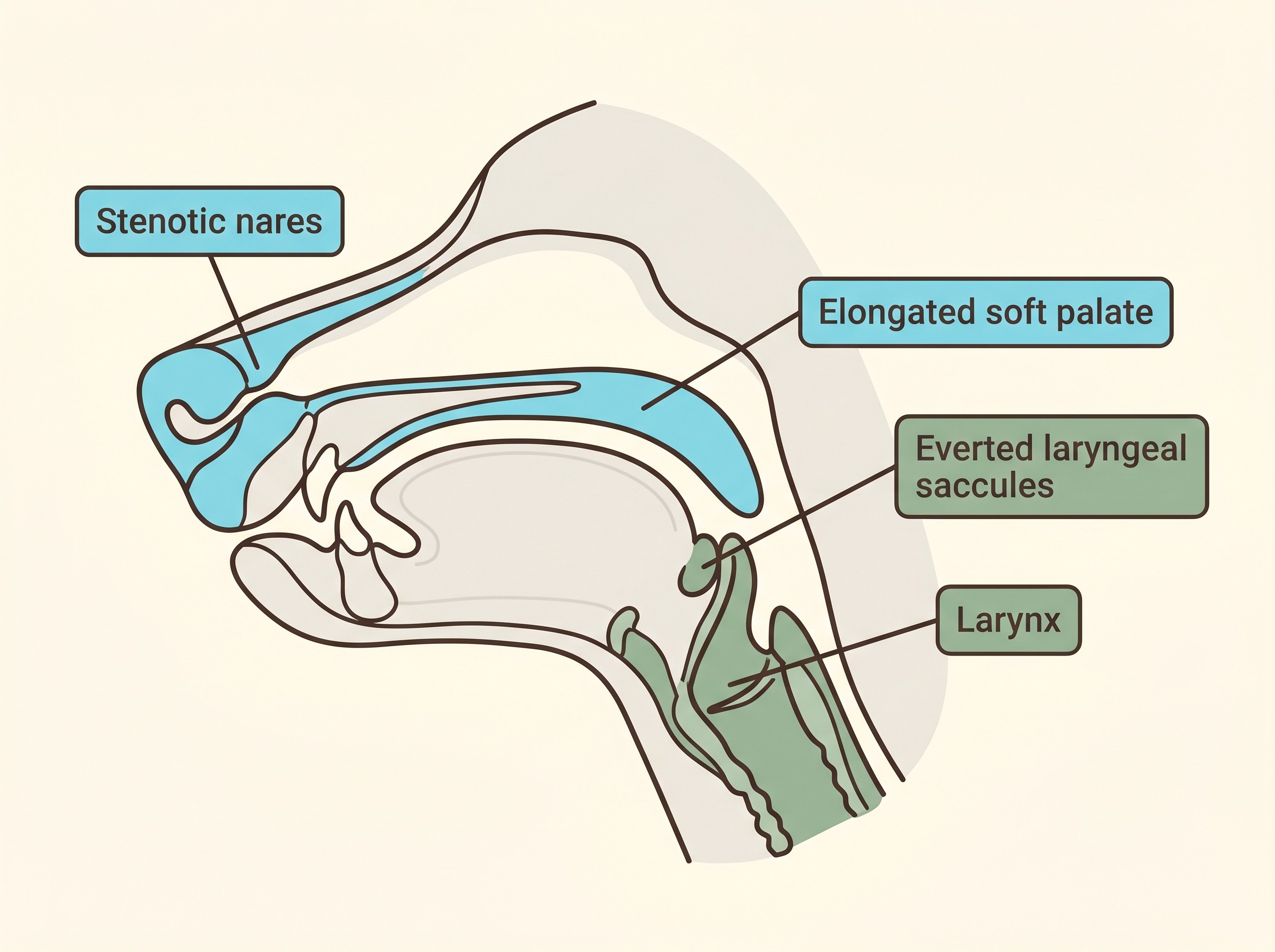
The changes this loop produces are the second group, the secondary changes: not present at birth, but acquired through years of effort (Dupré and Heidenreich, 2016). Often the earliest are everted laryngeal saccules, small pockets of soft tissue just in front of the vocal folds that get turned inside out and pulled into the airway by the negative pressure (Cornell Riney Canine Health Center, n.d.). Over a longer time comes laryngeal collapse, where the cartilage framework meant to hold the airway open loses its integrity and folds in on itself (Dupré and Heidenreich, 2016; Today's Veterinary Practice, n.d.), and the tonsils can be pushed out of their crypts into an already crowded throat (Cornell Riney Canine Health Center, n.d.).
This is the load-bearing point, and it's why your vet may talk about acting sooner rather than later. The primary changes can usually be improved: a surgeon can widen narrow nostrils and shorten an over-long palate. But laryngeal collapse is a structural failure of the cartilage itself, not swelling that will settle, and once it is advanced it carries a less favourable outlook with or without surgery (Cornell Riney Canine Health Center, n.d.; Dupré and Heidenreich, 2016). So correcting the primary obstructions before the cascade has done its worst can slow or prevent the slide towards it (Today's Veterinary Practice, n.d.; Cornell Riney Canine Health Center, n.d.). Whether, when and how to operate is a genuine decision with real trade-offs, and that whole question lives in the BOAS surgery decision. For now, hold onto this: BOAS is progressive, and the airway you hear today is not necessarily the airway your dog will have in three years if nothing changes.
Which breeds, and the spectrum within them
Three breeds sit at the centre of BOAS: pugs, French bulldogs and English bulldogs. Plenty of others are brachycephalic too, including Boston terriers, boxers, Pekingese, Shih Tzus, Cavaliers, Dogues de Bordeaux and bullmastiffs (Dupré and Heidenreich, 2016). The numbers for the headline breeds are striking. In the Royal Veterinary College's large UK study of pug health, pugs had nearly 54 times the odds of BOAS compared with dogs that aren't pugs, and the authors concluded the pug "can no longer be considered a typical dog from a health perspective" (O'Neill et al., 2022). French bulldogs and bulldogs aren't far behind: across UK practices, the most extreme flat-faced breeds carried around three and a half times the odds of an upper-respiratory disorder compared with non-flat-faced and moderately-flat-faced dogs, with roughly 22% affected against under 10% (O'Neill et al., 2015). Those figures describe odds and prevalence across populations, though, not a verdict on your individual dog.
And that matters, because the spectrum within these breeds is wide. Not every flat-faced dog is severely affected. When researchers in Cambridge tested pugs, French bulldogs and bulldogs objectively, around half were clinically BOAS-affected, roughly 65% of pugs, 59% of French bulldogs and 51% of bulldogs, and even among the affected the signs ranged from a bit of snoring and tiring on walks all the way to fainting episodes (Liu et al., 2017). So if your dog snores gently and bounces back quickly, that's reassuring. The reason to learn the signs isn't to assume the worst, it's so that you, who see your dog every day, are the one who notices if effort starts creeping up. Whether your particular dog is one of the affected ones is exactly what the front-door piece on whether flat-faced breathing is normal or dangerous is for.
How vets work out what's going on inside
Because so much of BOAS is hidden in the throat, assessing it takes more than a look up the nose. Your vet starts with the breed, the history and a physical exam, but actually seeing the soft palate, saccules and larynx usually means a brief look under light sedation, sometimes with radiographs and, at referral level, endoscopy or a CT scan to map the whole airway (Cornell Riney Canine Health Center, n.d.). There's also a non-invasive way to grade how a dog copes with exercise, the Kennel Club and University of Cambridge Respiratory Function Grading Scheme, which scores a dog from 0 (clinically unaffected) to 3 (severely affected) by listening to the breathing before and after a brisk three-minute walk (Royal Kennel Club and University of Cambridge, n.d.). What each grade means, and what you can check at home, has its own guide in grading BOAS at home, which pairs with our BOAS self-assessment tool.
One last point, because it follows straight from the anatomy. Dogs cool themselves mainly by panting, by moving large volumes of air over a wet tongue, and a brachycephalic airway both struggles to move that much air and becomes inflamed and swollen when it pants hard, which is why these dogs overheat so dangerously in warm weather (Cambridge BOAS Research Group, n.d.). That's not a footnote in summer, it's a life-or-death issue, and it has its own guide on flat-faced dogs and heatstroke. Please read it before the weather turns.
What this means for you and your dog
Follow the mechanism this far and you already understand more about your dog's breathing than most owners ever will. You'll recognise the snore and the snort for what they usually are, signs of effort rather than personality, and you'll know why noticing them early is a kindness rather than a worry.
It also means the everyday advice you'll hear elsewhere stops sounding like nagging and starts making obvious sense. Keeping your dog lean is the single biggest lever you have, because every extra bit of weight loads the airway further, and the Cambridge work found body condition tied directly to how badly dogs were affected (Liu et al., 2017). A harness rather than a collar matters because a collar presses straight onto a windpipe that's already too narrow. Both of those, and the rest of the daily playbook, are laid out properly in living with a brachycephalic dog.
References
- Cambridge BOAS Research Group. (n.d.). Pathophysiology and About BOAS. University of Cambridge Department of Veterinary Medicine. Retrieved from and https://www.vet.cam.ac.uk/boas/about-boas
- Cornell Riney Canine Health Center. (n.d.). Brachycephalic Obstructive Airway Syndrome (BOAS). Cornell University College of Veterinary Medicine. Retrieved from
- Dupré, G., and Heidenreich, D. (2016). Brachycephalic Syndrome. Veterinary Clinics of North America: Small Animal Practice, 46(4), 691-707.
- Liu, N-C., Troconis, E. L., Kalmar, L., Price, D. J., Wright, H. E., Adams, V. J., Sargan, D. R., and Ladlow, J. F. (2017). Conformational risk factors of brachycephalic obstructive airway syndrome (BOAS) in pugs, French bulldogs, and bulldogs. PLoS ONE, 12(8), e0181928.
- O'Neill, D. G., Jackson, C., Guy, J. H., Church, D. B., McGreevy, P. D., Thomson, P. C., and Brodbelt, D. C. (2015). Epidemiological associations between brachycephaly and upper respiratory tract disorders in dogs attending veterinary practices in England. Canine Genetics and Epidemiology, 2, 10.
- O'Neill, D. G., Sahota, J., Brodbelt, D. C., Church, D. B., Packer, R. M. A., and Pegram, C. (2022). Health of Pug dogs in the UK: disorder predispositions and protections. Canine Medicine and Genetics, 9(1), 4.
- Royal Kennel Club and University of Cambridge. (n.d.). Respiratory Function Grading Scheme (RFGS). The Royal Kennel Club. Retrieved from
- Today's Veterinary Practice. (n.d.). Corrective Surgery: Brachycephalic Airway Syndrome. Retrieved from
Keep track of how your pet is doing
The owners who cope best are the ones who notice changes early. A simple health log shows you what is working, and what is not, before the next vet visit.
Start tracking, freeYou're not doing this alone
Compare treatment journeys and talk to owners managing breathing & airways. Free to join.
Join PetsLikeMine