

Flat-Faced Dogs and Heatstroke: The Rules That Save Lives
Alastair Greenway
BVM&S MRCVS
For a flat-faced dog, heatstroke is not a hot-summer worry to file away for July. It is a fast, year-round killer, and the difference between a dog that recovers and a dog that doesn't is very often a few decisions an owner makes in the first few minutes, before any vet is involved.
If a flat-faced dog overheats, you cool it first and travel to the vet second, starting where you stand. That single instruction saves lives, and most owners get the order wrong: in the UK research, only about one dog in five was actively cooled before being taken in (Hall et al., 2023). The rest of this page is how to spot trouble early, what to actually do, and how to make sure you almost never need to. None of it is a telling-off. You didn't design the skull, and you love the dog you've got.
Why the heat hits them so much harder
Start with how dogs cool down, because it explains everything that follows. Dogs barely sweat: a few largely ineffective glands in the paw pads, nothing like the system we have (Merck Veterinary Manual, n.d.). They shed heat by panting, moving air fast over the wet surfaces of the nose, mouth and upper airway so water evaporates and carries heat away, with a clever bit of plumbing that cools the blood heading to the brain (Merck Veterinary Manual, n.d.; Nascimento et al., 2025). Panting is a dog's air-conditioning. It is the whole system.
Now picture a flat-faced dog. The same soft tissue is packed into a shortened skull, the nasal passages are short and narrowed, and the upper airway is partly obstructed. The nasal turbinates and upper airway are meant to be the broad, moist surface where heat is shed, and a brachycephalic dog simply has less of it, so the very anatomy that makes the breed snore is the anatomy that can't move enough air to cool (Nascimento et al., 2025). Vets sometimes describe these breeds as "ineffectual panters", and brachycephalic syndrome sits on the recognised list of conditions that reduce a dog's ability to cool, alongside obesity, laryngeal paralysis and a collapsing windpipe (Tabor, 2014). Their air-conditioning is undersized for their body, so even mild activity in warm conditions can tip them into overheating fast (Nascimento et al., 2025).
The UK data makes this concrete. In a large study of dogs under primary veterinary care, brachycephalic dogs had around twice the odds of heat-related illness compared with medium-skulled dogs, rising to more than four times the odds in the harder-hit emergency population (Hall et al., 2020a; Beard et al., 2024). Worse, once affected, a flat-faced dog is around three times more likely to die of it (Hall et al., 2022). Compared with a Labrador, the heat-specific risk runs to roughly fourteen times for the English bulldog, six to seven times for the French bulldog and around three times for the pug, with the Chow Chow topping the list (Hall et al., 2020a). One flag, since you may have read it elsewhere: the eye-catching "pugs are 54 times more likely" figure is about how common breathing disease is in the breed, not about heatstroke risk, so it doesn't belong here (O'Neill et al., 2022). The full airway anatomy has its own home in BOAS explained; for this page the one-line version is enough, their cooling system is their breathing system, and their breathing system is compromised.
The danger is exertion, not just the car
Here is the myth I most want to break, because it lulls good owners into a false sense of safety. The famous danger, the dog left in a parked car, is real and you should never do it. But it is not the main way UK dogs die of heat. Of cases with a recorded trigger, around three-quarters were exertional, brought on by exercise or activity, while hot weather alone accounted for about one in eight and a vehicle for only about one in twenty (Hall et al., 2020b). Exercise kills far more UK dogs by overheating than hot cars do, by something like eight to one (Hall et al., 2020b). The RSPCA puts it plainly: dogs are roughly ten times more likely to suffer heat illness out in the weather than shut in a car (RSPCA, n.d.).
So the lethal combination is not a locked car. It is heat plus exercise plus excitement, layered together. A bouncy, happy dog does not know to stop, and a flat-faced dog generates heat with effort while struggling to vent it. The danger sits in ordinary stuff: a ball game in the garden, a longer walk than planned, a giddy welcome at the door on a warm evening. The hot car is rarer, but worse when it happens, a trapped dog has about three times the odds of severe illness because it cannot escape and no one is there to cool it (Hall et al., 2022). Exertional heatstroke is the bigger killer because it is far more common, not because any one episode is milder. Both deserve your respect.
And it does not have to be a heatwave. On a humid day, evaporation works less well, so panting cools less, and a short walk can push a flat-faced dog over the edge (BVNA, 2023b). Heat-related illness shows up in UK dogs all year, not just on scorchers (Hot Dogs, n.d.). Risk is also individual, set by weight, breed, skull shape, fitness, hydration and acclimatisation, and dogs take around six weeks to adjust to hotter conditions (Hot Dogs, n.d.). Weight is the lever you control most directly: dogs at or above their breed-average weight had about 1.4 times the odds of heat illness, the very heaviest far more (Hall et al., 2020a). The deeper weight and everyday-routine picture sits in the everyday-management bundle, so I'll leave the detail there.
What it looks like, from first warning to emergency
Heatstroke announces itself before it becomes a catastrophe, and learning the early notes buys you the time that matters. The first sign is usually heavy or rapid panting, often with a dog that seeks shade, slows down, or refuses to go on (Hot Dogs, n.d.). That refusal is not stubbornness. It is information. Believe it.
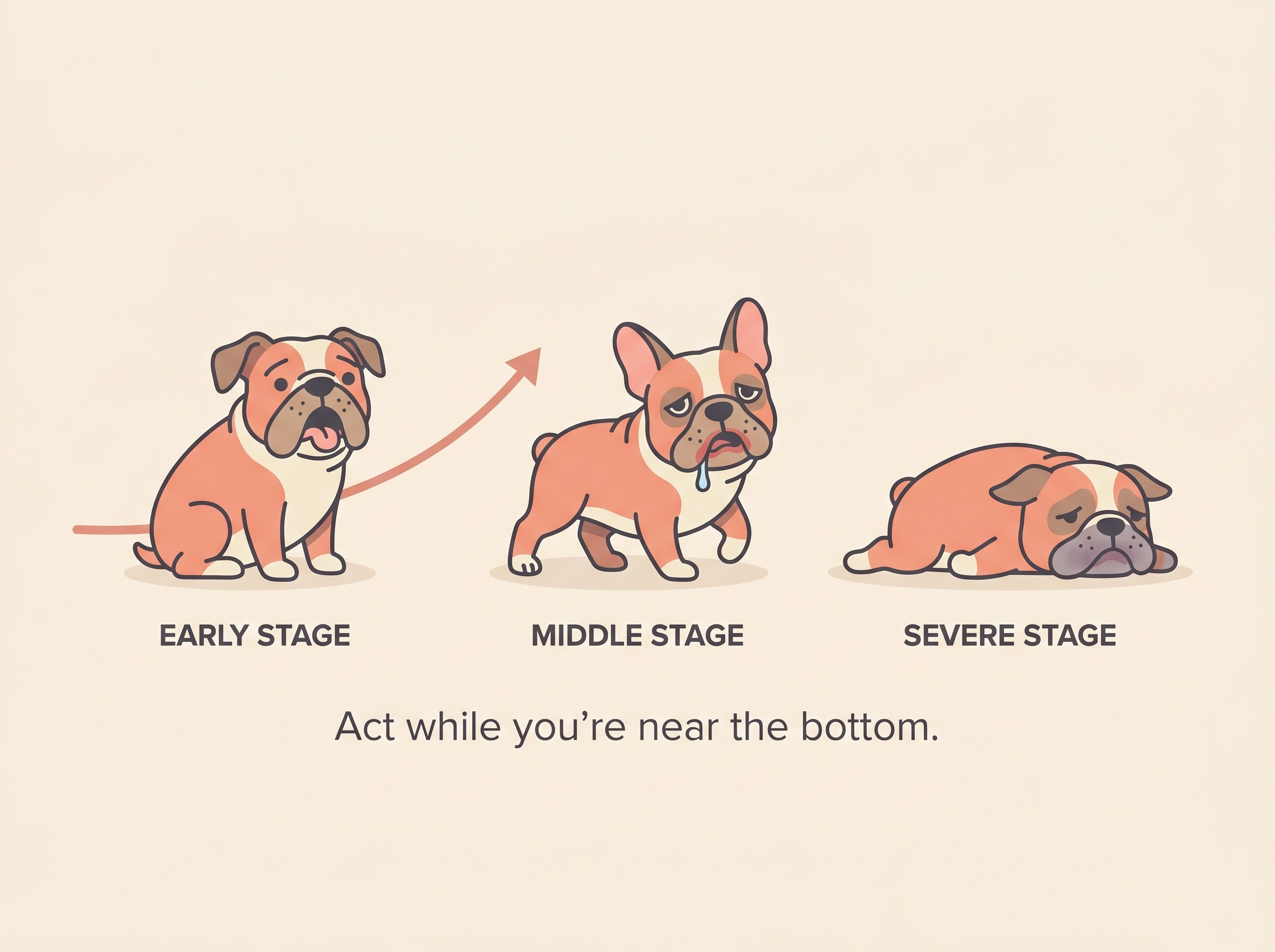
From there it escalates: the gums go bright red or congested then dusky or bluish, with heavy drooling, a racing heart, a wobbly or disoriented walk, vomiting or diarrhoea, then weakness, collapse and, in the worst cases, seizures (RSPCA, n.d.; Hall et al., 2021). Vets sort this into mild signs (lethargy, stiffness, heavy panting), moderate (vomiting or diarrhoea, a brief collapse, a single seizure) and severe (persistent disorientation or coma, repeated seizures, internal bleeding, organ failure) (Hall et al., 2021). The reason to learn the ladder is the survival gap between its rungs. Dogs caught at the mild-to-moderate stage survive more than nine times out of ten, while severe cases survive less than half the time (Hot Dogs, n.d.; Hall et al., 2021). You want to act while you are still near the bottom.
A quick word on thresholds, because people ask. A dog's normal temperature is around 38.3 to 39.2 degrees, and heatstroke is generally defined as a temperature above about 40 degrees, with real cellular damage higher still (Tabor, 2014; Merck Veterinary Manual, n.d.). That is worth knowing, but do not turn yourself into a thermometer-watcher. In the moment, the cue is the picture in front of you, the panting, the gums, the wobble, not a number.
What to do: cool first, transport second
The instinct most owners follow is the wrong one. The instinct is to scoop the dog into the car and race to the vet. The problem is that a hot car interrupts the dog's own cooling, and the minutes spent loading and driving are the very minutes that decide the outcome. Delayed cooling is linked to a higher death rate (Hall et al., 2021). So the rule, established by the UK researchers and welfare bodies who study this, is cool first, transport second (RSPCA, n.d.; BVNA, 2023a; Hot Dogs, n.d.). Start cooling where you are, then travel, ideally in a cool, ventilated or air-conditioned vehicle (RSPCA, n.d.). The gap is stark: only about a fifth of UK dogs were actively cooled before being taken in, and of the few that were, half were cooled with wet towels draped on top, which barely works (Hall et al., 2023).
So, in order:
Stop the activity and get out of the heat, into shade, ideally with a breeze.
Cool with water, and get it onto the skin, not just the coat. Pour, douse or run water over the body, soaking down to the skin, and keep it off the head (RSPCA, n.d.; BVNA, 2023b). Here I need to correct advice you have almost certainly been given. The old "use tepid or lukewarm water only" rule is wrong, and dangerous. Research has shown that cold water, tested as cold as near-freezing, cools dogs effectively and safely, and the people who ran those studies are blunt: the myth that cold water is dangerous is itself putting dogs' lives at risk (SRUC, 2023; BVNA, 2023a). As the RSPCA puts it, cold water rarely causes shock in an overheating dog, and dousing or immersing them is vital to recovery (RSPCA, n.d.). Cold tap water is good. The temperature myth is what kills time.
For a flat-faced dog in particular, favour pouring and air movement over full immersion. This is the nuance that matters most for your breed and that most pages miss. Plunging a fit, healthy, long-nosed dog into a paddling pool or stream is excellent first aid (RSPCA, n.d.). But the same researchers are explicit that full cold-water immersion is not the method for dogs with brachycephaly, airway disease or heart disease, nor for the unconscious, because a dog that cannot reliably protect its own airway can inhale water (Hot Dogs, n.d.). A flat-faced dog already sits in that group. So for your dog the safer default is evaporative cooling: pour or spray water that is cooler than the dog over its body and drive air across it with a fan, a breeze or the car's air-con (Hot Dogs, n.d.; BVNA, 2023b). That method is safe for every dog and is the right call whenever you are unsure (Hot Dogs, n.d.). A quick dunk is fine if your dog is bright and breathing easily; if it is wobbly, struggling or collapsing, pour and fan, do not submerge.
Skip the ice, and don't force water into the mouth. Avoid wrapping a collapsing dog in ice, ice packs or an ice coat, and don't leave sodden towels lying on top of it, both trap heat or cool too harshly (BVNA, 2023b). So the line is: cold tap water onto the skin, yes; an ice bath on a collapsing dog, no. Let your dog drink cool water if it wants to, but never pour water into the mouth of a dog struggling to breathe.
Cool hard for a couple of minutes, then go. You can in theory overcool a dog into rebound hypothermia, and active cooling should stop once the temperature is back to around 39.5 to 40 degrees (Tabor, 2014; BVNA, 2023b). In practice you will not have a thermometer in the park. The realistic instruction is to cool aggressively for a couple of minutes, or until the breathing eases and the dog brightens, keep cooling on the way, and let the vet take over the fine judgement.
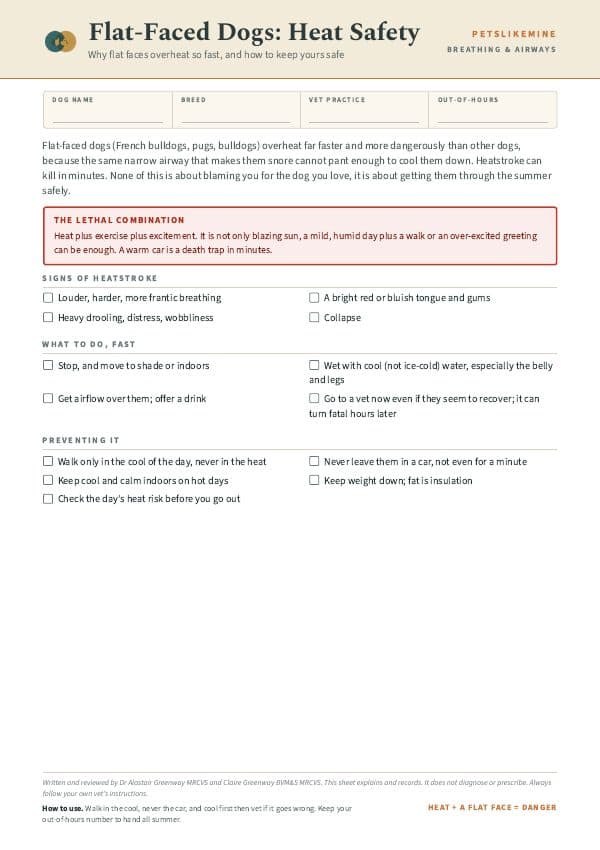
This first-aid sequence is shared with other airway-compromised dogs. Older large-breed dogs with laryngeal paralysis face the same heat trap from a different cause, and if that's your dog, laryngeal paralysis and heat safety carries the version for them. If you are ever unsure how serious a given moment is, the breathing triage tool walks you through it, and the one-page flat-faced heat-safety guide is worth printing for the fridge before the warm weather arrives.
Even if they seem to recover, see a vet that day
Let me be firm about this, because it is where a frightening number of dogs are lost after the danger seems to have passed. Heatstroke is not just overheating. It is a whole-body injury. The heat damages the gut lining, the kidneys, the clotting system and the brain, and that damage can keep unfolding for hours, even a day or two, after the event (Tabor, 2014; BVNA, 2023b). Serious complications such as disseminated intravascular coagulation, a failure of the blood to clot, or acute kidney injury can develop after the dog has cooled, which means a dog you have brought back to a normal temperature can still be seriously, even fatally, injured inside (BVNA, 2023b; Tabor, 2014).
So the rule has no asterisk. If your flat-faced dog has had a heat episode, it needs a vet that day, even if it has bounced back and is wagging at you. Cool it, take it in, and let them check what you cannot see.
Prevention is almost the whole game
The good news, and it is real, is that nearly all of this is avoidable, and the steps are not onerous. A flat-faced dog asks for a slightly more careful life, not a sad one.
Walk in the cool of the day, early morning and late evening, and on a hot or humid day skip the walk entirely. A flat-faced dog loses nothing from a rest day, and a missed walk is a far smaller cost than a heatstroke (Hot Dogs, n.d.; Hall et al., 2020b). Manage the excitement as much as the exercise, because a giddy dog overheats just as readily as a running one. Never leave a dog in a car or any warm, poorly-ventilated space, not even briefly, not even with a window cracked. Keep fresh water and shade available, give a new dog the better part of six weeks to acclimatise as the weather warms rather than going straight into long summer walks, and keep your dog lean, since carrying less weight genuinely lowers the risk (Hot Dogs, n.d.; Hall et al., 2020a).
It helps to check the day before anything strenuous, which is what the airway diary is for: alongside logging coughs, noise and exercise tolerance, it carries a real-time heat-risk indicator so you can glance at the conditions before you clip the lead on. The fuller everyday routine, the harness over a collar, the cool sleeping spot, the pacing of exercise across a whole life, sits in the everyday-management bundle, and if you're still working out whether your dog's day-to-day breathing is normal at all, is it normal or dangerous is the front door.
References
- Beard, S., Hall, E. J., Bradbury, J., Carter, A. J., Gilbert, S., & O'Neill, D. G. (2024). Epidemiology of heat-related illness in dogs under UK emergency veterinary care in 2022. Veterinary Record, 194(11), e4153.
- BVNA (British Veterinary Nursing Association). (2023a). 'Cool first, transport second': Recognising and responding to heatstroke in our pets. Retrieved from
- BVNA (British Veterinary Nursing Association). (2023b). Hot Dogs: Recognising and Managing Canine Heat Stroke. Retrieved from
- Hall, E. J., Carter, A. J., & O'Neill, D. G. (2020a). Incidence and risk factors for heat-related illness (heatstroke) in UK dogs under primary veterinary care in 2016. Scientific Reports, 10, 9128.
- Hall, E. J., Carter, A. J., & O'Neill, D. G. (2020b). Dogs Don't Die Just in Hot Cars: Exertional Heat-Related Illness (Heatstroke) Is a Greater Threat to UK Dogs. Animals, 10(8), 1324.
- Hall, E. J., Carter, A. J., Bradbury, J., Barfield, D., & O'Neill, D. G. (2021). Proposing the VetCompass clinical grading tool for heat-related illness in dogs. Scientific Reports, 11, 6828.
- Hall, E. J., Carter, A. J., Chico, G., Bradbury, J., Gentle, L. K., Barfield, D., & O'Neill, D. G. (2022). Risk Factors for Severe and Fatal Heat-Related Illness in UK Dogs: A VetCompass Study. Veterinary Sciences, 9(5), 231.
- Hall, E. J., Carter, A. J., Bradbury, J., Beard, S., Gilbert, S., Barfield, D., & O'Neill, D. G. (2023). Cooling Methods Used to Manage Heat-Related Illness in Dogs Presented to Primary Care Veterinary Practices during 2016–2018 in the UK. Veterinary Sciences, 10(7), 465.
- Hot Dogs. (n.d.). Hot Dogs: heatstroke education for dog owners. Retrieved from
- Merck Veterinary Manual. (n.d.). Hyperthermia in Animals (Emergency Medicine and Critical Care). Merck/MSD Veterinary Manual. Retrieved from (entry: Hyperthermia in Animals; thermoregulation by panting and the brachycephalic "ineffectual panter" risk)
- Nascimento, P. V., Veríssimo, T. N., Soares, W. A., Maia, M. I., Carvalho, L. R., & Saraiva, E. P. (2025). Heat stress in domestic dogs: morphological and environmental risk factors for dog welfare in a warming world. Frontiers in Animal Science, 6, 1679377.
- O'Neill, D. G., Sahota, J., Brodbelt, D. C., Church, D. B., Packer, R. M. A., & Pegram, C. (2022). Health of Pug dogs in the UK: disorder predispositions and protections. Canine Medicine and Genetics, 9, 4.
- RSPCA. (n.d.). How to Recognise and Treat Heatstroke in Dogs. Retrieved from
- SRUC (Scotland's Rural College). (2023). Research highlights importance of cooling hot dogs. Retrieved from
- Tabor, B. (2014). Today's Technician: Heatstroke in Dogs. Today's Veterinary Practice, September/October 2014. Retrieved from
Free downloads
Companion worksheets to put what you've read into practice. Free PDFs, print at home.
Keep track of how your pet is doing
The owners who cope best are the ones who notice changes early. A simple health log shows you what is working, and what is not, before the next vet visit.
Start tracking, freeYou're not doing this alone
Compare treatment journeys and talk to owners managing breathing & airways. Free to join.
Join PetsLikeMine