

Heat and Exercise Safety With Laryngeal Paralysis
Alastair Greenway
BVM&S MRCVS
A dog with laryngeal paralysis can look completely fine and still be minutes away from a crisis. He's lying in the kitchen, breathing easily, maybe snoring a little, and nothing about him says anything is wrong. Then the doorbell goes, or a squirrel breaks cover on a warm walk, or it's just one of those close, humid afternoons and he can't settle, and within a couple of minutes the same dog is standing rigid, eyes wide, hauling for air through a throat that won't open. A dog who was comfortable at rest can rapidly decompensate if it becomes excited, is exercised harder than usual, or cannot find a cool spot on a hot day (Davies Veterinary Specialists, n.d.). That gap between "fine" and "frightening" is what this article is about.
I won't re-explain what laryngeal paralysis is here, because the recognition guide does that properly: the changed bark, the raspy in-breath, the classic patient being an older, large-breed dog, most often a Labrador, average age around nine to eleven (Davies Veterinary Specialists, n.d.; Michigan State University GOLPP Study Group, 2009). What I want to give you instead is the one piece of knowledge that prevents most laryngeal paralysis emergencies: why heat and exercise are so uniquely dangerous to a partly paralysed larynx, how to keep your dog out of trouble, and what to do in the few minutes that matter if a crisis starts anyway.
Why a hot day is the real enemy
Start with how dogs cool down, because it explains everything that follows. Dogs barely sweat. They shed almost all their excess heat by panting, moving air rapidly over the wet tongue and the lining of the upper airway so that heat evaporates away. Panting is the air conditioning, and the larynx is the doorway that air has to pass through.
Now picture a larynx that won't open fully. The very airflow a hot dog depends on to cool itself is exactly the airflow a paralysed larynx throttles, so affected dogs are more prone to overheating under conditions that would not make a normal dog hot (American College of Veterinary Surgeons, n.d.; Brooks, n.d.). That's the whole danger, and it's why it isn't only the scorching day in full sun that gets these dogs. A mild, muggy afternoon, a slightly-too-brisk walk, a warm room with no through-draught, any of these can be enough, because the dog starts from a position where it cannot move enough air to keep up. Vets formally list laryngeal paralysis as a heatstroke risk factor in its own right, alongside being a flat-faced breed, older or overweight (Cornell University Riney Canine Health Center, n.d.-b).
A dog with laryngeal paralysis and a flat-faced dog are caught in the same trap for the same reason: an obstructed upper airway can't pant enough to cool down, so heat plus exertion plus excitement is the combination that kills, and the first-aid response is identical. If you've also got a brachycephalic dog, or want the deeper UK heat-illness picture and the cold-versus-tepid-water science, the flat-faced dog heatstroke guide owns all of that. One fact from there reframes the whole risk: in the largest UK study of heat-related illness in dogs, exercise was the commonest trigger by far, around three-quarters of events, vastly outnumbering the hot-car cases that get all the headlines (Hall et al., 2020). For a dog with laryngeal paralysis, the walk is the danger, not just the parked car.
How a crisis snowballs
The reason a laryngeal paralysis episode can go from "a bit noisy" to "genuine emergency" in minutes is a feedback loop, and once you can picture it you'll understand why everything I recommend later is aimed at breaking it early.
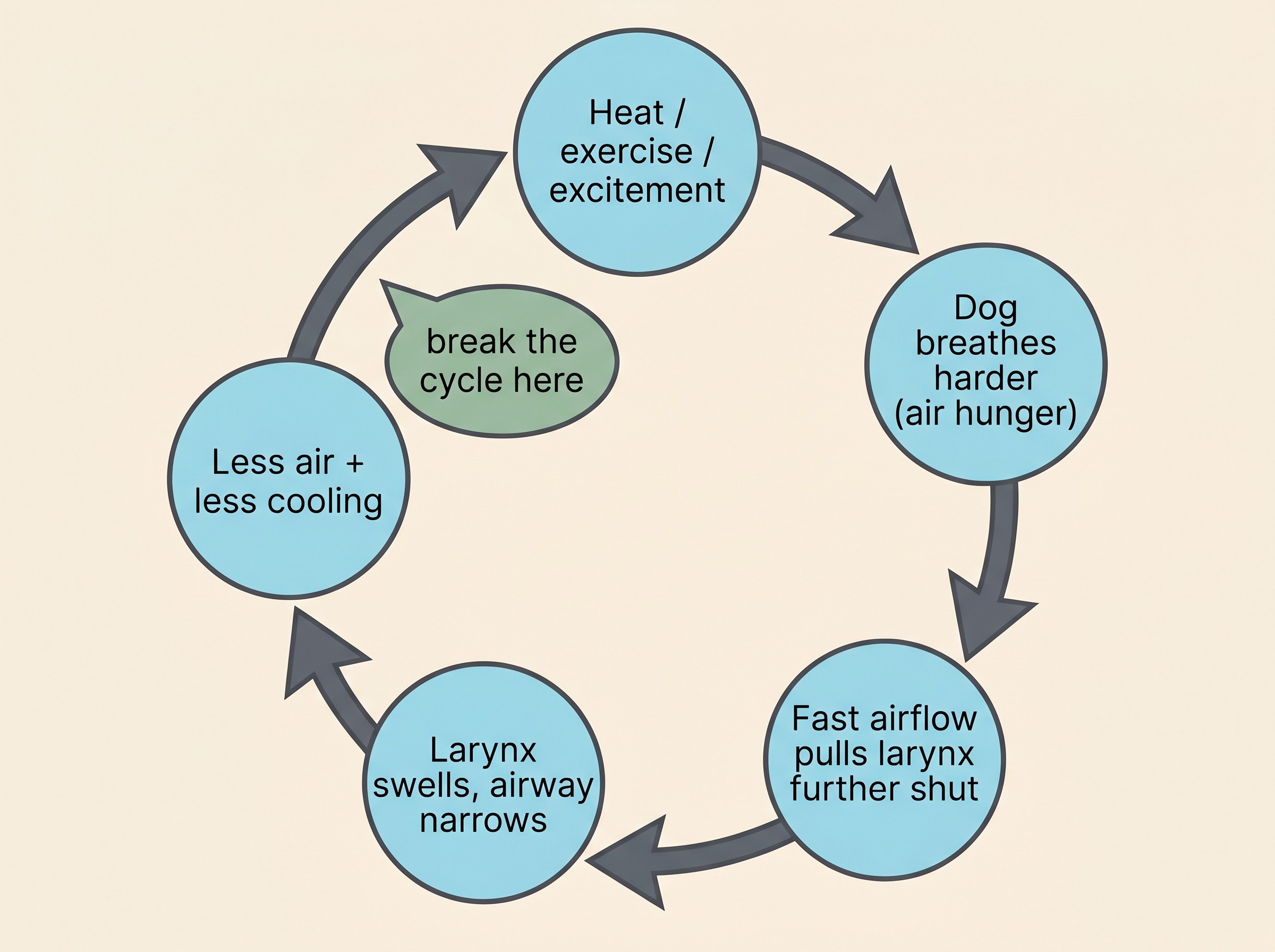
Air behaves a certain way through a narrow, floppy opening. Fast-moving air sucks the airway further shut, while slow-moving air passes more easily, but the feeling of air hunger is a powerful drive that makes an animal try to breathe harder, which speeds the airflow up, and a vicious cycle begins (Brooks, n.d.). Put more formally, flow limitation may reduce the efficiency of body cooling because of decreased airflow across the tongue, causing a vicious cycle of increased demand for ventilation and airway obstruction (Monnet, n.d.). So the frightened, overheating dog breathes harder to get more air and to cool down, and breathing harder is exactly what pulls the larynx tighter. Neither the air exchange nor the cooling works, and the dog spirals.
There's a second turn of the screw. The harder the dog fights, the more the larynx itself inflames and swells: dogs with laryngeal paralysis develop laryngeal oedema and laryngitis through severe panting or respiratory effort during excitement or hyperthermia (Merck Veterinary Manual, n.d.-a). That swelling narrows an airway that was already too narrow, which is the physical reason a crisis snowballs rather than just plateaus, and it's why calming your dog and stopping the effort in the first thirty seconds is so powerful. You're intervening before the swelling has had time to build.
Catching it early
Most of the time, you'll have warning before things get serious, if you know what you're looking at. The early signs are loud, harsh, frantic breathing and obvious distress or anxiety. There's often very heavy panting, and a particular tell worth committing to memory is increased panting or panting when the dog is cool and calm, with no good reason to be hot (American College of Veterinary Surgeons, n.d.). A dog panting hard in a cool room is telling you its airway is struggling.
From there, the signs that mean you are now in an emergency are the ones to act on without hesitation: respiratory distress or difficulty breathing, especially in warm, humid environments; the gums and tongue going pale, then blue or purple; decreased exercise tolerance; and collapse (Michigan State University GOLPP Study Group, 2009). Blue or grey gums, real distress while the dog is at rest, or any collapse mean this is happening now, not soon. Those are the same red flags that the is my pet's breathing an emergency hub and the breathing triage tool are built to flag, so if you're ever unsure which side of the line you're on, that's the fastest way to check.
What to do in a crisis: cool and calm, then go
If you ever find yourself here, the plan is short enough to remember while your heart is pounding: stop, cool, calm, go. Seconds genuinely count, and "wait and see" is the wrong instinct (Buzby, n.d.).
Stop the activity at once and get your dog somewhere cool and shaded. Keep yourself calm, because your dog reads your panic and panic feeds the cycle. Then start cooling. The advice from vets who manage these dogs is to wet your dog down with cool, not cold, water, crank up the air conditioning in the car or open the windows, and immediately head to the vet (Buzby, n.d.). Cornell's heatstroke guidance is the same: start cooling immediately, wetting the dog with cool water and placing them in front of the car's air conditioning while on the way to the hospital (Cornell University Riney Canine Health Center, n.d.-b). Pour the water onto the skin rather than just the coat, get air moving over the wet dog because that's what drives the evaporation, and never force water into the mouth of a gasping dog. The principle is cool first, transport second (RSPCA, n.d.). Keep it simple and safe: cool water on the skin, moving air, and don't pack a collapsing dog in ice. (The fuller cold-versus-tepid-water debate, which has shifted in recent years, is handled in the flat-faced dog heatstroke guide.)
Then get to a vet, and this is the part owners most want to skip: go even if your dog seems to recover on the way. There are two solid reasons. The first is that the desperate effort of breathing in against a shut larynx can pull fluid into the lungs, a problem called negative-pressure (post-obstructive) pulmonary oedema. It is a recognised consequence of upper-airway obstruction in dogs, found after all sorts of obstruction events in a UK case series, from choking to anatomical narrowing of the airway (Herrería-Bustillo et al., 2022). So a dog that has calmed and cooled in the car can still have fluid quietly building on its lungs. The second reason is that overheating is a whole-body injury whose damage can take hours to declare itself (Hall et al., 2020). A dog that looks better is not necessarily a dog that is better.
It helps to know roughly what the vet team will do, so the trip makes sense rather than just feeling frightening. They'll give oxygen, cool an overheated dog, often use light sedation to break the panic-and-effort loop, anti-inflammatory steroids to settle the laryngeal swelling, and intravenous fluids; rarely, if a dog is deteriorating badly, they'll place a temporary tracheostomy to bypass the larynx altogether (Cornell University Riney Canine Health Center, n.d.-a; Merck Veterinary Manual, n.d.-b). That is why sedation and steroids help so much, and why none of it is for home. Your job is the cooling, the calm and the car.
Prevention is most of the win
Almost all of this is preventable, and the levers are the same handful you'll carry into everyday life with laryngeal paralysis. Cornell lists them almost as a checklist: stress reduction, anti-anxiety medications, limiting exercise, limiting exposure to hot and humid weather, replacing neck collars with harnesses, and weight loss (Cornell University Riney Canine Health Center, n.d.-a).
In practice that comes down to a short list of habits:
Walk in the cool of the day, and skip the walk on bad days. Early morning and late evening, when the air is coolest, and on genuinely hot or humid days, accept that a sniff round the garden is enough. A missed walk never hurt a dog; a heatstroke walk can kill one.
Keep exercise gentle and short, and let your dog set the pace. For a mildly affected dog, much of the management is simply minimising the stress of exercise and exposure to heat (Merck Veterinary Manual, n.d.-b). The aim is movement that never tips into hard panting.
Head off excitement and stress, not just heat. A doorbell, a visitor or a squabble at the gate can start the cycle as surely as a heatwave can. For dogs with predictable flashpoints your vet may suggest calming medication or short-term sedation, and it's worth avoiding rough play that pulls at the neck, like tug-of-war (Buzby, n.d.; Animal Medical Center, n.d.).
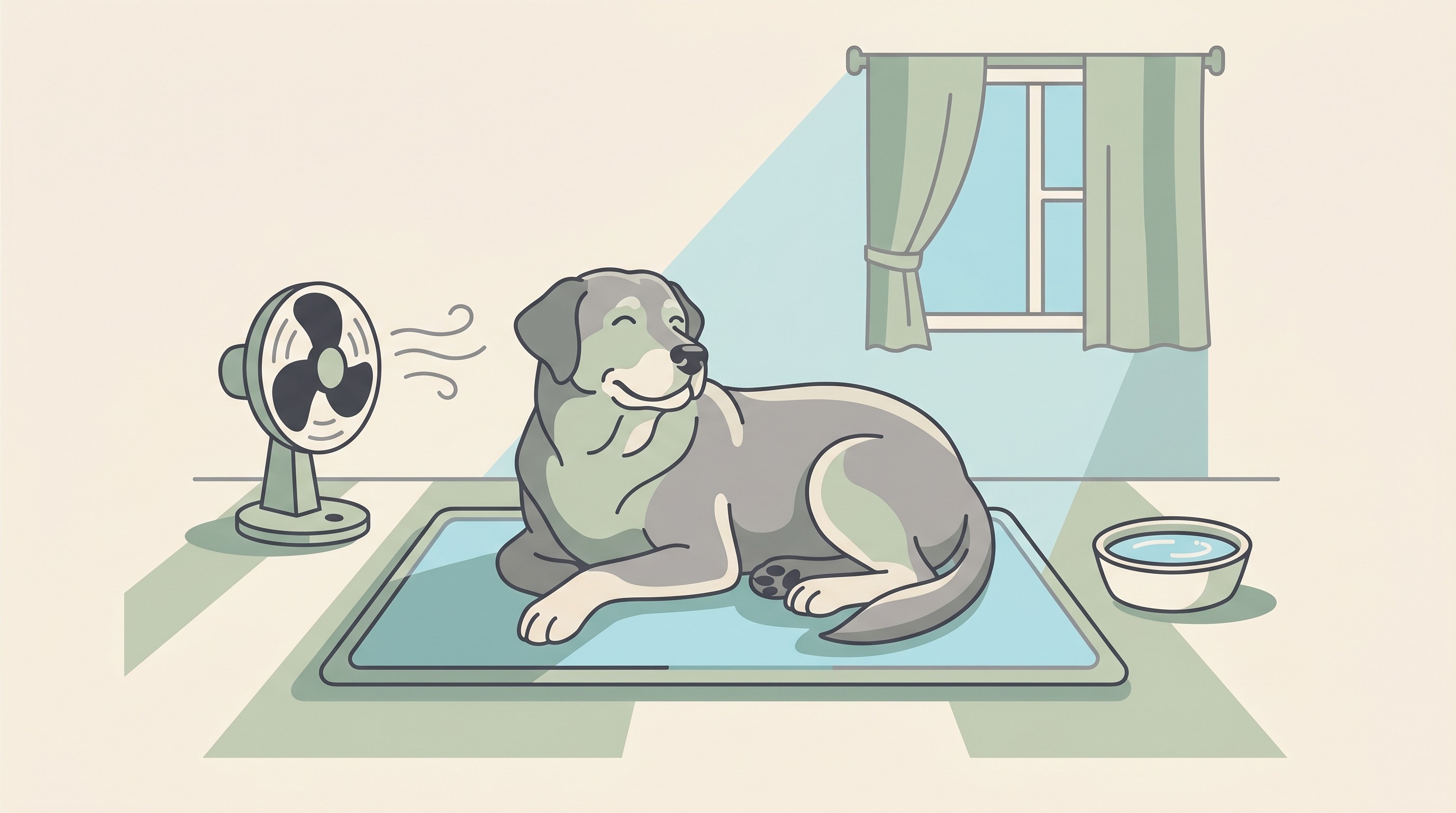
Keep your dog cool indoors in summer. Shade, fans, air conditioning if you have it, cool mats, and constant fresh water. The hottest, most humid parts of the day are for staying in (Buzby, n.d.).
Keep your dog lean. Excess weight worsens both the airway and the heat load, so it's one of the highest-yield things you can do, and the Weight Management resources cover the how. I'll flag it here as a lever, not lecture you on it.
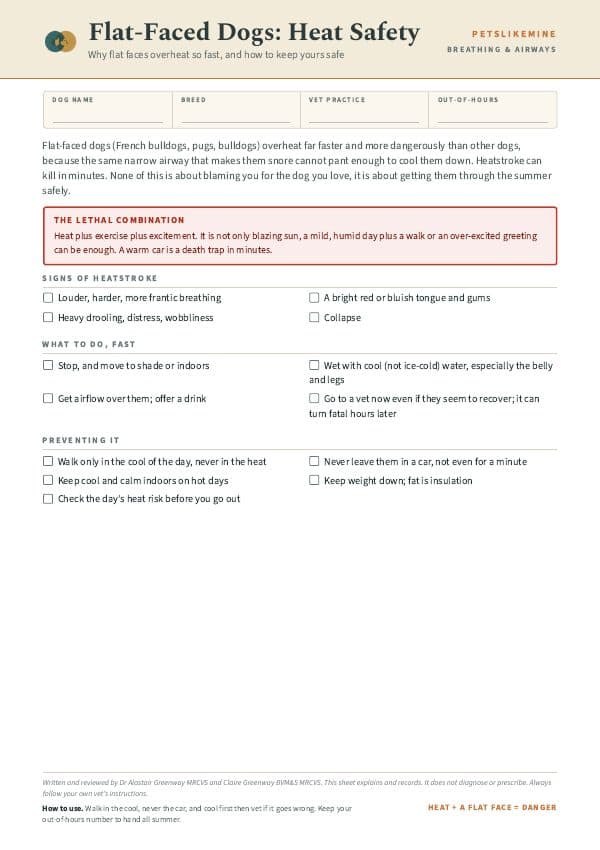
Walk on a harness, never a neck collar. This is the small daily rule that matters most. A collar presses straight onto a windpipe that is already struggling to move air, so a harness is the standard recommendation for these dogs across the board (American College of Veterinary Surgeons, n.d.; Animal Medical Center, n.d.; Cornell University Riney Canine Health Center, n.d.-a). If you want the practical version of all six of these in one place, the flat-faced heat safety download is the shared card for any dog that can't cool itself well.
One more habit earns its place because laryngeal paralysis doesn't stand still. It's usually part of a slowly progressive condition called GOLPP, which the whole-body GOLPP guide explains in full, and the practical upshot is that the distance or effort that triggers noisy breathing tends to creep downward over months. Logging your walks, the noise, how fast your dog recovers and any near-miss episodes in the Airway Diary, which carries a real-time heat-risk indicator, lets you notice the airway tightening and rein in exercise before a hot day forces the issue. It's the kind of habit that means you adjust on a Tuesday in your own time, not in a car park in a panic.
A crisis isn't the only danger to keep half an eye on, either: dogs with laryngeal paralysis carry a lifelong risk of inhaling food or water into the lungs, which the aspiration pneumonia guide covers. And if you find yourself increasingly managing your dog around the weather rather than living alongside the condition, that's often the conversation that leads to the tie-back surgery decision, the right thing to read when prevention starts to feel like a full-time job.
For now, hold on to the simple version, because it's the version that saves dogs. Your laryngeal-paralysis dog is fine until a trigger tips it over, and you control most of the triggers.
References
- American College of Veterinary Surgeons. (n.d.). Laryngeal Paralysis. Retrieved from
- Animal Medical Center. (n.d.). Laryngeal Paralysis in Dogs. Pet Health Library. Retrieved from
- Brooks, W. C. (n.d.). Laryngeal Paralysis in Dogs. Veterinary Partner / VIN. Retrieved from
- Buzby, J. (n.d.). Laryngeal Paralysis in Dogs: Symptoms, Treatment, What to Do. Dr. Buzby's ToeGrips for Dogs. Retrieved from
- Cornell University College of Veterinary Medicine, Riney Canine Health Center. (n.d.-a). Laryngeal Paralysis. Retrieved from
- Cornell University College of Veterinary Medicine, Riney Canine Health Center. (n.d.-b). Heatstroke: A Medical Emergency. Retrieved from
- Davies Veterinary Specialists. (n.d.). Laryngeal Paralysis & Collapse Fact Sheet. Retrieved from
- Hall, E. J., Carter, A. J., & O'Neill, D. G. (2020). Dogs Don't Die Just in Hot Cars: Exertional Heat-Related Illness (Heatstroke) Is a Greater Threat to UK Dogs. Animals (Basel), 10(8), 1324.
- Herrería-Bustillo, V. J., Adamantos, S., Lamb, C. R., García-Arce, M., Thomas, E., Saiz-Álvarez, M. R., Cook, S., & Cortellini, S. (2022). Retrospective evaluation of negative-pressure pulmonary edema in dogs (2006-2018): 35 cases. Journal of Veterinary Emergency and Critical Care, 32(3), 397-404.
- Merck Veterinary Manual. (n.d.-a). Laryngeal Disorders in Animals (Respiratory System). Retrieved from
- Merck Veterinary Manual. (n.d.-b). Laryngeal Paralysis in Dogs and Cats (Respiratory System). Retrieved from
- Michigan State University College of Veterinary Medicine, GOLPP Study Group. (2009). Geriatric Onset Laryngeal Paralysis Polyneuropathy (GOLPP) (client handout). Retrieved from
- Monnet, E. (n.d.). Laryngeal Paralysis (textbook chapter), indexed by ScienceDirect Topics. Retrieved from
- RSPCA. (n.d.). How to Recognise & Treat Heatstroke in Dogs. Retrieved from
Free downloads
Companion worksheets to put what you've read into practice. Free PDFs, print at home.
Keep track of how your pet is doing
The owners who cope best are the ones who notice changes early. A simple health log shows you what is working, and what is not, before the next vet visit.
Start tracking, freeYou're not doing this alone
Compare treatment journeys and talk to owners managing breathing & airways. Free to join.
Join PetsLikeMine