

Laryngeal Paralysis and the Aspiration Pneumonia Risk: Feeding, Water and the Lifelong Watch
Alastair Greenway
BVM&S MRCVS
Once a dog is diagnosed with laryngeal paralysis, or comes through the tie-back operation, the phrase "aspiration pneumonia" tends to get raised, and raised seriously. It's an unsettling thing to be handed, especially when the surgery was meant to be what made your dog better. So let me set out, calmly and clearly, what this risk is, why it exists, and the genuinely useful things you can do at the food and water bowls to keep it as low as possible.
I'll be straight with you throughout. This is a real risk, not a box-ticking warning, and it doesn't disappear once the breathing is fixed. But it is largely manageable with small daily habits, the warning signs are learnable, and aspiration pneumonia caught early is usually treatable. What I want you to leave with is not fear, but a plan.
Why the risk exists in the first place
The voice box, the larynx, sits at the top of the windpipe and works as a valve. When your dog breathes in, the cartilages on each side are pulled open so air can reach the lungs (American College of Veterinary Surgeons, n.d.). It has a second, opposite job too: it closes over during a swallow, so that food and water travel down the gullet and not into the airway. In laryngeal paralysis the first half of that fails, the cartilages that should swing open on each breath stay slack, which is what causes the noisy, laboured breathing you'll know well (American College of Veterinary Surgeons, n.d.). The trouble is that a slack, poorly moving voice box also guards the airway less reliably when your dog swallows.
That alone would create some risk. But in the older, larger dogs we most often see this in, the paralysis is usually the first and loudest sign of a slowly progressive nerve condition called GOLPP, geriatric onset laryngeal paralysis polyneuropathy, which quietly affects nerves throughout the body, including the nerves that drive the gullet itself (Michigan State University GOLPP Research Program, n.d.). I won't unpack the whole-body picture here, because the back-leg weakness and wider neurological side of GOLPP have their own home in GOLPP as a whole-body condition. What matters for this page is the consequence: the gullet becomes less coordinated, food and water can travel "the wrong way", and anything that reaches the lungs can seed an infection.
So the risk has two roots: a voice box that no longer guards the airway, and a gullet that no longer moves food along smoothly. The oesophagus is often affected early, and that swallowing difficulty is precisely what raises the chance of inhaling food or water (Cornell Riney Canine Health Center, n.d.). It's also why aspiration pneumonia can happen even in dogs that have never had surgery (Cornell Riney Canine Health Center, n.d.).
The fact most owners are never told
The swallowing problem is common, and it is usually invisible. In the landmark Michigan State study, around 70% of dogs already had measurable gullet dysfunction at the very moment their laryngeal paralysis was diagnosed, most obvious in the liquid part of the swallow (Stanley et al., 2010). Reported another way, the same research group found about 75% had swallowing dysfunction while only 28% had ever been seen to regurgitate or gag (Purina Pro Club, n.d.). The great majority of these dogs have a swallow that doesn't work perfectly, and most owners have never seen a single sign of it.
So you cannot assume your dog is safe just because you've never watched them choke on their dinner. It matters which dogs are most at risk, too, because the same research showed that the dogs with the worst gullet function were the ones that went on to develop aspiration pneumonia (Stanley et al., 2010). The swallow is part of the disease, even when it's silent.
What surgery changes, and what it leaves alone
If your dog has had, or is going to have, the tie-back operation (its proper name is unilateral arytenoid lateralisation), it helps to understand what it alters. The surgery permanently holds one side of the voice box open, which relieves the breathing obstruction, often dramatically, and for the breathing it's a genuinely good operation: most dogs come out with a significantly improved airway (North Downs Specialist Referrals, n.d.). But there is a trade-off. With one side propped permanently open, the valve can close even less well during a swallow, and the dog's ability to cough forcefully (the body's own way of clearing something inhaled) is reduced too (North Downs Specialist Referrals, n.d.). The airway is left permanently more open than before, which increases the risk of inhaling food or water (Southfields Veterinary Specialists, n.d.). This is the single most important reason a tie-back dog needs the feeding and water habits below, not for a few weeks but for good.
And let me be clear about something this topic demands: a tie-back fixes the breathing, not the nerves. The underlying polyneuropathy carries on, the gullet keeps weakening, and the open airway is permanent. Surgery still gives a real lift in quality of life, but it isn't a cure, and ongoing management has to continue for these dogs (Michigan State University GOLPP Research Program, n.d.). The aspiration watch doesn't end when the stitches come out. Whether to operate at all, what it costs and the referral pathway sit with the companion piece, the tie-back surgery decision. My job here starts the moment that decision is made.
As for how big the risk is, the figures are worth knowing without letting them frighten you. UK and international referral centres put the lifetime chance at somewhere around 8 to 21%, with roughly 18% the most commonly quoted single number (Southfields Veterinary Specialists, n.d.; Animal Surgical Center, n.d.). The largest study, following 232 dogs, found the figure climbs the longer dogs are watched, from about 18.6% at one year to about 31.8% by three to four years (Wilson and Monnet, 2016). In that study, the things that raised the risk further were a weak gullet after surgery (post-operative megaoesophagus) and the use of strong opioid pain relief before going home, both of which are exactly the sort of thing your surgical team weighs up and manages (Wilson and Monnet, 2016). That rising line is the whole reason I keep saying "lifelong watch".
Four habits that genuinely help: raised, soft, small, slow
This is the part to put on the fridge. None of it is complicated, and together these changes make a real difference. They apply for life after a tie-back, and are sensible in any laryngeal paralysis or GOLPP dog whose swallow may not be reliable.
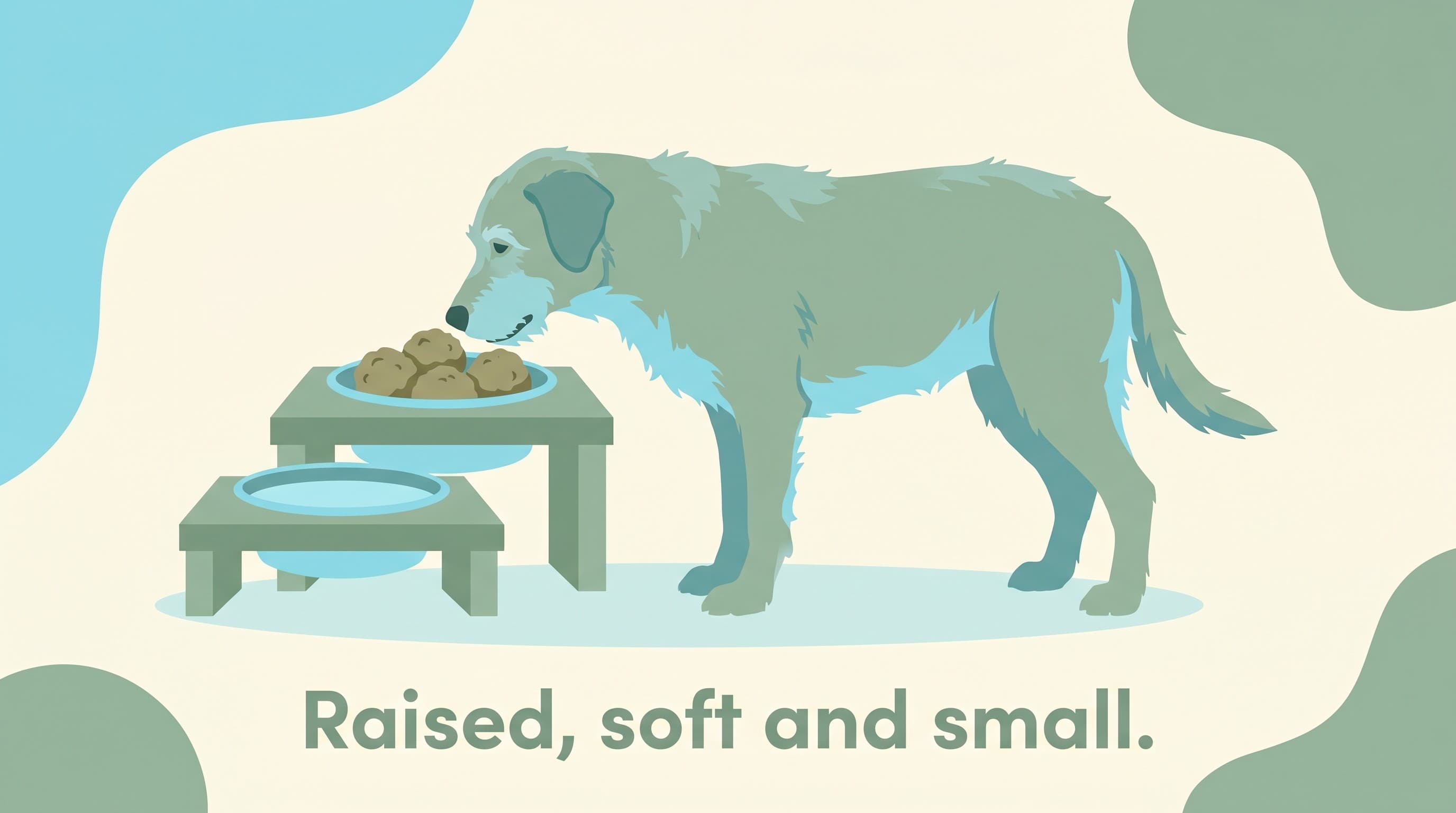
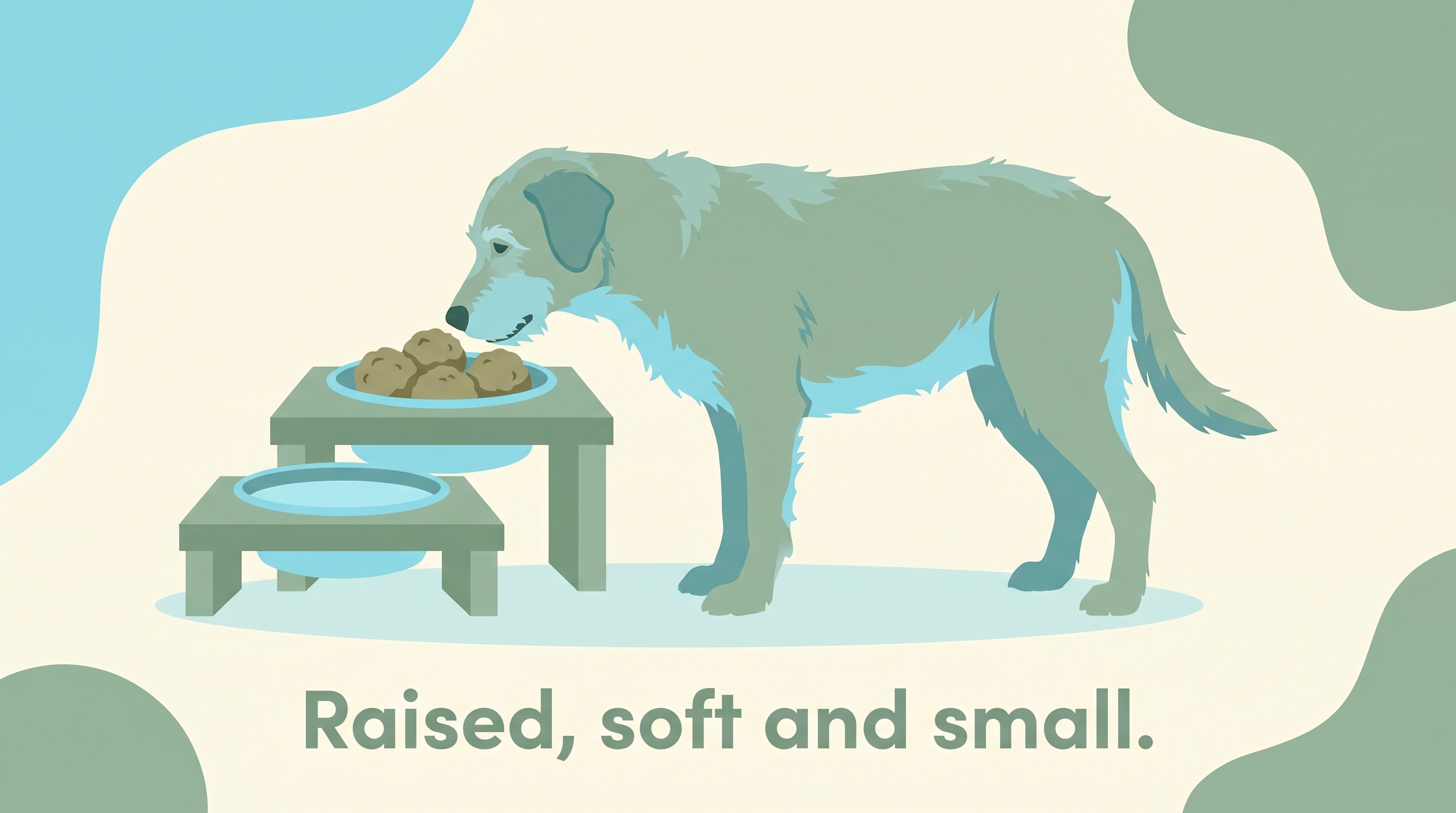
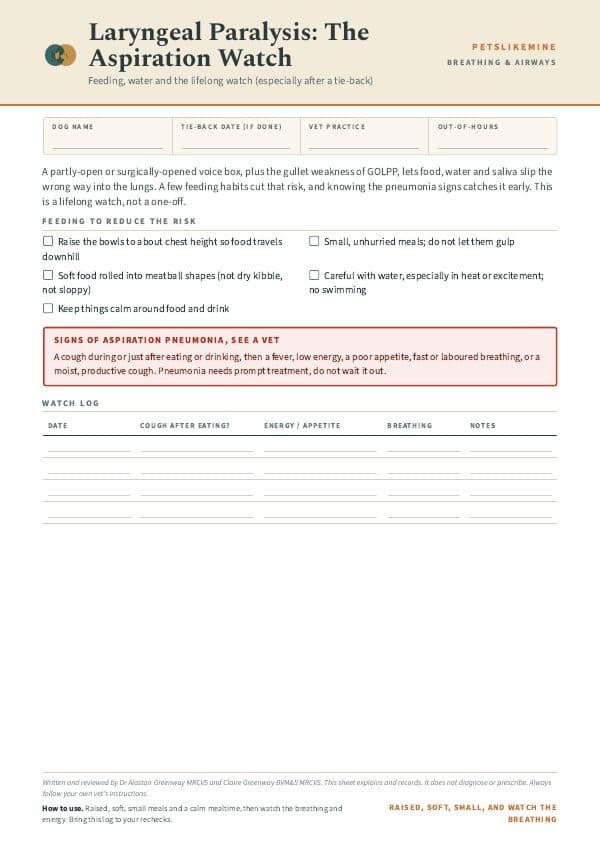
Feed and water from a height. Raising the bowls lets gravity help the meal travel down the gullet instead of pooling at the back of the throat where it can be inhaled. Referral guidance commonly suggests around 8 to 10 inches, roughly 20 to 25cm, off the floor, or feeding from an incline such as a couple of stairs (Animal Surgical Center, n.d.). For a tall dog you may need more. The principle is simply that the head and neck should sit higher than the stomach while they eat and drink, and an elevated feeding station is a sensible setup (American College of Veterinary Surgeons, n.d.).
Soft food, shaped into meatballs. Soft, canned food rolled into round, meatball-sized balls is much easier and safer to swallow than loose food, and UK referral hospitals recommend exactly this, soft food "in the shape of round meatballs" fed from a height (Southfields Veterinary Specialists, n.d.). If your dog is set on kibble, moisten it thoroughly with warm water first (Animal Surgical Center, n.d.). What to avoid is dry, dusty, crumbly food, the easiest of all to inhale, and many surgeons advise steering clear of dry kibble for the rest of a tie-back dog's life (North Downs Specialist Referrals, n.d.; Animal Surgical Center, n.d.).
Small and frequent, never rushed. Smaller meals more often, and small, frequent drinks rather than one long gulping session, are far easier for a faltering swallow than one big bowlful bolted in thirty seconds (Southfields Veterinary Specialists, n.d.; Cornell Riney Canine Health Center, n.d.). If your dog is a fast eater or a frantic drinker, slowing them down is worth real effort.
No swimming, ever, after a tie-back. This is a hard rule, not a "be careful". With the airway held permanently open, if your dog's head goes under water the larynx cannot close to keep it out, and water can be inhaled, with drowning a genuine risk (Animal Surgical Center, n.d.). No paddling pools, no lakes, no sea. I'd rather be blunt about this than gentle.
One more line, lightly, because the full playbook lives elsewhere: heat, panting and excitement all make a compromised airway work harder and the swallow messier, so keeping your dog cool, calm and lean helps here too (North Downs Specialist Referrals, n.d.). Weight is the biggest modifiable lever you have. The heat and exercise crisis has its own guide in heat and exercise safety with laryngeal paralysis, and a harness rather than a collar keeps pressure off the throat on every walk.
Warning signs to act on
This is the safety core, so learn the pattern. Aspiration pneumonia rarely announces itself dramatically at the start. The early signs are quiet and easy to brush off, which is exactly why knowing them matters.
The classic first tell is a new or changed cough, and the giveaway is timing: a cough that appears during or soon after eating or drinking (Animal Surgical Center, n.d.). After that, watch for your dog going off their food, becoming flat and lethargic, running a fever, and a cough that won't settle (Cornell Riney Canine Health Center, n.d.). Breathing that is faster or more laboured than usual belongs on the same list. Any one of these in a dog with laryngeal paralysis, particularly the cough around meals, earns a same-day call to the vet. Don't wait for the full set to appear, and don't wait to see whether it passes.
Some signs mean don't wait at all. A deep, moist or productive cough, your dog becoming dull and depressed, obvious effort to breathe, or gums that look blue or grey, is an emergency now (Animal Surgical Center, n.d.). At that point you're not monitoring, you're driving to the vet.
Now the reassurance, because it's real. Aspiration pneumonia is serious and needs prompt treatment, but it is usually treatable, and the professional surgical bodies are clear that it is less and less commonly fatal, with pets making a full recovery even from severe cases (American College of Veterinary Surgeons, n.d.). Caught early, it generally responds well. I'm deliberately not walking you through the treatment here, because that belongs to recovering from pneumonia at home, and the broader question of any cough tipping into pneumonia sits with when a cough becomes pneumonia. My remit stops at the front door: spot it, and get there quickly.
Living with the lifelong watch
Here's the realistic framing, and I think it's actually the kindest one. This is a watch you keep for life, not a hurdle the surgery cleared for you, because laryngeal paralysis needs lifelong monitoring and management, the GOLPP swallowing problem progresses, and the open airway is permanent, so the habits above don't expire (Cornell Riney Canine Health Center, n.d.). That sounds heavier than it is in practice. Once raised, soft, small and slow become routine, they take no thought at all, and most owners settle into them within a fortnight.
To turn the watch into something concrete rather than a low background worry, lean on two simple tools. Counting your dog's resting breathing rate at home is a genuinely useful early-warning habit: a settled rate is reassuring, and a rate that creeps up over days can be one of the first hints that something, including a brewing pneumonia, is off. The number itself (normal is under about 30 breaths a minute at rest) was validated for heart disease and is used here as a general signal of laboured breathing rather than a pneumonia-specific test, so it's the upward trend you're watching, not a magic threshold (Veterinary Partner, n.d.). The resting breathing rate tracker makes the counting easy, and the Airway Diary is the place to log coughs, any "wrong way" moments around meals, and how your dog copes with exercise, so a pattern shows itself early. For an at-a-glance reminder of the feeding rules and warning signs, the laryngeal paralysis tie-back aspiration watch download is built to live on the fridge.
References
- American College of Veterinary Surgeons. (n.d.). Laryngeal Paralysis. Retrieved from
- Animal Surgical Center. (n.d.). Laryngeal Paralysis (Paralyzed Voice Box). Retrieved from
- Cornell Riney Canine Health Center. (n.d.). Laryngeal paralysis. Cornell University College of Veterinary Medicine. Retrieved from
- Michigan State University GOLPP Research Program. (n.d.). Geriatric Onset Laryngeal Paralysis & Polyneuropathy: information for veterinarians. Retrieved from
- North Downs Specialist Referrals. (n.d.). Laryngeal paralysis. Retrieved from
- Purina Pro Club. (n.d.). Laryngeal Paralysis Is First Sign of General Neurological Paralysis. Retrieved from
- Southfields Veterinary Specialists. (n.d.). Laryngeal Paralysis. Retrieved from
- Stanley, B. J., Hauptman, J. G., Fritz, M. C., Rosenstein, D. S., and Kinns, J. (2010). Esophageal dysfunction in dogs with idiopathic laryngeal paralysis: a controlled cohort study. Veterinary Surgery, 39(2), 139-149.
- Veterinary Partner. (n.d.). Respiratory Rate and Effort in Dogs and Cats. Veterinary Information Network. Retrieved from
- Wilson, D., and Monnet, E. (2016). Risk factors for the development of aspiration pneumonia after unilateral arytenoid lateralization in dogs with laryngeal paralysis: 232 cases (1987-2012). Journal of the American Veterinary Medical Association, 248(2), 188-194.
Free downloads
Companion worksheets to put what you've read into practice. Free PDFs, print at home.
Keep track of how your pet is doing
The owners who cope best are the ones who notice changes early. A simple health log shows you what is working, and what is not, before the next vet visit.
Start tracking, freeYou're not doing this alone
Compare treatment journeys and talk to owners managing breathing & airways. Free to join.
Join PetsLikeMine