

Harness, Not Collar: The Free Daily Change That Takes Pressure Off Your Dog's Airway
Alastair Greenway
BVM&S MRCVS
Swap the collar for a harness. It is the kind of advice that gets said quickly at the end of a busy consult, and then the old collar stays on because it is already hanging by the door. I understand that completely. But of all the things on a long management list, this is one of the cheapest and most genuinely worthwhile, and I want to give it the page it deserves so it actually sticks.
It covers a lot of different dogs: a Yorkie with a collapsing windpipe, a French bulldog who snores and snorts, an old Labrador gone hoarse with laryngeal paralysis, a dog with long-term bronchitis. They all share an airway working harder than it should, and the same rule helps every one of them, so I have written this for the airway itself. The front of a dog's neck is the front of a dog's neck whatever the diagnosis above it.
Why the collar is the problem
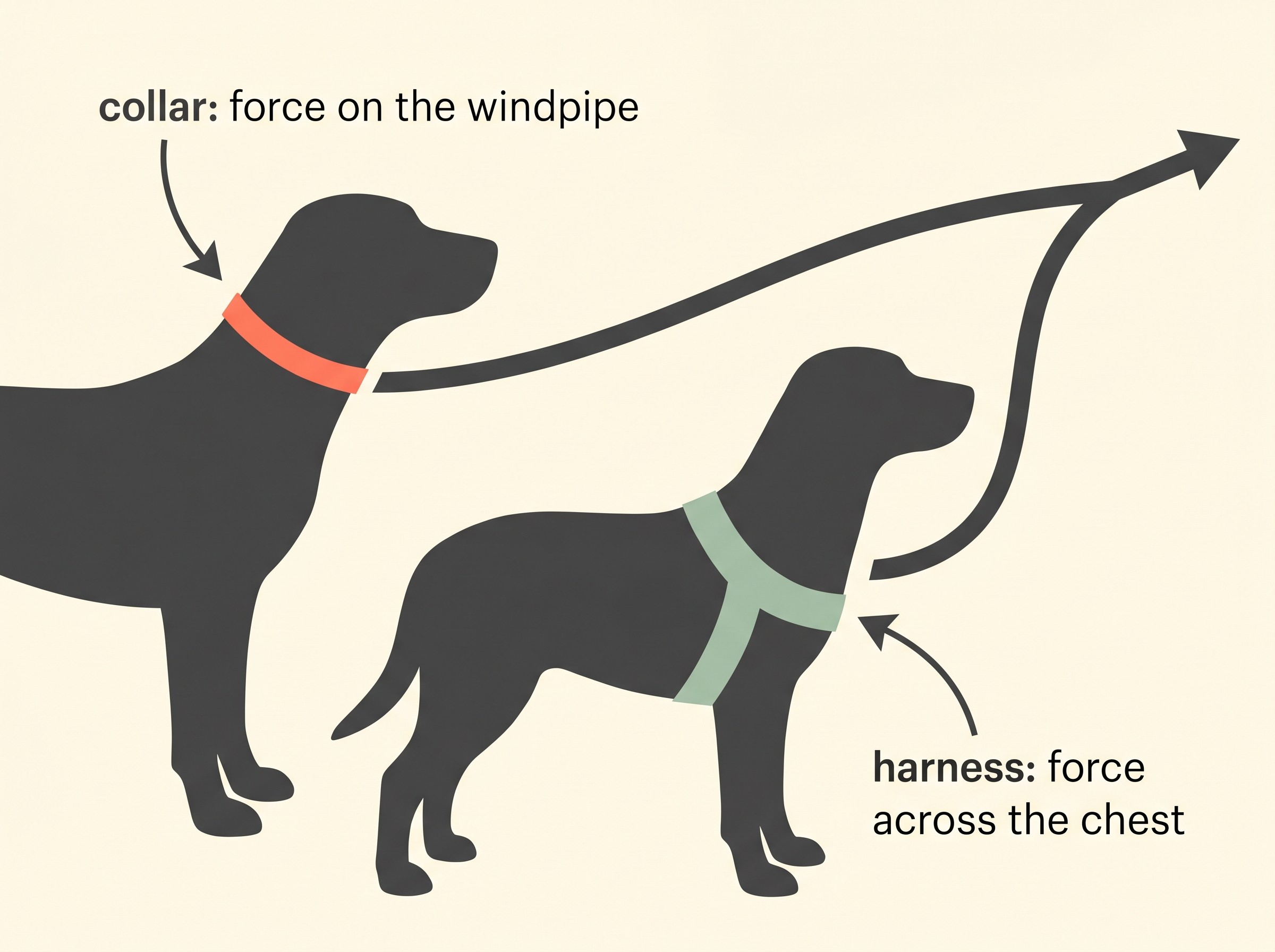
A collar sits in exactly the wrong place. When your dog leans into the lead, lunges at a squirrel, or simply pulls towards the park, all of that force lands on a narrow band around the front of the neck, right over the windpipe and the voice box, the spot an already narrowed, floppy or inflamed airway can least afford to have squeezed. You see this most clearly in collapsing trachea, where the windpipe is soft and tends to flatten. Pressure on the neck from a collar is a classic, named trigger of the honking cough these dogs get, which is why the surgical college and the major referral centres list switching from a neck collar to a body harness as a core, first-line daily change, not an optional extra (American College of Veterinary Surgeons, n.d.; Cornell University Riney Canine Health Center, n.d.; Tappin, 2016). For a flat-faced dog the logic is the same: a collar only adds strain to an airway already compromised by small nostrils, an over-long soft palate and a narrow windpipe (Coates, n.d.).
It is fair to ask how much force we are really talking about, because "it presses on the windpipe" can sound a little hand-wavy. When researchers measured the contact pressure under a collar on dogs walking on a lead, even the gentlest steady pressure was around 4.28 newtons per square centimetre and pulling peaks reached about 44.6, against roughly 0.43 at which sustained loading starts to close off the tiny blood vessels in human skin (Hunter et al., 2019). That last figure is a human skin threshold rather than a proven injury point for a dog's trachea, so I am not claiming a single walk damages the windpipe. But it gives you the scale: even the lightest steady collar pressure they recorded was about ten times that comparison figure, and a hard pull a hundred times. The squeeze is real, and it is not gentle. Worth knowing too: the study found a double-layer padded collar produced the highest pressures of all, because the bulk concentrated the load, so a thicker collar is not the gentle option it looks like.
What the measured evidence now shows
For a long time the case for a harness rested mostly on the windpipe argument. In the last twenty years the measured evidence has caught up, and the clearest line comes from the eye. In a foundational study, neck pressure from a collar raised the pressure inside the eye significantly while the same pressure through a harness did not, and the authors advised a harness for any dog with glaucoma, a fragile cornea, or any condition where raised eye pressure does harm, especially during exercise (Pauli et al., 2006). A recent UK study made it land on the dogs we worry about most: just wearing a collar while standing still raised eye pressure in flat-faced (brachycephalic) dogs, though not in longer-nosed dogs, and exercising in a collar raised it in every dog tested, whereas a harness raised it in neither group (Bailey et al., 2025). These studies report that the pressure went up and in which dogs, rather than a tidy number of millimetres, so I will not invent one. The likely reason is that pressure on the front of the neck squeezes the big jugular veins and backs up the drainage of blood from the head, so a collar is not only pressing on the windpipe but quietly congesting the whole front end.
What makes this the single load-bearing daily rule is that it does not change from one airway disease to the next. Collapsing trachea, brachycephalic obstructive airway syndrome, laryngeal paralysis: the standard supportive advice for all of them is a body harness rather than a neck lead, alongside keeping cool and keeping activity gentle (American College of Veterinary Surgeons, n.d.; Cornell University Riney Canine Health Center, n.d.; Coates, n.d.). One rule, every condition.
Choosing and fitting a harness that actually helps
Here is where I want to save you from the marketing, because the harness aisle is full of confident claims and the truth is simpler. The non-negotiable part is easy: the lead must attach at the chest or the back, so the pull spreads across the chest, shoulders and body rather than landing on the throat. Get that right and you have done the important thing.
Where I would ask you to be sceptical is the idea that there is one perfect, scientifically anointed design. A careful gait study found that both a "restrictive" chest-strap harness and a "non-restrictive" Y-shaped harness reduced shoulder movement at walk and trot, and, counter-intuitively, the Y-shaped one restricted it slightly more, by a couple of degrees (Lafuente et al., 2019). That is not a reason to go back to a collar, but it does take the pressure off the choice: no harness is biomechanically invisible, so fit matters more than the label on the box. Aim for one that:
- clears the front of the throat completely, so nothing crosses where a collar would sit
- does not dig into the armpits or cut across the point of the shoulder
- sits snugly but not tight: a couple of fingers should slide under any strap, yet it should not slip, rotate or ride up
- lets the front legs swing freely
For a dog that pulls, a front-clip attachment takes some strain out of the lead without anything tightening on the neck. For a flat-faced dog, choose something light and breathable, ideally a mesh, because a bulky padded harness adds warmth to a dog who already struggles to keep cool (Coates, n.d.).
There is one neat bonus for the older, larger dog. Laryngeal paralysis in these dogs is usually not a stand-alone throat problem but the first sign of a slowly progressive, body-wide nerve disease, GOLPP, so the same dog who needs a harness for the airway tends to develop weakness in the back legs too (Stanley et al., 2010). A support harness with a sturdy back handle lets you help that dog up steps or into the car without hauling on the neck: a genuine two-birds win. The nerve disease itself belongs with GOLPP as a whole-body condition and the mobility space.
What else costs nothing and goes with it
The harness earns top billing, but it is not the only cheap daily win for a breathing-compromised dog. Think of these as the cluster that travels with it. None is a cure, and all help a little, every day, which is exactly the kind of help a chronic airway needs.
Keep them lean. This is the biggest modifiable lever of the lot. Carrying extra weight makes every breath harder, and the authorities do not soften it: the veterinary manual calls weight loss "critical" in managing tracheal collapse, and obesity is significantly linked with worse brachycephalic breathing, to the point that weight loss is advised before surgery is even considered (Merck/MSD Veterinary Manual, n.d.; University of Cambridge BOAS Research Group, n.d.). I say this with no judgement, because a heavy dog is almost always a well-loved one and a slimming plan is a kindness, not a telling-off. The how-to-lose-it belongs with the Weight Management home.
Walk in the cool, keep it gentle, and dial down the excitement. Heat, humidity, hard exercise and over-excitement all spike the demand for air a compromised airway cannot meet. The Cambridge BOAS group's plain advice is to avoid exercising excessively or on hot days, and to keep the dog away from situations that wind it up into too much excitement or stress (University of Cambridge BOAS Research Group, n.d.). For a flat-faced dog, that combination of heat and exertion is the recipe for heatstroke, a genuine emergency in these breeds, and I am keeping that seasonal life-saving detail off this page on purpose so it lives where it can be foregrounded.
Cut the airway irritants. Tobacco smoke is top of the list, vaping included, along with aerosol sprays, plug-in air fresheners and dust, all of which the trachea and brachycephalic guidance single out as things to remove from a sensitive airway's day (American College of Veterinary Surgeons, n.d.; Cornell University Riney Canine Health Center, n.d.). The room-by-room of home air is the job of home for easy breathing.
Track the breathing. Pair these changes with something that shows whether they are working, otherwise you are guessing. The Airway Episode and Exertion Diary logs coughs, episodes, exercise tolerance and how warm the day was, and it is the natural place to record your dog's resting breathing rate: the quiet number you count while they sleep, and the most useful early-warning sign you can keep at home. As a rough guide, most healthy dogs rest at under about 30 breaths a minute, so a rate that sits above that, and especially one creeping up over several days, is worth a word with your vet rather than a wait-and-see.
For all five levers in one place, that is what living with a breathing condition is for, and this page is the detailed look at its harness lever. If your dog's problem is a long-term cough, calming a chronic cough at home walks the daily management through practically.
Making the switch stick
Knowing you should use a harness and actually using one are two different things, so let me close with the bit that fails most often: the habit.
People sometimes worry about losing the collar for identification, but the danger is the lead's force on the neck, not the mere presence of something around it (Hunter et al., 2019; Bailey et al., 2025). So if you want a tag for ID, keep a flat tag collar on loosely with no lead ever attached, or clip the tag onto the harness. Introduce the new harness over a few days with treats and short happy sessions so it becomes a good thing rather than a wrestling match, then leave it hanging by the door on top of the lead so reaching for the walk means reaching for the harness. Make it the default and the old collar quietly retires itself.
None of this treats the disease underneath. The windpipe is still soft, the palate still long, the nerves still tiring. What the harness does is remove one daily insult to the airway, for free, on every walk, which is precisely why it sits at the very top of the daily list. Put it together with keeping your dog lean, cool, calm and breathing clean air, and you have changed several things the airway feels every day for the price of one harness and a handful of habits. Hang the harness on the door tonight, open the diary tomorrow, and let the pattern show you what your dog has been trying to tell you all along.
References
- American College of Veterinary Surgeons. (n.d.). Tracheal Collapse (Small Animal Topic). Retrieved June 2026 from
- Bailey, M. E., Packer, M. J., & Wills, A. P. (2025). Effect of a collar and harness on intraocular pressure and respiration rate of brachycephalic and dolichocephalic dogs. Veterinary Medicine and Science, 11(3), e70384.
- Coates, J. (n.d.). Why Flat-Faced Breeds Need Dog Harnesses Instead of Collars. PetMD. Retrieved June 2026 from
- Cornell University College of Veterinary Medicine, Riney Canine Health Center. (n.d.). Tracheal Collapse. Retrieved June 2026 from
- Hunter, A., Blake, S., & Ferro De Godoy, R. (2019). Pressure and force on the canine neck when exercised using a collar and leash. Veterinary and Animal Science, 8, 100082.
- Lafuente, M. P., Provis, L., & Schmalz, E. A. (2019). Effects of restrictive and non-restrictive harnesses on shoulder extension in dogs at walk and trot. Veterinary Record, 184(2), 64.
- Merck/MSD Veterinary Manual. (n.d.). Tracheal Collapse in Dogs (pet-owner version). Retrieved June 2026 from
- Pauli, A. M., Bentley, E., Diehl, K. A., & Miller, P. E. (2006). Effects of the application of neck pressure by a collar or harness on intraocular pressure in dogs. Journal of the American Animal Hospital Association, 42(3), 207-211.
- Stanley, B. J., Hauptman, J. G., Fritz, M. C., Rosenstein, D. S., & Kinns, J. (2010). Esophageal dysfunction in dogs with idiopathic laryngeal paralysis: a controlled cohort study. Veterinary Surgery, 39(2), 139-149.
- Tappin, S. W. (2016). Canine tracheal collapse. Journal of Small Animal Practice, 57(1), 9-17.
- University of Cambridge BOAS Research Group, Department of Veterinary Medicine. (n.d.). Management & Treatment of BOAS. Retrieved June 2026 from
Keep track of how your pet is doing
The owners who cope best are the ones who notice changes early. A simple health log shows you what is working, and what is not, before the next vet visit.
Start tracking, freeYou're not doing this alone
Compare treatment journeys and talk to owners managing breathing & airways. Free to join.
Join PetsLikeMine