

Making Your Home a Place for Easy Breathing
Alastair Greenway
BVM&S MRCVS
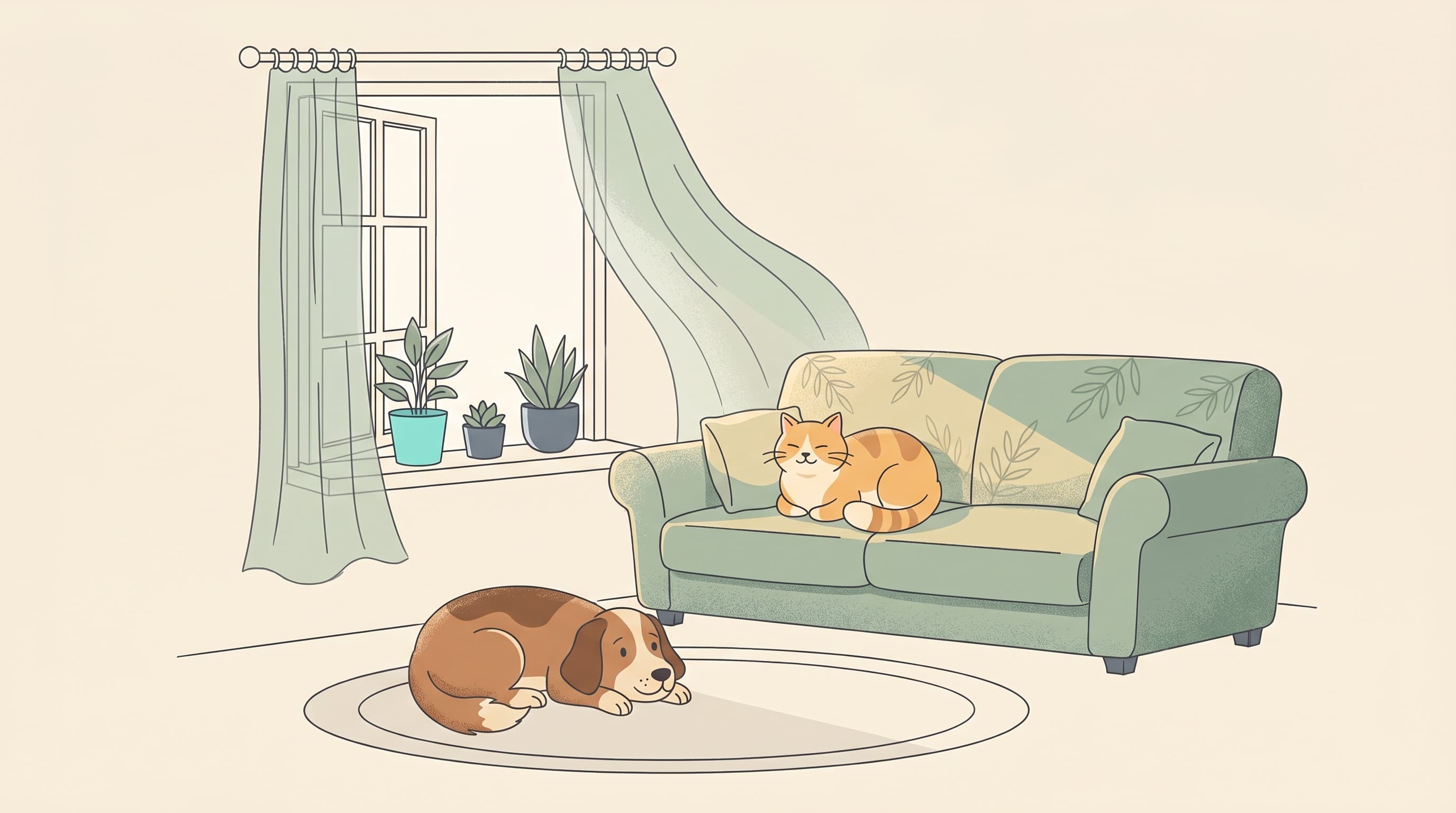
A pet with a breathing condition, an asthmatic cat, a flat-faced dog, a windpipe that collapses, a long-term cough, gets most of the attention pointed at the medicine and the vet visits, and rightly so. But your pet spends most of its life not at the clinic, breathing your air, hundreds of times an hour, day and night. That air is one of the few things in this whole picture you control completely, for free, starting this afternoon, and it makes a measurable difference to how hard your pet's lungs work.
So let me walk you through your home the way I would if I came round, candid throughout about which changes are backed by firm evidence and which are sensible-but-unproven, so you know where to put your effort. This piece is about the environment. The wider day-to-day bundle, the harness, the weight, the pacing, lives in the cross-condition playbook, and I'll hand the pieces I don't own across as we go.
One firm line before anything else
If your cat is ever breathing with its mouth open, if its gums look blue or grey, or if it's heaving with its belly to get air, that is an emergency. Go to a vet now. Don't finish reading, don't stop to film it. Cats almost never breathe through an open mouth unless they are in real trouble, and open-mouth breathing with grey or blue gums reflects a major loss of lung function that can precede respiratory arrest (Tonozzi, 2026). No tidy home undoes a crisis, so if that's where you are, the breathing triage tool and your nearest emergency vet come first. Everything below is for calmer days.
The clean-air principle, and why it's not just a cat thing
An inflamed or narrowed airway is touchier than a healthy one, so the irritants in household air, the ones a normal pet shrugs off, can tip a compromised one into coughing, wheezing or a flare. Cutting that load is a real lever, and it's one you hold, not the vet.
Cornell put it plainly: "The more we prevent our cats from coming in contact with cigarette smoke, dust mites, irritating cat litter and other bronchial irritants, the fewer cats will need asthma treatment" (Cornell Feline Health Center, n.d.). The MSD Veterinary Manual agrees that avoidance of environmental aeroallergens like cigarette smoke, perfumes, pollens, moulds and dust must be considered in managing an asthmatic cat, alongside the medication rather than instead of it (Tonozzi, 2022). Strikingly, the same advice turns up independently on the dog side: the collapsing-trachea guidance tells owners to switch to a harness, avoid respiratory irritants like cigarette smoke and avoid hot, humid environments (Cornell Riney Canine Health Center, n.d.), and the Cambridge BOAS group says much the same about heat and stress for flat-faced dogs (University of Cambridge BOAS Research Group, n.d.). When the cat and dog specialists reach the same conclusion separately, you can trust it.
So who are the usual suspects? Tobacco and vape smoke, dusty or scented cat litter, aerosol sprays, air fresheners and plug-ins, perfume and scented cleaning products, smoke from fireplaces, candles and incense, household dust and dust mites, and pollen, mould and damp (Cornell Feline Health Center, n.d.; Tonozzi, 2022; Lee-Fowler, 2018). Let's take the ones that matter most, in order of how firmly the evidence backs them.
Smoke: the one to be unhedged about
Tobacco smoke is the best-supported harmful thing in a pet's home air, and it earns a firm, unhedged line: no smoking or vaping around your pet, ideally not indoors at all.
It isn't just an asthma trigger, it's a disease risk in its own right. In cats, living with household smoke roughly doubles the risk of malignant lymphoma (adjusted relative risk 2.4), climbing higher still, to around 3.2, with five or more years of exposure (Bertone et al., 2002). In long-nosed dogs specifically, it's linked to cancer of the nose and sinuses (odds ratio around 2.0, rising towards 2.5 at the heaviest exposure), the carcinogens lodging in those long nasal passages; the effect did not show in short and medium-nosed dogs, so this is an "especially long-nosed dogs" point rather than a blanket one (Reif et al., 1998). A recent scoping review found that over half the studies on disease outcomes reported real associations between secondhand smoke and cancer or respiratory or cardiovascular disease in dogs and cats, and is blunt that there is no safe level of exposure (Cerquetella et al., 2026).
And here's the part that catches people out, the reason "I only smoke by the window" isn't enough. The smoke doesn't vanish when you exhale, it settles, onto surfaces, soft furnishings and your pet's coat, and the pet then swallows it grooming. A UK study measured nicotine in cats' fur and found it markedly higher in cats whose owners reported smoking at home, so the residue genuinely builds up on the coat and the cat acts as a living sentinel of the household's smoke (Smith et al., 2017). Because cats groom almost constantly, they ingest that residue, part of why smoking households carry a higher risk of oral cancer in cats too (Cerquetella et al., 2026). The residue is in the room either way, so smoking outside, fully, is the kind thing. Vaping hasn't been studied in pets the way tobacco has, in fact the same review found no eligible studies on e-cigarette aerosol in pets at all, but with the aerosol settling the same way, the sensible line is to treat it as off-limits indoors too (Cerquetella et al., 2026).
The air you can't see: particulate and fragrance
After smoke comes the fine particulate and chemical vapours drifting through indoor air, the stuff you mostly can't see or, sometimes, can very much smell. There's now real veterinary data here, and the species story is interesting. In a study of 348 pets, cats with respiratory disease lived in homes with significantly higher fine-particulate (PM2.5) levels (a median of 38.6 versus 27.4 micrograms per cubic metre), and cats in homes above the "unacceptable" threshold of 35 micrograms per cubic metre were over four times more likely to have respiratory disease (odds ratio 4.13) (Lin et al., 2018). A follow-up found dogs living with excess particulate or raised volatile organic compounds showed an inflamed, hypercellular response deep in their airways, and incense exposure was more common in dogs with respiratory disease (Lin et al., 2020). The nuance is worth keeping: in cats the strongest signal was the particle level, whereas in dogs household particulate alone wasn't the discriminator, the signal leaned more on vapours and incense (Lin et al., 2018; Lin et al., 2020). But the headline holds, and its everyday sources, smoke, incense, candles, sprays, cooking, dust, are exactly what you can dial down.
Which brings me, gently, to scented "wellness" products. A nice-smelling home is lovely and I'm not here to lecture, but air fresheners, plug-ins, scented candles and incense release volatile organic compounds and fine particulate into the very air your pet breathes, and in a non-smoking home candle use can become the single biggest source of indoor particulate (Mishra & Coggins, 2024). A masking scent doesn't clean the air, it adds to the load. Swapping the plug-in and the candle for an open window is an easy win.
Essential-oil diffusers deserve a specific word for cat owners. Beyond the scent load, inhaled essential-oil vapour can irritate a cat's airways directly, a watery nose and eyes, a burning sensation, drooling, even difficulty breathing, and cats with existing asthma or airway disease are more vulnerable still (Pet Poison Helpline, n.d.). No essential oil is established as safe for cats, and the welfare advice is plainly that if a pet has a history of breathing problems it's best to avoid a diffuser altogether (ASPCA, n.d.). For an asthmatic cat, the rule is simple: skip the diffuser.
Cool, airy, calm: the atmosphere of the rooms
Two more levers are less about what's in the air and more about its temperature and pace. A compromised airway works harder in hot, humid, stagnant air, which is why the collapsing-trachea guidance tells owners to avoid hot and humid environments that worsen the cough (Cornell Riney Canine Health Center, n.d.), and why flat-faced dogs, who already struggle to regulate their body temperature, should be kept from overheated rooms and from too much excitement (University of Cambridge BOAS Research Group, n.d.). Keep sleeping spots cool and well-ventilated, don't let rooms get hot, stuffy or muggy, and offer a cool mat or tiled floor in warm weather. There's no validated "ideal humidity percentage" for pets, so aim for "not hot, not stuffy, not muggy" rather than chase a number. The acute danger, heatstroke in flat-faced dogs, is its own emergency, handed off in full to the flat-faced heatstroke guide.
Calm is the other half. Excitement spikes the demand for air, the doorbell, the over-the-top greeting, the rough game, and a surge can tip a stable airway into coughing or worse, which is why the brachycephalic advice flags keeping a dog away from situations that cause too much excitement or stress (University of Cambridge BOAS Research Group, n.d.). So keep the atmosphere unhurried: a managed front door, a quiet retreat for the cat. The exercise side of pacing belongs with the harness, not collar piece, and a collar pressing straight on the windpipe is the single daily change I'd push hardest for any airway dog.
Litter and bedding: the cat-specific corner
One swap is particular to cats, and I'll hand the full feline trigger hunt to the asthma triggers article. Litter is the big one. Dusty clay and silica litters throw fine particles straight into the air at nose height, right where the cat is digging and breathing, and a scented litter or a deodoriser by the tray adds fragrance on top (Cornell Feline Health Center, n.d.; Lee-Fowler, 2018). A low-dust, unscented litter is the single most actionable feline change you can make, and keeping the tray well-ventilated rather than shut in a small cupboard helps too. It's a low-risk improvement rather than a proven cure, but it's cheap, easy and points the right way.
What about an air purifier?
People ask me about HEPA filters constantly. One does trap the fine airborne particles we've been talking about, dander, dust, pollen, mould spores, and the particulate that Lin's work showed matters to a cat's lungs (Lin et al., 2018), so on paper it should help. But be clear-eyed: it is supportive, not a treatment, it never replaces the medication, and there's no controlled evidence proving it changes outcomes in pets, the case for it is borrowed from human asthma and from the physics of what the filter removes. Put it behind the cheaper, better-proven wins, no smoke, low-dust litter, ditching the sprays, opening a window. Add a purifier as a reasonable extra, not the thing you rely on.
How to actually find your pet's triggers
That list of suspects can read like an instruction to sterilise your whole life. It isn't. You rarely pin down a single villain, it's almost always the cumulative load, and that's oddly freeing, because every reduction stacks up even if you never find one smoking gun. So the method isn't detective work, it's a diary. Cornell calls it a trial-and-error approach to asthma-proofing the home (Cornell Feline Health Center, n.d.), and the practical version is to pair any cough or flare with what changed: a new litter, a candle lit, cleaning day, a visitor who smokes, a shift in the season. Over a few weeks the pattern usually shows itself. This is exactly what the Airway Diary is built for, logging episodes alongside what was going on, so the home audit becomes something you can see rather than guess at. To watch the effect on the breathing itself, the breathing rate tracker lets you do that, though I'll leave what the numbers mean to the monitoring siblings.
None of this replaces the medicine, and I'd never want a line here read as "fix the house instead of treating the condition". The treatment does the heavy lifting, and a breathe-easy home is the quiet, free help you stack underneath it. Start with the window and the smoke today, add the litter and the diffuser this week, keep a diary as you go, and let the small wins add up. Your pet won't know why the air got easier. It'll just breathe a little better, in the place it spends almost all its life.
References
- ASPCA. (n.d.). The essentials of essential oils around pets. Retrieved from
- Bertone, E. R., Snyder, L. A., & Moore, A. S. (2002). Environmental tobacco smoke and risk of malignant lymphoma in pet cats. American Journal of Epidemiology, 156(3), 268-273.
- Cerquetella, M., Zagà, V., Gardi, V., Marchegiani, A., Vitturini, C., & Cattaruzza, M. S. (2026). Secondhand smoke and e-cigarette aerosol exposure in dogs and cats: A scoping review with implications for smoking cessation among pet owners. Tobacco Prevention & Cessation, 12, 19.
- Cornell Feline Health Center. (n.d.). Feline asthma: A risky business for many cats. Cornell University College of Veterinary Medicine. Retrieved from
- Cornell Riney Canine Health Center. (n.d.). Tracheal collapse. Cornell University College of Veterinary Medicine. Retrieved from
- Lee-Fowler, T. (2018). Asthma in cats: Acute and long-term management guidelines. Today's Veterinary Practice, May/June 2018. Retrieved from
- Lin, C.-H., Lo, P.-Y., Wu, H.-D., Chang, C., & Wang, L.-C. (2018). Association between indoor air pollution and respiratory disease in companion dogs and cats. Journal of Veterinary Internal Medicine, 32(3), 1259-1267.
- Lin, C.-H., Lo, P.-Y., & Wu, H.-D. (2020). An observational study of the role of indoor air pollution in pets with naturally acquired bronchial/lung disease. Veterinary Medicine and Science, 6(3), 314-320.
- Mishra, A. K., & Coggins, M. (2024). How home fragrances can impact indoor air quality and your health. The Conversation. Retrieved from
- Pet Poison Helpline. (n.d.). Essential oils and cats. Retrieved from
- Reif, J. S., Bruns, C., & Lower, K. S. (1998). Cancer of the nasal cavity and paranasal sinuses and exposure to environmental tobacco smoke in pet dogs. American Journal of Epidemiology, 147(5), 488-492.
- Smith, V. A., McBrearty, A. R., Watson, D. G., Mellor, D. J., Spence, S., & Knottenbelt, C. (2017). Hair nicotine concentration measurement in cats and its relationship to owner-reported environmental tobacco smoke exposure. Journal of Small Animal Practice, 58(1), 3-9.
- Tonozzi, C. C. (2022). Feline bronchial asthma. MSD (Merck) Veterinary Manual. Retrieved from
- Tonozzi, C. C. (2026). Clinical signs of respiratory disease in animals. MSD (Merck) Veterinary Manual. Retrieved from
- University of Cambridge BOAS Research Group. (n.d.). Management & treatment of BOAS. Department of Veterinary Medicine. Retrieved from
Keep track of how your pet is doing
The owners who cope best are the ones who notice changes early. A simple health log shows you what is working, and what is not, before the next vet visit.
Start tracking, freeYou're not doing this alone
Compare treatment journeys and talk to owners managing breathing & airways. Free to join.
Join PetsLikeMine