


Feline Asthma Triggers: Hunting the Things That Set Your Cat Off
Alastair Greenway
BVM&S MRCVS
Once the diagnosis is in and the inhaler routine has settled, almost every owner asks the same practical question next: what's setting it off, and can I do something about it at home? It's the right instinct. Feline asthma is, at heart, a problem of over-reactive airways, so the air your cat breathes all day genuinely matters. Take some of the irritation out of that air and you can often take some of the heat out of the disease.
First, one line has to sit at the top of a page like this, because it's the one that saves lives. A cat breathing with its mouth open, with gums that look blue or grey, or breathing hard from the belly, is an emergency. That cat needs a vet now. Don't wait, don't try the inhaler a couple more times first, and don't stop to film it. We cover exactly what to do in that moment in what to do in a feline asthma attack, and the breathing triage tool will sort a now-emergency from a watch-and-book in a few taps. Everything below is about the quieter, longer game of reducing how often your cat gets anywhere near that point.

Why triggers matter at all
Feline asthma is an allergic, hypersensitivity-type disease of the lower airways. The current understanding is that it behaves like a type I hypersensitivity reaction: the cat's immune system makes antibodies against an inhaled allergen, and on the next exposure those antibodies set off a cascade that floods the airways with inflammatory cells. The lining of the bronchi swells, the muscle around them contracts, and the airway narrows (Cornell Feline Health Center, n.d.-a; Cornell Feline Health Center, n.d.-b; Norsworthy, 2009; Trzil and Reinero, 2014). That narrowing is exactly why an asthmatic cat struggles to push air back out and ends up crouched and coughing.
This is also precisely why reducing exposure helps. An asthmatic cat's airways are primed to over-react to what they breathe in, so the fewer provoking particles in the air, the less often that cascade fires. It isn't a cure, as I'll spell out further down, but it's a real and sensible lever. Asthma is not rare, either: it affects around 1% of pet cats, with some reviews putting the figure as high as 5% (Cornell Feline Health Center, n.d.-a; Trzil, 2020). I'll stay on triggers and the home environment here. The full picture of what asthma is and how it's diagnosed lives in the complete guide to feline asthma.
The usual suspects
Reassuringly, the list of common triggers is fairly consistent wherever you look, which gives you a sensible starting set to work through. The authorities line up well on it (Cornell Feline Health Center, n.d.-a; Norsworthy, 2009; MSD Veterinary Manual, 2022; International Cat Care, n.d.; Lee-Fowler, 2018). The most frequently named culprits are:
- Tobacco smoke, and the residue it leaves on surfaces and fur.
- Dusty or scented cat litter, both the dust it throws up and the added fragrances and deodorising granules.
- Aerosols and sprays: household deodorisers and air fresheners, hairspray, furniture polish, flea sprays and flea powders.
- Scented cleaning products and disinfectants, especially the strongly perfumed ones.
- Perfume, essential-oil diffusers, scented candles and incense, anything designed to push a strong scent into the air.
- Smoke from fireplaces and candles.
- Pollen from trees, weeds and grasses, mould and mildew, and house dust mites.
- Even some foods, occasionally, although this is far less common than the inhaled triggers.
It's worth knowing that the same household allergens that bother people, dust mites being the classic example, are biologically relevant to cats too. Your cat shares your indoor air and your exposures, and feline asthma genuinely resembles human allergic asthma, though it's fair to say the evidence linking specific shared allergens to disease in both species is still limited (Reinero et al., 2009). So if a product makes a person in the house cough or sneeze, it's reasonable to wonder about the cat as well.
Two of these earn a firmer word than the rest, because the evidence behind them is stronger.
Tobacco smoke is the one to be unambiguous about. It's a named asthma trigger, but it does more harm than that. Living with environmental tobacco smoke roughly doubles a cat's risk of malignant lymphoma, a cancer, and the risk climbs the longer the exposure goes on: about two and a half times the risk overall, and more than three times with five or more years of exposure (Bertone et al., 2002). So this is the recommendation I won't soften. No smoking around the cat, and ideally not in the home at all.
Litter dust is the single most actionable thing in most homes, and unlike the weather or the pollen count it's entirely within your control (Norsworthy, 2009; MSD Veterinary Manual, 2022; Lee-Fowler, 2018). Let me be straight about the evidence here. We don't have a controlled study proving that a litter switch cures feline asthma. What we do have is the consistent expert advice to reduce dust, plus a sobering reminder that inhaled silica from clay-based (bentonite) litter is a real airway hazard. In one documented case it caused serious granulomatous lung disease in a person who had been heavily exposed to it for years (Hubska et al., 2022). That doesn't prove your cat's litter caused their asthma. It does make a low-dust litter a very sensible, very low-risk change to try.
Pinning down your cat's own triggers
This is the part that turns a generic list into something useful for your specific cat. The single trigger is usually never pinned down, but you can often spot what makes your cat worse, and the way to do it is to watch and write it down.
The method is simple: log every cough, wheeze or attack against what changed in the environment around it. Did you light a candle, switch the litter brand, clean with a new spray, have a visitor who smoked, or is it the week the tree pollen spiked? Over a few weeks, patterns surface that you'd never catch in the moment. A useful clue to watch for is timing and place: in some cats the problem turns out to be seasonal, or it only flares in particular rooms, and that is often the thread that leads you to a real, removable irritant (International Cat Care, n.d.). This is exactly what the Airway Episode and Exertion Diary is built for: it pairs your cat's episodes with what's going on around them, so the connections become visible instead of guessed at.
A quick word on what not to bother with, because it saves money and false hope. Blood "allergy tests" are a poor way to hunt a cat's triggers. When cats with lower-airway disease are tested, house dust mite is the commonest reaction, but here's the catch: perfectly healthy cats react just as much, in fact more, and the blood and skin tests frequently disagree with each other (Hartung et al., 2023). A positive result mostly tells you the cat has been exposed to something at some point, not that it's driving the asthma. A patient home diary will serve you far better than a lab panel.
The practical swaps
Once you've a sense of the suspects, the changes themselves are mostly common sense, and none of them carries any real downside (Cornell Feline Health Center, n.d.-a; MSD Veterinary Manual, 2022; International Cat Care, n.d.; Lee-Fowler, 2018):
- Switch to a low-dust, unscented litter. Avoid the scented and deodorising kinds, and any litter that visibly clouds when you pour it. Pour it gently, away from the cat.
- Stop smoking indoors, ideally entirely.
- Retire the sprays near the cat. Air fresheners, aerosol deodorisers, hairspray and scented cleaners all swap easily for unscented or wipe-on alternatives.
- Put away the diffusers and scented candles, at least in the rooms your cat actually uses.
- Bring the everyday dust down with regular vacuuming and dusting, and keep an eye on heavily fabric rooms, where dust and mites gather.
- Mind the damp. Tackle mould and mildew, and keep rooms ventilated.
- Help the air quality. Good ventilation helps, and a HEPA air filter is a reasonable thing to try, with the caveat below.
One caveat, to keep you from over-investing. Several of these measures, the air purifiers and the broader allergen-avoidance ideas in particular, are borrowed from human asthma and have not been rigorously tested or proven specifically in cats (Cornell Feline Health Center, n.d.-b; MSD Veterinary Manual, 2022). That's no reason to skip the cheap, easy, low-risk swaps like litter and smoke. It is a reason not to spend a fortune on gadgets expecting a miracle.
It's the load, not a single culprit
Here's the part most pages skip, and the part I most want you to hold onto. You will probably never identify the one single thing that triggers your cat. The specific antigens that set off an attack are usually never pinned down in an individual cat, and reducing exposure, while worth doing, is usually not curative on its own (Norsworthy, 2009; MSD Veterinary Manual, 2022; Lee-Fowler, 2018).
So don't frame this as a detective story with one guilty party at the end. Frame it as lowering the total burden. Asthmatic airways react to the sum of what they breathe: the dust plus the candle plus the pollen plus the new cleaner. Every irritant you remove lightens that cumulative load a little. You're turning a dial down, not flicking a single switch off.
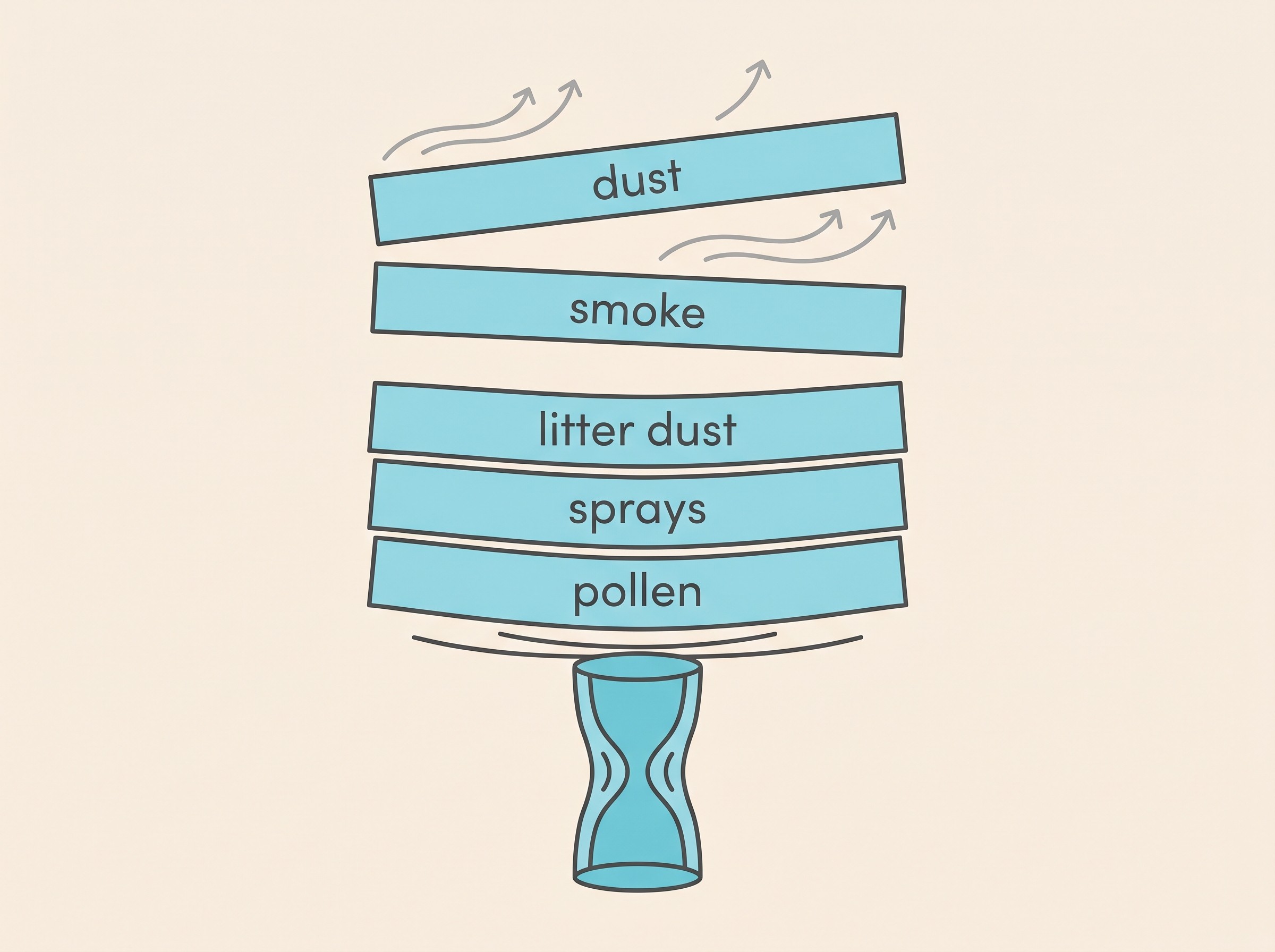
Some cats improve noticeably once a couple of big triggers go. Others change less, and that doesn't mean you've failed. It means their airways are reactive enough that the air alone was never going to be the whole answer.
Which brings me to the thing I won't let environmental control quietly displace. The medication is the backbone of managing this disease, and it stays the backbone (Trzil, 2020; MSD Veterinary Manual, 2022). Trigger-reduction sits alongside the daily controller inhaler that calms the airways, never instead of it. It's genuinely tempting, when the house is cleaner and the cat seems well, to wonder whether you can ease off the inhaler. Please don't make that call on your own. Why inhaled treatment is preferred, and how any change should be handled, are set out in feline asthma medicines, and any adjustment belongs with your vet.
If you want the deeper environmental-allergen science, the immunology and how indoor allergens behave more broadly, that's the territory of our Allergies and Skin home, where the feline atopic syndrome piece is the closest cousin to this one.
Where this leaves you
Of everything in managing feline asthma, the trigger hunt is the part that sits entirely in your hands. You can't change your cat's airways, but you can change the air, and even modest wins, a cleaner litter, a smoke-free home, a few sprays retired to the cupboard, tend to add up to fewer of those frightening crouched, coughing episodes over a year. So start small and start measurable. Pick the two biggest, easiest changes for your household, almost always the litter and the smoke, make them this week, and let the Airway Diary tell you over the next month whether your cat's episodes are easing. Keep the controller going throughout, hold the emergency line at the top of this page in mind, and you'll be doing the quiet, steady work that lets a well-managed asthmatic cat live a full and comfortable life.
References
- Bertone, E. R., Snyder, L. A., and Moore, A. S. (2002). Environmental tobacco smoke and risk of malignant lymphoma in pet cats. American Journal of Epidemiology, 156(3), 268-273.
- Cornell Feline Health Center. (n.d.-a). Feline asthma: a risky business for many cats. Cornell University College of Veterinary Medicine.
- Cornell Feline Health Center. (n.d.-b). Feline asthma: what you need to know. Cornell University College of Veterinary Medicine.
- Hartung, B. F., Mueller, R. S., Gauss, J., et al. (2023). Reactions to environmental allergens in cats with feline lower airway disease. Frontiers in Veterinary Science, 10, 1267496.
- Hubska, J., Shahnazaryan, U., Rosłon, M., et al. (2022). Sarcoid-like lung disease as a reaction to silica from exposure to bentonite cat litter complicated by end-stage renal failure: a case report. International Journal of Environmental Research and Public Health, 19(19), 12921.
- International Cat Care. (n.d.). Asthma and chronic bronchitis in cats.
- Lee-Fowler, T. (2018). Asthma in cats: acute and long-term management guidelines. Today's Veterinary Practice, May/June 2018 (updated August 2022).
- MSD Veterinary Manual. (2022). Feline bronchial asthma (Tonozzi, C. C.).
- Norsworthy, G. D. (2009). Allergens can trigger feline asthma. Veterinary Practice News, 17 April 2009.
- Reinero, C. R., DeClue, A. E., and Rabinowitz, P. (2009). Asthma in humans and cats: is there a common sensitivity to aeroallergens in shared environments? Environmental Research, 109(5), 634-640.
- Trzil, J. E. (2020). Feline asthma: diagnostic and treatment update. Veterinary Clinics of North America: Small Animal Practice, 50(2), 375-391.
- Trzil, J. E., and Reinero, C. R. (2014). Update on feline asthma. Veterinary Clinics of North America: Small Animal Practice, 44(1), 91-105.
Keep track of how your pet is doing
The owners who cope best are the ones who notice changes early. A simple health log shows you what is working, and what is not, before the next vet visit.
Start tracking, freeYou're not doing this alone
Compare treatment journeys and talk to owners managing breathing & airways. Free to join.
Join PetsLikeMine