

Feline Asthma: The Complete Guide
Alastair Greenway
BVM&S MRCVS
Most cats reach a feline asthma diagnosis by a roundabout route. For months the cat does that thing, crouching low, neck stretched out, hacking away as if a hairball is finally on its way, and then nothing comes up. You clear the rug, you wait for the hairball that never appears, and you half-file it under "one of her quirks". Then one evening she does it harder, her sides heaving, and it stops looking like a quirk at all.
If that's roughly your story, here's the one thing the internet rarely gives you: a single, candid, complete picture, with the frightening bits handled properly and the reassuring bits not oversold. Feline asthma is common, lifelong, and genuinely very manageable for the great majority of cats. But it asks something of you, and you deserve the whole arc before you're in a consult room nodding at words like fluticasone and bronchoalveolar lavage.
First, the line that matters most. A cat breathing with its mouth open, with blue, grey or pale gums, or breathing hard from the belly, is an emergency. That is a vet, now. Do not wait to see if it settles, and do not stop to film it. Cats hide illness brilliantly, so by the time the breathing is visibly hard, the margin is thin (Cornell Feline Health Center, n.d.-a; Lee-Fowler, 2018). Keep that sentence in mind, because everything else here is the calmer, longer game of keeping your cat well away from that moment. The in-the-moment playbook, including the rescue inhaler if your vet has set one up, has its own home in what to do in a feline asthma attack, and I'd read it while you're calm.
What feline asthma actually is
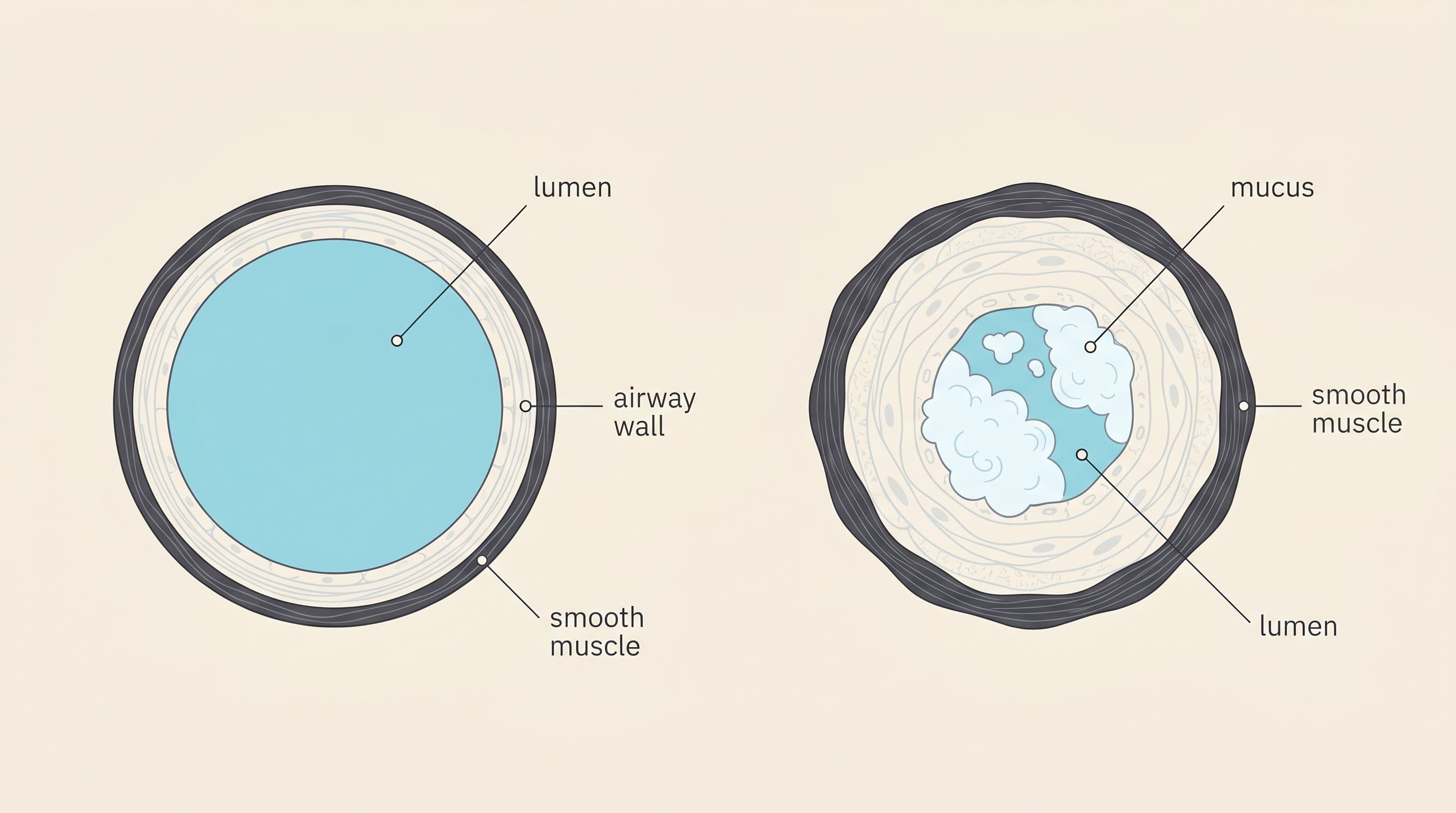
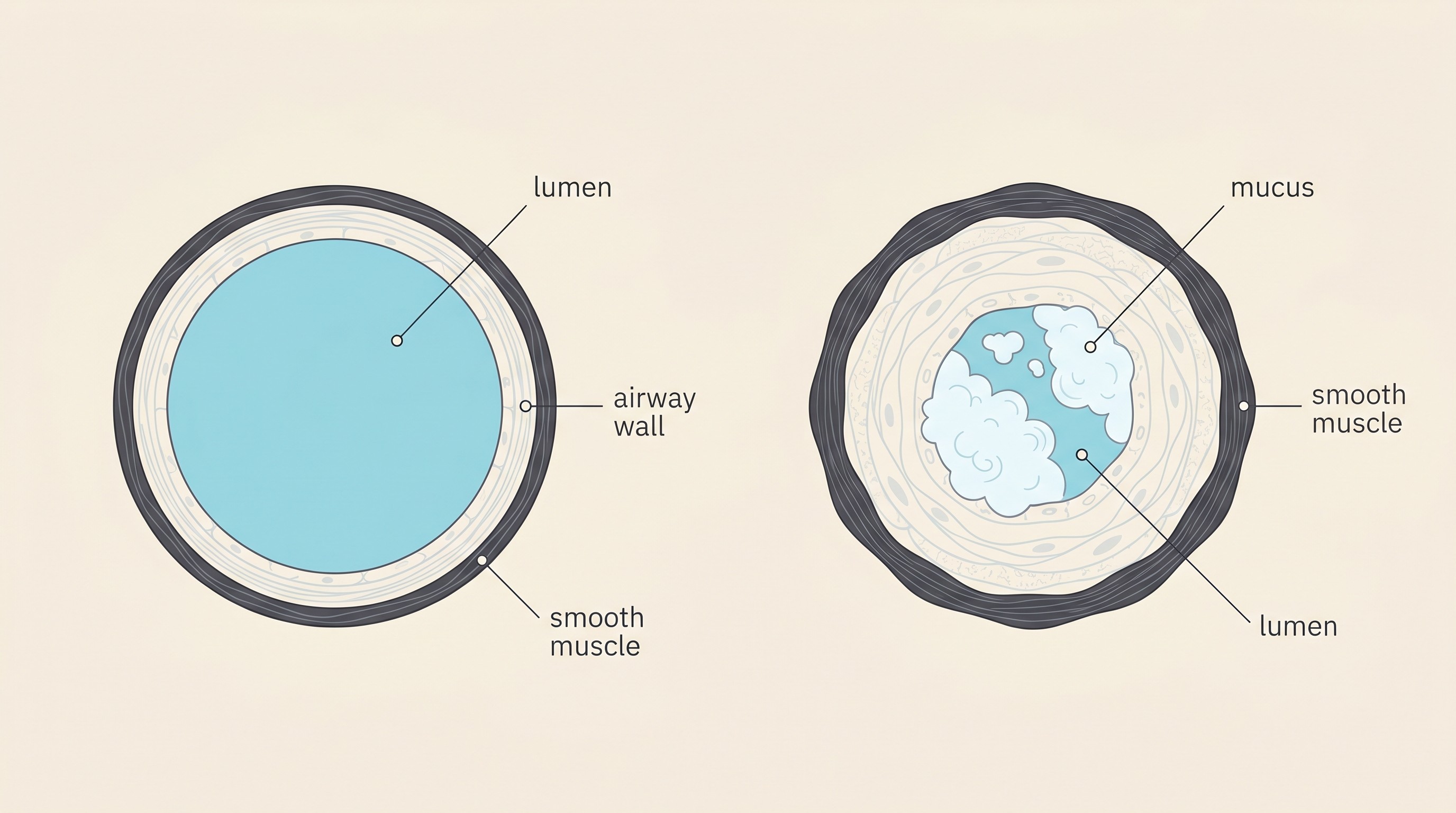
Asthma is a disease of the lower airways, the small branching tubes deep in the lungs that carry air to where oxygen crosses into the blood. In the classic allergic picture, the cat's immune system over-reacts to something inhaled, a type I hypersensitivity, and the airways become inflamed, swollen and hyper-reactive, filling with mucus while the ring of smooth muscle around them tightens and spasms (Cornell Feline Health Center, n.d.-a; Trzil & Reinero, 2014). Picture a drinking straw that's both furred up inside and squeezed from outside. Less air gets through, and getting it through takes effort: that effort is the cough, the wheeze and, at its worst, the open-mouthed struggle.
One distinction does a lot of work here: asthma is something you control, not something you cure. The airways stay prone to inflammation for life, and the aim of everything we do is to keep that inflammation quiet so the cat breathes easily and lives normally (Cornell Feline Health Center, n.d.-a). Left to smoulder it can be progressive, because repeated bouts of inflammation gradually remodel and scar the airway wall, which is the real reason the daily, unglamorous side of treatment earns its keep (Lee-Fowler, 2018).
It tends to appear in young and middle-aged cats. Around 1 to 5% of cats are affected, with the average age at diagnosis around four to five years, though plenty are older (one comparison study had median ages of six and seven and a half) (Cornell Feline Health Center, n.d.-a; Grotheer et al., 2020). Siamese cats are sometimes said to be predisposed, but that isn't well proven, and there's no clear sex difference (Cornell Feline Health Center, n.d.-a). In short, this can happen to any cat, and it being your cat is not the result of anything you did.
You'll also hear a close relative named in the same breath: chronic bronchitis. Both sit under feline lower airway disease and present so similarly they're genuinely hard to tell apart, the broad difference being that asthma is the reversible, allergic-type airway spasm with eosinophilic inflammation, while chronic bronchitis is more persistent neutrophilic inflammation and mucus with less of the reversible squeeze (Reinero et al., 2019; Grotheer et al., 2020). In practice your vet often can't separate them cleanly from signalment, a single sign, bloods or x-rays alone, and it matters less than you'd think because the management is largely shared (Grotheer et al., 2020). I draw that line in chronic bronchitis in cats; here, just know the two are cousins.
The cough that fools everyone
The signature of feline asthma is a particular cough. The cat crouches low, body close to the floor, neck and head stretched forward, and produces a dry, repeated hacking that brings nothing up (Cornell Feline Health Center, n.d.-a). To most of us that posture reads as "about to be sick", which is precisely the trap. So many asthmatic cats spend months labelled as having hairballs that the mix-up has become the single biggest cause of delay in getting them help. The short version: a true hairball builds to a productive retch and delivers something, while an asthma cough is a struggle to breathe, not to be sick, and the rug stays clean. I've given that distinction its own home in asthma or hairball?, because it's worth getting right.
Alongside the cough you may notice wheezing (a faint musical whistle on the breath), a faster or more laboured breathing rate, less stamina for play, and episodes that come and go (Cornell Feline Health Center, n.d.-a; Merck Veterinary Manual, n.d.). Some cats flare months apart; others cough most weeks. The pattern varies hugely from cat to cat.
And then the severe end, which is why I put the emergency line at the top. In a bad attack the airways narrow so much the cat can't shift enough air, and you'll see open-mouth breathing, exaggerated effort with the belly pumping, and possibly gums that turn blue, grey or pale (Cornell Feline Health Center, n.d.-a; Lee-Fowler, 2018). At its most extreme this is status asthmaticus, and it can be fatal. That is the moment the emergency rule exists for. What to do in those minutes is owned by what to do in a feline asthma attack, and reading it before you ever need it is one of the kindest things you can do for your cat.
How it's diagnosed (and why it can take more than one visit)
Here I'll be straight, because a lot of pages gloss over it. No single test says "asthma, confirmed". The diagnosis is a picture, built from several pieces that have to fit together (Cornell Feline Health Center, n.d.-a; Trzil & Reinero, 2014).
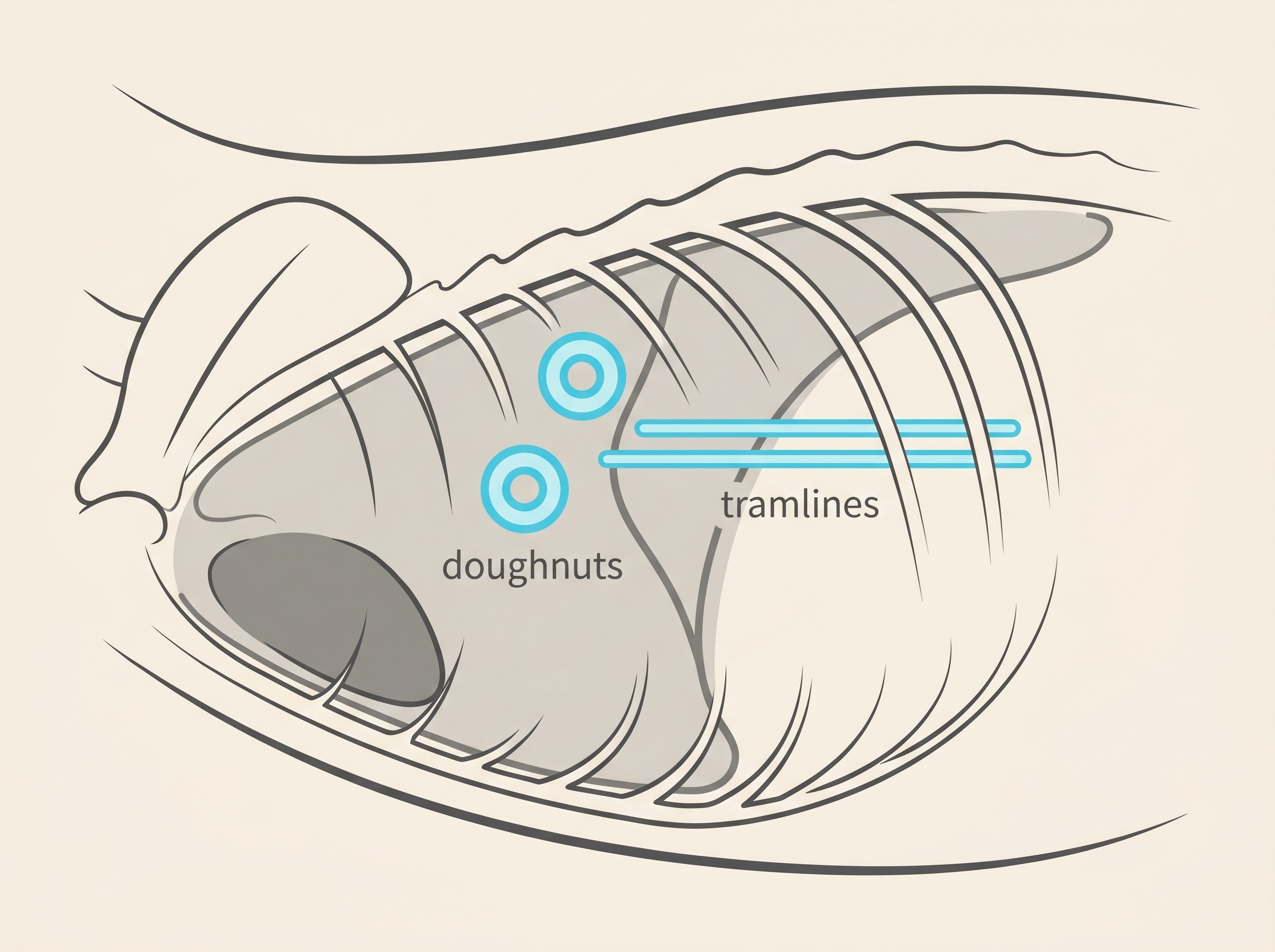
It starts with the history and the signs. Then come chest x-rays, where asthma often leaves a characteristic mark: bright branching lines through the lung fields (the classic "doughnuts and tramlines" of thickened airway walls seen end-on and side-on), frequently with the lungs looking over-inflated because air is trapped behind narrowed airways (Cornell Feline Health Center, n.d.-a; Reinero et al., 2019). It's worth knowing the x-ray is suggestive rather than absolute: some asthmatic cats have near-normal films, and the smallest-airway changes can hide from radiography altogether, which is part of why one clear test rarely settles it (Reinero et al., 2019). Where needed, a sample of cells washed from the airways (a bronchoalveolar lavage) can show the eosinophilic inflammation typical of asthma, as opposed to the neutrophilic pattern that leans towards chronic bronchitis (Reinero et al., 2019; Grotheer et al., 2020).
But the part that earns your patience is the ruling-out. Several conditions mimic asthma almost perfectly and need completely different treatment, so your vet has to exclude them, chiefly lungworm, heart disease and infection (Cornell Feline Health Center, n.d.-a; Lee-Fowler, 2018). In the UK the feline lungworm to think of is Aelurostrongylus abstrusus, picked up from slugs and snails (often via hunting, since cats usually swallow them inside prey like rodents or birds), which can cause coughing, fast breathing and open-mouthed breathing that look identical to asthma; it's diagnosed on a special faecal test called a Baermann, which is why your vet may ask for pooled droppings over a few days (Companion Animal Parasite Council, n.d.; Cornell Feline Health Center, n.d.-b). None of this is your vet being slow. It's the difference between treating the right disease and chasing the wrong one, and it's entirely normal for the full picture to take more than one appointment to assemble.
Two medicines, two jobs
Once asthma is the answer, the management arc is reassuringly logical, resting on two jobs done by two different medicines.
The first is to keep the inflammation switched off, every day, in the background. This is the controller, and the modern standard of care is an inhaled corticosteroid, most commonly fluticasone, given by metered-dose inhaler twice a day (often started at one 220 µg actuation twice daily, then stepped down as control improves) (Barchilon & Reinero, 2023; Lee-Fowler, 2018). Inhaled is the goal for one reason: it lands a strong dose of anti-inflammatory right where the trouble is, the airway lining, while very little reaches the rest of the body (Barchilon & Reinero, 2023; Lee-Fowler, 2018). That matters in cats, who are already prone to diabetes and heart disease, both of which long-term whole-body steroids can aggravate (Lee-Fowler, 2018). Inhaled steroids come with one catch: they're not instant. They take roughly one to two weeks (about seven to ten days, sometimes longer) to build their effect, so they control the disease but cannot rescue an attack (Barchilon & Reinero, 2023).
The second job is rescue: opening the airways fast when they spasm. That's the reliever, a bronchodilator, usually salbutamol (you may see the American name albuterol) (Merck Veterinary Manual, n.d.; Lee-Fowler, 2018). It works within minutes, exactly what you want mid-attack, but does nothing for the underlying inflammation. And there's a fact most owner pages miss: used regularly, salbutamol actually makes feline airway inflammation worse, because one half of the standard drug mixture (the S-enantiomer) is pro-inflammatory in cats (Reinero et al., 2009). So the reliever is for emergencies only, ideally no more than two or three times a week, and never as a substitute for the daily steroid (Barchilon & Reinero, 2023; Reinero et al., 2009). A cat reaching for the reliever often is a signal the controller needs reviewing.
Oral steroids (prednisolone) still have a legitimate place, usually as a bridge: to settle a newly diagnosed or severely affected cat quickly while you introduce the inhaler, or for cats who genuinely can't tolerate a mask (Lee-Fowler, 2018). They work, they're cheap and widely available, but the long-term trade-off in body-wide side effects is exactly why inhaled is preferred once things are stable (Lee-Fowler, 2018). The full pharmacology, doses and side-effect detail live in feline asthma medicines.
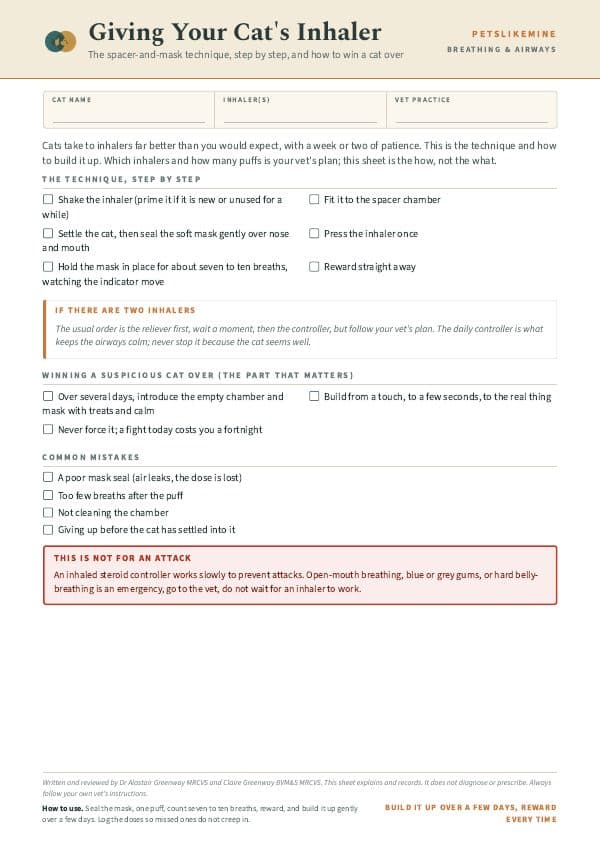
Two things tie this together. First, the inhaler itself: a metered-dose inhaler fires into a spacer (a valved holding chamber) with a soft face mask, the cat-specific version being the AeroKat with its Flow-Vu indicator, and the one-way valve lets your cat breathe the drug in during normal, quiet tidal breathing rather than having to time a deep breath (Barchilon & Reinero, 2023; Trudell Animal Health, n.d.). I know that sounds optimistic if you've met a cat, but most take to it with a week or two of patience, and the whole technique, including how many breaths to allow per puff and how to win a suspicious cat over, lives in the AeroKat inhaler technique, with a printable version to download.
Second, the bit I most want to land: a cat that looks fine is not necessarily a cat whose airways are calm. Inflammation can rumble on underneath even after the coughing stops, and there is real evidence that signs can resolve while the airway inflammation quietly continues, which is why you must never drop the controller because your cat "seems better" (Lee-Fowler, 2018). Stopping the steroid is the most common way a well-managed cat ends up back in the emergency picture. Control is the destination, and a lifelong one, adjusted to your cat over time rather than ever simply finished.
Living with an asthmatic cat
Beyond the medicines, a few everyday levers genuinely lower the number of attacks.
Start with the trigger load. Asthma is airway over-reactivity, so the less irritating stuff your cat breathes, the calmer the airways stay. The usual suspects are cigarette smoke, dusty or heavily scented cat litter, aerosols and air fresheners, perfume, household dust, pollen and mould (Merck Veterinary Manual, n.d.; Cornell Feline Health Center, n.d.-a). You rarely find one single villain; it's usually the combined load, which is why small changes across the board help more than hunting for a culprit. The proper trigger hunt, swap by swap, is owned by feline asthma triggers.
Next comes keeping your cat lean and unstressed, both of which ease the work of breathing. After that, one simple home measurement. Counting your cat's breathing rate while she sleeps is the single most useful habit you can build. As a general guide, a calm or sleeping rate is normally under about 30 breaths a minute; 30 or more is worth watching, and 40 or more needs a call to the vet. In fairness, this threshold was validated for monitoring heart failure, where stable cats sit around a median of 20 and almost always under 30, and we borrow it here as a sensible signal of a cat working too hard to breathe (Porciello et al., 2016). It catches trouble before the cat is in obvious distress. The breathing rate tracker makes counting easy, and the airway diary lets you log attacks, coughs and inhaler use so you and your vet see the real pattern rather than relying on memory.
What the future looks like
Here's the reassurance, and it's earned rather than a platitude. The great majority of asthmatic cats, once they're on a sensible inhaled controller with their triggers trimmed back, go on to live full, normal-length, comfortable lives (Cornell Feline Health Center, n.d.-a; Lee-Fowler, 2018). They play, they hunt, they annoy you at five in the morning, all the usual things. What they need from you is steadiness: the daily puff that never feels urgent, the resting-rate count, the willingness to keep the controller going on the good days as faithfully as the bad.
This is a condition you and your cat grow used to managing together, not one that hangs over the rest of her life. If you've just had the diagnosis, the most useful next steps are practical ones: learn the inhaler before you're under pressure with the AeroKat technique, read what to do in an attack while you're calm, and start a baseline resting breathing rate tonight while she's asleep. Get those three in place and you've already done the hard part of turning a frightening diagnosis into a quiet, well-run routine.
References
- Barchilon, M., & Reinero, C. R. (2023). Breathe easy: inhalational therapy for feline inflammatory airway disease. Journal of Feline Medicine and Surgery, 25(9).
- Companion Animal Parasite Council. (n.d.). Aelurostrongylus abstrusus. Retrieved from
- Cornell Feline Health Center. (n.d.-a). Feline Asthma: What You Need To Know. Cornell University College of Veterinary Medicine. Retrieved from
- Cornell Feline Health Center. (n.d.-b). Feline Asthma: A Risky Business for Many Cats. Cornell University College of Veterinary Medicine. Retrieved from
- Grotheer, M., Hirschberger, J., Hartmann, K., Castelletti, N., & Schulz, B. (2020). Comparison of signalment, clinical, laboratory and radiographic parameters in cats with feline asthma and chronic bronchitis. Journal of Feline Medicine and Surgery, 22(7), 649-655.
- Lee-Fowler, T. (2018). Asthma in Cats: Acute and Long-Term Management Guidelines. Today's Veterinary Practice. Retrieved from
- Merck Veterinary Manual. (n.d.). Tracheobronchitis (Bronchitis, Bronchial Asthma) in Cats. Retrieved from
- Porciello, F., Rishniw, M., Ljungvall, I., Ferasin, L., Haggstrom, J., & Ohad, D. G. (2016). Sleeping and resting respiratory rates in dogs and cats with medically-controlled left-sided congestive heart failure. The Veterinary Journal, 207, 164-168.
- Reinero, C. R., Delgado, C., Spinka, C., DeClue, A. E., & Dhand, R. (2009). Enantiomer-specific effects of albuterol on airway inflammation in healthy and asthmatic cats. International Archives of Allergy and Immunology, 150(1), 43-50.
- Reinero, C. R., Masseau, I., Grobman, M., Vientos-Plotts, A., & Williams, K. (2019). Perspectives in veterinary medicine: Description and classification of bronchiolar disorders in cats. Journal of Veterinary Internal Medicine, 33(3), 1201-1221.
- Trudell Animal Health. (n.d.). AeroKat Feline Aerosol Chamber. Retrieved from
- Trzil, J. E., & Reinero, C. R. (2014). Update on feline asthma. Veterinary Clinics of North America: Small Animal Practice, 44(1), 91-105.
Free downloads
Companion worksheets to put what you've read into practice. Free PDFs, print at home.
Keep track of how your pet is doing
The owners who cope best are the ones who notice changes early. A simple health log shows you what is working, and what is not, before the next vet visit.
Start tracking, freeYou're not doing this alone
Compare treatment journeys and talk to owners managing breathing & airways. Free to join.
Join PetsLikeMine