


Chronic Bronchitis in Cats: The Close Cousin of Asthma
Alastair Greenway
BVM&S MRCVS
Asthma and chronic bronchitis get used almost interchangeably in the same conversation, and owners often leave a consult unsure whether they mean the same thing, two different things, or whether anyone is quite certain. It's a fair muddle to be in, and the answer is more interesting than a flat "they're different". Chronic bronchitis is the close cousin of asthma, and once you can see the family resemblance the whole thing makes a good deal more sense.

One family: feline lower airway disease
Both conditions live under a single umbrella. Vets group asthma and chronic bronchitis together as feline lower airway disease, and over the years the cluster has picked up a confusing pile of names: feline asthma, bronchial asthma, allergic airway disease, chronic bronchitis (Reinero et al., 2019). They aren't separate illnesses that happen to resemble each other. They're two recognised patterns, two phenotypes, of the same broad problem: the small airways deep in the lungs become inflamed, and that makes a cat cough.
The full picture of feline asthma itself, what it is, how it's diagnosed and the whole management arc, lives in the complete guide to feline asthma. This piece stays on the narrower question you've arrived with: what makes chronic bronchitis its own thing, and what makes it so similar to its better-known cousin.
What's different under the bonnet
The real distinction isn't in the cough you see. It's in the kind of inflammation driving it, and in whether the airway narrowing can be reversed.
Asthma, in the strict sense, is driven by eosinophilic inflammation. Eosinophils are a white blood cell tied up in allergic, hypersensitivity-type reactions, and in an asthmatic cat the airways turn over-reactive to something inhaled and respond by going into spasm. Crucially, that spasm, the bronchoconstriction, is reversible: the airway clamps down and can then open back up (Reinero et al., 2019; Sharp, 2013). It's an allergic-type, twitchy-airway disease.
Chronic bronchitis works differently. The inflammation here is neutrophilic, the kind you see in long-running, grumbling inflammation rather than a classic allergic flare, and the neutrophils are what a pathologist would call non-degenerate and non-septic, meaning they aren't the sign of an active infection (Sharp, 2013; Reinero et al., 2019). Instead of an airway that spasms and releases, you get ongoing low-grade inflammation with excess mucus and gradual change to the airway lining, and far less of the reversible spasm. It's believed to follow an earlier insult, a previous infection or a lungful of something irritating that did some lasting damage, rather than a clear-cut allergy (Sharp, 2013; Reinero et al., 2019). So where asthma is the over-reactive, allergic, spasming airway, chronic bronchitis is the chronically inflamed, mucusy, less reversible one.
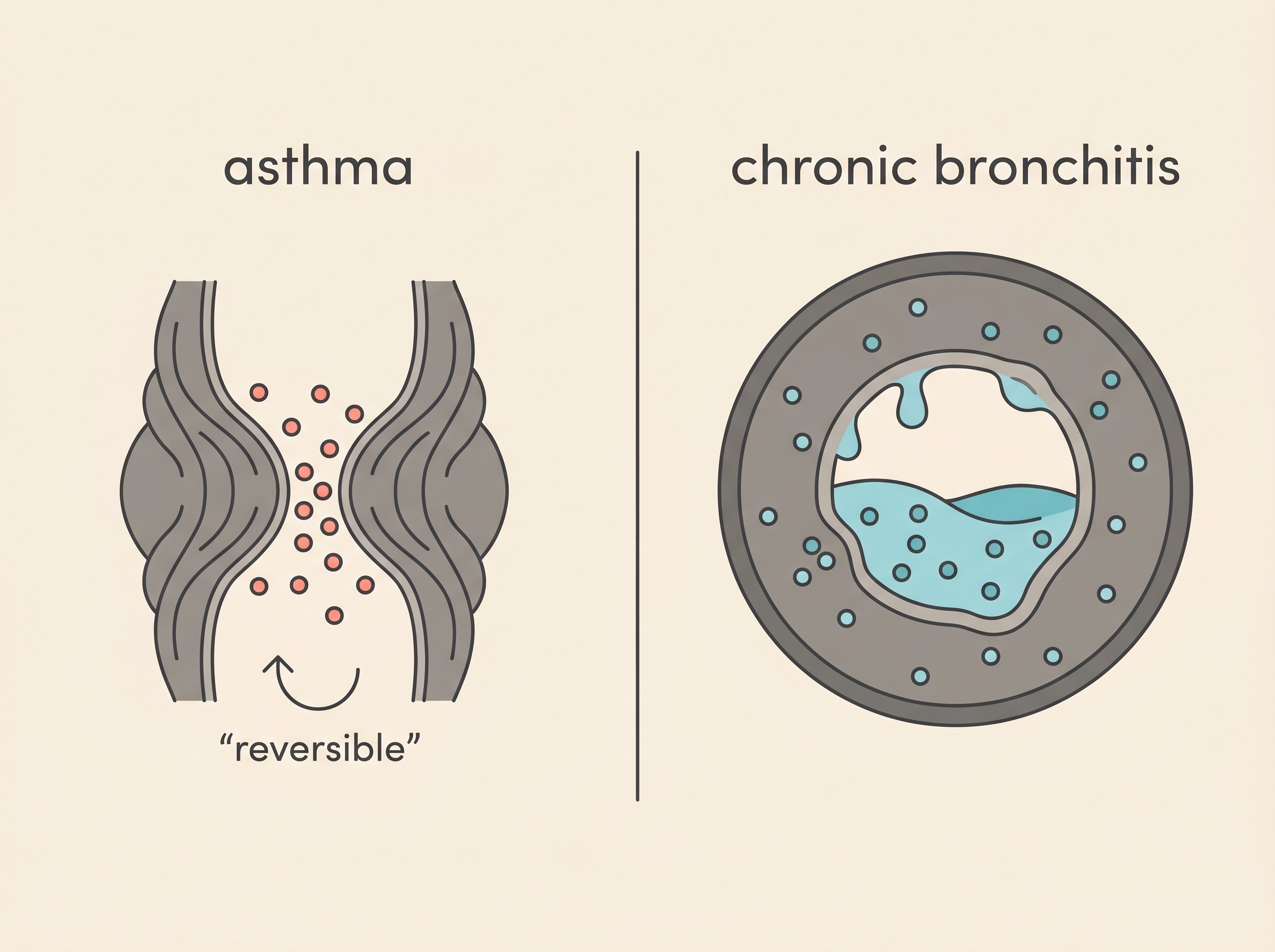
The cleanest way to separate them is the cells in the airways themselves, from fluid washed out of the lower airways under anaesthetic: asthma shows a high proportion of eosinophils, roughly more than 17 in every hundred cells, while chronic bronchitis is neutrophil-dominated (Sharp, 2013). That airway wash is about the closest thing we have to a definitive separator.
Why they look identical from the outside
From where you sit, watching your cat, the two can look essentially the same, and this overlap is the heart of the matter. Both cause the same characteristic chronic cough as their main and sometimes only sign: a low crouch with the neck and head stretched out and down, a dry repeated hacking that brings nothing up, often with wheezing, faster breathing and a cat that tires more easily, and the cough is frequently worst just after rest or at the start of activity (Cornell Feline Health Center, n.d.; MSD Veterinary Manual, n.d.).
And this isn't just an impression. A 2020 study compared 73 cats with asthma against 24 cats with chronic bronchitis across the things a vet normally leans on to tell diseases apart, signalment, clinical signs, blood tests and chest x-rays, and found none of it reliably separated the two. Cough showed up in around 95% of cats in both groups and breathing difficulty in roughly three-quarters of each. The only thing that reliably distinguished them was the airway cytology. Even a raised blood eosinophil count, which you might hope would flag the allergic asthmatic end, was only a little more common in asthma (40%) than chronic bronchitis (27%), and although that gap reached statistical significance it overlaps far too much to label any individual cat (Grotheer et al., 2020). The authors put it bluntly: telling the two apart by signalment, a single clinical sign, blood work or radiographs "is not possible" (Grotheer et al., 2020).
So if the line between your cat's "asthma" and "bronchitis" has felt blurry, you're not imagining it. The blur is real, and it's been measured.
Why the treatment looks the same anyway
All that overlap carries a reassuring upshot. Because the two behave so similarly and respond to the same things, managing chronic bronchitis looks almost identical to managing asthma.
For decades the cornerstone for both has rested on the same handful of levers: cutting the cat's exposure to airway irritants such as smoke, perfumes, pollens, moulds and dust, using glucocorticoids (steroids) to calm the inflammation, and using bronchodilators to ease airway narrowing where it helps, all aimed at the same goals of damping the inflammation and limiting long-term remodelling of the airways (Sharp, 2014; MSD Veterinary Manual, n.d.). The backbone of long-term control is usually an inhaled steroid, because inhaled fluticasone is absorbed into the body only minimally and so tends to be gentler over a lifetime than steroid by mouth or injection; oral steroid is often used at the start to settle things, then stepped down towards the inhaler (Sharp, 2014; Trzil, 2020). I'm keeping this brief, because the feline asthma medicines guide is where the controller-versus-reliever detail, the why-inhaled reasoning and the frank side-effect picture properly live. The same drugs do the same jobs in both, and an inhaler is just as much the mainstay for a bronchitic cat as for an asthmatic one (Barchilon and Reinero, 2023).
There is one small, real difference in emphasis. A reliever bronchodilator, salbutamol in the UK (written as albuterol in American sources, the same drug), earns its keep most in asthma, where there's reversible spasm to relieve during an acute episode. In pure chronic bronchitis there's less of that springy narrowing to open up, so the reliever tends to do less, and either way it's an add-on, never the whole treatment on its own (Sharp, 2014; MSD Veterinary Manual, n.d.). Cutting the triggers in the home, the dusts, smokes and sprays that irritate sensitive airways, helps in both, and the feline asthma triggers guide walks through how to hunt down yours.
The candid bit: your vet may not split hairs
Here is the part I most want you to take away, and I want to give you both halves of it. Given how heavily the signs and the treatment overlap, and given that truly nailing the label needs an anaesthetised airway wash, a great many cats are sensibly managed for "feline lower airway disease", or "the chronic bronchitis and asthma complex", without the exact phenotype ever being pinned down. The single most authoritative line on this, from the veterinary treatment literature, is that the clinical signs of asthma and chronic bronchitis "are very similar, as is their current management" (Sharp, 2014). When the picture and the plan overlap this much, the control you actually achieve matters far more, day to day, than the precise name on the file.
That is not a fudge or a sign of cutting corners, but it does come with an important second half. The very same source goes on to say it remains "important to differentiate between them due to different underlying pathologies" (Sharp, 2014). The reason is practical: a more allergic, eosinophilic asthma can behave differently from a neutrophilic, mucus-driven bronchitis, including how much a bronchodilator helps. So the right way to hold it is this. Where an airway wash is feasible and the answer would genuinely change the plan, the label is worth chasing. Where it wouldn't, or where the cat is too fragile to anaesthetise, treating the airways well on the shared plan is the sound call in the meantime, not a compromise. If your cat's cough is settling, their breathing is easy and they're living a normal life, your vet has done the job that counts, whichever cousin you're dealing with. Just don't let "the label matters less" slide into "don't bother investigating", because those are not the same thing.
Two caveats so the reassurance doesn't run away with itself. Before settling on chronic bronchitis, your vet will rule out the conditions that mimic it: heart disease, lungworm (in cats, Aelurostrongylus abstrusus), other parasites, and infection or pneumonia, usually with chest x-rays, an airway wash and sometimes a heart scan (Cornell Feline Health Center, n.d.; MSD Veterinary Manual, n.d.). That workup is owned by the complete guide. And neither condition is curable. The feline inflammatory airway diseases are, in plain terms, "common and incurable disorders" needing "lifelong therapy" (Barchilon and Reinero, 2023). Both are controlled, not cured, and the genuinely good news is that well-managed cats live full, comfortable lives (Cornell Feline Health Center, n.d.; Trzil, 2020). Just don't let anyone sell you a cure, because that isn't on the table, and you deserve the truth.
The line that never changes
One thing does not blur between asthma and chronic bronchitis, or between a good day and a bad one. A cat breathing with its mouth open, or with gums that look blue or grey, or visibly heaving with its belly to shift air, is an emergency. Go to a vet now. Don't wait to see if it passes, and don't stop to film it. Cats hide trouble until they can't, so by the time the effort is obvious they need help straight away. The in-the-moment response is covered in what to do in a feline asthma attack, worth reading before you ever need it, and if you are ever unsure how urgent things are, the breathing triage tool will sort it with you in a couple of taps.
Keeping an eye on things at home
Chronic bronchitis is a long game of staying in good control, so the most useful thing you can do between check-ups is notice the trend. A cough creeping up in frequency, breathing that looks like more work, more wheeze, less appetite for play, or reaching for the reliever more often: these are the signs control is slipping and the plan may need a tweak. Logging them as you go turns a vague "he's seemed a bit worse" into a clear pattern your vet can act on, and the Airway Diary is built for exactly this.
Alongside it, the single most useful number you can gather is your cat's resting breathing rate. Count the breaths (one in-and-out is one breath) while your cat is asleep or settled, over a minute. As a guide, under about 30 breaths a minute at rest is normal; 30 or more is worth watching, and 40 or more warrants a call to the vet (Porciello et al., 2016; Brooks, n.d.). I'll be straight about where that threshold comes from: it was established in cats with heart disease, where cats with well-controlled heart failure sat at a median sleeping rate of around 20 breaths a minute, and we borrow it here as a general signal of a cat working harder to breathe rather than something validated specifically for bronchitis (Porciello et al., 2016). It's still a genuinely handy early warning, and the resting respiratory rate tracker makes counting it a tap-along habit. A rate quietly climbing over several days is your cue to get in touch.
That, really, is the shape of living well with chronic bronchitis: the right daily controller keeping the inflammation quiet, the irritants kept down, an eye on the cough and the breathing rate, and a plan you adjust as you learn your particular cat. If you're still building that daily picture, the complete guide to feline asthma is the natural next read, because almost everything that keeps an asthmatic cat well keeps a bronchitic one well too.
References
- Barchilon, M., and Reinero, C. R. (2023). Breathe easy: inhalational therapy for feline inflammatory airway disease. Journal of Feline Medicine and Surgery, 25(9), 1098612X231193054.
- Brooks, W. C. (n.d.). Sleeping and Resting Respiratory Rates of Dogs and Cats with Heart Disease. Veterinary Partner (VIN).
- Cornell Feline Health Center. (n.d.). Feline Asthma: What You Need To Know. Cornell University College of Veterinary Medicine.
- Grotheer, M., Hirschberger, J., Hartmann, K., Castelletti, N., and Schulz, B. (2020). Comparison of signalment, clinical, laboratory and radiographic parameters in cats with feline asthma and chronic bronchitis. Journal of Feline Medicine and Surgery, 22(7), 649-655.
- MSD Veterinary Manual. (n.d.). Feline Bronchial Asthma.
- Porciello, F., Rishniw, M., Ljungvall, I., Ferasin, L., Haggstrom, J., and Ohad, D. G. (2016). Sleeping and resting respiratory rates in dogs and cats with medically-controlled left-sided congestive heart failure. The Veterinary Journal, 207, 164-168.
- Reinero, C. R., Masseau, I., Grobman, M., Vientos-Plotts, A., and Williams, K. (2019). Perspectives in veterinary medicine: Description and classification of bronchiolar disorders in cats. Journal of Veterinary Internal Medicine, 33(3), 1201-1221.
- Sharp, C. R. (2013). Diagnosis of Feline Lower Airway Disease. Today's Veterinary Practice.
- Sharp, C. R. (2014). Treatment of Feline Lower Airway Disease. Today's Veterinary Practice.
- Trzil, J. E. (2020). Feline Asthma: Diagnostic and Treatment Update. Veterinary Clinics of North America: Small Animal Practice, 50(2), 375-391.
Keep track of how your pet is doing
The owners who cope best are the ones who notice changes early. A simple health log shows you what is working, and what is not, before the next vet visit.
Start tracking, freeYou're not doing this alone
Compare treatment journeys and talk to owners managing breathing & airways. Free to join.
Join PetsLikeMine