

Feline Asthma Medicines: The Controller, the Reliever and Why Inhaled Wins
Alastair Greenway
BVM&S MRCVS
A new asthma diagnosis usually sends you home holding an inhaler the colour of a child's toy and, often, a pot of small tablets. Somebody used words like "controller", "reliever", "steroids" and "lifelong", and by the time you're through the front door half of it has evaporated. So treat this page as the slow version of that conversation: what each drug does, why your vet reached for it, and the question that worries almost everyone, are we really giving steroids for the rest of this cat's life, and is that safe?
Take the big fear first. Yes, this is usually lifelong treatment, because feline asthma is managed rather than cured. But the modern approach is built to keep your cat well while sparing them the body-wide cost that long-term steroids used to carry, and well-controlled asthmatic cats live full, normal-length lives (Cohn et al., 2010; Trzil, 2020). The medicines are how you get there.
One line before anything else, because no daily plan ever cancels it. A cat breathing with its mouth open, with blue or grey gums, or heaving from the belly, is an emergency. Go to a vet now, do not stop to film it. No inhaler at home substitutes for that. What to do in that moment has its own guide, what to do in a feline asthma attack; here I'm talking about the medicines and how they fit together.
Two drugs, two completely different jobs
Almost every confusion about asthma medicines dissolves once you hold onto this: there are two jobs, and most cats end up with a drug for each.
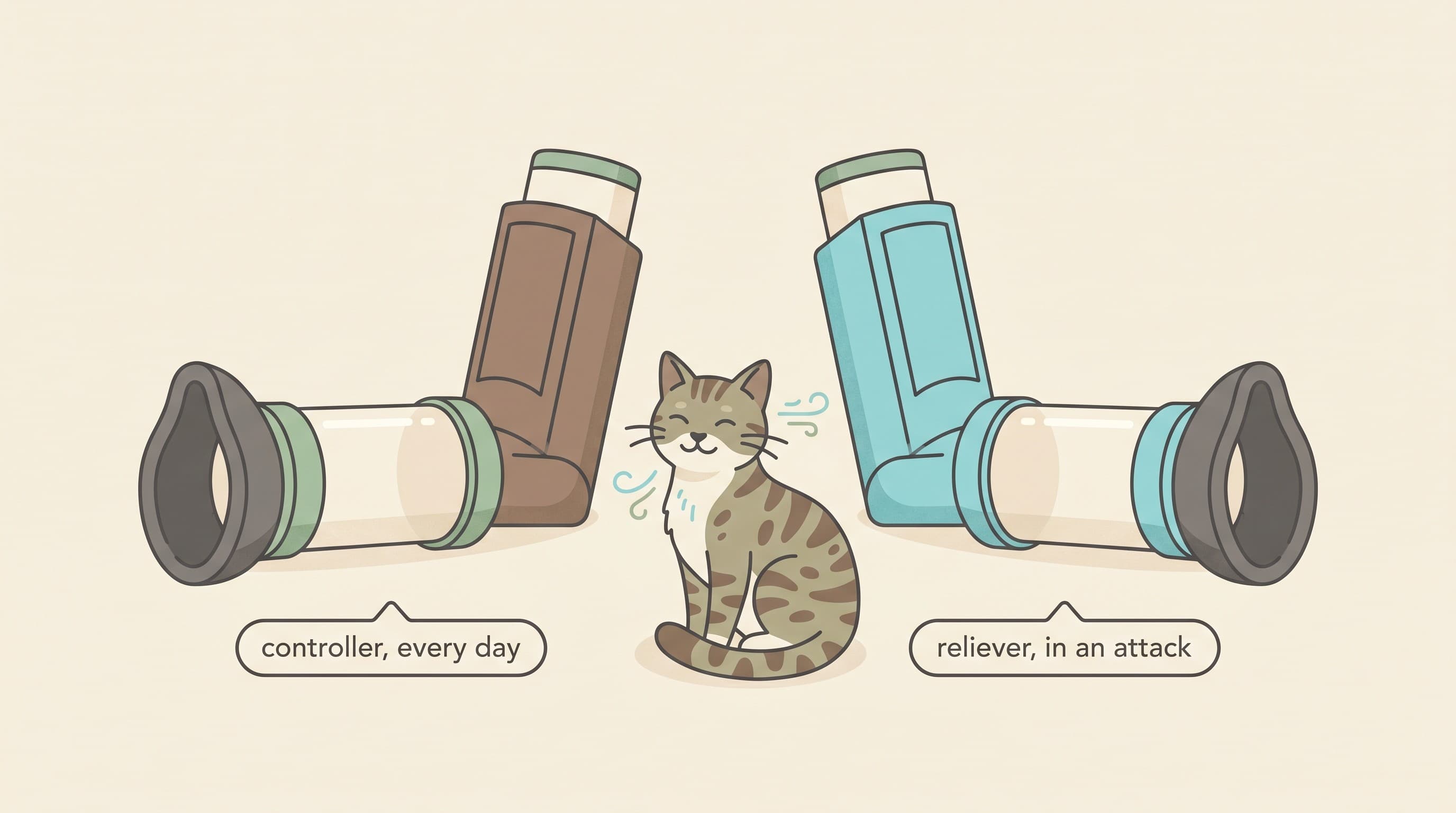
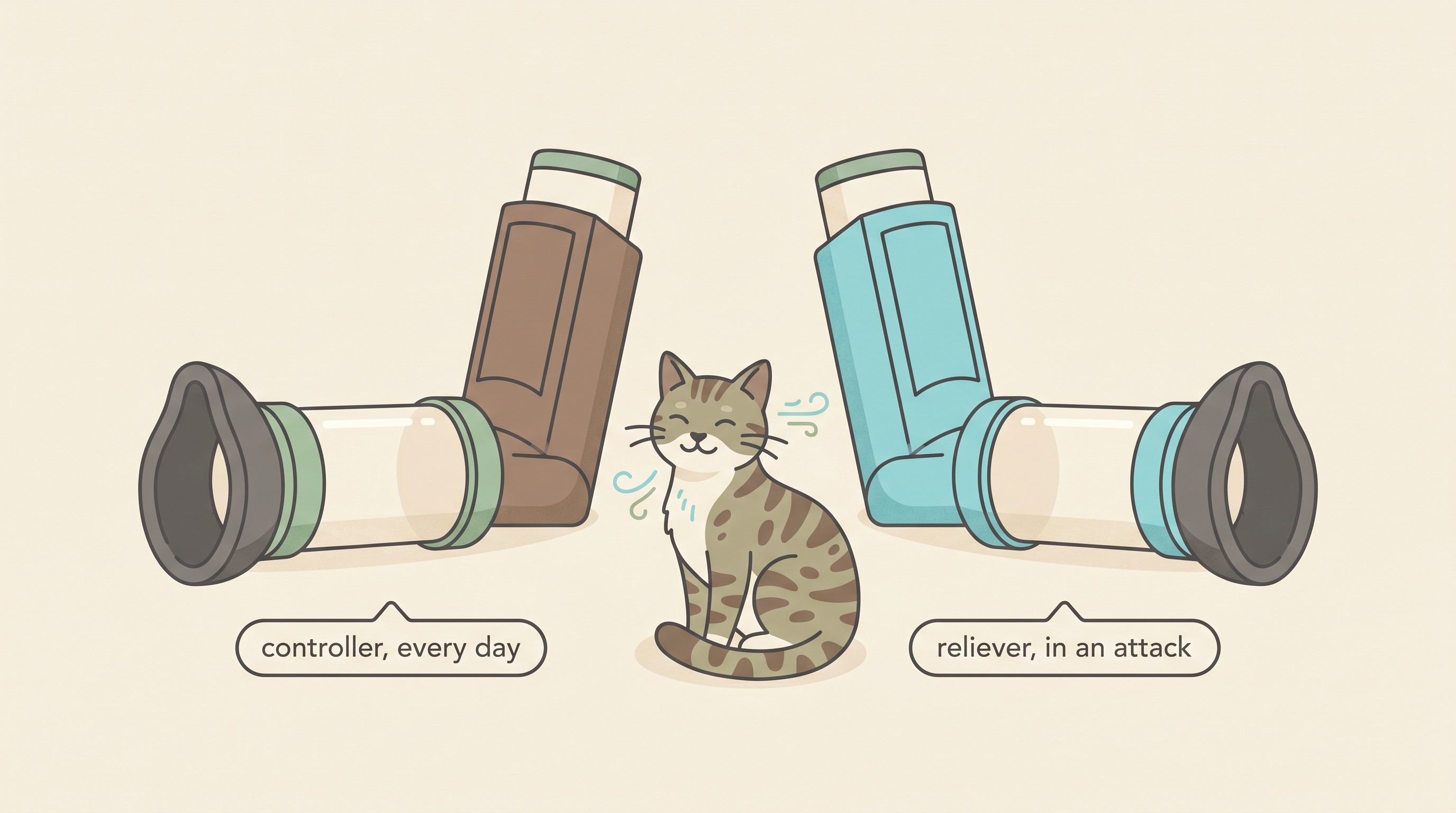
The first job is to control the inflammation, every single day. Asthma is, at heart, chronically inflamed, over-reactive lower airways: the lining is swollen and irritable even on the good days when your cat seems fine, and that smouldering inflammation is the actual disease (Trzil, 2020; Barchilon and Reinero, 2023). The drug that does this is the controller, the backbone of treatment. The second job is to open the airway fast when it spasms shut in an attack: an emergency rescue, not daily maintenance, done by the reliever.
The reliever on its own is not adequate treatment, and getting that wrong is dangerous. It opens a spasming airway but does nothing for the underlying inflammation that caused the spasm, so a cat on the reliever alone is a cat whose disease is quietly worsening behind a drug that only treats the symptom (Cornell Feline Health Center, n.d.-b; Barchilon and Reinero, 2023; Trudell Animal Health, n.d.). The controller is the foundation; the reliever is the fire extinguisher on the wall.
Your daily steroid, inhaled to calm the airways
The controller is almost always an inhaled corticosteroid, and in the UK that usually means fluticasone propionate (the brands on the inhaler are Flixotide or Flovent). It's a steroid, but an inhaled one, and that distinction does a great deal of work.
What it does is dampen the airway inflammation so the lungs stop over-reacting, and the evidence is solid. In an experimental model of feline asthma, fluticasone delivered through a metered-dose inhaler and a feline spacer significantly reduced airway eosinophilia, a direct measure of that allergic inflammation, at all three doses tested (44, 110 and 220 micrograms twice daily), with no meaningful difference between them and none suppressing the adrenal axis (Cohn et al., 2010; EveryCat Health Foundation, n.d.), and inhaled glucocorticoids are the mainstay of long-term management (Trzil, 2020; Barchilon and Reinero, 2023). A common starting point is 110 micrograms twice daily, though some cats do well on 44, and once your cat is stable your vet will usually titrate down to the lowest dose that keeps the airways quiet (Today's Veterinary Practice, 2014; Barchilon and Reinero, 2023). That last move is the whole philosophy: enough to control the disease, no more than you need.
The catch is timing. Inhaled steroids are slow to start, roughly 7 to 10 days and sometimes up to 10 to 14, to reach full effect (Today's Veterinary Practice, 2014; Barchilon and Reinero, 2023). That makes them useless in a crisis: the inhaled controller is a daily-control device, never a rescue one. Which is exactly why your vet may hand you tablets as well at the start.
Bridging the gap with a short oral course
If the controller takes a week and a half to get going, what holds the line meanwhile? Usually a short course of oral prednisolone, given alongside the inhaler at the start to control the inflammation while the inhaler catches up. Typical dosing in the references runs around 0.5 to 1 mg/kg twice daily for the first week or two, then a gradual taper, with oral and inhaled steroid overlapping for about 7 to 10 days before the tablets stop (Today's Veterinary Practice, 2014; Barchilon and Reinero, 2023). The taper must be gradual, because the signs come straight back if it's dropped too fast (Today's Veterinary Practice, 2014). So if your cat is on tablets now, don't be surprised and don't stop them abruptly: they're the scaffolding holding things up until the inhaler is load-bearing.
Oral prednisolone is also the fallback, not just the bridge: for cats that genuinely cannot manage the inhaler, or whose disease is severe, ongoing oral steroids are a legitimate, effective option (Today's Veterinary Practice, 2014). They really do work. The issue with them long term is never effectiveness, it's the body-wide cost.
Why inhaled is the goal: the steroid-safety story
This is the question that brings most owners here. We prefer the inhaled steroid for long-term control not because it's stronger, but because it puts the drug straight into the lungs with very little absorbed elsewhere, sparing your cat the systemic side effects that long-term oral steroids carry; in the same experimental work, the inhaled doses didn't even suppress the adrenal axis, a marker of how little spills over (Cohn et al., 2010; Today's Veterinary Practice, 2014; Barchilon and Reinero, 2023).
That systemic cost is worth naming, because cats are unusually prone to one steroid side effect in particular: diabetes. In one cohort of cats on oral prednisolone, 9.7 per cent developed prednisolone-induced diabetes mellitus, and of those, 85.7 per cent did so within the first three months (Nerhagen et al., 2021). Steroid-driven diabetes and, less often, congestive heart failure are the headline concerns with long-term glucocorticoids in cats (Cornell Feline Health Center, n.d.-a; Dutch et al., 2023). It is worth keeping the size of that risk in proportion: a large study of cats given low, non-immunosuppressive injectable steroid doses found diabetes in only about 4 per cent and heart failure in under 1 per cent, so this is a real concern to design around, not a reason to fear steroids (Dutch et al., 2023). The point is simply that the lungs-only route avoids almost all of it. So "let's get you onto the inhaler and off the daily tablet" isn't a fussy preference: it matters most for cats that already have, or are at risk of, diabetes, cardiomyopathy or heart failure (Today's Veterinary Practice, 2014; Barchilon and Reinero, 2023).
Now the point plenty of pages skip. Head to head, oral steroids are at least as effective as inhaled at quelling airway inflammation, sometimes a touch more. A structured review concluded the two routes are broadly equal on admittedly weak evidence (Williams, 2022), and a small randomised pilot in cats with naturally occurring asthma found both improved the inflammation and the signs, with individual cats responding to either and no change in fructosamine (a marker of blood sugar) on the inhaled route (Verschoor-Kirss et al., 2021). So inhaled isn't the more potent choice, it's the safer one for lifelong use, and that's the right reason to favour it. Anyone selling the inhaler as "stronger medicine" is overselling it.
Actually getting an inhaler into a cat, the AeroKat spacer, the mask, the breath count, training a suspicious cat over a week or two, is a real skill with its own guide, the cat inhaler and AeroKat technique. I'll only note the device exists so the drugs make sense; the technique lives there.
Reaching for the reliever in the bad moments
The reliever is a bronchodilator, most likely salbutamol (you may see it called albuterol, the US name for the same drug). Where the controller is the brown inhaler, the reliever is usually the blue one, and it does one thing, fast: it relaxes the muscle around the airways and opens them up within minutes. Onset is roughly 5 to 10 minutes, the effect builds over 5 to 20 minutes and lasts around 4 to 6 hours (Today's Veterinary Practice, 2014; Trudell Animal Health, n.d.). That speed is exactly why it's the rescue puff in an attack and not a daily drug: when an airway spasms shut you can't wait a week and a half for a steroid, you need it open now.
That speed comes with a rule. Regular reliever use should be limited, ideally no more than two or three times a week. If your cat needs the blue inhaler more often, it's a signal the controller isn't holding the disease, not a reason to keep puffing (Barchilon and Reinero, 2023). There's a pharmacological reason too: standard racemic salbutamol contains a component (the S-enantiomer) that is actually pro-inflammatory with regular use, so if a cat genuinely needs it often, vets may switch to the levo form (R-salbutamol, or levalbuterol) and, more importantly, review the whole controller plan (Barchilon and Reinero, 2023). For you it's simple: frequent reliever use is a "tell your vet" sign. A simple record of inhaler use, coughs and breathing changes in the Airway Episode & Exertion Diary makes that creeping pattern visible, and a rising reliever count over a fortnight is often the first sign the controller dose needs revisiting.
Never stop the controller just because the cat seems fine
Owners break this rule with the best of intentions. Your cat will have good spells where the cough vanishes and they seem completely well, and the temptation to skip the daily controller on those days is enormous. Please don't, and here's the evidence that turns that from nagging into medicine. In a study of cats whose clinical signs had fully resolved on high-dose oral steroids, 70 per cent (seven of ten) still had active inflammation in their airways when those airways were sampled directly (Cocayne et al., 2011). A well-looking cat is simply not proof the inflammation is controlled. The disease is still there on the good days, and the controller is keeping the lid on it. Skip it because the cat seems fine and you remove the very thing making them seem fine.
A brief note on the rest of the cabinet: where a steroid plus a bronchodilator isn't enough, vets sometimes reach for add-on drugs, but the evidence for most is limited and they belong to a vet's judgement, not an owner's shopping list (Today's Veterinary Practice, 2014; Barchilon and Reinero, 2023). The core story, daily controller, rescue reliever, oral bridge, manages the vast majority of asthmatic cats well. You can help it along by cutting trigger exposure (dust, scented litter, smoke, sprays), which genuinely lowers the medication burden over time, covered in feline asthma triggers; and if your cat's label is chronic bronchitis rather than asthma, the drugs largely overlap (chronic bronchitis in cats). For the whole picture, the complete guide to feline asthma is the hub this page sits beneath.
The aim is the lowest effective controller dose that keeps your cat comfortable and the airways quiet, and that is very achievable (Cohn et al., 2010; Barchilon and Reinero, 2023). Most asthmatic cats, on a steady daily inhaler with the reliever held in reserve, go on doing the ordinary, sleeping-in-the-sun things cats do, for years. The medicines feel like a lot at the diagnosis. Within a few weeks, for most families, they become a thirty-second routine and a cat who breathes easy.
References
- Barchilon, M., and Reinero, C. R. (2023). Breathe easy: inhalational therapy for feline inflammatory airway disease. Journal of Feline Medicine and Surgery, 25(9).
- Cocayne, C. G., Reinero, C. R., and DeClue, A. E. (2011). Subclinical airway inflammation despite high-dose oral corticosteroid therapy in cats with lower airway disease. Journal of Feline Medicine and Surgery, 13(8), 558-563.
- Cohn, L. A., DeClue, A. E., Cohen, R. L., and Reinero, C. R. (2010). Effects of fluticasone propionate dosage in an experimental model of feline asthma. Journal of Feline Medicine and Surgery, 12(2), 91-96.
- Cornell Feline Health Center. (n.d.-a). Feline Asthma: A Risky Business for Many Cats. Retrieved from
- Cornell Feline Health Center. (n.d.-b). Feline Asthma: What You Need To Know. Retrieved from
- Dutch, W. A., Norsworthy, G. D., Mayfield, M. R., Mayfield, J. R., and Schmitt, C. W. (2023). Incidences of steroid-induced diabetes mellitus and congestive heart failure in cats given non-immunosuppressive doses of methylprednisolone acetate: 1042 cats. The Canadian Veterinary Journal. Retrieved from
- EveryCat Health Foundation. (n.d.). Treatment of Feline Asthma (summary of Cohn et al., 2010). Retrieved from
- Nerhagen, S., Moberg, H. L., Boge, G. S., and Glanemann, B. (2021). Prednisolone-induced diabetes mellitus in the cat: a historical cohort. Journal of Feline Medicine and Surgery, 23(2), 175-180.
- Today's Veterinary Practice. (2014). Treatment of Feline Lower Airway Disease. Retrieved from
- Trudell Animal Health. (n.d.). Bronchodilator Medications For Cats: what they are, types available, and why inhaled medication is preferred. Retrieved from
- Trzil, J. E. (2020). Feline asthma: diagnostic and treatment update. Veterinary Clinics of North America: Small Animal Practice, 50(2), 375-391.
- Verschoor-Kirss, M., Rozanski, E. A., Sharp, C. R., Oura, T. J., Egan, A., Bain, P., and Knoll, J. (2021). Treatment of naturally occurring asthma with inhaled fluticasone or oral prednisolone: a randomized pilot trial. Canadian Journal of Veterinary Research, 85(1), 61-67.
- Williams, S. (2022). Do inhaled or oral glucocorticoids more effectively control feline asthma? Veterinary Evidence, 7(4).
Keep track of how your pet is doing
The owners who cope best are the ones who notice changes early. A simple health log shows you what is working, and what is not, before the next vet visit.
Start tracking, freeYou're not doing this alone
Compare treatment journeys and talk to owners managing breathing & airways. Free to join.
Join PetsLikeMine