

Cat Having an Asthma Attack: What to Do Right Now
Alastair Greenway
BVM&S MRCVS
A cat breathing with its mouth open, or with blue, grey or very pale gums, or heaving hard from the belly to get air, is in a genuine emergency. Go to a vet now. Phone ahead if you can, but do not wait, do not dose from the medicine cupboard, and do not chase your cat round the room trying to film it. Cats almost never breathe through an open mouth the way a panting dog does, so when one does, it is a loud, clear signal that the lungs are in serious trouble (Cornell Feline Health Center, 2014; International Cat Care, n.d.).
With that said, let me slow things down and walk you through what is happening, what to do, and how to tell the frightening-but-manageable from the truly dangerous. Most asthma attacks are survivable and, with a plan, often manageable at home or quickly steadied by your vet. The point of this page is to help you act calmly and correctly in the moment, then know what to do once the dust settles.
What an attack actually looks like
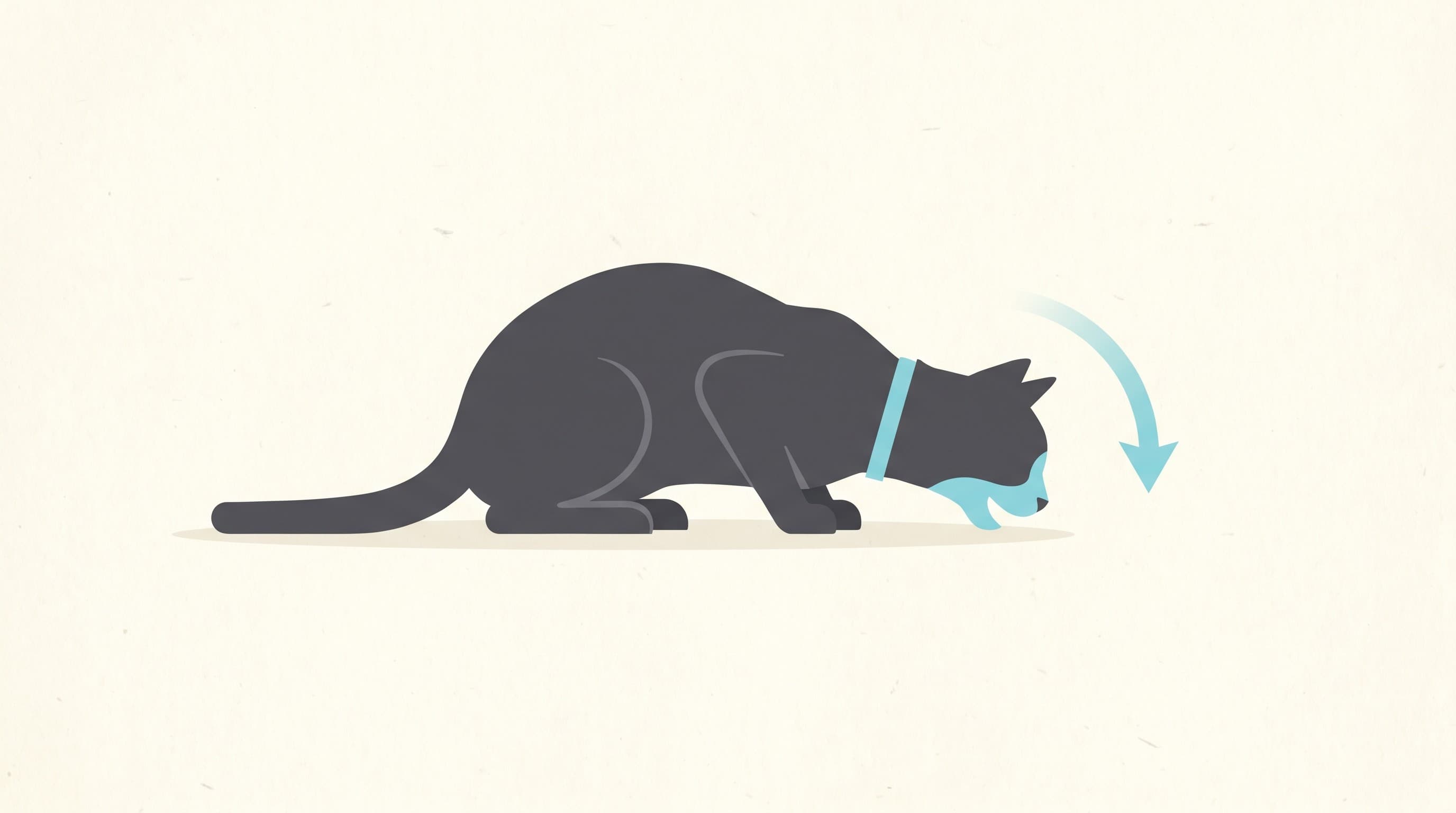
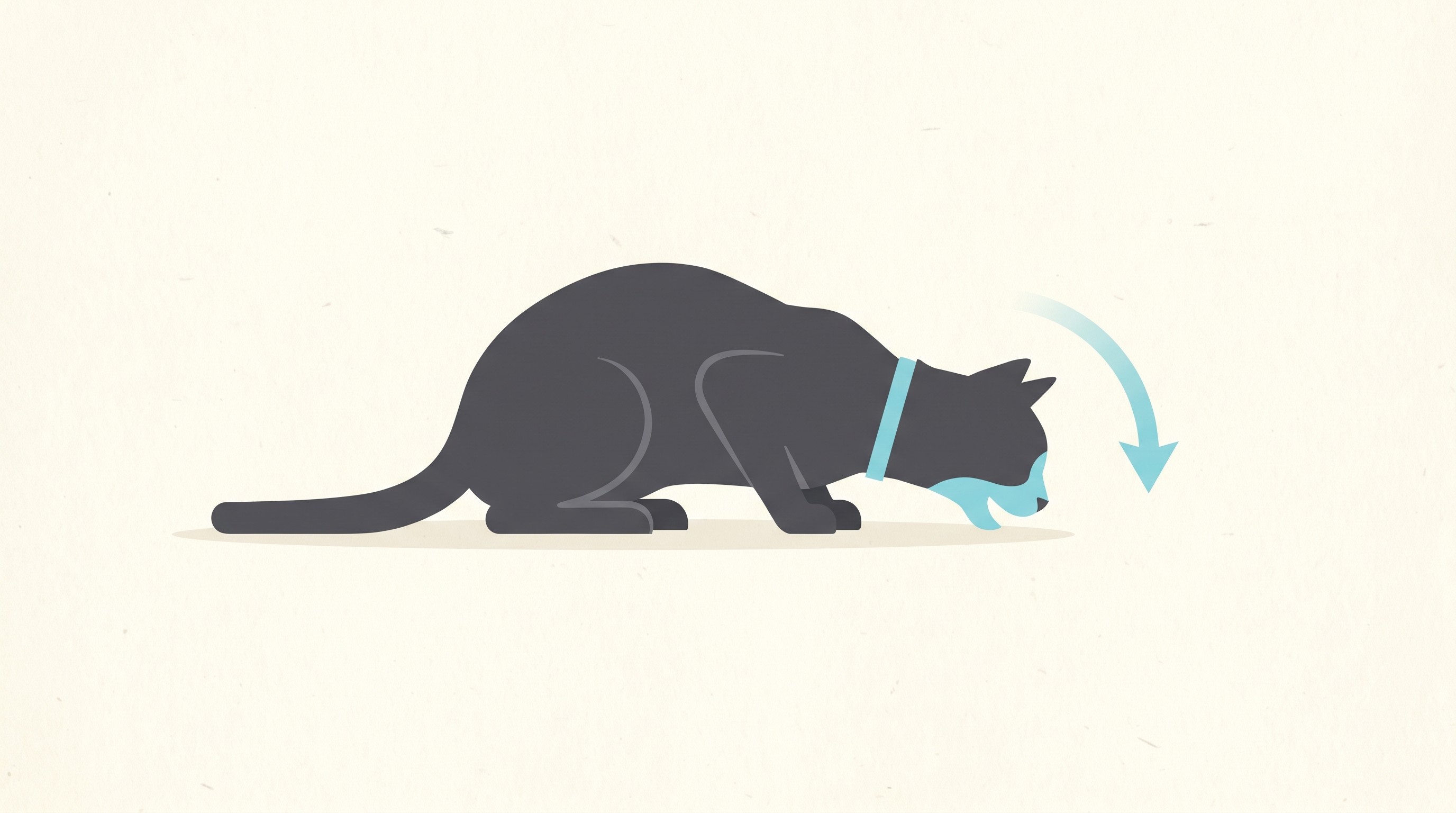
During an attack the small airways deep in the lungs tighten and clamp down, and the lining swells and pumps out mucus, so there is suddenly far less room for air to move (Cornell Feline Health Center, 2014; Tonozzi, 2022). Your cat feels that, and the body does something very particular in response. Many cats hunch low to the ground and extend the neck and head forward, as if reaching for air, and then cough or wheeze with fast or laboured breathing (Cornell Feline Health Center, 2014). That crouched, neck-stretched shape is the textbook asthma picture, and once you have seen it you tend not to forget it.
The cough itself is dry and comes in repeated bouts, and it can look unnervingly like your cat is trying to bring something up. That overlap with hairballs is why so many asthmatic cats go undiagnosed for months. A hairball builds to a wet retch and produces something; an asthma cough is dry, crouched and brings nothing up. The full distinction lives in the asthma or hairball guide. For the moment, the thing to hold onto is the breathing, not the cough.
Attacks vary in intensity from mild to life-threatening (Cornell Feline Health Center, 2014). A mild flare might be a short bout of coughing and wheezing that eases within a few minutes and leaves your cat tired but recovering. A severe attack, where the airways are so constricted that the cat cannot move enough air, is a true emergency, and at its worst it is called status asthmaticus (Reinero, n.d.). The same condition produces both.
Signs that mean go now
Some signs lift an attack out of "watch and help" and into "emergency, this minute". Memorise these, because in the moment you will not want to be reading.
A cat breathing with its mouth open is the cardinal one. Pair it with gums that have gone blue, grey or pale, which means the blood is not getting enough oxygen, and with marked belly effort, where the whole abdomen pumps with each breath because the chest alone cannot do the job (Cornell Feline Health Center, 2014; International Cat Care, n.d.). Add to that any weakness, wobbliness or collapse (International Cat Care, n.d.). Any one of these, on its own, is enough. You do not need the full set.
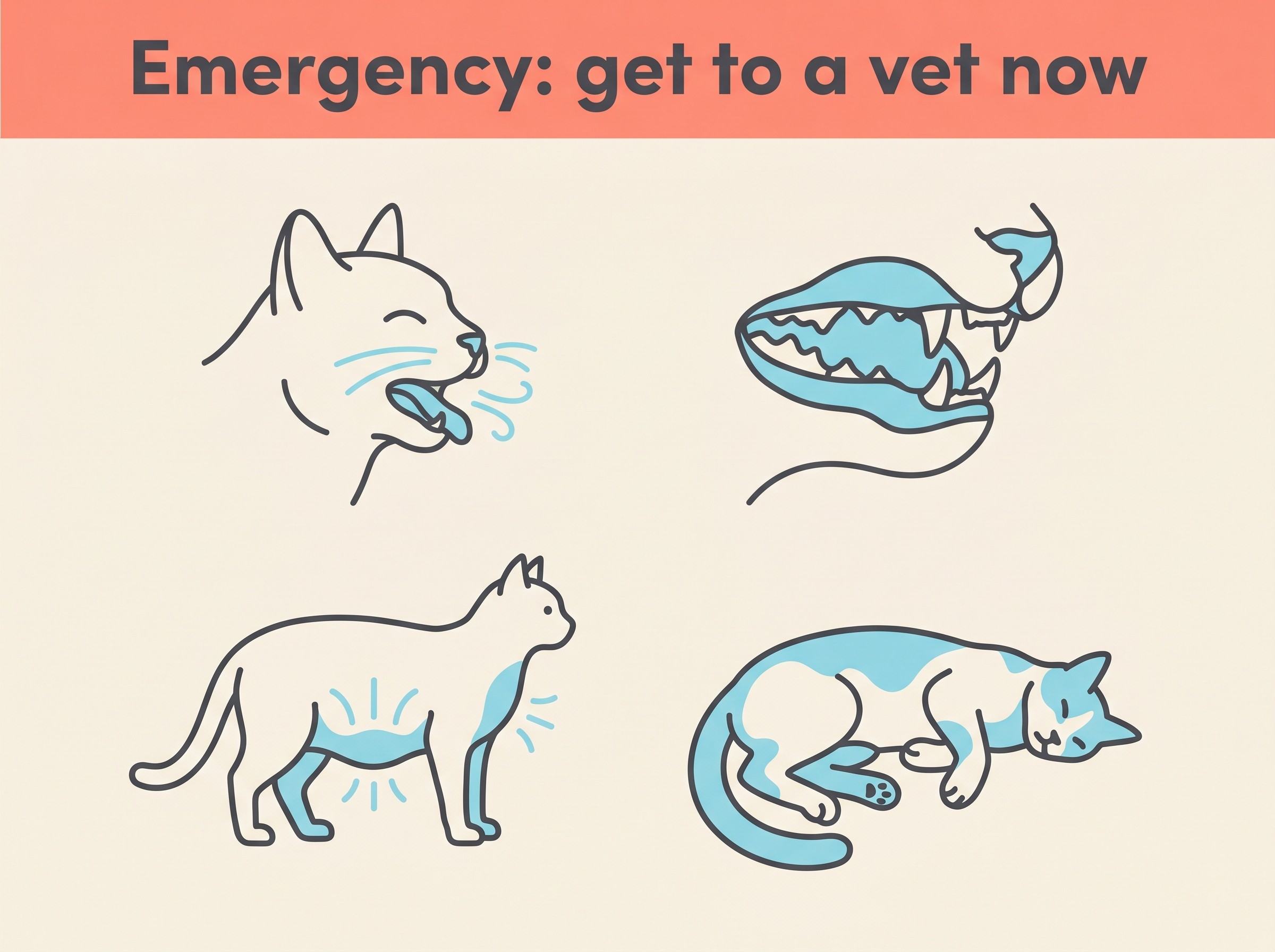
If you see them, your cat needs oxygen and a vet's hands, not another puff of an inhaler at home, so the right move is to get going. Phone the practice or the emergency service on the way so they can have oxygen ready, because the first thing they will do is stabilise your cat in an oxygen-rich environment, often with mild sedation, before they even fully examine it (Lee-Fowler, 2018; Reinero, n.d.). That order of events matters, and it tells you something useful: even the professionals reach for oxygen and calm first, before anything clever.
If your vet has set you up with a rescue inhaler
Some asthmatic cats are sent home with a reliever inhaler, a fast-acting bronchodilator to open the airways during an attack. In the UK this is usually salbutamol, the same drug Americans call albuterol, a short-acting beta-2 agonist that relaxes the muscle wrapped around the airways (Lee-Fowler, 2022; VCA Animal Hospitals, n.d.). Given by inhaler through a spacer and mask it acts fast, beginning to work within minutes, with its biggest effect within about five to twenty minutes and lasting a few hours (Lee-Fowler, 2022). That speed is exactly why it is the reliever, the thing for the moment of crisis, and not a drug your cat takes every day.
If, and only if, your own vet has prescribed this and shown you how, a rescue plan in a mild-to-moderate attack usually looks like this: take your cat somewhere quiet, keep yourself calm because your cat reads your panic, and give the reliever through the AeroKat spacer as your vet directed, then watch closely to see whether the breathing eases. I am deliberately not teaching the full inhaler technique here, the seal, the breath count, the Flow-Vu window, because getting it right matters enough to have its own home in the cat inhaler and AeroKat technique guide. Keep the device where you can find it in the dark.
Two cautions sit alongside that reliever, and they change how you use it.
First, the reliever opens the airways but does nothing for the inflammation underneath, so it is never the whole answer and never a daily habit (Lee-Fowler, 2022; Tonozzi, 2022). It is rescue-only, partly for a subtler reason: the standard salbutamol mix contains a component that, used too often, can actually increase airway inflammation and twitchiness, so leaning on it again and again can make things worse rather than better. The veterinary guidance puts it plainly, that it "may be used as a rescue treatment only" (VCA Animal Hospitals, n.d.; Lee-Fowler, 2022). Reaching for it often is not a cue to keep puffing; it is a signal that the daily treatment needs reviewing. I will come back to that.
Second, even when everything goes right, surprisingly little inhaled drug reaches the lungs. A study modelling salbutamol moving through a cat's airway found that only around one and a half to two and a half per cent of the particles actually reached the lung, and that fast breathing dumped most of the dose uselessly in the upper airway, because delivery needs slower, longer breaths (Fernández-Parra et al., 2023). A cat mid-attack is panicking and breathing fast, which means it gets even less. That is not a reason to skip the reliever if your vet has prescribed it. It is the reason the home reliever buys you time rather than fixes the problem, and why it must never delay the trip to the vet in a real attack.
This is also why, in a severe attack, your vet may bypass the inhaler entirely. When a cat is in status asthmaticus the bronchospasm is so tight that hardly any inhaled drug gets through, so vets often give an injection of terbutaline, another fast-acting bronchodilator, which typically starts working within about fifteen minutes (Reinero, n.d.; Lee-Fowler, 2018). It is a good illustration of the plain truth here: the inhaler in your cupboard is a bridge to the vet, not a substitute for one.
Deciding whether to watch at home
So how do you decide? Here is the practical split.
If the attack is mild, settles within a few minutes (with your reliever if you have one), and your cat returns to breathing comfortably with pink gums and no belly heave, you can reasonably watch at home for now, log what happened, and book a non-urgent vet appointment to review things. A single mild flare in a cat already diagnosed and on treatment is the kind of event a good monitoring plan is built to catch.
If there is no improvement, or the gums go blue, grey or pale, or your cat is open-mouth breathing, collapsing or simply not getting better, that is an emergency and you go now (Cornell Feline Health Center, 2014; International Cat Care, n.d.). No exceptions, no waiting to see if it passes.
And if this is the first time you have ever seen this, get your cat seen promptly even if it settles, because a first episode needs a diagnosis. The crouching, coughing and wheezing of asthma can be mimicked by heart disease, by infection, and by feline lungworm, and in cats that lungworm is Aelurostrongylus abstrusus, not the Angiostrongylus vasorum that affects dogs (ABCD, n.d.). I am not going to send you down the path of trying to diagnose which it is, that is your vet's job with an x-ray and an exam, but you should know that "it looks like asthma" and "it is asthma" are not the same thing until someone has confirmed it.
Through all of this, the single most useful thing you can do, beyond the reliever, is to lower the temperature in the room and in yourself. A cat in respiratory distress can tip over the edge from the stress of being restrained, bundled into a box, or chased around to be photographed, so keep handling to a minimum, keep things quiet and cool, and move calmly (Reinero, n.d.; American Animal Hospital Association, 2023). Your stillness genuinely helps your cat breathe.
After the attack is over
Once your cat is steady again, there are three small jobs that turn a frightening night into something useful.
Log it. Note the date, the time, how long it lasted, how bad it looked, and what you did. The Airway Episode and Exertion Diary is built for exactly this, and a run of logged attacks is the single most valuable thing you can hand your vet, far more useful than a description from memory. Patterns that are invisible night to night jump out across a fortnight.
Note what came before it. Was there a new air freshener, a dusty change of litter, someone smoking near the cat, a scented candle, a dusty day? You are not trying to solve the whole environmental puzzle in one go, and you certainly will not catch every trigger, but jotting down what changed feeds the proper trigger hunt. That work lives in the feline asthma triggers guide, which is where to go when you are ready to comb through the house.
Review the controller. Asthma attacks are flare-ups of an underlying inflammation that the daily treatment is meant to keep quiet, and the corticosteroid controller, not the bronchodilator reliever, is what treats that inflammation, so frequent attacks are not just bad luck, they are often a sign the everyday medication needs adjusting (Tonozzi, 2022; Cornell Feline Health Center, 2014). The reliever calms the moment; the daily inhaled steroid is what actually reduces how often these moments come. If attacks are clustering, that is a conversation with your vet about the controller, not a reason to use more reliever. The drug detail, the controller, the reliever, the oral-steroid bridge, and the reason inhaled is usually preferred, is set out in the feline asthma medicines guide, and the whole condition is mapped in the complete guide to feline asthma.
It is worth holding two things together here. Asthma is common, affecting somewhere between one and five per cent of cats, and it is also very manageable (Cornell Feline Health Center, 2014; Trzil, 2020). A well-controlled asthmatic cat lives a full, ordinary life, and most attacks, handled with a clear head and a plan, end quietly. The frightening night you have just had is not a verdict on the future. It is information.
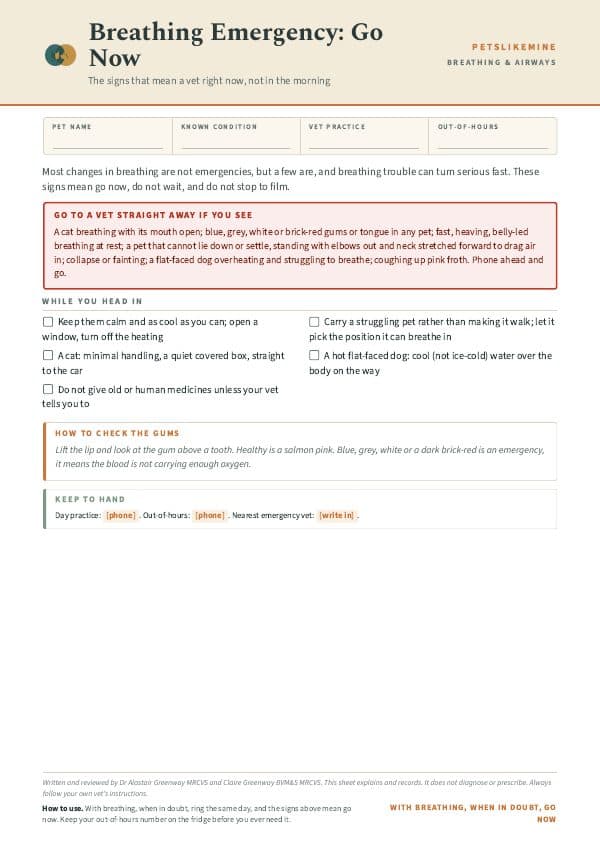
One last habit pays off long after tonight. When your cat is calm or asleep, count its breaths over a minute now and then. A resting cat normally breathes under about thirty times a minute, and a sleeping rate that sits consistently over thirty, especially one climbing over several days, is worth a call to your vet. Be clear-eyed about that number, though, because the under-thirty threshold is best validated for monitoring cats with controlled heart disease rather than asthma specifically, so treat it as a general "the lungs or heart are working harder" signal rather than an asthma-only alarm (Porciello et al., 2016; International Cat Care, n.d.). The resting respiratory rate tracker makes the counting easy, and a printable breathing emergency red flags card on the fridge means the next time something happens at 2am, the lines that mean "go now" are already in front of you. If you are ever unsure in the moment, the respiratory distress and cough triage will sort the now-emergency from the wait-and-book in a few taps. You handled this one. Next time you will be even readier.
References
- ABCD (European Advisory Board on Cat Diseases). (n.d.). Guideline for Lungworm Disease in Cats. Retrieved from
- American Animal Hospital Association. (2023). Respiratory Distress in Pets. AAHA Trends Magazine, January 2023. Retrieved from
- Cornell Feline Health Center. (2014). Feline Asthma: What You Need To Know. Cornell University College of Veterinary Medicine. Retrieved from
- Fernández-Parra, R., Pey, P., Reinero, C., & Malvè, M. (2023). Salbutamol transport and deposition in healthy cat airways under different breathing conditions and particle sizes. Frontiers in Veterinary Science, 10, 1176757.
- International Cat Care. (n.d.). Asthma and Chronic Bronchitis in Cats. Retrieved from
- Lee-Fowler, T. (2018). Asthma in Cats: Acute and Long-Term Management Guidelines. Today's Veterinary Practice, May/June 2018 (updated August 2022). Retrieved from
- Lee-Fowler, T. (2022). Albuterol Sulfate for Cats. Today's Veterinary Practice, September/October 2022. Retrieved from
- Porciello, F., Rishniw, M., Ljungvall, I., Ferasin, L., Häggström, J., & Ohad, D. G. (2016). Sleeping and resting respiratory rates in dogs and cats with medically-controlled left-sided congestive heart failure. The Veterinary Journal, 207, 164-168.
- Reinero, C. R. (n.d.). Treatment of Feline Allergic Asthma. dvm360. Retrieved from
- Tonozzi, C. C. (2022). Feline Bronchial Asthma. MSD/Merck Veterinary Manual. Retrieved from
- Trzil, J. E. (2020). Feline asthma: Diagnostic and treatment update. Veterinary Clinics of North America: Small Animal Practice, 50(2), 375-391.
- VCA Animal Hospitals. (n.d.). Albuterol Sulfate. Retrieved from
Free downloads
Companion worksheets to put what you've read into practice. Free PDFs, print at home.
Keep track of how your pet is doing
The owners who cope best are the ones who notice changes early. A simple health log shows you what is working, and what is not, before the next vet visit.
Start tracking, freeYou're not doing this alone
Compare treatment journeys and talk to owners managing breathing & airways. Free to join.
Join PetsLikeMine