

Asthma or Hairball? How to Tell a Cough from a Coughing-Up
Alastair Greenway
BVM&S MRCVS
There is a sound most cat owners know by heart. Your cat flattens herself to the floor, stretches her neck out, and makes that awful hacking, retching noise, the one that always seems to end in a swallow or a gag. Every time, you think the same thing: here we go, another hairball. You wait for the wet tube of fur on the rug. Sometimes it comes. Lately, more and more often, it doesn't.
That last detail is the one I want you to sit with, because it is the single most useful thing I can do for an asthmatic cat and her owner. The noise might not be a hairball at all. It might be a cough, and in cats one of the most common reasons for a recurring dry cough is asthma (Just Cats Clinic, n.d.). This matters more than it sounds: asthma gets mistaken for hairballs all the time, and the mistake quietly costs cats months of untreated airway disease. As one veterinary review puts it, "Many owners think that coughing is associated with hairballs, not realizing that a hairball vomited up from the stomach is separate from cough. Unfortunately, this misunderstanding means owners often dismiss coughing until signs worsen" (Sharp, 2013).
So this page does one job: it helps you tell a cough from a coughing-up. I won't walk you through the whole of feline asthma here. The full picture, the diagnosis and the long-term management all live in the complete guide to feline asthma. What I want is for you to be able to look at your cat with a fighting chance of knowing which thing you are watching, because getting that one judgement right shortens the gap between a worried owner on the rug and a cat who finally gets help.
Why this gets mixed up so easily
The confusion has one root, and once you see it you can't unsee it. A cough and a hairball come from two completely different parts of the body that happen to produce a similar-looking performance.
A cough is a respiratory event. It comes from the airways and the lungs: a sudden, noisy expulsion of air outward (Just Cats Clinic, n.d.). A hairball is a digestive event. That tube of fur is brought up from the stomach and oesophagus, which means it has to be vomited to come out at all, because hairballs are a product of vomiting and not of coughing (Just Cats Clinic, n.d.). One is the chest clearing the airways. The other is the gut emptying itself. They simply look alike from across the room when you are not expecting anything else.
It does not help that the asthma cough has a sting in its tail, almost designed to fool you. A feline lower-airway cough is mostly an out-breath: "Cats with asthma have predominantly expiratory dyspnea. Those more severely affected may have a marked expiratory push or even expiratory grunt" (Sharp, 2013). It also tends to come in spasms that are worst after rest or at the start of activity (Merck Veterinary Manual, n.d.). So your cat braces, forces air out hard, and finishes the fit with a gag or a swallow. That terminal gag is the exact moment an owner thinks, "there it is, she's bringing up a hairball." Often she isn't. She is finishing a cough, and that single misread lies behind a great many delayed diagnoses (Sharp, 2013).
Why hairballs form, how grooming and diet play in, and when vomiting itself is a problem are all genuinely gut questions, and they belong with our digestive team. If your cat truly is bringing up fur regularly, the Digestive Health home is the place to read about it. What I am drawing here is just the line between the two, so you know which door to walk through.
Telling them apart: what comes up, and how the body looks
The most reliable difference between a hairball and an asthma cough is what is actually produced.
A true hairball builds. There is a run-up of retching and gagging, the abdomen heaves, and then something comes up: a slug of matted fur, often slick with fluid or mucus (Trudell Animal Health, n.d.). It is, in the end, productive. An asthma cough produces nothing. The cat coughs, strains, hunches, looks for all the world like she is struggling, then stops, with no hairball and no fur, just a swallow and a return to normal (Trudell Animal Health, n.d.). It is dry and non-productive. This is the red flag I most want you to hold on to: if your cat does the "hairball thing" again and again yet you never find a hairball, that mismatch is itself the warning sign. A cat that brings up fur now and then is doing something normal. A cat that runs the whole routine and brings up nothing is very possibly coughing, and a recurring cough in a cat is not normal and is worth investigating.
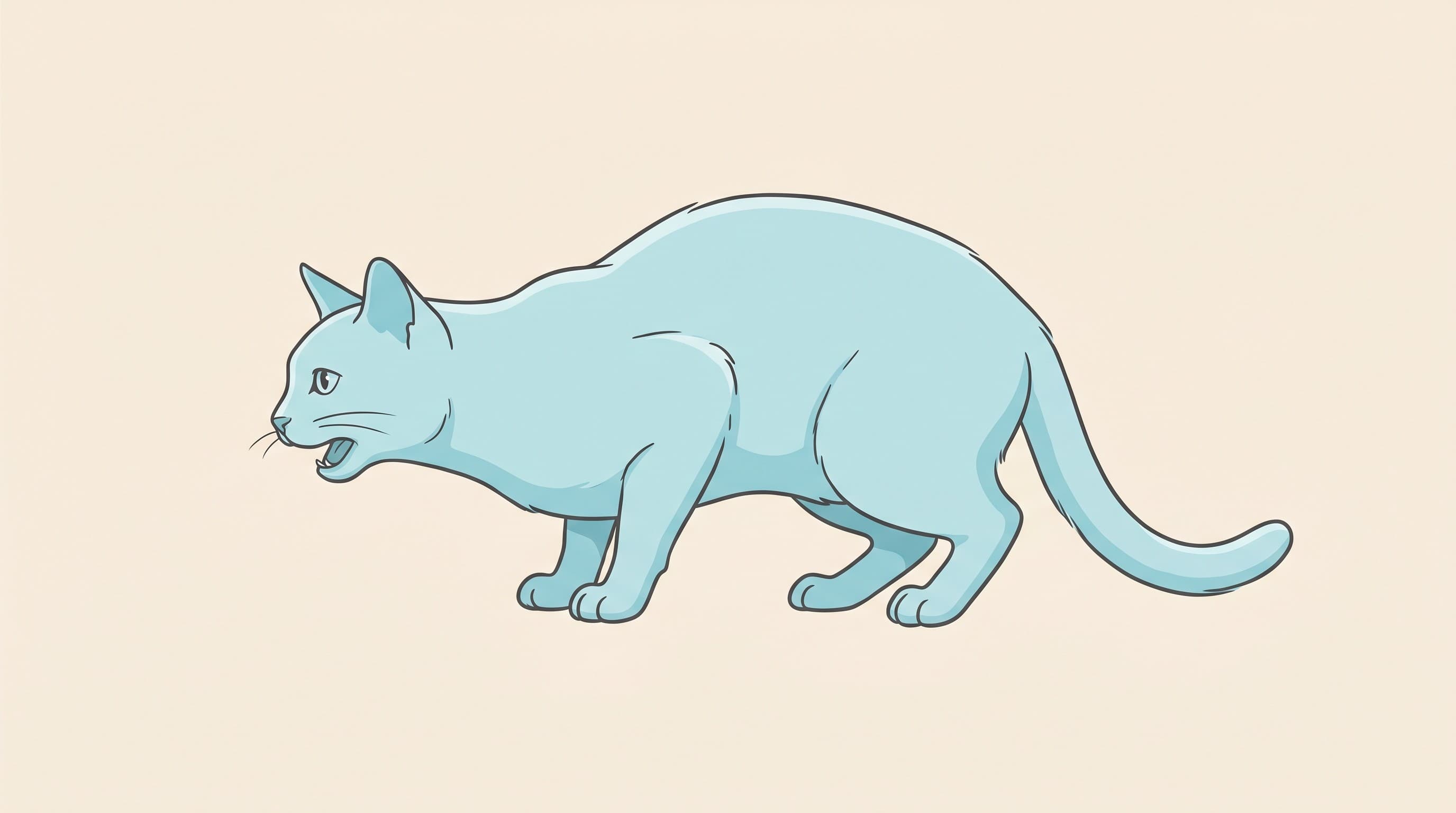
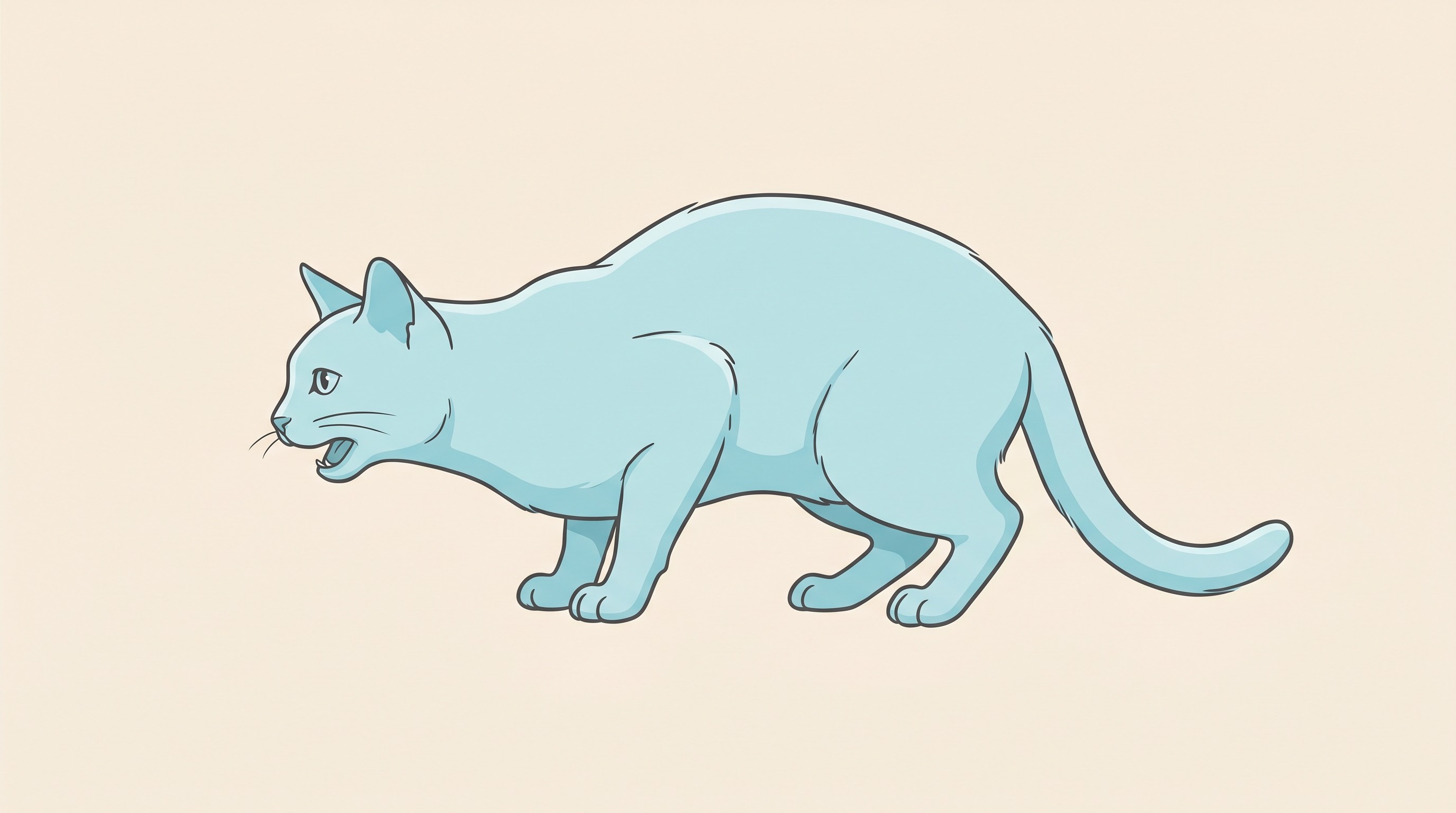
The posture is the second clue, and one you can genuinely watch for. During an asthma cough the cat tends to drop low and stay put. Cornell describe it precisely: "During an asthma attack, many cats hunch their body close to the ground and extend their necks forward in a characteristic posture" (Cornell Feline Health Center, n.d.-a). Picture the head and neck stretched forward, roughly parallel to the floor, the body crouched and braced, the cat rooted to one spot, the effort directed outward and downward, a struggle to breathe rather than to be sick. A cat bringing up a hairball usually looks a little different: more of an arch to the back, the belly heaving with the retch, often shuffling or even backing up across the floor, frequently with a give-away preamble of lip-licking and repeated swallowing.
Now the caveat, because I would rather tell you the truth than hand you a rule that fails you. Posture alone is not definitive. There is real overlap, and a cat can adopt a squatting position with its neck extended in either situation (Trudell Animal Health, n.d.). So read posture as a strong supporting clue alongside the all-important "what came up" question, never as proof on its own. The two together are far more telling than either by itself.
How often is too often?
Owners ask me this constantly, and it deserves a straight answer. The occasional genuine hairball is part of normal cat life and nothing to lose sleep over. What is not normal is the same hacking episode happening over and over with nothing to show for it.
A useful rule of thumb, drawn from owner guidance, is to take notice if the cough recurs more than about once a week, or if it comes and goes but rumbles on for more than around four weeks, especially when no hairball is ever produced (Trudell Animal Health, n.d.). Treat those numbers as a prompt to act rather than a hard line in the sand: a cat coughing twice a week with nothing coming up is telling you something worth taking to a vet. Left to drift, these cats go unhelped, each episode waved away as "just another hairball" until the day the breathing visibly worsens (Sharp, 2013).
What to do next
If a doubt has formed, here is how to turn it into something genuinely useful for your vet.
First, and most usefully, film it. Cats are maddening this way: they will cough five times a day at home and then sit serenely on the consulting table as if butter wouldn't melt. A short phone video of an episode is worth more than any description, because a vet can usually tell a cough from a retch just by watching the clip (Trudell Animal Health, n.d.). Keep your phone within reach and catch the next one. Our Airway Episode and Exertion Diary is built for logging exactly these episodes, with the clip and what was happening when they struck, so the pattern becomes visible over time.
Second, get it checked properly rather than reaching for hairball remedies and hoping. I'll keep the work-up brief because it belongs with the complete guide, but in short: diagnosing feline asthma is a clinical job backed up by a chest X-ray, where "radiographs often, but not always, reveal a characteristic bright branching pattern along the airways", so a normal X-ray does not rule it out (Cornell Feline Health Center, n.d.-a). It is a diagnosis of exclusion, which means part of your vet's task is ruling out the other things that make a cat cough (Merck Veterinary Manual, n.d.; Trzil, 2020). Two of those are worth flagging, because they are the reason a "looks like asthma" cough still deserves a real examination, not a guess.
One is lungworm. The cat lungworm Aelurostrongylus abstrusus can cause signs that "can be identical to those associated with feline bronchial disease/asthma", and it is screened for with a specific faecal test, the Baermann test (Traversa and Di Cesare, 2016). Here is the sobering part: a lungworm-infected cat can even appear to improve on the steroids and bronchodilators we use for asthma, so that "veterinarians have no reason to suspect a misdiagnosis" while the real cause sits there untreated (Traversa and Di Cesare, 2016). The full UK lungworm story lives in lungworm UK facts; I just want it on your radar as a reason not to self-treat. The other masquerader is heart disease, which brings me to the one number you can keep an eye on at home.
The one number worth watching at home
While we are untangling coughs, one simple measurement helps separate "watch this and book a routine appointment" from "something is wrong now": your cat's breathing rate at rest. Count the breaths while your cat is asleep or fully settled, one rise and fall of the chest as a single breath, over a full minute. A healthy cat sits comfortably under about 30 a minute. In the study that pinned this down, the sleeping breathing rate in healthy cats, and in cats with early, subclinical heart disease, was "consistently <30 breaths/min", with a median of about 21 (Ljungvall et al., 2014). I will be upfront about where the action thresholds come from: they were validated for monitoring heart disease, and we use them here as a general signal of fast resting breathing, not as an asthma-specific test. As a rule of thumb, under about 30 is reassuring, 30 or more is worth watching, and 40 or more warrants a call to the vet. Our resting breathing rate tracker makes it easy to count and log the trend over time, which is far more telling than any single reading.
Now the line that overrides everything else on this page, the one I will not soften. None of the cough-versus-hairball detective work above applies if your cat is in trouble right now. A cat breathing with its mouth open, with blue or grey gums, or pushing hard with its belly to breathe, is an emergency: get to a vet immediately. If shortness of breath is severe, "bluish mucous membranes, signaling a lack of oxygen in the blood, may be seen", and that is not something to wait out (Merck Veterinary Manual, n.d.). A severe asthma crisis is genuinely life-threatening, one where "the cat may die unless emergency treatment is immediately obtained" (Cornell Feline Health Center, n.d.-b). So do not stop to film it, do not sit and count, do not wait to see if it passes. Open-mouth breathing in a cat is never normal. What an attack looks like, and exactly what to do in the moment, is set out in what to do in a feline asthma attack, worth reading before you ever need it.
Where this leaves you
The quiet "oh" that forms when the penny drops, the suspicion that those weren't hairballs after all, means you have already done the hard part. You have noticed. The cats this article is written for are the ones whose coughing got filed under hairballs for so long that their airways were inflamed for months before anyone looked properly, and the way that story changes is exactly this: an owner who pauses on the rug, watches a little more closely, films the next episode, and books the appointment instead of buying another tube of hairball paste.
The good news on the other side of that appointment is real. Asthma in cats is a manageable, long-term condition, and well-controlled cats go on to live full, ordinary lives, all of which the complete guide to feline asthma lays out properly. For today you have done the thing that mattered most: you stopped assuming, and started watching. That is the step that gets these cats their lungs back.
References
- Cornell Feline Health Center. (n.d.-a). Feline Asthma: What You Need To Know. Cornell University College of Veterinary Medicine.
- Cornell Feline Health Center. (n.d.-b). Feline Asthma: A Risky Business for Many Cats. Cornell University College of Veterinary Medicine.
- Just Cats Clinic. (n.d.). Coughing versus Vomiting: Why Does My Cat Do That?
- Ljungvall, I., Rishniw, M., Porciello, F., Häggström, J., and Ohad, D. (2014). Sleeping and resting respiratory rates in healthy adult cats and cats with subclinical heart disease. Journal of Feline Medicine and Surgery, 16(4), 281-290.
- Merck Veterinary Manual. (n.d.). Feline Bronchial Asthma and Tracheobronchitis (Bronchitis, Bronchial Asthma) in Cats. Merck & Co.
- Sharp, C. R. (2013). Diagnosis of Feline Lower Airway Disease. Today's Veterinary Practice, November/December 2013.
- Traversa, D., and Di Cesare, A. (2016). Diagnosis and management of lungworm infections in cats: Cornerstones, dilemmas and new avenues. Journal of Feline Medicine and Surgery, 18(1), 7-20.
- Trudell Animal Health. (n.d.). Does My Cat Have Asthma or a Hairball?
- Trzil, J. E. (2020). Feline Asthma: Diagnostic and Treatment Update. Veterinary Clinics of North America: Small Animal Practice, 50(2), 375-391.
Keep track of how your pet is doing
The owners who cope best are the ones who notice changes early. A simple health log shows you what is working, and what is not, before the next vet visit.
Start tracking, freeYou're not doing this alone
Compare treatment journeys and talk to owners managing breathing & airways. Free to join.
Join PetsLikeMine