


Lungworm in UK Dogs: The Honest Facts, Without the Hard Sell
Alastair Greenway
BVM&S MRCVS
Two things tend to bring people to a page like this. One is an advert doing its job, the dramatic "Be Lungworm Aware" sort with the close-up of a slug, leaving behind a low hum of worry. The other is the lawn: you've just watched your own dog hoover up a snail before you could stop them, and now you want to know how frightened to be.
Let me do something the brand pages rarely do and give you the straight version. Lungworm is a real parasite, it is spreading across the UK, and in a small number of dogs it does genuine harm. It is also preventable with the right wormer and very treatable when caught early. None of that needs hype, so I'll stay product-neutral and talk about active ingredients rather than brand names. By the end you'll know what to actually do, which mostly comes down to one quiet, load-bearing fact: not every wormer covers lungworm.

What lungworm actually is
The "lungworm" that worries UK dog owners is a specific parasite, Angiostrongylus vasorum. It is a roundworm with a slightly confusing name, because the adult worms don't live in the airways at all. They live in the pulmonary arteries and the right side of the heart, which is why it also goes by the name French heartworm (ESCCAP, 2025). The "lungworm" label comes from the next stage: the young larvae lodge in the lungs and trigger a kind of worm-driven pneumonia, and that is what causes the breathing signs (ESCCAP, 2025).
One clean point before we go on: this is a dog parasite. A. vasorum infects dogs and other wild canids such as foxes, but essentially not cats, which get their own separate lungworms (ESCCAP, 2025). If you have a coughing cat, feline asthma is the better place to start.
How a dog actually catches it
This is the fact that does the most work. Dogs don't catch lungworm from other dogs, or from the air. They catch it by swallowing larvae that live inside slugs and snails (ESCCAP, 2025; PDSA, n.d.). Sometimes that's deliberate, the dog that seems to enjoy eating slugs, but far more often it's accidental: a snail mouthed while cropping grass, a slug on a chew or ball left out overnight, a tiny one swallowed from the rim of a water bowl (PDSA, n.d.).
And there's a wrinkle the "don't let your dog eat slugs" advice misses: your dog doesn't have to eat the slug at all. Slugs and snails leave larvae behind in their slime trails, and a dog can pick those up directly by drinking from a puddle or eating grass that's been crawled over (ESCCAP, 2025). Those larvae are hardy, staying infective for at least eight weeks after a snail has shed them, so contaminated grass and water are a real route, not just the slug in the mouth (ESCCAP, 2025).
Foxes are the engine keeping all this going in the background, carrying the same parasite and seeding the local slug and snail population, which is why fox numbers matter to your dog's risk (ESCCAP, 2025). Once a dog is infected, the worms mature in the heart and arteries and the females start producing eggs about six to eight weeks later, which hatch into larvae that are coughed up, swallowed and passed in the faeces for the next slug to pick up (ESCCAP, 2025).
Spreading, but not everywhere the same
This is where the brand pages and the truth part company a little. The plain headline is that Angiostrongylus vasorum, spread by slugs and snails, is established across much of the UK and still spreading, but that is not the same as a uniform, year-round national emergency. It is what vets call a focal disease, patchy and hotspot-driven, so the level of risk genuinely depends on where you live and what your dog gets up to (Elsheikha, 2024).
The spread itself is data, not marketing. First found in UK dogs in small pockets in Cornwall and south Wales, A. vasorum has over recent decades pushed out across south-east England, the Midlands and as far north as Glasgow, into Scotland and Northern Ireland (Elsheikha, 2024). A nationwide survey of vet practices found around one in five having seen at least one confirmed case in the previous year (Kirk et al., 2014), and the fox surveys agree, prevalence in British foxes climbing from 7.3% to 18.3% between surveys and reaching regions that previously had none (Taylor et al., 2015).
A few miles can change the picture entirely, though, so the most useful thing you can do is find out whether your own patch is a hotspot, and your vet, who sees the local case pattern, is the one who actually knows. One myth worth busting: you do not need to live on a farm. A study along the rural-to-urban gradient in an endemic city found infection was actually more common in suburban slugs than rural ones, and concluded slugs are a likely source of infection to dogs all year round (Aziz et al., 2016). In a hotspot, the slugs in an ordinary back garden can carry it, and it isn't only a summer worry.
Signs that are vague, varied, and easy to miss
If lungworm announced itself with one unmistakable sign it wouldn't be dangerous, but the picture is varied and often vague, and some infected dogs show nothing at all early on, which is exactly why it matters (ESCCAP, 2025). It helps to think in three groups.
The first is breathing signs, from that worm-driven pneumonia in the lungs: a cough, faster or more laboured breathing, or a dog that tires more easily on a walk. This is the most commonly reported group, with cardiorespiratory signs in roughly 40 to 65% of clinical cases (Willesen et al., 2022).
The second is the group that really separates lungworm from an ordinary cough, and the reason this parasite earns its reputation: bleeding and clotting problems. Lungworm can interfere with normal clotting, so affected dogs may show unexplained bruising, prolonged bleeding from a small cut or after a routine procedure, nosebleeds, bleeding into the whites of the eyes, blood in the stools, or coughing up blood (ESCCAP, 2025; Willesen et al., 2022). It's exactly the kind of thing you'd never expect from a "just a cough" illness, and it can turn serious quickly. If your dog is bruising or bleeding for no clear reason, that is not a wait-and-see sign.
The third is the non-specific group, where dogs quietly slip through: simply being tired, off colour, off their food, or losing weight (ESCCAP, 2025). In a smaller number of dogs the bleeding extends into the brain or spinal cord, producing neurological signs such as wobbliness, seizures or a change in behaviour (PDSA, n.d.), and occasionally, sadly, a dog dies suddenly with little warning (ESCCAP, 2025).
I'm not listing all that to frighten you, but because the vague, multi-system nature is the whole point: it's why a slightly off-colour dog in a known hotspot is worth a mention to your vet rather than a shrug. A cough in particular overlaps with a lot of other things, so if that is your dog's main problem and you're working out whether it comes from the chest or the heart, that sort is covered properly in is my dog's cough coming from the heart or the lungs. Lungworm is simply one item on that differential.
The good news: it's diagnosable and treatable
Now the part the scary adverts tend to underplay: caught before things get severe, lungworm has a good outlook.
Your vet can confirm it. The classic test is a Baermann faecal examination for the parasite's first-stage larvae, ideally on samples from three separate motions over a day or two, because infected dogs don't shed larvae every single day and a single sample can miss it (ESCCAP, 2025). A quick in-house blood test for the worm's antigen, sometimes an airway wash, plus chest imaging and clotting bloods, fills in the picture (ESCCAP, 2025). Treatment is then a course of a suitable wormer, drawing on the same active ingredients used to prevent the disease: a moxidectin spot-on, or fenbendazole tablets given daily for around three weeks (ESCCAP, 2025). The results are good. A field study in naturally infected dogs found cure rates of around 85% with a moxidectin spot-on and around 91% with fenbendazole, no significant difference between them, and an excellent prognosis in mildly to moderately affected dogs (Willesen et al., 2007).
The catch is in those words "mildly to moderately". A dog that has tipped into serious bleeding or breathing failure is a different proposition, needing hospital care, oxygen, fluids, steroids and sometimes blood transfusions, with a genuinely poorer outlook (ESCCAP, 2025). That gap, between the dog caught early and the dog caught late, is the real argument for not ignoring the early signs.
Prevention, without naming a brand
This is the fact this whole page exists to deliver, so I'll say it plainly: not every wormer covers lungworm.
A standard worming tablet aimed at the everyday roundworms and tapeworms does not necessarily protect against lungworm at all (PDSA, n.d.). Prevention relies on a specific family of drugs, the macrocyclic lactones, and in UK practice that means one of two active ingredients given to the right schedule: moxidectin or milbemycin oxime (ESCCAP, 2025).
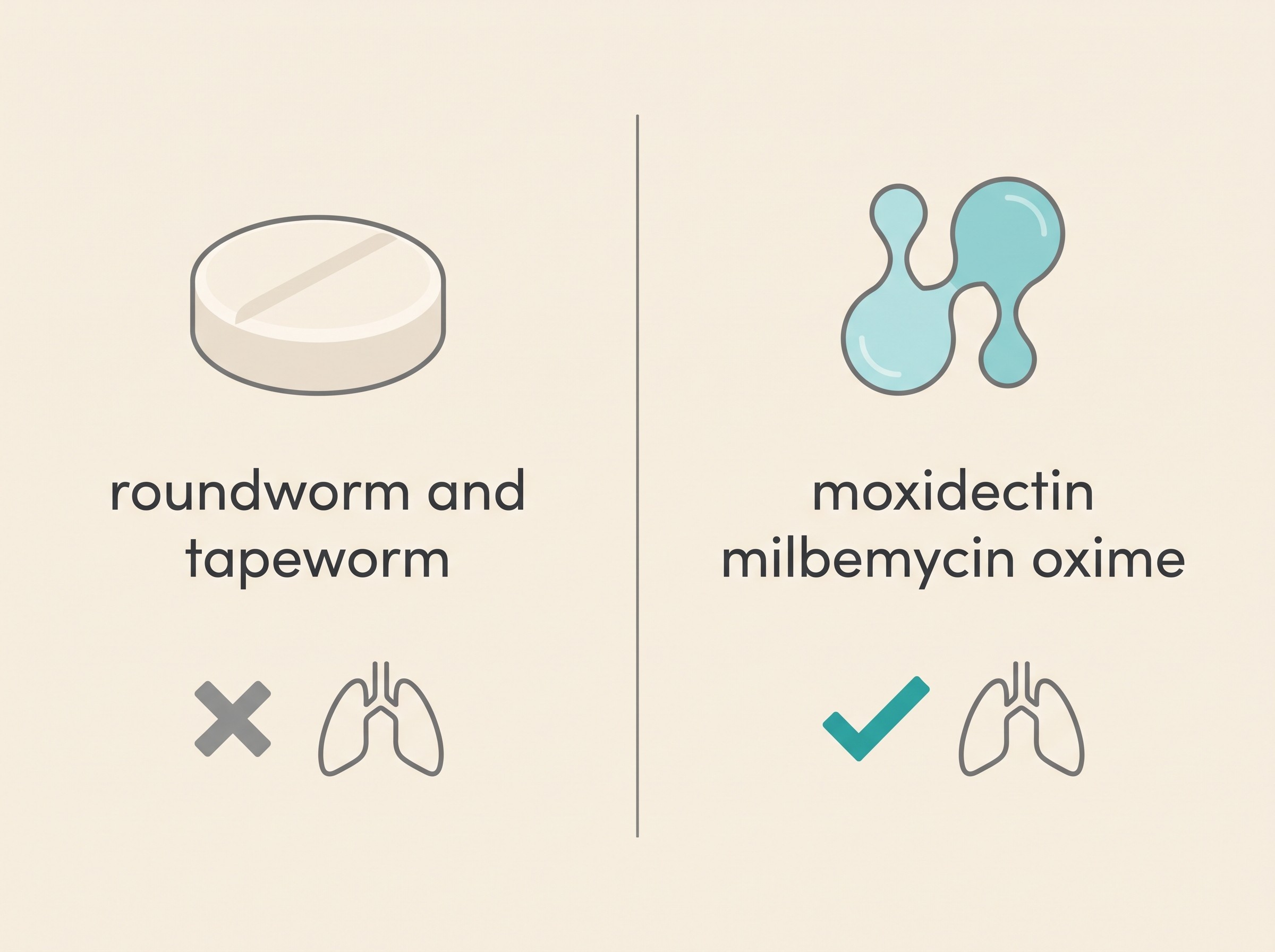
Even those two are not simply interchangeable. A monthly moxidectin spot-on is licensed for monthly prevention of lungworm, killing the larvae before they mature into adult worms, and a monthly oral moxidectin in a combination product does the same job (ESCCAP, 2025; Böhm et al., 2017; Becskei et al., 2020). Milbemycin oxime, by contrast, is licensed only for reducing the level of infection rather than full monthly prevention, and for lungworm it needs its own schedule, given weekly for four weeks (Elanco, 2022). So two products can both call themselves "monthly wormers" and not be equal when it comes to lungworm.
It's also worth knowing that the products that genuinely cover lungworm are prescription-only in the UK, so the bits and bobs you can pick up off a supermarket shelf are not licensed for it and should not be relied on (PDSA, n.d.). ESCCAP's own guidance is refreshingly un-dramatic: in an endemic area, or for a dog that eats grass, slugs or snails, the "hoovers" of this world, monthly preventive treatment with a suitable macrocyclic lactone prevents disease, decided on your vet's advice and tailored to your dog and area (ESCCAP, 2025). Not every dog needs the same product or schedule. So the takeaway is small and concrete: don't assume the wormer you already give covers lungworm, turn the box over and look for moxidectin or milbemycin rather than just "roundworm and tapeworm", and if you're not sure, ask.
What to actually do
Lungworm is a real and spreading UK parasite, but it's preventable with the right wormer and treatable when caught early, which makes the useful actions reassuringly concrete. Find out from your vet whether your area is a hotspot. Make the garden a little less of a buffet by picking up toys, chews and water bowls overnight rather than leaving them out for slugs to crawl over. And keep the two real red flags in mind: an unexplained cough or change in breathing, and any unexplained bruising or bleeding, both earn a vet visit rather than a wait.
One line on emergencies before I let you go. If breathing ever becomes a struggle at rest, the gums look blue or grey, or your dog collapses, that is not a lungworm question, it's a now question, and the place to go is is my pet's breathing an emergency and the breathing triage tool. For everything short of that, the calm truth is the reassuring one: this is a parasite you can stay ahead of, with a turn of the box and a five-minute conversation at your next appointment.
References
- Aziz, N. A. A., Daly, E., Allen, S., Rowson, B., Greig, C., Forman, D., & Morgan, E. R. (2016). Distribution of Angiostrongylus vasorum and its gastropod intermediate hosts along the rural-urban gradient in two cities in the United Kingdom, using real time PCR. Parasites & Vectors, 9, 56.
- Becskei, C., Fias, D., Mahabir, S. P., & Farkas, R. (2020). Efficacy of orally administered combination of moxidectin, sarolaner and pyrantel for the prevention of experimental Angiostrongylus vasorum infection in dogs. Parasites & Vectors, 13, 64.
- Böhm, C., Petry, G., Schmidt, H., Raue, K., Barthel, F., & Schaper, R. (2017). Evaluation of the persistent preventive efficacy of 2.5% moxidectin/10% imidacloprid spot-on in dogs experimentally infected with Angiostrongylus vasorum. Parasitology Research, 116(Suppl 1), 1-10.
- Elanco. (2022). MILBEMAX Tablets for Dogs (milbemycin oxime and praziquantel): Package Leaflet. Retrieved from
- Elsheikha, H. M. (2024). Angiostrongylus vasorum: where is it, and what are the risks? Veterinary Times, 3 July 2024.
- ESCCAP (European Scientific Counsel Companion Animal Parasites). (2025). Guideline 01, Seventh Edition: Worm Control in Dogs and Cats (Section 4, French Heartworm, Angiostrongylus vasorum). Retrieved from
- Kirk, L., Limon, G., Guitian, F. J., Hermosilla, C., & Fox, M. T. (2014). Angiostrongylus vasorum in Great Britain: a nationwide postal questionnaire survey of veterinary practices. Veterinary Record, 175(5), 118.
- PDSA (People's Dispensary for Sick Animals). (n.d.). Lungworm in dogs. Pet Health Hub. Retrieved from
- Taylor, C. S., Garcia Gato, R., Learmount, J., Aziz, N. A., Montgomery, C., Rose, H., Coulthwaite, C. L., McGarry, J. W., Forman, D. W., Allen, S., Wall, R., & Morgan, E. R. (2015). Increased prevalence and geographic spread of the cardiopulmonary nematode Angiostrongylus vasorum in fox populations in Great Britain. Parasitology, 142(9), 1190-1195.
- Willesen, J. L., Kristensen, A. T., Jensen, A. L., Heine, J., & Koch, J. (2007). Efficacy and safety of imidacloprid/moxidectin spot-on solution and fenbendazole in the treatment of dogs naturally infected with Angiostrongylus vasorum (Baillet, 1866). Veterinary Parasitology, 147(3-4), 258-264.
- Willesen, J. L., Langhorn, R., & Nielsen, L. N. (2022). Hemostatic dysfunction in dogs naturally infected with Angiostrongylus vasorum: a narrative review. Pathogens, 11(2), 249.
Keep track of how your pet is doing
The owners who cope best are the ones who notice changes early. A simple health log shows you what is working, and what is not, before the next vet visit.
Start tracking, freeYou're not doing this alone
Compare treatment journeys and talk to owners managing breathing & airways. Free to join.
Join PetsLikeMine