

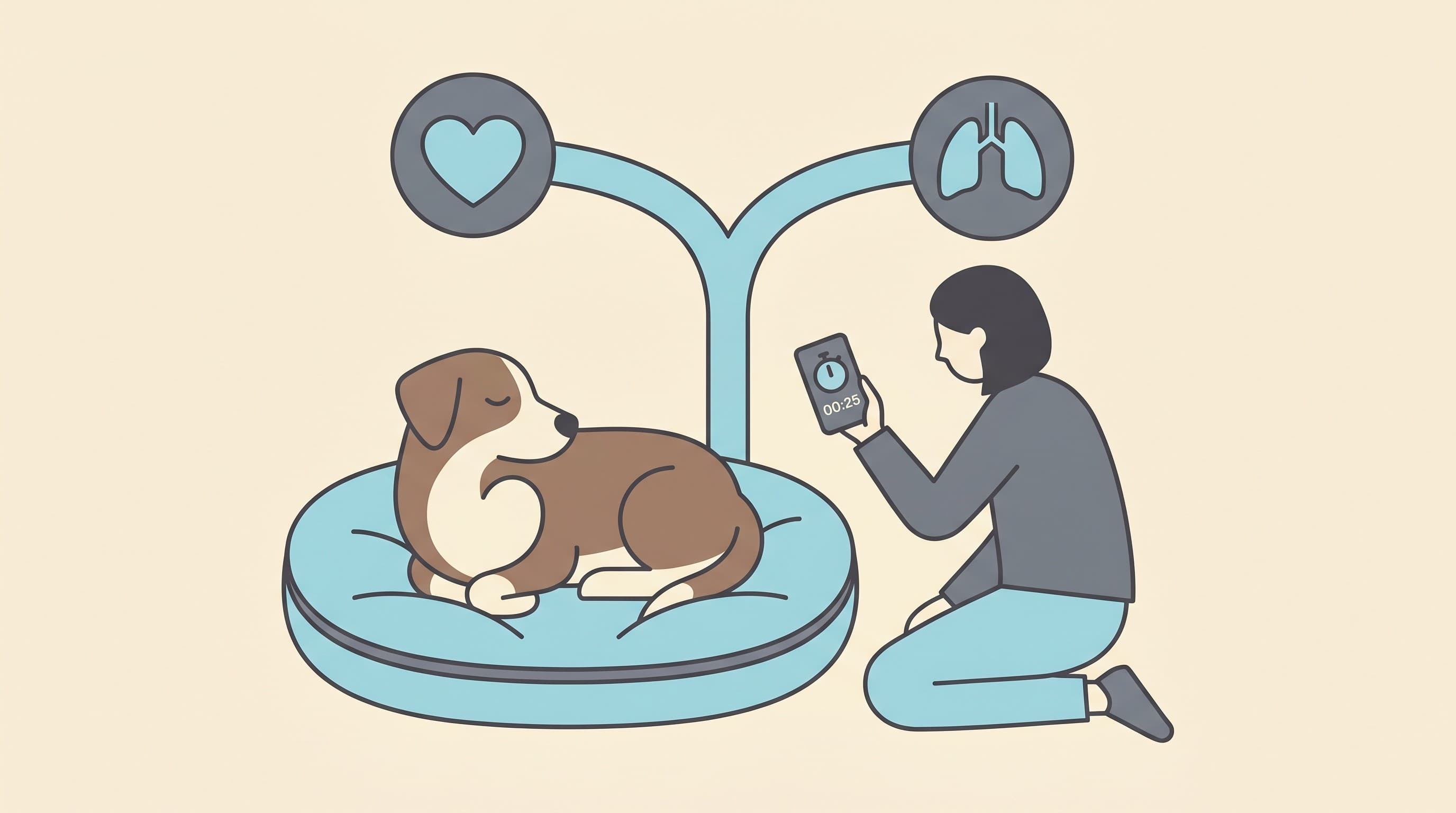
Why Is My Dog Coughing? Is It the Heart or the Lungs?
Alastair Greenway
BVM&S MRCVS
A cough almost always shows up at the wrong time of day. A dog brings up a dry, hacking cough after a drink, or a soft one that worsens the moment they settle for the night. Or it's the cat, crouched low with her neck stretched out, making a sound you've never quite heard before. The question underneath both is the same: is this serious, and where is it coming from?
There are two things worth holding in view at once. A cough can come from the heart or from the airways, and those need very different help. But the cough itself is a surprisingly poor witness, and rarely tells you on its own which organ is to blame. The good news is that there is one simple number you can measure at home that tells you far more, and learning to read it is the most valuable thing on this page.
The one number that tells you most
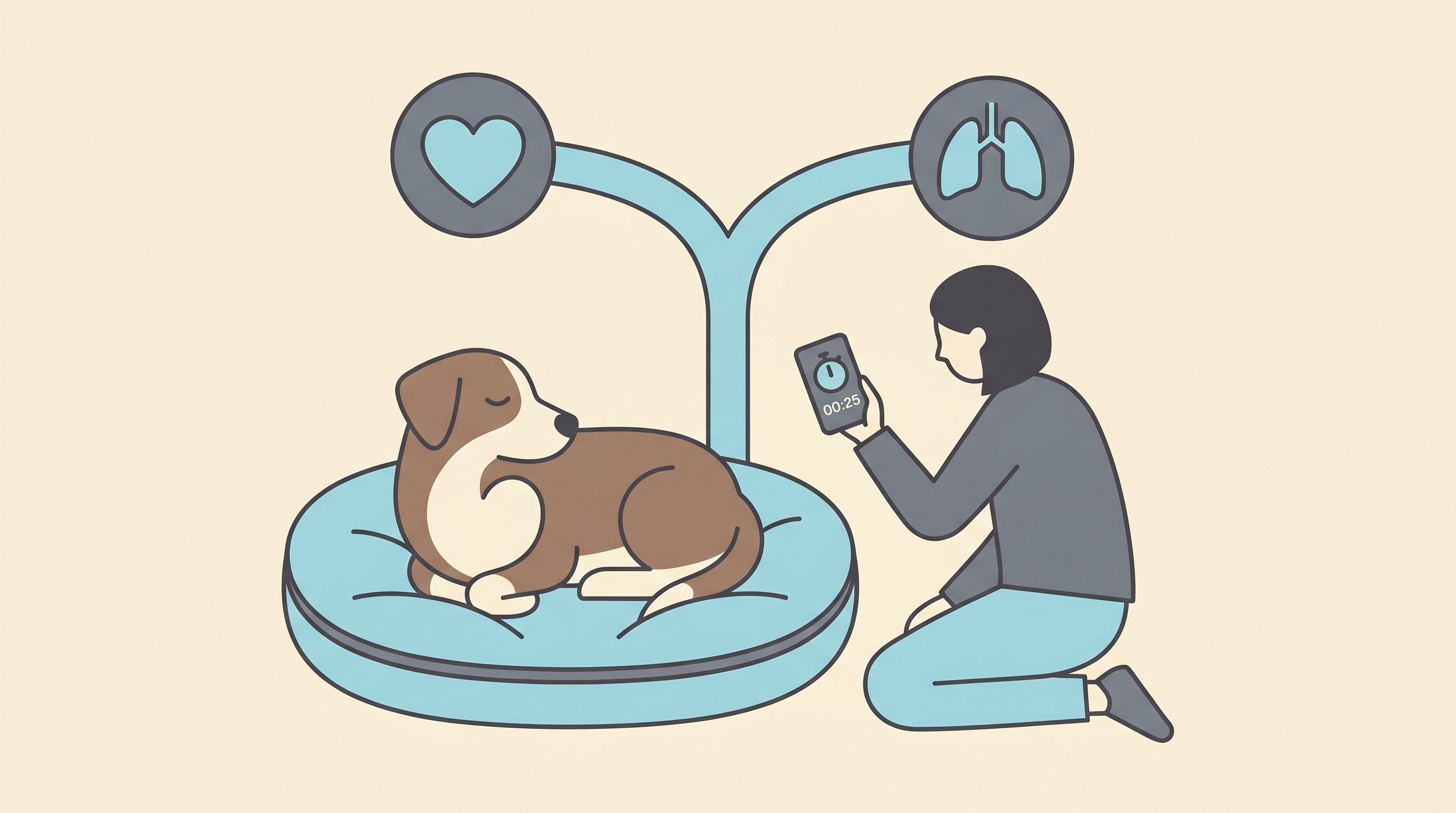
While your pet is fully asleep or completely at rest, count how many breaths they take in a minute, counting one full in-and-out as a single breath. In a healthy dog or cat, and even in one with early, hidden heart disease that has not yet tipped into trouble, that sleeping rate sits comfortably under about 30 a minute. The actual averages are lower still: in study after study, apparently healthy adult dogs breathe in the mid-teens to low twenties while asleep, and cats sit at a median of around twenty (Rishniw et al., 2012; Ohad et al., 2013; Ljungvall et al., 2014). So "under 30" is a generous ceiling, not the normal figure.
This number is powerful because it is the earliest reliable sign that fluid is building up on the lungs, which is what happens in left-sided congestive heart failure. When the heart can no longer keep up, that fluid backs up, and the body's first response, well before any drama, is to breathe a little faster at rest. The evidence here is unusually solid. Even dogs and cats whose heart failure is well controlled and stable on medication still, as a group, hold their sleeping rate under 30: in the largest study of such pets, the median sleeping rate was 20 breaths a minute in both species, and only a single dog and a single cat ever crept to 30 or more (Porciello et al., 2016). So the warning sign is not one high reading on a restless evening. It is a rate sitting steadily at 30 or more, and above all one climbing over days from your pet's own normal.
One thing deserves to be said plainly. The threshold was studied and validated specifically for heart disease, in dogs and cats whose hearts were under strain (Porciello et al., 2016; Ohad et al., 2013). I'm offering it here as a general "is the breathing working too hard at rest" signal, which is reasonable and useful, but you deserve to know that is what it is. A good rule of thumb, echoed by UK owner guidance from the makers of a common heart medicine, is this: under about 30 breaths a minute at rest is normal, 30 or more is worth watching, and 40 or more needs a call to the vet (Vetmedin, 2026). The under-30 line is the well-evidenced part; the 40 mark is a sensible "this is clearly too fast, ring now" escalation rather than a separately proven cut-off, and I'd rather tell you that than dress it up.
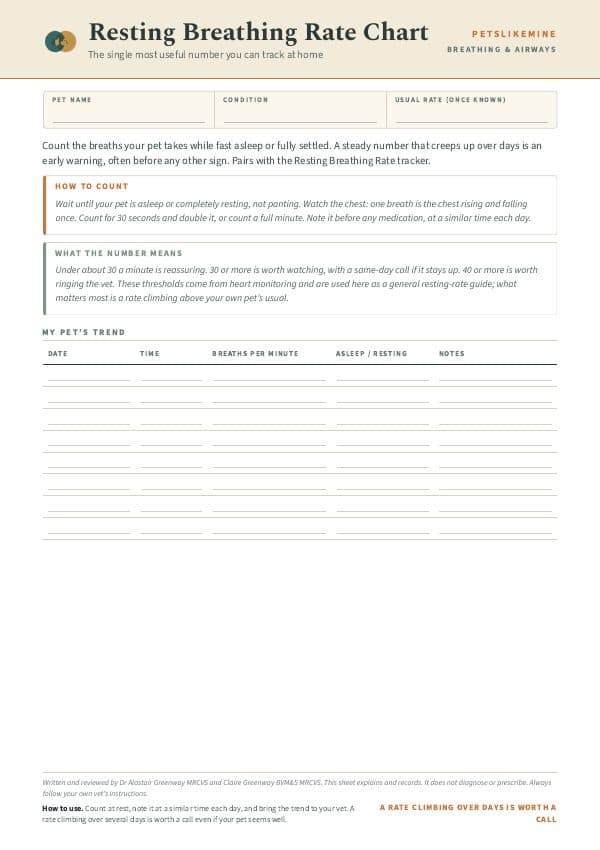
Counting that resting rate a few times a week, and writing it down, hands your vet something a single appointment never can. Our resting respiratory rate tracker lets you tap along to the breaths and keeps the history, and the breath camera will count them from a short phone clip if your pet won't sit still. There's also a printable resting respiratory rate chart for the fridge.
When the cough itself misleads you
This is the part that overturns a lot of older advice, including advice you may have been given in good faith. For years, a soft cough in a small dog with a heart murmur was assumed to be a "cardiac cough", the heart's own distress signal. The modern evidence does not support that as a rule, and saying so plainly will save you from chasing the wrong problem.
In dogs with the common leaky-valve condition, mitral valve disease, coughing turns out to correlate poorly with how big the heart is and far better with whether the dog also has airway disease such as a collapsing windpipe or chronic bronchitis (Ferasin and Linney, 2019). In plain terms, a coughing small dog with a murmur is very often coughing because of its airways, not its heart.
The old picture of an enlarged heart squashing the windpipe has taken a knock too, although here I want to be scrupulously fair, because the research genuinely disagrees with itself. A 2025 study of dogs with markedly enlarged hearts and stretched left atria found no link between chronic coughing and any narrowing of the airways on the x-ray, and radiologists looking at the films could not tell the coughers from the non-coughers; the authors concluded that compression by the enlarged heart is an unlikely cause of the cough (van Opstal et al., 2025). Against that, an earlier study using CT, a far more detailed scan than a plain x-ray, did find measurable narrowing of the airways that tracked with heart and left-atrial size in coughing dogs with murmurs (Lebastard et al., 2021). So the squashed-airway idea is not dead, but it is clearly not the tidy, universal explanation it was once taught as: it may matter in some dogs and not in others.
What both of those studies agree on is the bottom line that helps you tonight: the cough is a weak organ-locator. So we should stop interrogating the sound and start reading the pattern around it, and above all that resting rate.
Signs that lean towards the airway
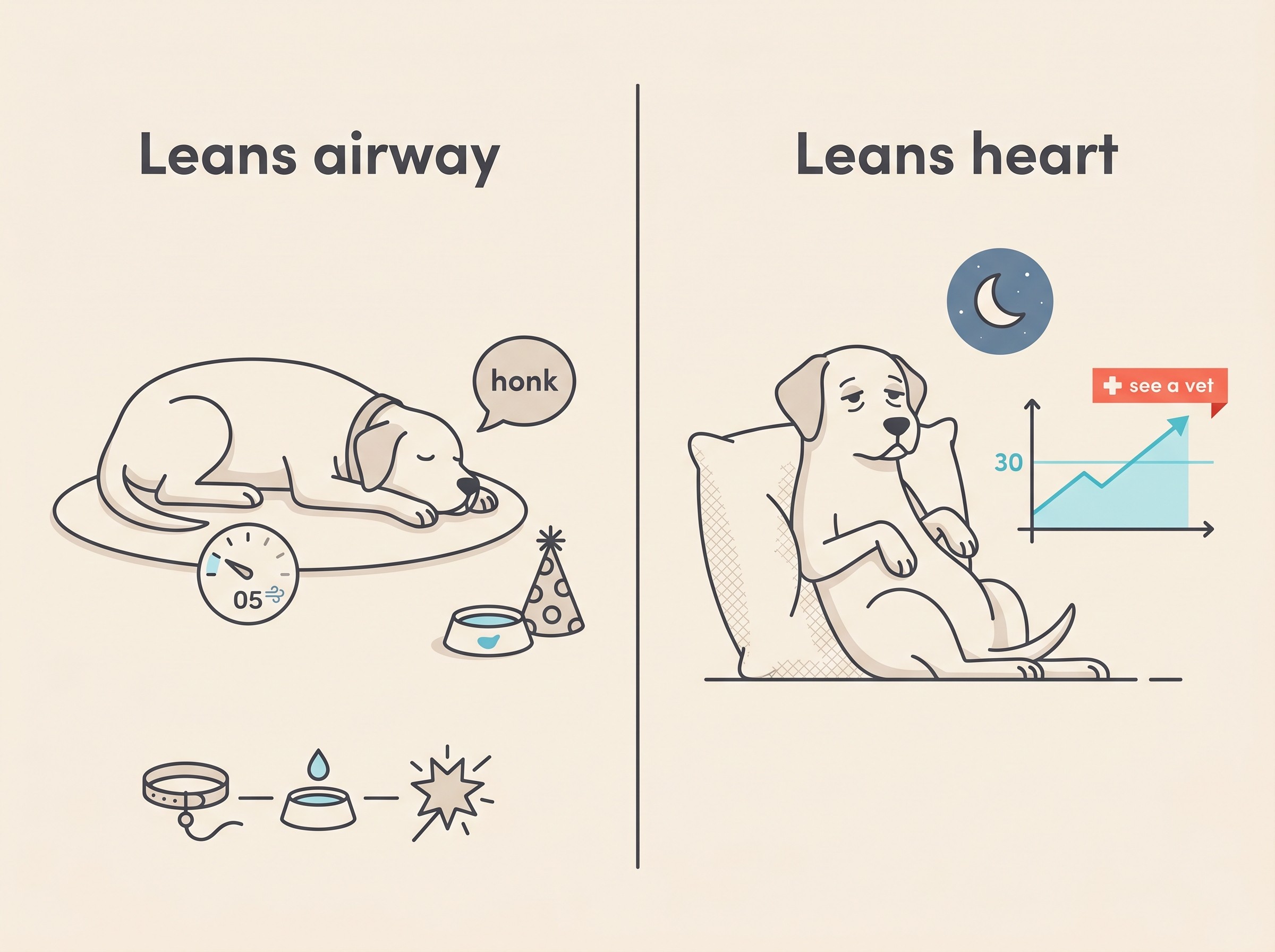
With that caveat in place, the company a cough keeps still leans one way or another. Airway-driven coughs usually come with a normal-ish resting breathing rate, itself a reassuring sign the heart is keeping up, and as a rough rule a loud cough tends to come from the large airways while a softer one comes from deeper down (Hsieh and Beets, 2020). The classic airway pictures (Hsieh and Beets, 2020; Ferasin and Linney, 2019):
- A dry, harsh "goose honk", loud and unmistakable, often set off by excitement or a tug on the collar. That sound is the signature of a collapsing windpipe, and it has its own home in collapsing trachea explained.
- A cough triggered by collar pressure, pulling, excitement or a drink of water. A windpipe that coughs the moment it is gently pinched is an irritable airway, not a struggling heart.
- A productive, wet or harsh hacking cough that ends in a retch, gag or big swallow, as if something is being brought up.
- A recent stay in kennels, daycare or boarding, pointing towards an infectious cough.
- In cats, a crouched, low cough with the neck stretched out and head down, repeated and dry. A coughing cat is far more likely to have an airway problem such as asthma than anything cardiac, and the full feline picture belongs in the complete guide to feline asthma.
One word on that infectious cough, so you are not falsely reassured. Most kennel cough is mild and clears over roughly one to three weeks in an otherwise-well dog, but some cases do tip into pneumonia (Reagan and Sykes, 2020). A cough with a fever, flatness, a lost appetite or fast and laboured breathing has crossed a line and needs a vet. I'll keep that to a sentence and hand the detail to is kennel cough serious or not, written for exactly that worry.
Signs that lean towards the heart
The other set leans towards the heart and the fluid that backs up behind it. None proves a cardiac cause on its own, but together they shift the picture (Porciello et al., 2016; Ferasin and Linney, 2019; Hsieh and Beets, 2020):
- A raised, climbing resting or sleeping breathing rate. This is the single strongest tell on the page, which is why it had its own section above. A cough sitting on top of a rate creeping past 30 deserves prompt attention.
- Tiring more easily, or a new reluctance to exercise.
- A cough or breathlessness that is worse at night, or worse lying flat, easing when the dog sits up or props itself on something. Vets call that orthopnoea, and it is a meaningful pattern.
- A known heart murmur in an at-risk patient: older small-breed dogs for valve disease, certain larger breeds for the muscle disease DCM.
A soft, wet cough in a senior dog that is clearly worse at night is the textbook heart-leaning picture. But, and this is the hinge of the whole article, a murmur on its own does not prove the cough is cardiac (Ferasin and Linney, 2019). The murmur and the cough can be two true things that simply share a dog. There is one exception worth knowing: in a dog already diagnosed with heart failure and on the water tablet furosemide, a cough that is getting worse can mean fluid is building again, and that is worth a same-day call to your vet (Tufts HeartSmart, 2026). What heart failure actually is, what furosemide does and how the resting rate is used to manage failing hearts all belongs in the Heart Health home, which owns that ground properly. We own the airway angle and the fork in the road; the cardiac workup is theirs.
Where heart and airway overlap, and why pictures help
The cough alone can never settle this for you, and there's a good reason why. Older small-breed dogs, your Yorkies, Chihuahuas, Cavaliers, Pomeranians and Shih Tzus, very frequently have both a leaky heart valve and an airway problem at once: a systolic heart murmur can be heard in at least a third of dogs with a collapsing windpipe (Hsieh and Beets, 2020). Two conditions, one small chest, one cough.
This is precisely why a good vet often reaches for chest x-rays, and sometimes a treatment trial, rather than pronouncing from the stethoscope alone, and why tracking that resting rate is so quietly powerful. If the rate climbs, or settles once heart treatment starts, that tells your vet something the cough never could. So if you are told "we may need some pictures, and we might try a treatment and see how the breathing responds", please hear careful medicine rather than a vet who cannot make up their mind. With a problem that wears two faces at once, working methodically is the kindness.
Red flags that mean now, not the morning
Whichever way the cough is leaning, some signs mean the time for working it out has passed and you need a vet immediately. Do not wait for morning, and do not stop to film it (Merck Veterinary Manual, 2026):
- Fast or laboured breathing at rest, or breathing driven from the belly with obvious effort.
- A cat breathing with its mouth open. In a cat this is always an emergency. Cats do not pant like dogs, so an open mouth means a cat in real trouble.
- Gums gone grey, blue or a dark, dusky colour, a sign the body is short of oxygen.
- Collapse, or coughing up pink, frothy fluid.
- A pet who cannot get comfortable: a cat hunched with its elbows pushed out, or a dog standing with its legs splayed and neck stretched, refusing to lie down.
Any of those, get to an emergency vet now. For the full "is this an emergency or can it wait" sort, including what to do on the way, is my pet's breathing an emergency is the hub, and the breathing triage tool walks you through it in the moment.
What to do tonight
If you are not in the red zone above, here is the genuinely useful thing you can do between now and the appointment, and it is the heart of why this page exists. Count and log that resting breathing rate, asleep or fully settled, a few times over the next day or two, and note whether it is steady or climbing. Then watch the cough itself and write down what you see: what it sounds like, what sets it off, when it happens, whether anything is brought up, and whether it is worse lying down at night. If you can safely film a clip, do, because thirty seconds of footage is worth a paragraph of description to your vet. Please do not reach for anything from the medicine cupboard. Human cough remedies and painkillers are at best useless and at worst dangerous to pets, and dampening the cough can mask the very pattern that would have pointed your vet to the answer.
Do those few things and you walk into that consult room with the one thing that turns a guessing game into a diagnosis: a clear pattern. "A dry honk that only happens when she gets excited, and a steady sleeping rate of twenty" sends your vet down a very different and faster road than "a soft cough that's worse every night, and a rate crept from twenty-two to thirty-four this week". You don't need to know which it is. You just need to have watched well, and now you know how.
References
- Ferasin, L., and Linney, C. (2019). Coughing in dogs: what is the evidence for and against a cardiac cough? Journal of Small Animal Practice, 60(3), 139-145.
- Hsieh, B. M., and Beets, A. K. (2020). Coughing in small animal patients. Frontiers in Veterinary Science, 6, 513.
- Lebastard, M., Le Boedec, K., Howes, M., Joslyn, S., Matheson, J. S., and O'Brien, R. T. (2021). Evaluation of bronchial narrowing in coughing dogs with heart murmurs using computed tomography. Journal of Veterinary Internal Medicine, 35(3), 1509-1518.
- Ljungvall, I., Rishniw, M., Porciello, F., Häggström, J., and Ohad, D. G. (2014). Sleeping and resting respiratory rates in healthy adult cats and cats with subclinical heart disease. Journal of Feline Medicine and Surgery, 16(4), 281-290.
- Merck Veterinary Manual. (2026). Clinical signs of respiratory disease in animals. Retrieved from
- Ohad, D. G., Rishniw, M., Ljungvall, I., Porciello, F., and Häggström, J. (2013). Sleeping and resting respiratory rates in dogs with subclinical heart disease. Journal of the American Veterinary Medical Association, 243(6), 839-843.
- Porciello, F., Rishniw, M., Ljungvall, I., Ferasin, L., Häggström, J., and Ohad, D. G. (2016). Sleeping and resting respiratory rates in dogs and cats with medically-controlled left-sided congestive heart failure. The Veterinary Journal, 207, 164-168.
- Reagan, K. L., and Sykes, J. E. (2020). Canine infectious respiratory disease. Veterinary Clinics of North America: Small Animal Practice, 50(2), 405-418.
- Rishniw, M., Ljungvall, I., Porciello, F., Häggström, J., and Ohad, D. G. (2012). Sleeping respiratory rates in apparently healthy adult dogs. Research in Veterinary Science, 93(2), 965-969.
- Tufts HeartSmart. (2026). Coughing. Cummings School of Veterinary Medicine, Tufts University. Retrieved from
- van Opstal, K. Y., Kittleson, M. D., Teske, E., Auriemma, E., van den Broek, H., Spattini, G., Vilaplana Grosso, F. R., and Szatmári, V. (2025). No correlation between chronic cough and radiographic signs of bronchial narrowing in dogs with cardiomegaly and left atrial dilation secondary to primary mitral valve regurgitation. Animals, 15(17), 2510.
- Vetmedin (Boehringer Ingelheim) UK. (2026). Resting respiratory rate: owner guidance. Retrieved from
Free downloads
Companion worksheets to put what you've read into practice. Free PDFs, print at home.
Keep track of how your pet is doing
The owners who cope best are the ones who notice changes early. A simple health log shows you what is working, and what is not, before the next vet visit.
Start tracking, freeYou're not doing this alone
Compare treatment journeys and talk to owners managing breathing & airways. Free to join.
Join PetsLikeMine