

Kennel Cough: Serious or Not?
Alastair Greenway
BVM&S MRCVS
Kennel cough nearly always announces itself a day or two after something sociable: a weekend in boarding kennels, a busy morning at daycare, a training class, or just a muddy, crowded park. Then comes a noise most owners have never heard before. A harsh, dry, hacking cough, the kind that sounds like something is stuck in the throat, often finishing with a gag or a retch and sometimes a little blob of white foam. The first time it happens you jump up, convinced your dog is choking. They aren't. They give a shake, look faintly embarrassed, and trot off, then do it all over again an hour later. In the small hours it sounds genuinely alarming.
Most of the time, kennel cough is not serious. In an otherwise-well dog it behaves like a dog cold: a self-limiting infection that runs its course and clears up on its own (PDSA, n.d.; Royal Kennel Club, n.d.). But "most of the time" is not "always", and you need to be able to tell the common, harmless version apart from the much smaller number of cases that have crossed into something that needs a vet. The cough you can usually wait out. The dog who is flat, feverish or breathing hard you cannot.
What kennel cough actually is
"Kennel cough" is the everyday name for a syndrome vets call canine infectious respiratory disease complex, or CIRDC (you may also see the older term, infectious tracheobronchitis). The word complex is doing real work there. This isn't one single germ. It's a contagious mixture of viruses and bacteria that inflame the windpipe and upper airways, often arriving one after another or ganging up together and leaving the airway twitchy and irritated (Reagan and Sykes, 2020; Maboni et al., 2019).
The cast list is long. On the viral side sit canine parainfluenza virus, canine adenovirus 2, canine respiratory coronavirus, canine pneumovirus, canine influenza and canine herpesvirus, with distemper in the mix only where vaccination has lapsed (Maboni et al., 2019; MSD Veterinary Manual, n.d.). On the bacterial side the best known by far is Bordetella bronchiseptica, the single most commonly named bacterial cause, alongside various Mycoplasma species and Streptococcus equi subspecies zooepidemicus (Maboni et al., 2019; Royal Kennel Club, n.d.). You don't need to memorise any of that. The useful takeaway is that because several different bugs cause the same cough, and because it's so often a mixture rather than one tidy culprit, there is frequently no single germ to "kill off", a point that matters a great deal when we reach the question of antibiotics. (A quick note for cat owners: this article is about dogs. Cats get their own, separate respiratory infections, so a coughing cat needs a different conversation with your vet.)
How to recognise the cough
The sound is the giveaway. The classic kennel cough is harsh, dry and honking, classically described as sounding "like a goose honk" or like the dog has something caught in their throat, and it is very often followed by a retch or a gag (MSD Veterinary Manual, n.d.; Royal Kennel Club, n.d.). That gag sometimes brings up a small amount of clear or white froth. Owners understandably read that as vomiting, but it isn't: it's mucus carried up by the cough, not stomach contents. One small clinical tell your vet may use: the cough is often easily set off by gently pressing on the windpipe, because the lining is so inflamed (MSD Veterinary Manual, n.d.).
A dog with uncomplicated kennel cough is, in themselves, well. They're bright, they greet you at the door, they want their dinner, and apart from the cough (and maybe a bit of sneezing, a runny nose or a slightly smaller appetite) you'd never know they were unwell (MSD Veterinary Manual, n.d.; Royal Kennel Club, n.d.). The cough sounds dreadful. The dog behind it is essentially fine. That gap between a horrible noise and a happy dog is the single best clue that you're looking at the uncomplicated version. Coughing fits also tend to be set off or worsened by excitement, exercise or a pull on the collar, which is exactly why an evening of zoomies makes it sound worse just as you were hoping for a quiet night.
As for how long it runs, the short answer is that in an otherwise-well dog it usually clears in one to three weeks (PDSA, n.d.; Royal Kennel Club, n.d.). The cough is often loudest in the first few days and then eases: the MSD Veterinary Manual notes that severity tends to diminish over the first five days even though the illness itself can persist for ten to twenty days (MSD Veterinary Manual, n.d.). If the timeline is what you're really chasing, or you're wondering at what point the duration itself means it's time to see the vet, how long kennel cough lasts is written for exactly that.
Why it spreads, and why it loves a crowd
Kennel cough earned its name. It is highly contagious and passes from dog to dog three ways: through the air in the fine droplets a coughing dog throws out, by direct nose-to-nose contact, and on shared surfaces such as water bowls, leads and kennel doors (Royal Kennel Club, n.d.; PDSA, n.d.). Bordetella in particular can linger in the environment for some time, which is part of why the cough sweeps through a whole building rather than touching one dog and stopping (PDSA, n.d.).
That's also why it thrives wherever lots of dogs mix and new ones keep arriving: boarding kennels above all, but equally rescue centres, daycare, training classes, dog shows, the groomer and a busy park on a Saturday morning (Maboni et al., 2019; Dear, 2020). The fuller picture of vaccination, and why boarding establishments insist on it, belongs to its own guide on vaccination and how kennel cough spreads. For now it's enough to know that if your dog has been somewhere full of other dogs in the last week or two, this cough fits the story neatly.
When it really is serious
The comforting "it's just a dog cold" message, repeated without its caveats, is exactly how the occasional seriously ill dog gets missed. Most kennel cough is mild and self-limiting (Reagan and Sykes, 2020). But in a minority of dogs the infection moves down into the lungs and becomes bronchopneumonia, and that is a genuinely serious illness that needs a vet.
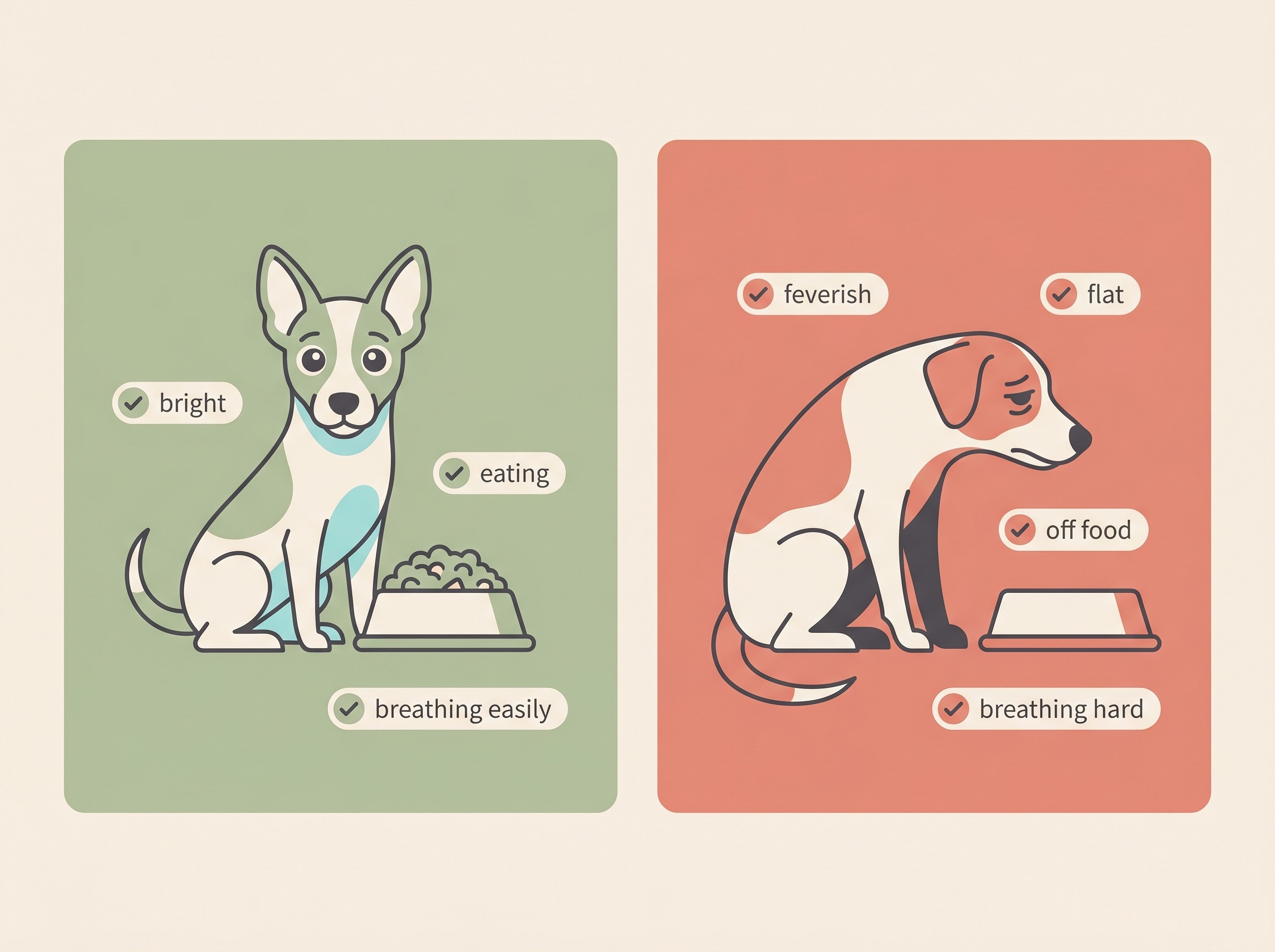
The signs that the picture has changed are specific and worth learning. The MSD Veterinary Manual puts it plainly: "development of more severe signs, including fever, purulent nasal discharge, depression, anorexia, and a productive cough, is indicative of bronchopneumonia" (MSD Veterinary Manual, n.d.). Translated into what you'd actually notice at home, the red flags are:
- A fever, or a dog who feels hot, dull and unwell in themselves.
- Lethargy or low mood: flat, withdrawn, not their usual self.
- Going off their food, or refusing it altogether.
- Fast or laboured breathing, or obvious effort to breathe even at rest.
- A moist, productive cough, often with thick green or yellow discharge from the nose, rather than the dry hack.
A dog who is coughing but stays bright, keeps eating and breathes easily is reassuring, and you can usually look after them at home. A dog who is coughing and is flat, off their food, feverish, or breathing hard has crossed a line, and that dog needs to be seen. The cough alone is rarely the emergency. It's the company the cough keeps that matters.
What happens next at the vet, and the deeper pneumonia story, is handled in the companion piece on when a cough becomes pneumonia. The job of this page is just to make sure you can spot the turn.
Some dogs deserve a lower threshold
The "wait and watch" approach is for the otherwise-healthy adult dog. There are groups for whom I would not wait at all, because they are more likely to develop severe disease or slip into pneumonia: very young puppies, elderly dogs, dogs whose immune system is naive or suppressed (including those on immunosuppressive medication), and dogs with pre-existing airway or heart disease (Dear, 2020; Royal Kennel Club, n.d.). Across the research, younger age comes up again and again as the single strongest predictor of severe signs and of carrying more than one bug at once (Maboni et al., 2019).
So if your coughing dog is a small puppy, a frail oldie, or already managing a heart or lung condition, please don't sit on it. Get them checked early, while the cough is still just a cough.
Why your vet may not reach for antibiotics
Something here catches owners off guard, so it's worth saying before it happens to you. You take a coughing dog to the vet expecting antibiotics, and the vet sensibly declines. That is good medicine, not your vet being stingy or dismissive.
Because most kennel cough is viral, antibiotics simply don't touch the cause of the average case. The international consensus guidance on this, the ISCAID antimicrobial-use guidelines, is explicit: "the majority of cases of CIRDC are currently believed to be viral in etiology and so antimicrobial administration is often not indicated", and "most dogs with clinical signs of CIRDC including mucopurulent nasal discharge maintain normal appetite and attitude and might resolve spontaneously within 10 days without antimicrobial treatment" (Lappin et al., 2017). UK owner guidance echoes this: "antibiotics are very rarely prescribed for kennel cough because most cases are caused by viruses" (PDSA, n.d.).
Antibiotics are held in reserve for the dogs who actually need them, the ones who are systemically unwell or not improving. The same consensus advises considering them only when fever, lethargy or inappetence appears alongside that mucky discharge, with doxycycline the usual first choice for a week to ten days (Lappin et al., 2017). So your vet withholding antibiotics from a bright, well dog and prescribing them for a flat, feverish one is exactly the right call in both cases. The full stewardship-and-timeline detail sits with how long kennel cough lasts.
Looking after a well dog at home
For the otherwise-healthy dog who's coughing but bright, a few practical things genuinely help while the infection runs its course.
Rest and quiet. Exercise and excitement both wind the cough up, so this is the week for short, calm lead walks and a lot of lounging, not the park or rough-and-tumble with other dogs (PDSA, n.d.).
Swap the collar for a harness. A lead clipped to a collar presses straight onto an already-inflamed windpipe and triggers more coughing. A well-fitted harness takes that pressure off the throat entirely. This is the single load-bearing daily rule across every airway condition we write about, and there's a dedicated guide on why a harness beats a collar if you want the detail.
A little humidity. Sitting with your dog in a bathroom made steamy by a hot shower can soothe an irritated airway and loosen things up (PDSA, n.d.).
Keep them away from other dogs. Your dog is contagious. Isolate them from other dogs while they're coughing and, because shedding continues after the cough settles, for a good two to three weeks after the signs have cleared (PDSA, n.d.; Dear, 2020). That means skipping daycare, the park and dog-owning visitors until you're well past it.
When to pick up the phone
Most dogs who match the description at the top of this page will be back to normal in one to three weeks, occasionally a little longer in older dogs, with nothing more than rest, a harness and a bit of patience (PDSA, n.d.; Royal Kennel Club, n.d.). That's the likely road, and it's a good one.
But ring your vet now, or run the situation through the breathing-triage tool, if any of the following is true: the breathing is fast or laboured, the gums look blue or grey, your dog collapses, there's a fever, they turn lethargic or go off their food, the cough is getting worse rather than slowly better, your dog is very young, very old or already unwell, or the cough simply isn't shifting within the window you'd expect. None of those should wait until morning.
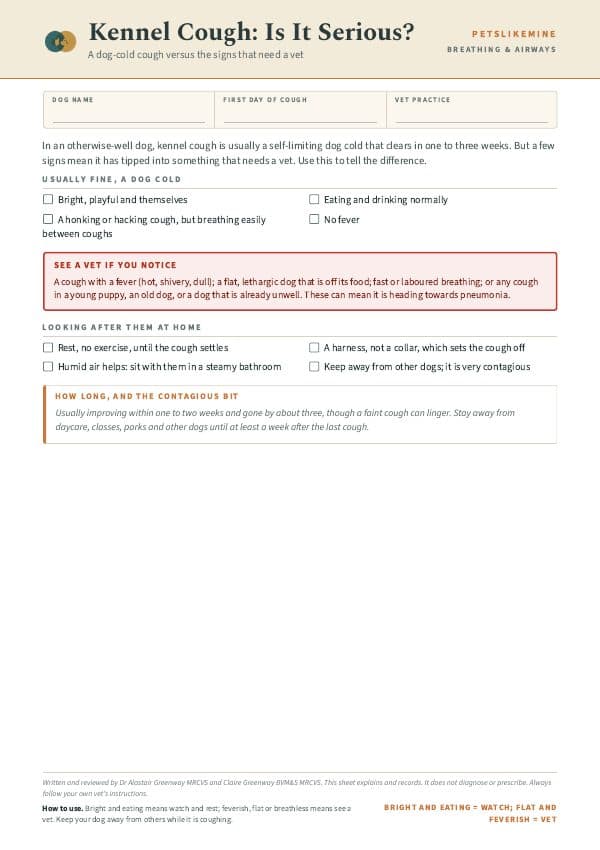
If you'd like the green-flags-versus-red-flags checklist somewhere you can see it through a long coughing week, the kennel cough: is it serious? download lays the whole triage out on one page. Keep half an eye on the things that matter, let the rest run its course, and there's every chance the next noise you celebrate is your dog's first proper bark in a fortnight.
References
- Dear, J. D. (2020). Canine Infectious Respiratory Disease Complex. Clinician's Brief.
- Lappin, M. R., Blondeau, J., Boothe, D., Breitschwerdt, E. B., Guardabassi, L., Lloyd, D. H., Papich, M. G., Rankin, S. C., Sykes, J. E., Turnidge, J., and Weese, J. S. (2017). Antimicrobial use guidelines for treatment of respiratory tract disease in dogs and cats: Antimicrobial Guidelines Working Group of the International Society for Companion Animal Infectious Diseases (ISCAID). Journal of Veterinary Internal Medicine, 31(2), 279-294.
- Maboni, G., Seguel, M., Lorton, A., Berghaus, R., and Sanchez, S. (2019). Canine infectious respiratory disease: New insights into the etiology and epidemiology of associated pathogens. PLoS ONE, 14(4), e0215817.
- MSD Veterinary Manual. (n.d.). Kennel Cough (Canine Infectious Tracheobronchitis), Professional Version.
- PDSA (People's Dispensary for Sick Animals). (n.d.). Kennel Cough. Pet Health Hub.
- Reagan, K. L., and Sykes, J. E. (2020). Canine infectious respiratory disease. Veterinary Clinics of North America: Small Animal Practice, 50(2), 405-418.
- Royal Kennel Club. (n.d.). Kennel cough in dogs.
Free downloads
Companion worksheets to put what you've read into practice. Free PDFs, print at home.
Keep track of how your pet is doing
The owners who cope best are the ones who notice changes early. A simple health log shows you what is working, and what is not, before the next vet visit.
Start tracking, freeYou're not doing this alone
Compare treatment journeys and talk to owners managing breathing & airways. Free to join.
Join PetsLikeMine