

How Long Does Kennel Cough Last?
Alastair Greenway
BVM&S MRCVS
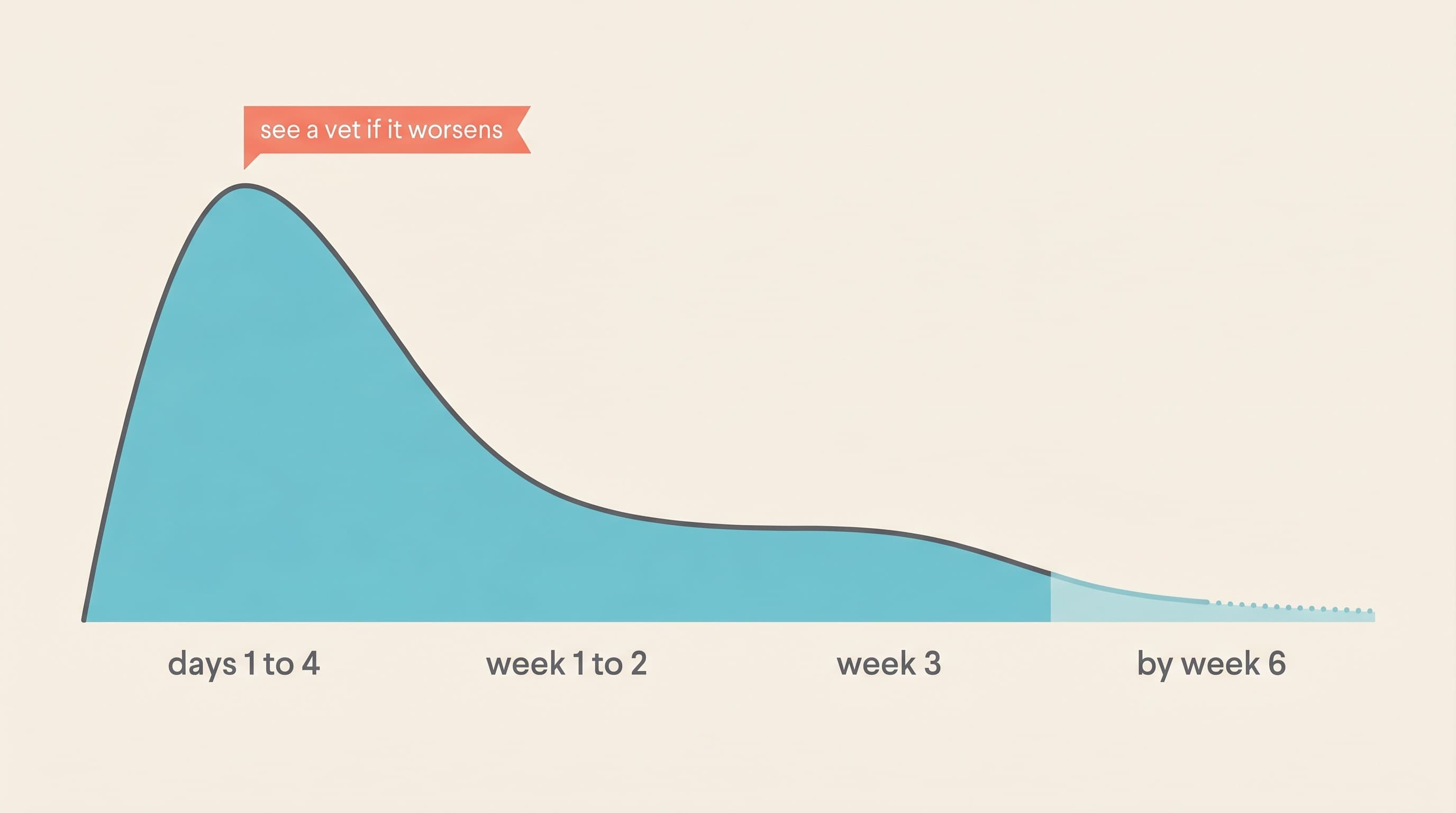
In an otherwise-well dog, kennel cough usually clears in one to three weeks. That's the short answer, and it's worth having up front before the detail underneath it. Most dogs are over the worst within a week or two and back to themselves by three. The cough is the last thing to fade, and a lingering hack in a dog that's still bright, eating well and breathing easily is almost always just an irritated windpipe settling down, not a sign that anything has failed. So if you've been counting the days since daycare or the kennels, and you're three or four in with the house echoing to that dry honk every time the dog gets up, you're roughly where most owners are at this stage. This piece is the calendar: how the cough usually runs its course, when the length itself becomes a reason to get checked, whether antibiotics speed anything up, and why the don't-spread-it clock runs longer than the recovery one. If you're still at the "is this even kennel cough, and is it serious" stage, start with is kennel cough serious or not, which is the proper front door. I'll assume here that you've already met the cough.
The usual shape of the cough
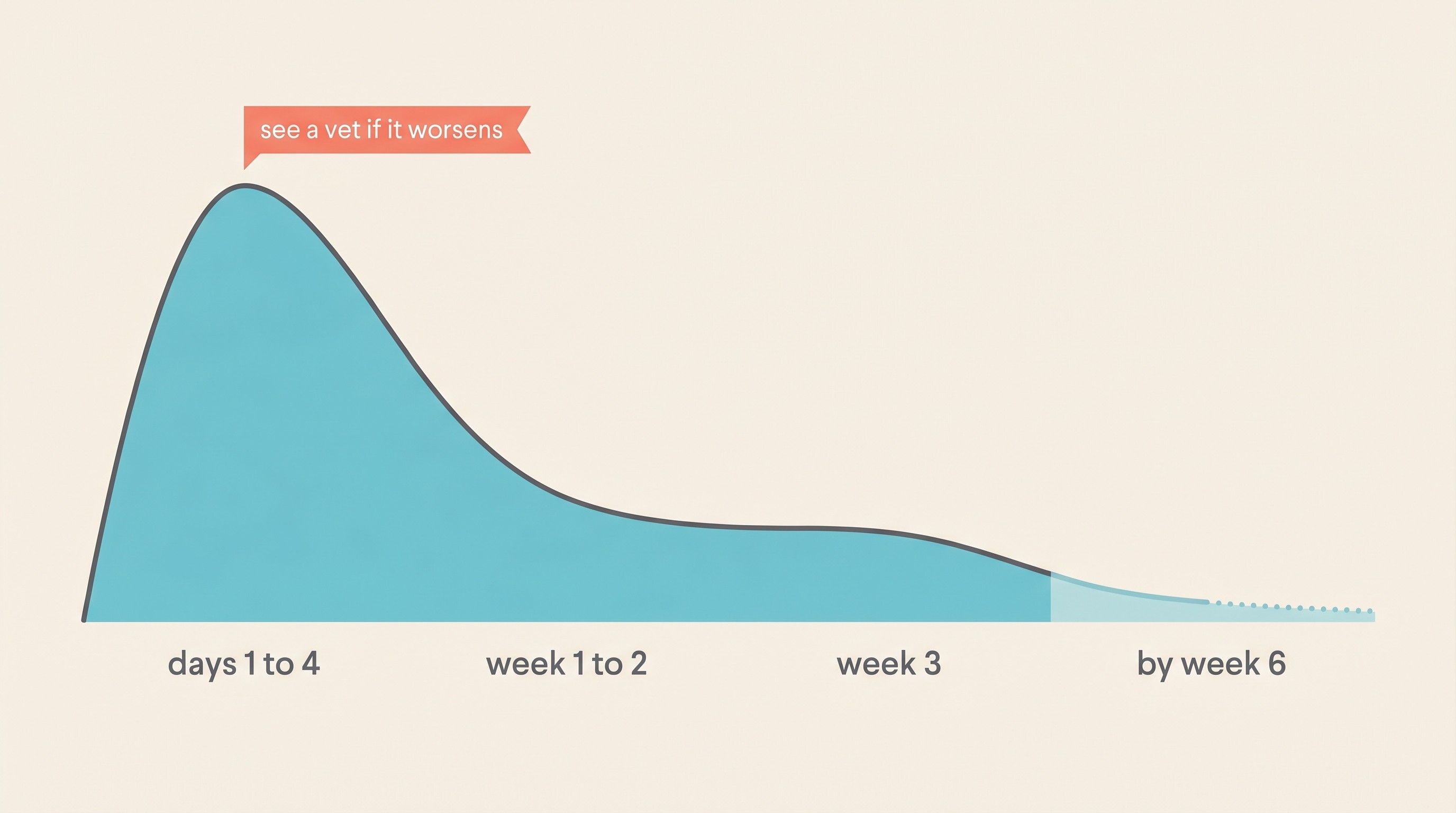
Kennel cough, which vets call canine infectious respiratory disease complex, tends to follow a fairly predictable curve, and knowing the shape of it is reassuring in itself. The signs usually take three to fourteen days to show up after your dog was exposed, then run their course over a couple of weeks (PDSA, n.d.; Royal Kennel Club, n.d.). The Merck Veterinary Manual puts the shape neatly: severity usually diminishes during the first five days, but the disease persists for ten to twenty days (Merck Veterinary Manual, n.d.). In other words, the loudest, most miserable phase is often the early part, and what you're left with afterwards is a fading cough rather than a worsening one.
Different trustworthy sources land in the same place from slightly different angles, which is why you can take the timeline to the bank. Cornell's canine health centre says simply that the dog will usually recover within two weeks (Cornell University, n.d.). The clinical reference Clinician's Brief gives complete resolution of uncomplicated disease as typically within ten to fourteen days after the signs start (Dear, 2020). And the modern veterinary reviews back the whole framing: the signs are frequently mild and self-limiting, even though a minority of cases do progress (Reagan and Sykes, 2020). That phrase self-limiting matters. It means the body clears most of these infections on its own, on roughly its own schedule, which is also why there's no home remedy that meaningfully shortens it.
Why some dogs cough for longer
Averages hide the dog in front of you, which is the caveat worth flagging next. If your elderly dog, or your young puppy, or a dog with another health condition is still coughing in week four, that is not necessarily a treatment failure. In older dogs especially, recovery can take up to six weeks (Royal Kennel Club, n.d.). Puppies, older dogs and dogs with underlying problems both take longer to shake it off and are more vulnerable to it turning into something more serious, so they earn a lower threshold for a check-up (PDSA, n.d.; Royal Kennel Club, n.d.).
There's also a reason the cough so often outlasts the infection itself, and it's worth understanding because it changes what you do at home. The lining of the windpipe stays irritated and twitchy for a while after the bugs themselves are on their way out. That leaves the cough very easy to set off: pressure on the throat, exertion, excitement and a gulp of cold air will all trigger a fresh bout, and the cough is characteristically harsh and readily induced (Merck Veterinary Manual, n.d.). This is exactly why the dog seems fine dozing on the sofa, then hacks for a minute the moment they leap up to greet you. It feels like a relapse. It's usually just a sensitive airway doing what a sensitive airway does.
What actually helps it pass
Because there's no medicine that shortens a viral cough, the job at home is comfort and not spreading it, and a few simple things genuinely take the edge off and stop you prolonging the misery. Rest is the big one. Keep your dog warm, comfortable and let them rest as much as they need, because exercise and excitement both worsen and drag out the cough (PDSA, n.d.). Swap the collar for a harness for now, so the lead isn't pressing straight onto an already-inflamed windpipe and setting off a fit every time you head out; that single change is the load-bearing daily rule for any irritated airway, and harness not collar explains why it earns its place. Gentle humidity can soothe too: some dogs benefit from sitting in a steamy bathroom for a few minutes, the air thick after a hot shower, though never shut a dog in a steamy room alone or make them stay if they're not relaxed (PDSA, n.d.). And keep them away from other dogs while they're coughing.
It's worth being clear about what doesn't shorten things either, so you're not chasing a cure that isn't there. Even the anti-inflammatory medicines that sometimes get reached for, steroids and the like, have not been shown to shorten the course of the illness, so any benefit is really about comfort rather than speeding recovery (Cornell University, n.d.). None of this is treatment in the drug sense. It's the difference between a dog that's comfortable while it heals and one that's hacking itself raw.
When the length itself means see a vet
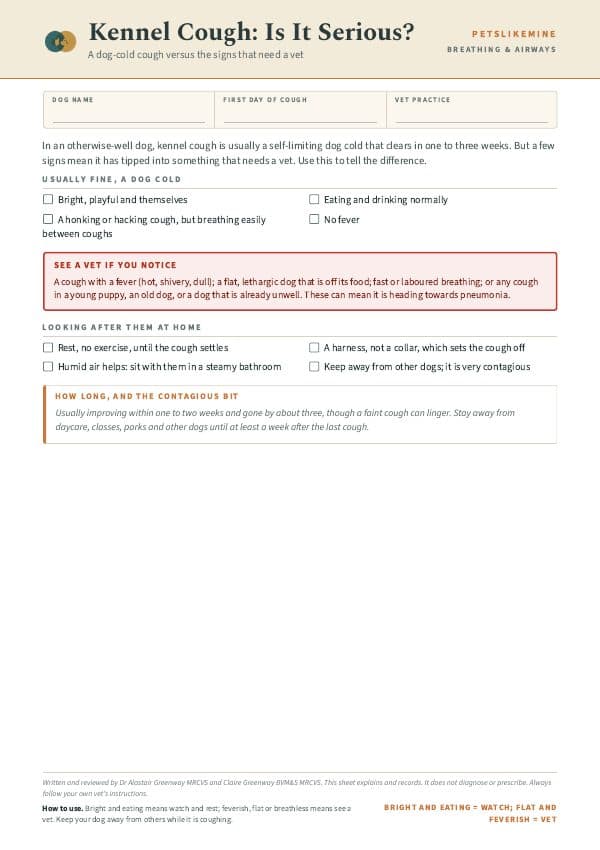
This is the part you came for, so I'll be plain about it. A cough that drags on in a bright, well dog is usually fine to keep watching. A cough that stalls, deepens or comes with the dog going flat has changed character, and that's when the calendar tips over into a reason to ring the vet.
Book a check if the cough isn't easing within the window you'd expect, roughly not improving within one to two weeks, or still hanging around beyond about three weeks in an otherwise-healthy adult. Book sooner, at any point, if it's getting worse rather than better, or if any red flag turns up: a fever, lethargy, going off food, fast or laboured breathing, or a wet, productive, gurgly-sounding cough rather than a dry one. Those signs mean it may have crossed from a simple upper-airway cough into the chest, and more severe signs including fever, purulent nasal discharge, depression, anorexia and a productive cough point towards bronchopneumonia (Merck Veterinary Manual, n.d.). Lower your threshold further for puppies, old dogs and any dog with heart or airway disease. If you're not sure which side of the line you're on, the breathing and cough triage tool will help you sort now-emergency from book-an-appointment in a couple of taps, and the is it serious one-pager is worth keeping on the fridge. What the vet does about a cough that's gone to the chest, the x-rays and the workup, belongs to when a cough becomes pneumonia, so I'll hand that on rather than half-tell it here.
Will antibiotics make it go faster?
This is the question almost every owner is really asking, and the answer surprises people: usually no, and that's good medicine rather than your vet being stingy. Most kennel cough is viral, and antibiotics don't touch viruses, so for the typical case they don't change the timeline at all (PDSA, n.d.; Cornell University, n.d.). The field's reference guideline says it directly: the majority of cases are believed to be viral in origin, so antibiotics are often not indicated, and most affected dogs keep a normal appetite and attitude and resolve on their own within about ten days without them (Lappin et al., 2017).
Antibiotics are held in reserve for the dogs that need them, the ones who are genuinely unwell rather than just coughing. The guidance is to consider them within the first ten days only if there's fever, lethargy or a poor appetite alongside a snotty discharge, with doxycycline as the usual first choice for seven to ten days, or if the cough simply hasn't settled past ten days (Lappin et al., 2017; Dear, 2020). So if your vet examines a bright, eating, comfortably-breathing dog and sends you home without antibiotics, that's them following best practice, not under-treating. Where antibiotics are appropriate, they may speed how quickly a sick dog perks up, often within a day to three, but they don't shorten a plain viral cough (Eldredge, 2024).
The clock that runs longer than the cough
Here's the bit that catches people out: your dog can still be spreading kennel cough after it looks better, so the don't-mix-with-other-dogs clock runs longer than the recovery clock. The clean rule of thumb is to keep a coughing dog away from other dogs and public spaces while they're coughing and for two to three weeks afterwards (PDSA, n.d.; Dear, 2020).
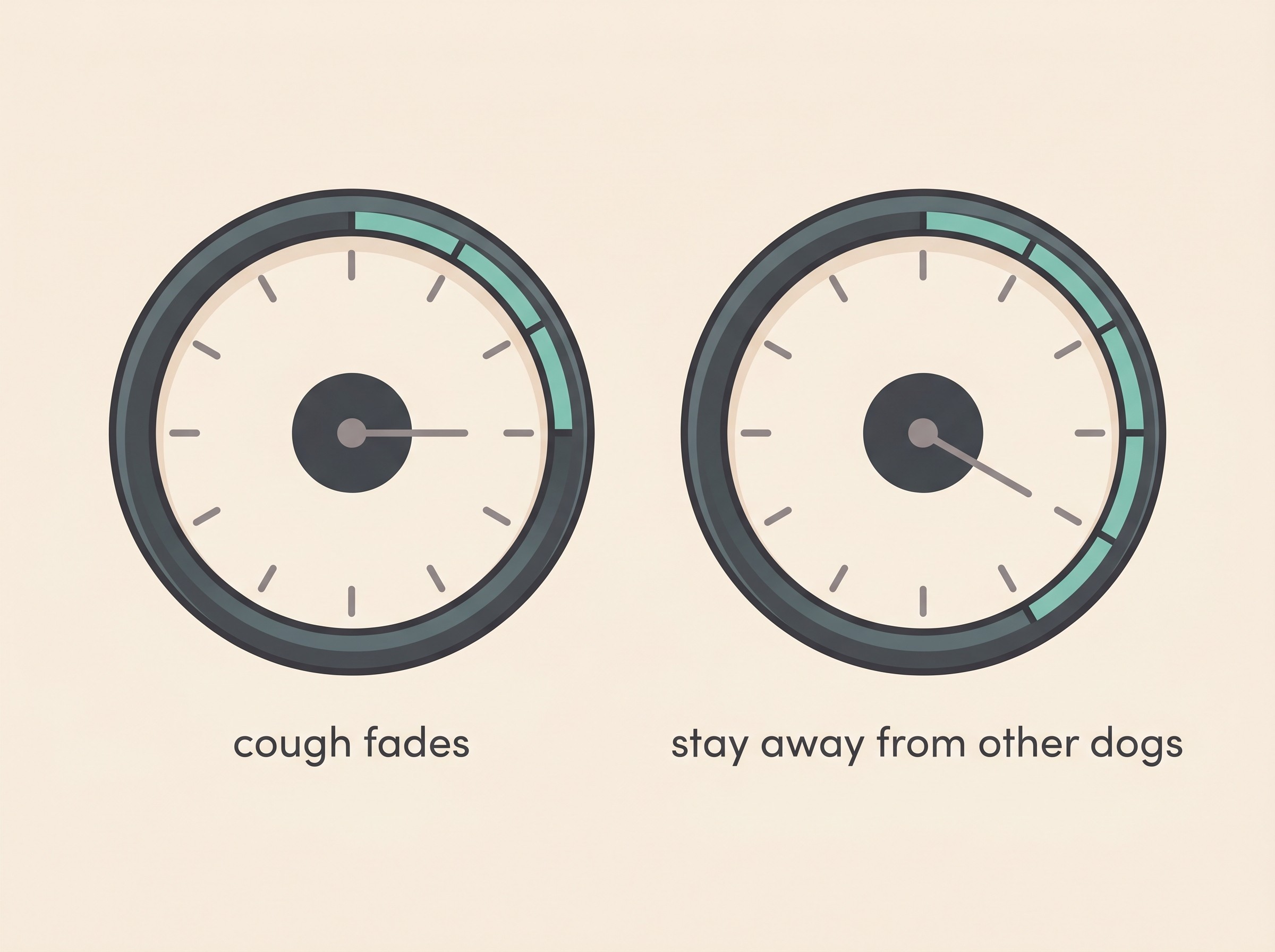
The real nuance is that shedding isn't a clean switch you flick off on a fixed day. Bordetella in particular can be shed for weeks after a dog seems recovered, which is why a sensible vet's rule is no contact with other dogs until at least a week after the very last cough, rather than a date on the calendar (Eldredge, 2024). Nobody can give you a tidy black-and-white "contagious until day X", because the biology simply doesn't work that way (Eldredge, 2024). If you want the detail on vaccination and how it spreads through daycare, boarding and the park, that's its own piece in kennel cough vaccination and spread.
So where does that leave you and the dog asleep beside you? Most likely a week or two from the worst of it, and back to your normal self by three weeks, with that last lingering hack fading slowest of all. Keep them rested, on a harness, and away from other dogs for a couple of weeks after the cough finally stops. Then the only thing left to watch is the picture changing: the moment a fever, a dropped appetite, harder breathing or a cough that's deepening rather than fading appears, call the vet or open the triage tool. Short of that, this is one of the few worrying-sounding things your dog will do that genuinely tends to sort itself out, on roughly the schedule above, with you doing very little except looking after them while it does.
References
- Cornell University College of Veterinary Medicine, Riney Canine Health Center. (n.d.). The risks of kennel cough. Retrieved from
- Dear, J. D. (2020). Canine Infectious Respiratory Disease Complex. Clinician's Brief. Retrieved from
- Eldredge, D. M. (2024). How Long Is Kennel Cough Contagious? Whole Dog Journal. Retrieved from
- Lappin, M. R., Blondeau, J., Boothe, D., Breitschwerdt, E. B., Guardabassi, L., Lloyd, D. H., Papich, M. G., Rankin, S. C., Sykes, J. E., Turnidge, J., and Weese, J. S. (2017). Antimicrobial Use Guidelines for Treatment of Respiratory Tract Disease in Dogs and Cats: Antimicrobial Guidelines Working Group of the International Society for Companion Animal Infectious Diseases (ISCAID). Journal of Veterinary Internal Medicine, 31(2), 279-294.
- Merck Veterinary Manual. (n.d.). Kennel Cough (Canine Infectious Tracheobronchitis). Retrieved from
- PDSA (People's Dispensary for Sick Animals). (n.d.). Kennel Cough. Pet Health Hub. Retrieved from
- Reagan, K. L., and Sykes, J. E. (2020). Canine Infectious Respiratory Disease. Veterinary Clinics of North America: Small Animal Practice, 50(2), 405-418.
- Royal Kennel Club. (n.d.). Kennel cough in dogs. Retrieved from
Free downloads
Companion worksheets to put what you've read into practice. Free PDFs, print at home.
Keep track of how your pet is doing
The owners who cope best are the ones who notice changes early. A simple health log shows you what is working, and what is not, before the next vet visit.
Start tracking, freeYou're not doing this alone
Compare treatment journeys and talk to owners managing breathing & airways. Free to join.
Join PetsLikeMine