

Kennel Cough: Vaccination, Spread and How Not to Pass It On
Alastair Greenway
BVM&S MRCVS
Every autumn we get the same call. A dog comes home from a weekend in boarding kennels, or a busy day at daycare, and a few days later starts up with that unmistakable honking cough. The owner is half worried and half mortified, because they did everything right, they had the jab, and the dog caught it anyway. They want to know two things: what actually spreads this, and what was the point of the vaccine? Both deserve straight answers rather than the reassuring half-truths that float around online.
So let me set out how kennel cough moves through a population of dogs, what the vaccines genuinely do and don't do, and how to avoid being the dog at the park that quietly seeds the next outbreak. I'll keep this to prevention and spread. If your dog is coughing right now and you need to know whether it's serious, the is-it-serious guide is the place to start, though I'll flag the red flags here too.
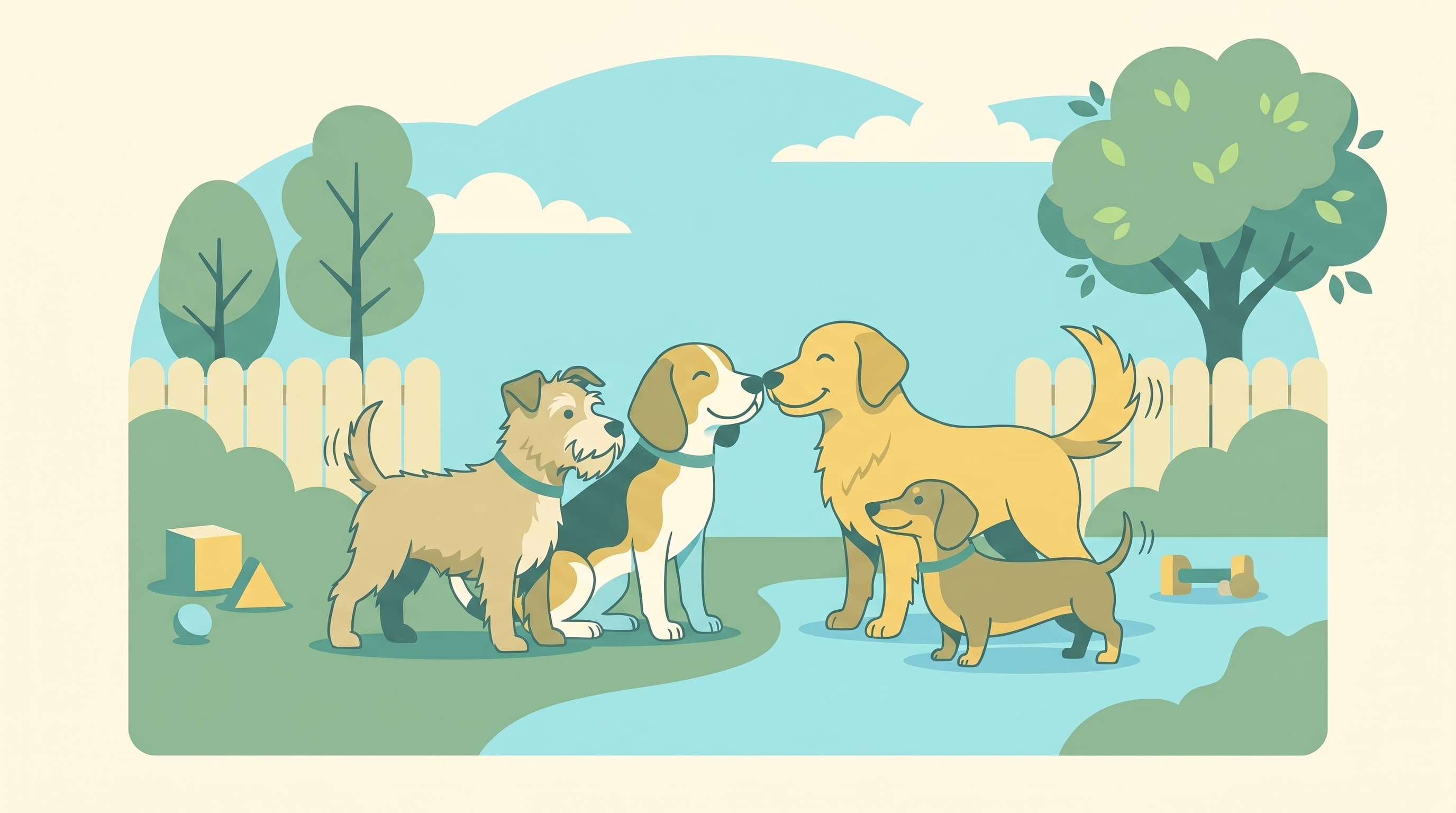
Not one bug, but many
First, a name. "Kennel cough" is the everyday term for what vets call canine infectious respiratory disease complex, or CIRDC, and the word complex is doing real work. This isn't a single germ. It's a contagious mix of viruses and bacteria that all cause much the same cough, and a coughing dog often has more than one at once (Reagan and Sykes, 2020). The usual UK suspects include the bacterium Bordetella bronchiseptica, the single most commonly named cause, alongside Mycoplasma species, plus a handful of viruses, chiefly canine parainfluenza virus and canine adenovirus type 2 (Ohio State University, 2020; MSD Veterinary Manual, 2026).
That matters more than it looks, because it explains the thing owners find hardest to accept. No single vaccine can cover every cause, because there is no single cause (American Kennel Club, 2026). Hold on to that, because it's the key to everything that follows.
How it spreads, and the part most people miss
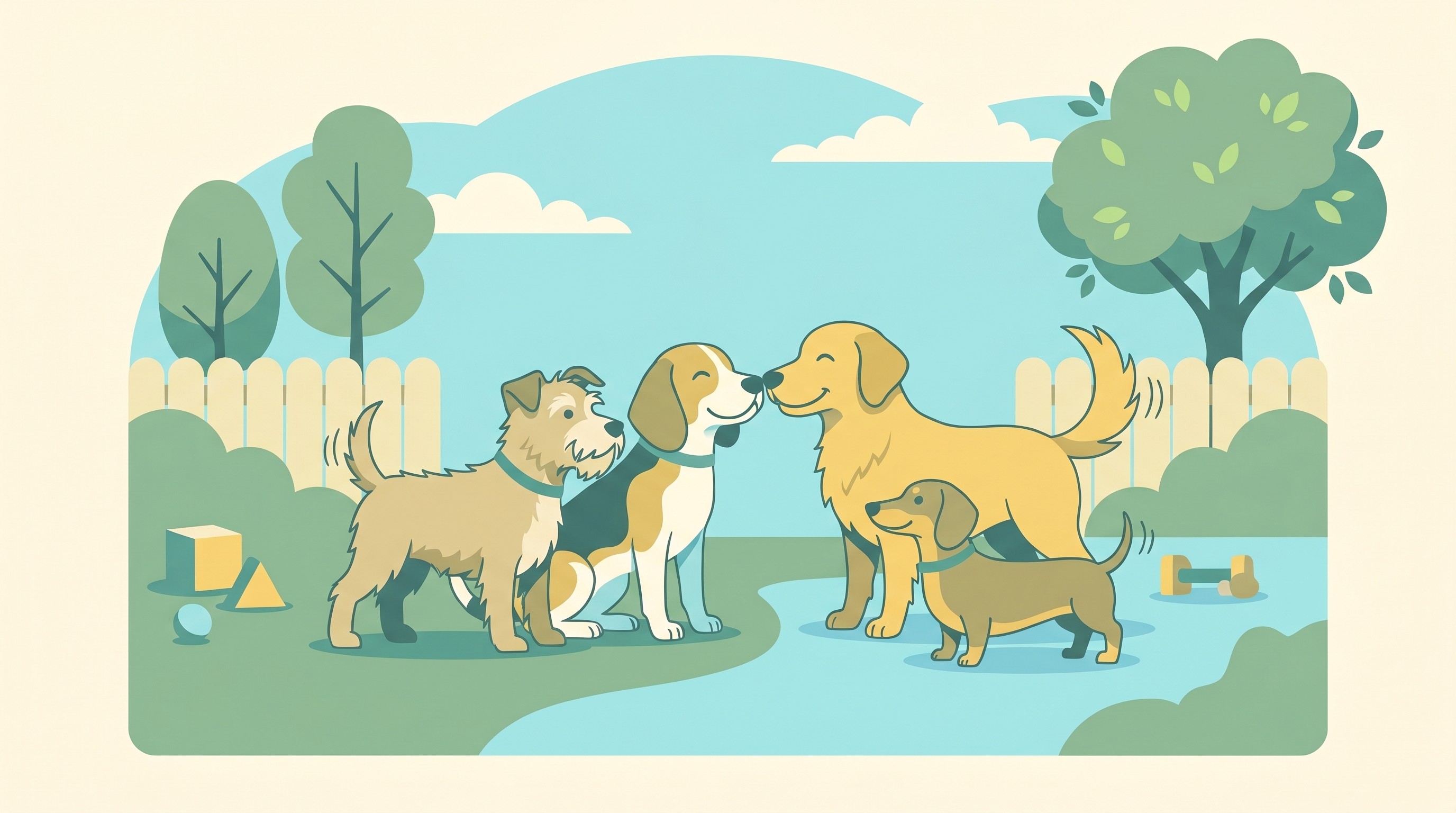
Kennel cough is highly contagious, and it travels the way you'd expect: through the air in the fine droplets a dog throws out when it coughs or sneezes, on direct nose-to-nose contact, and on shared surfaces like the water bowl, the lead, bedding and the bars of a kennel (The Royal Kennel Club, 2026; Cornell Riney Canine Health Center, 2026). Those surfaces matter more than people assume, because the bugs can sit on a bowl or a toy and survive in the environment for several weeks (PDSA, 2026). So it thrives precisely where dogs gather and new dogs keep arriving: boarding kennels, which is how it got its name, but equally daycare, rescue centres, training classes, grooming salons, shows and busy parks (Cornell Riney Canine Health Center, 2026; PDSA, 2026).
Now the part that catches everyone out. A dog can be spreading kennel cough before it looks remotely ill, and some dogs pass it on without ever coughing at all. The Ohio State veterinary fact sheet puts it plainly: dogs "can shed the organism before signs of illness are obvious and some dogs are infectious but never show signs of illness" (Ohio State University, 2020). The review literature calls the same problem "widespread subclinical infections" that make outbreaks hard to interpret and contain (Reagan and Sykes, 2020). The incubation period is short, usually around two to ten days from exposure to the first cough (Cornell Riney Canine Health Center, 2026), so a dog that mingled on Saturday can be quietly shedding by Wednesday while still bouncing around as if nothing's wrong.
That is why a healthy-seeming dog is the one that seeds an outbreak, and why these things are so frustrating to trace. Nobody did anything careless. The well dog simply was the source.
It also answers the "when can my dog go back?" question, and the answer is later than the cough suggests. Signs and shedding commonly last around five to ten days, but some agents, Bordetella especially, are shed for longer, so a dog can stay contagious after the cough you can hear has settled (Ohio State University, 2020; PDSA, 2026). The rule of thumb is to keep an affected dog away from other dogs for about two to three weeks from when signs appear, and certainly until it's properly well (PDSA, 2026; The Royal Kennel Club, 2026). I'll give you that window once, but the full recovery picture, and when a cough that won't quit becomes a reason to see the vet, belongs to how long kennel cough lasts.
What the vaccines really do
Now to the jab, and to that owner whose vaccinated dog caught it anyway. They were not lied to, but they may have been oversold.
A kennel cough vaccine reduces the risk, severity, duration and shedding of disease. It does not guarantee your dog will never catch it, and it cannot cover every cause. That single sentence is the heart of the matter, and every authority worth citing says a version of it. The Royal Kennel Club is blunt that the vaccine "can't guarantee protection against kennel cough, but it does reduce the chance of your dog being affected" (The Royal Kennel Club, 2026). Cornell draws the human parallel, that much like a human flu jab the vaccine doesn't prevent infection but lessens the severity of symptoms, including the risk of it tipping over into pneumonia (Cornell Riney Canine Health Center, 2026). And on why a vaccinated dog can still cough: "even when dogs are vaccinated ... clinical signs of disease can still occur if the dog is exposed. However, the clinical disease should be less severe and of shorter duration than in dogs that have not been vaccinated" (Lappin, 2018).
So think of the vaccine as stacking the odds heavily in your dog's favour, and as a kindness to every other dog it meets, rather than as a force field. And it does work. In a challenge study where dogs met Bordetella and parainfluenza a full year after vaccination, the vaccinated dogs had a 65% reduction in coughing (clinical signs in 9% of them against 74% of unvaccinated controls) and shed the parainfluenza virus for a median of one day instead of six (Wiechert-Brown et al., 2025). That last figure is the community benefit made concrete: a vaccinated dog that does catch it is infectious for a fraction of the time, so it passes far less on. Protection from a course runs to about a year, which is why the booster is yearly (Lappin, 2018; Wiechert-Brown et al., 2025).
Drops, tablet or injection: the three forms you'll meet
In the UK the everyday product targets Bordetella and canine parainfluenza, and you'll meet it in three forms (WSAVA Vaccination Guidelines Group, 2024). (To clear up confusion from American advice: canine influenza is a separate disease and isn't established in the UK, so the flu vaccine you may read about over there isn't part of the picture here.)
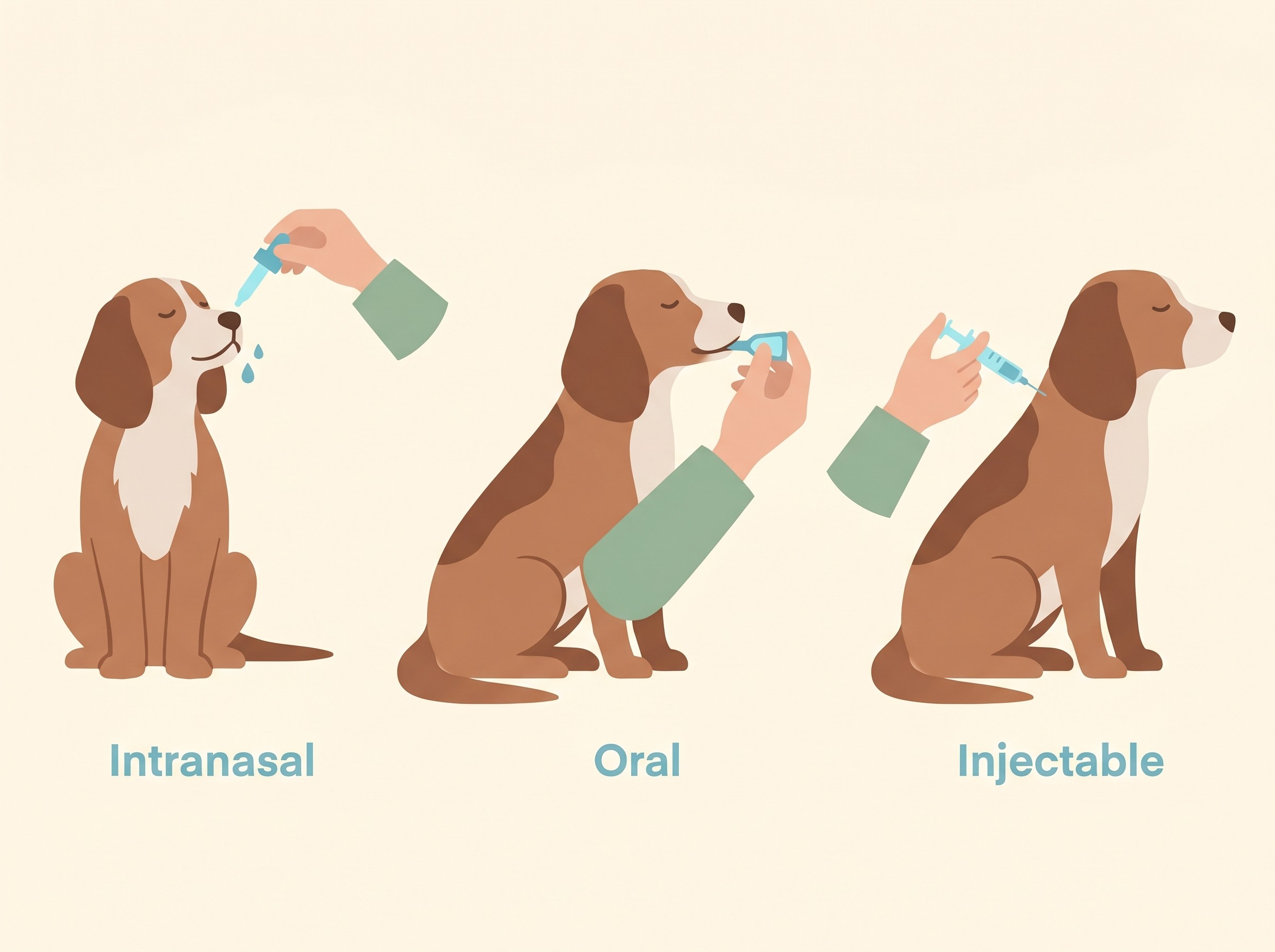
The intranasal vaccine is a few drops up the nose and the oral version goes in the mouth. Both put the live, weakened vaccine straight onto the lining of the airway, where the infection lands, so they build local defences fast: a single intranasal dose can give protection within about 48 to 72 hours (American Kennel Club, 2026). The injectable vaccine goes under the skin, needs two doses several weeks apart, and isn't protective until at least about five days after that second dose (American Kennel Club, 2026). There's some evidence the intranasal route gives slightly better outcomes than the oral one (WSAVA Vaccination Guidelines Group, 2024), but all three are reasonable, and your vet will pick what suits your dog and your timeline.
One wrinkle with the nasal and oral types: because they contain live, weakened Bordetella, a small number of dogs get a few days of mild snuffling, sneezing or a runny nose or eye afterwards, and can even pass that mild grumble on (WSAVA Vaccination Guidelines Group, 2024; Association of Dog Boarders, 2026). It's brief and harmless, but it's exactly why kennels want it done in good time, not the day before drop-off.
So does my dog legally need it for boarding?
Here's the bit owners really want pinned down. In the UK there is no single law saying every dog must be vaccinated against kennel cough. Under the DEFRA model licence conditions for boarding and daycare, the core vaccines (parvovirus, distemper, hepatitis and leptospirosis) must be current, while kennel cough vaccination "may be required by the establishment", and it is "up to each establishment as to whether you ask for kennel cough vaccination or not" (Association of Dog Boarders, 2026). It's the kennel's call, not the state's, and plenty of good ones insist on it precisely because their spread risk is real.
If you're booking a stay, the rule that saves the headache is this: get the kennel cough vaccine done at least about two weeks beforehand, which is also what DEFRA guidance asks of primary vaccination, so immunity has had time to develop and any brief post-vaccine snuffle has passed before your dog is mixing (Association of Dog Boarders, 2026; PDSA, 2026). Most kennels ask for dated proof from your vet, so book it early rather than scrambling the week before. The busier and more constantly changing the setting, the higher the spread risk, which is the whole reason the requirement exists.
Breaking the chain at your end
If your dog is the one coughing, the considerate thing, and genuinely the thing that breaks the chain, is to keep it out of shared spaces even though it feels perfectly well in itself. That means home, away from other dogs, no daycare, classes, shows or park, for the infectious window (Ohio State University, 2020; PDSA, 2026). Don't share bowls, bedding, toys or leads between your dogs, wash your hands, and give shared items a proper clean (Cornell Riney Canine Health Center, 2026). Tell your daycare, kennel or dog walker so they can protect the other dogs in their care (Ohio State University, 2020). And if you need the vet, phone ahead, so the practice can keep you out of a crowded waiting room rather than letting it spread there.
None of that is about blame. A well dog shedding a virus did nothing wrong. But keeping an infectious dog home for a couple of weeks is the neighbourly act that stops the whole street's dogs going down with it.
When it's more than a nuisance
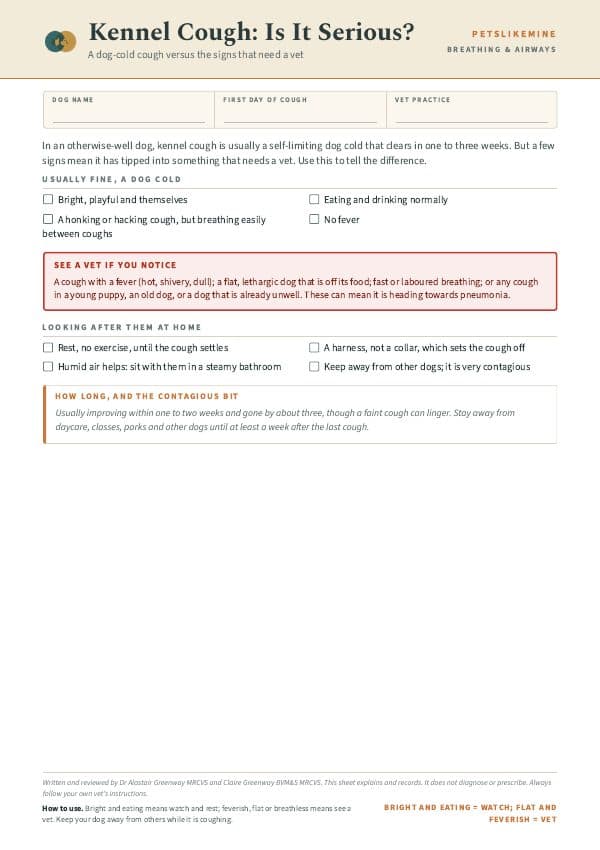
One last thing, kept brief because the siblings own it. Most healthy adult dogs ride kennel cough out and clear it within roughly one to three weeks (The Royal Kennel Club, 2026). But puppies, elderly dogs, the immunocompromised and dogs with existing heart or airway disease deserve a lower threshold to be seen, because the serious cases and the rare deaths cluster in exactly those groups (Ohio State University, 2020). And for any dog the line is the same: a cough that comes with a fever, a flat and listless mood, a dog gone off its food, or fast or laboured breathing has crossed from contagious nuisance into something that needs a vet (MSD Veterinary Manual, 2026). That's your safety net. The full triage lives in is it serious? and the escalation in when a cough becomes pneumonia; the breathing triage tool sorts an urgent breathing problem from a routine cough if you're unsure, and the is-it-serious download is worth keeping on the fridge.
The truth to leave you with is that this is a manageable, largely preventable nuisance, not a disaster. Keep the vaccine current, time it before boarding, and keep a coughing dog home until it's truly past it, and you've done the two things that matter most: protected your own dog as far as anything can, and quietly stopped the next outbreak before it started.
References
- American Kennel Club. (2026). Bordetella Vaccine: What to Know About the Vaccine for Dogs. Retrieved from
- Association of Dog Boarders. (2026). Vaccination Protocols for Home Boarding and Day Care: The DEFRA Guidance (H. Merrett). Retrieved from
- Cornell University College of Veterinary Medicine, Riney Canine Health Center. (2026). The risks of kennel cough. Retrieved from
- Lappin, M. R. (2018). Management of the Canine Infectious Respiratory Disease Complex (Kennel Cough). WSAVA 2018 Congress Proceedings (VIN). Retrieved from
- MSD Veterinary Manual. (2026). Kennel Cough (Canine Infectious Tracheobronchitis), Professional Version. Retrieved from
- Ohio State University College of Veterinary Medicine. (2020). Canine Infectious Respiratory Disease Complex (CIRDC) Fact Sheet. Retrieved from
- PDSA (People's Dispensary for Sick Animals). (2026). Kennel Cough. Pet Health Hub. Retrieved from
- Reagan, K. L., and Sykes, J. E. (2020). Canine Infectious Respiratory Disease. Veterinary Clinics of North America: Small Animal Practice, 50(2), 405-418.
- The Royal Kennel Club. (2026). Kennel cough in dogs. Retrieved from
- WSAVA Vaccination Guidelines Group (Squires, R. A., et al.). (2024). 2024 guidelines for the vaccination of dogs and cats. Journal of Small Animal Practice, 65(5), 277-316.
- Wiechert-Brown, S. A., Classe, H. M., Dant, J. C., et al. (2025). One year duration of immunity of a combination Bordetella bronchiseptica - canine parainfluenza oral vaccine in dogs. Frontiers in Veterinary Science, 12, 1634190.
Free downloads
Companion worksheets to put what you've read into practice. Free PDFs, print at home.
Keep track of how your pet is doing
The owners who cope best are the ones who notice changes early. A simple health log shows you what is working, and what is not, before the next vet visit.
Start tracking, freeYou're not doing this alone
Compare treatment journeys and talk to owners managing breathing & airways. Free to join.
Join PetsLikeMine