

How to Give a Cat an Inhaler: The AeroKat Technique, Step by Step
Alastair Greenway
BVM&S MRCVS
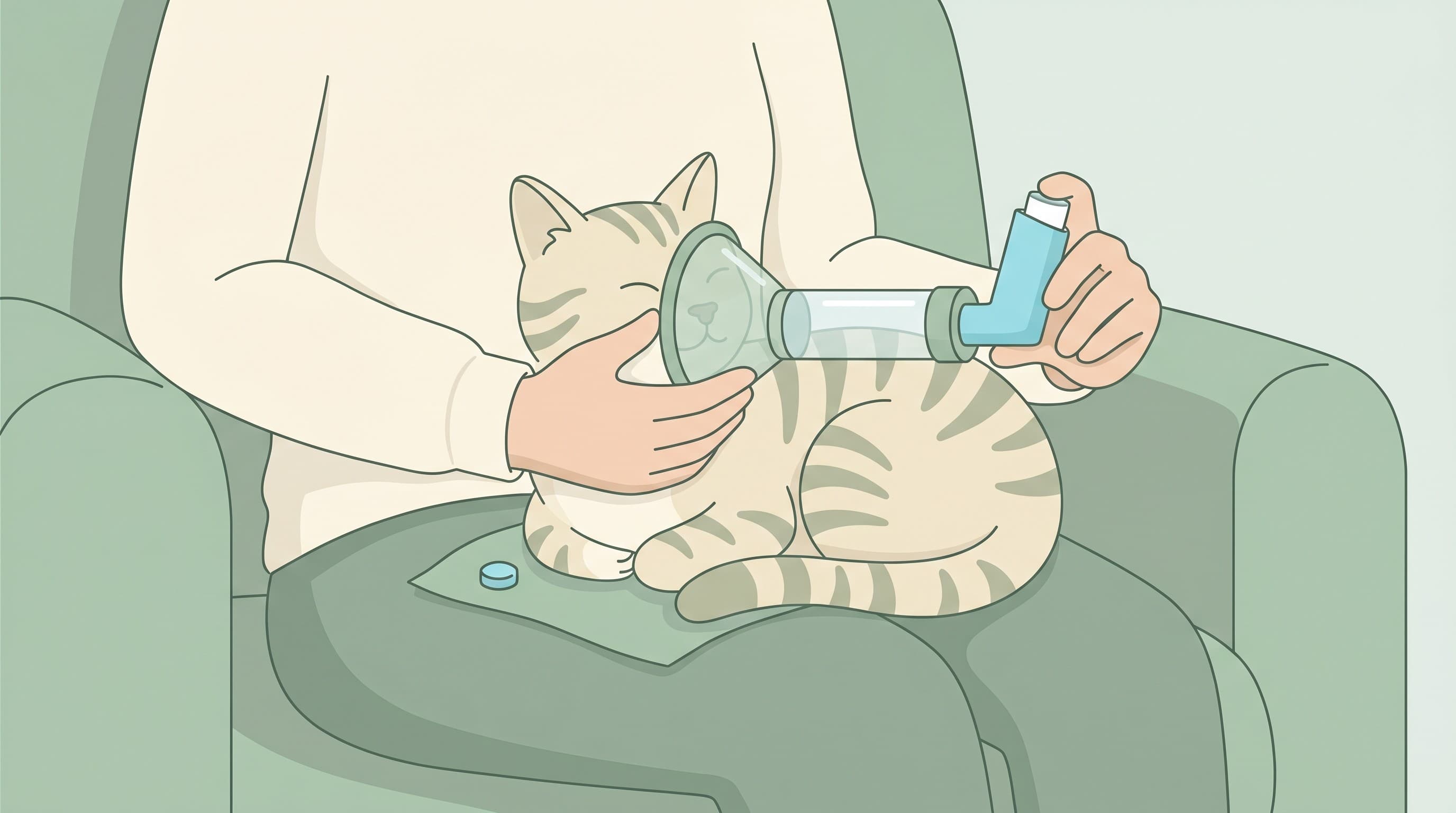
Handing an owner an inhaler for their cat usually earns a long, doubtful pause. A cat. An inhaler. The picture that comes to mind is a wrestling match twice a day for the rest of the cat's life, and it's a fair thing to wonder. So let me say the reassuring part up front: cats take to this far better than almost anyone expects.
Most cats don't naturally love something held over their face, that part is true. But with patience and the right approach the majority come to accept the device calmly, and a good number end up pushing their own nose into the mask for the treat that follows (Trudell Animal Health, n.d.-a; International Cat Care, n.d.). It isn't done in one sitting. Give it a week or two of gentle, unhurried practice and you'll usually have a cat who tolerates their inhaler with a sigh rather than a fight. This page is about how to get there: the kit, the technique, and the slow, reward-led way to win a suspicious cat round.
One thing first, before any of the technique, because it's the line that matters most. The inhaler is for daily control and, with a separate reliever, for calming a flare. It is not a magic wand for a cat in real distress. A cat breathing with its mouth open, with blue or grey gums, or heaving hard from the belly, is an emergency, and needs a vet now, not a puff from the chamber. There's a whole page on what to do in an asthma attack, and it's worth reading before you ever need it.
The kit, and why it's shaped the way it is
There are three pieces, and understanding what each does makes the whole thing click into place.
The first is the inhaler itself, a standard human metered-dose inhaler, the same little pressurised canister a person with asthma uses. The drug inside is almost always one of two things: a controller you give every day to calm the inflammation, usually inhaled fluticasone, or a reliever you give to open the airways in a flare, usually salbutamol (you'll see it called albuterol on American packaging, it's the same drug). I won't go deep on the drugs here, the feline asthma medicines page owns that. What matters for technique is knowing which of your cat's inhalers does which job.
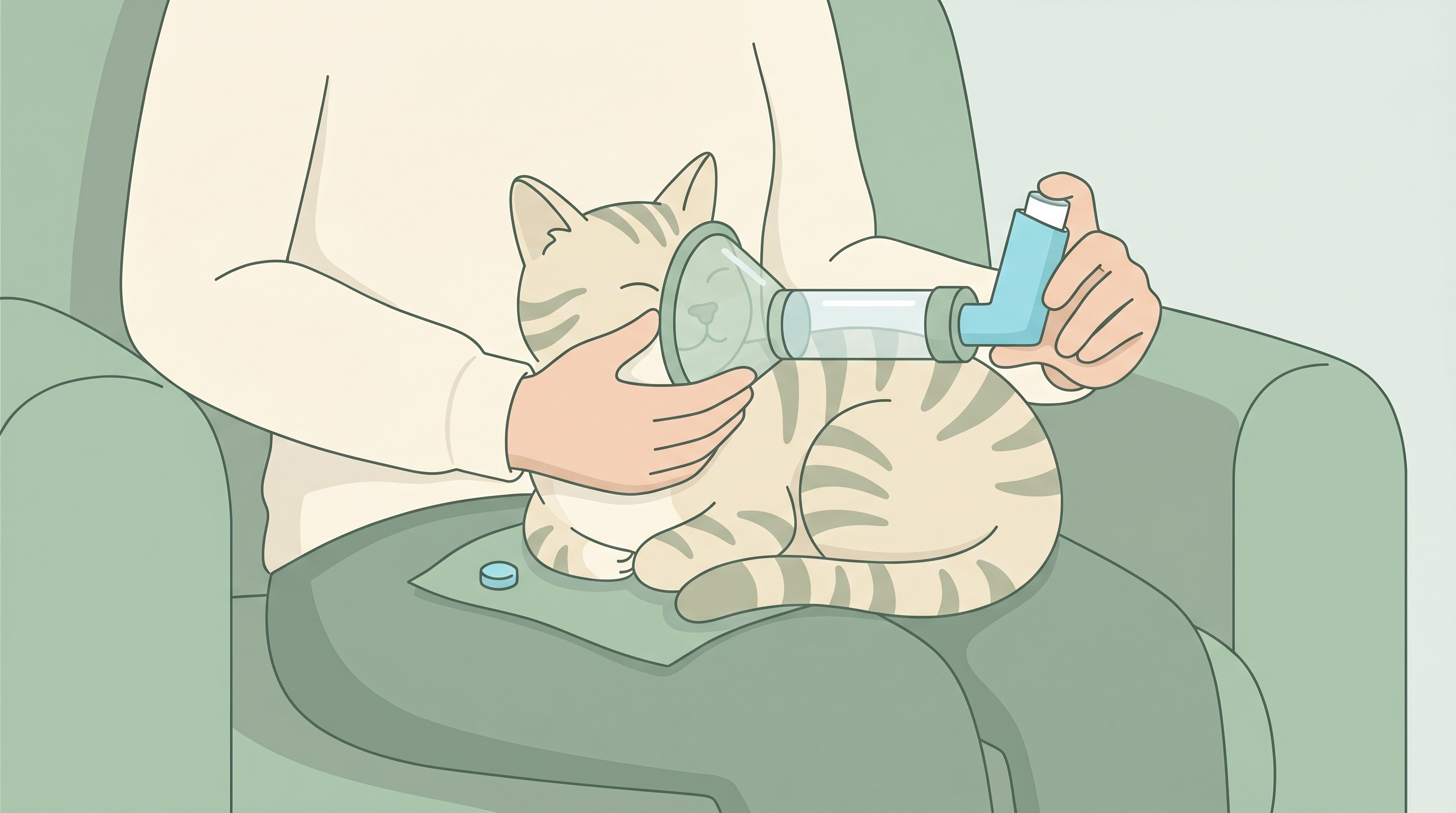
The second piece is the spacer, also called a valved holding chamber or aerosol chamber (three names, one device). For cats, the one to ask for is the AeroKat, made by Trudell, designed specifically for feline breathing rather than borrowed from the human range (Trudell Animal Health, n.d.-b). A cat breathes in fast, shallow little breaths and cannot be told to take one big slow lungful, so the AeroKat uses custom valves built for feline breathing and a right-sized mask shaped for a small furry face so it seals without dragging on the whiskers and fur (Trudell Animal Health, n.d.-b). A human spacer simply doesn't fit either the breathing or the face.
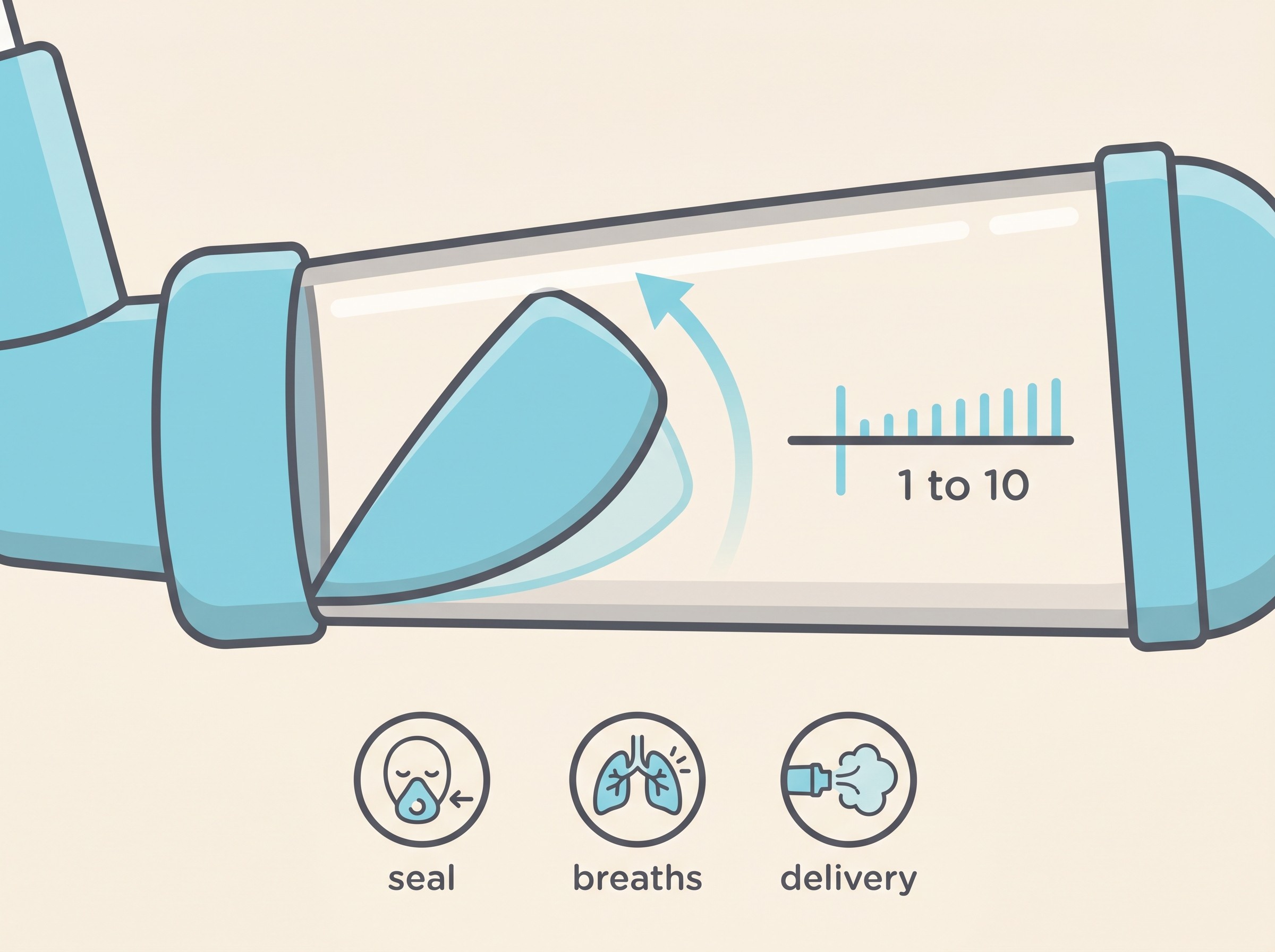
Small as it is, the third piece is the hero of the whole thing: the Flow-Vu indicator, a little flap on the chamber that moves visibly every time your cat breathes in. It does four jobs at once: it confirms the mask is sealed, it lets you count the breaths, it confirms the cat is using the chamber correctly, and it gives you confidence the medication is being drawn down into the lungs (Trudell Animal Health, n.d.-c). With a cat, who can't tell you whether the puff went in, that little moving flap is your entire feedback loop. When people ask me "but how do I know it worked?", the Flow-Vu is the answer.
The technique, step by step
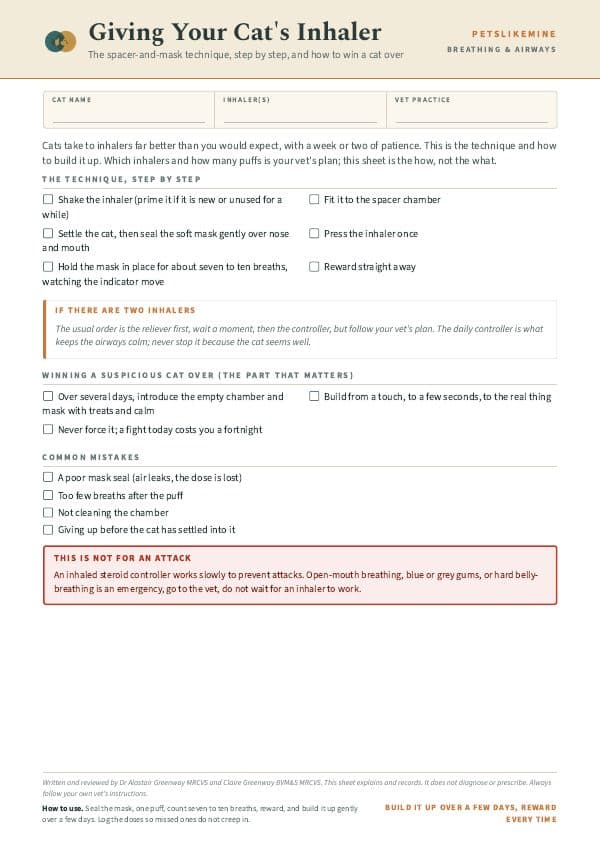
Once your cat is comfortable with the device (and the next section is all about getting them there), the routine itself is quick. Here it is, the way the manufacturer teaches it (Trudell Animal Health, n.d.-c).
- Shake the inhaler. Give it a good few shakes to mix the medication. If it's a brand-new inhaler or one that hasn't been used in a while, it may need priming first, a couple of test puffs into the air, so check the leaflet.
- Fit the inhaler into the back of the chamber. It pushes into the end opposite the mask.
- Gently bring the mask up over your cat's nose and mouth. You want a soft, complete seal against the face, not a hard press. Approach from slightly to the side or below rather than looming over the top, and keep your own body relaxed, cats read tension.
- Press the inhaler once to release a single puff of medication into the chamber. You're firing it into the chamber, not at the cat, the chamber holds the dose as a fine mist ready to be breathed in.
- Hold the mask in place and watch the Flow-Vu, counting 7 to 10 breaths before you take the mask away (Trudell Animal Health, n.d.-c). You'll see some product summaries say five or six breaths, but I'd follow the device maker's own number of seven to ten, and the lovely thing is that the chamber makes the dose forgiving: the mist sits there waiting, so a breath or two either way won't lose the dose.
- If your vet has prescribed more than one puff, wait about 30 seconds, shake again, and repeat the single-puff sequence (Trudell Animal Health, n.d.-c).
- Wipe any residue off the fur afterwards with a damp cloth, especially around the muzzle, so the cat doesn't groom it off and so the medication doesn't sit on the skin (Trudell Animal Health, n.d.-c).
The reason the whole performance exists, the chamber, the mask, the breath count, comes down to one fact about cats: a cat cannot be instructed to take a slow, deep breath, coordinate it with the puff, or hold its breath afterwards the way a person can (Barchilon and Reinero, 2023). The chamber gets around that. It holds the medication as a cloud, and a one-way valve lets the cat draw it in over several of its own normal, shallow breaths (Barchilon and Reinero, 2023), which is exactly why the seven-to-ten-breath count is the heart of the technique.
If your cat is on both a reliever and a controller, the order can matter, and this is where I'd point you firmly at your vet's written plan rather than a rule from me. A widely used approach in a flare is to give the reliever first to open the airways, wait a short while, then give the controller so it can travel deeper. That is common practice rather than a fixed law, and protocols vary between cats and between vets, so follow the plan you were given. On an ordinary day, the daily controller is usually given on its own.
Winning over a suspicious cat
This is the part owners worry about, and it's the part that decides whether inhaler therapy works, because a cat you have to pin down twice a day is a cat you'll quietly give up on. The trick is to never force it, and to build up so gradually that the mask becomes boring and then becomes a treat dispenser, long before any medication is involved. This is the evidence-based approach as well as the kind one: getting a cat to tolerate a tight-fitting mask reliably is exactly why acclimatising to the device in advance is recommended (Barchilon and Reinero, 2023).
International Cat Care and ISFM, working with Trudell, built a five-step training plan for exactly this, designed by feline behaviour experts including Sarah Ellis, the author of The Trainable Cat (Trudell Animal Health, n.d.-a; International Cat Care, n.d.). It runs on rewards, with a treat your cat adores given before and after, and it goes at the cat's pace, never yours. In outline (Trudell Animal Health, n.d.-a):
- Step one, get them comfortable with the chamber. Just have it about, let them sniff it, pair it with treats. No mask on the face yet.
- Step two, build their confidence around it. Bring it closer, keep it positive, keep the treats coming, so the device predicts good things, and steadily progress while avoiding any fear or frustration.
- Step three, introduce the mask until they place their own nose in. This is the key shift, you're teaching the cat to volunteer their nose into the mask for the reward, rather than you chasing their face with it. A cat who opts in is a cat who'll cooperate.
- Step four, extend how long the mask stays on. Build from a touch, to a second or two, towards holding it against the face for the full length of a real treatment, treating throughout.
- Step five, add the actual medication. Only once all of the above is easy do you load the inhaler and give a real puff.
The golden rule running through all five is simple: stop before your cat gets frightened or frustrated, and always end on a good note (Trudell Animal Health, n.d.-a; International Cat Care, n.d.). A few unhurried minutes a day for a week or two will get most cats there. If you push too hard and turn it into a battle once, you can set yourself back days, so patience genuinely is the fast route, not the slow one.
The mistakes I see most
A handful of small errors account for nearly all the "it isn't working" calls, and every one is easy to fix.
The commonest is a poor seal. If the Flow-Vu isn't moving, the mask isn't sealed and your cat is breathing room air, not medication, so reposition gently until you see that flap move (Trudell Animal Health, n.d.-c). The second is too few breaths, whisking the mask away after two or three, which leaves most of the dose in the chamber. The third is giving up after one bad attempt, deciding the cat "won't have it" on day one, when day one is meant to be hard and the device is earned over a fortnight. The fourth is not cleaning the chamber and mask, which lets residue build up and valves stick. And the fifth is the quietest one: expecting instant results.
That last one deserves a proper word, because it's where good owners lose heart. An inhaled steroid controller is slow to start working, often taking around seven to ten days, sometimes up to a fortnight, to reach full effect (Barchilon and Reinero, 2023; Today's Veterinary Practice, 2014). That's precisely why your vet may give a short course of oral prednisolone at the same time, to bridge the gap while the inhaler gets going, with the two overlapping before the tablets are tapered off (Barchilon and Reinero, 2023; Today's Veterinary Practice, 2014). It's also why the inhaler is never a rescue device for an attack. The reliever, by contrast, works within minutes, which is what makes it the flare drug rather than the daily one (Trudell Animal Health, n.d.-d; Today's Veterinary Practice, 2014). Knowing this in advance stops you concluding the inhaler has failed when it's simply still warming up.
There's one more reason to keep going on the days your cat seems completely fine, and it's the most important justification for the whole daily habit. In one study, 70% of cats whose outward signs had completely resolved on high-dose steroids still had active inflammation deep in their airways when it was actually sampled (Cocayne et al., 2011). In other words, a cat that looks well is not proof that the inflammation is controlled. The damage carries on quietly under the surface, which is exactly why you don't stop the controller just because the cough has gone, and why getting the technique right every single day genuinely matters.
Where this goes from here
Logging your doses is worth the thirty seconds it takes, and the Airway Diary is built for it: it catches the missed days that creep in, and it lets you and your vet see whether good technique is translating into fewer coughs and flares. Pair that with a printed reminder of the steps, the AeroKat inhaler technique download is a one-page version to stick on the fridge, and you've turned a daunting prescription into a calm part of the day.
The thing I'd most like you to take away is this. The first week is the hard week. Once your cat has decided the mask means a treat, and once you've seen that little Flow-Vu flap moving and known the dose went in, the whole thing becomes a quiet, unremarkable ritual. If you want the bigger picture of where the inhaler fits, the complete guide to feline asthma is the hub, and the medicines guide explains why this fiddly little chamber is, for most cats, kinder than a lifetime of tablets for the body as a whole.
References
- Barchilon, M., and Reinero, C. R. (2023). Breathe easy: inhalational therapy for feline inflammatory airway disease. Journal of Feline Medicine and Surgery, 25(9), 1098612X231193054.
- Cocayne, C. G., Reinero, C. R., and DeClue, A. E. (2011). Subclinical airway inflammation despite high-dose oral corticosteroid therapy in cats with lower airway disease. Journal of Feline Medicine and Surgery, 13(8), 558-563.
- International Cat Care. (n.d.). Inhaler Training. Retrieved from
- Today's Veterinary Practice. (2014). Treatment of Feline Lower Airway Disease. Retrieved from
- Trudell Animal Health. (n.d.-a). Teach Any Cat AeroKat. Retrieved from
- Trudell Animal Health. (n.d.-b). AeroKat Chamber. Retrieved from
- Trudell Animal Health. (n.d.-c). How To Use A Cat Inhaler To Treat Feline Asthma. Retrieved from
- Trudell Animal Health. (n.d.-d). Bronchodilator Medications For Cats: What They Are, Types Available, And Why Inhaled Medication Is Preferred. Retrieved from
Free downloads
Companion worksheets to put what you've read into practice. Free PDFs, print at home.
Keep track of how your pet is doing
The owners who cope best are the ones who notice changes early. A simple health log shows you what is working, and what is not, before the next vet visit.
Start tracking, freeYou're not doing this alone
Compare treatment journeys and talk to owners managing breathing & airways. Free to join.
Join PetsLikeMine