

Laryngeal Paralysis Explained: Reading the First Signs in an Older Dog
Alastair Greenway
BVM&S MRCVS
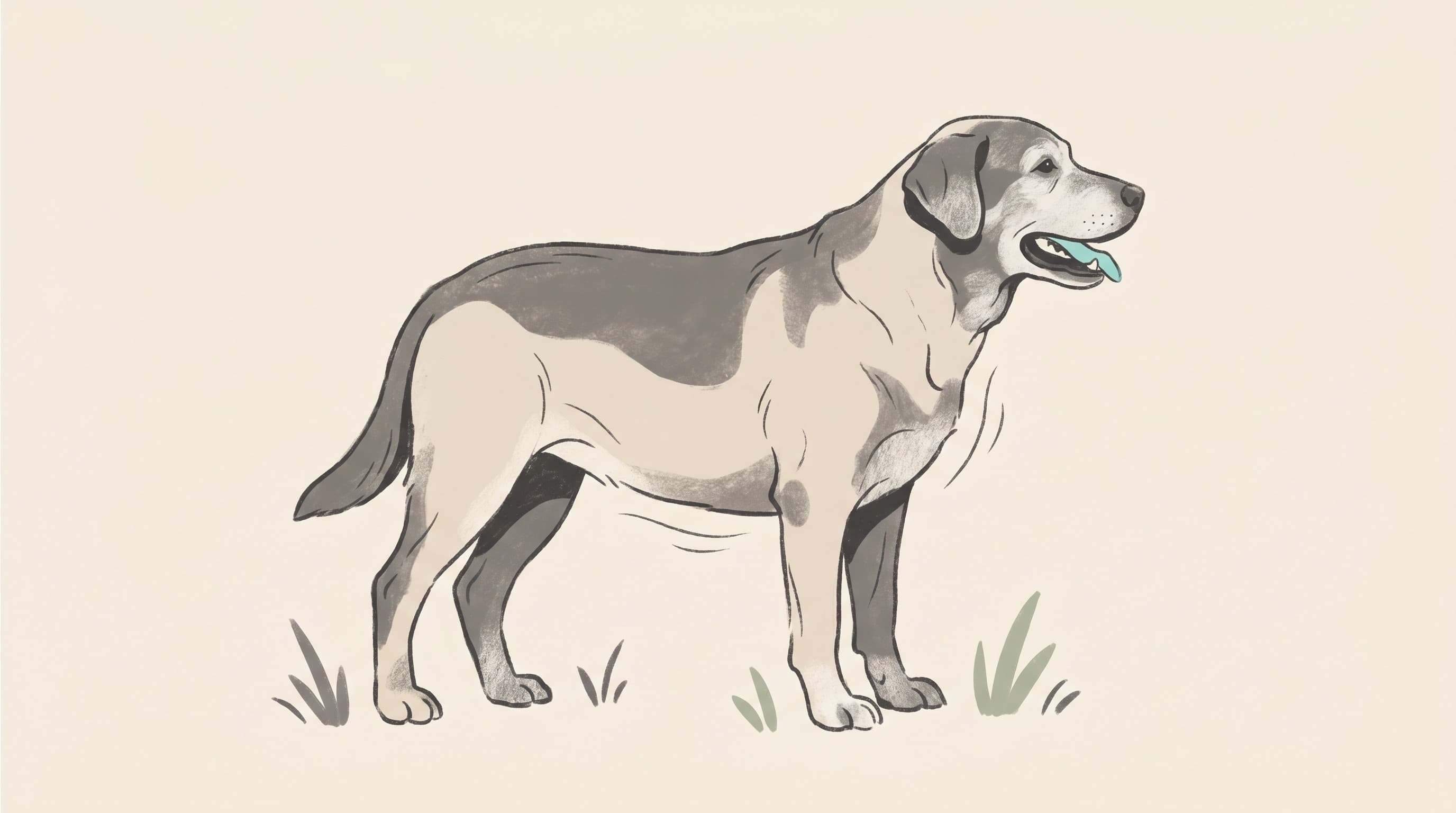
Laryngeal paralysis usually creeps in so gently that you only see it looking back. The bark sounds a bit different first, hoarser or oddly quiet, as though your dog has a cold that never quite clears. Walks that used to be easy now end with heavier panting than they should, and on a warm day there is a raspy, dragging noise on the breath in, the kind of sound you find yourself listening for once you have noticed it. The dog in question is very often an older Labrador, grey around the muzzle, still keen, still themselves, just not quite breathing the way they did a year ago. If any of that sounds familiar, this page is here to help you read what you are seeing.
Naming this condition early genuinely changes how the next year or two goes, and there is a clear path forward. The job of this page is recognition: what is going wrong, the three signs that name it, and the one situation that turns from slow to dangerous fast. I want to be straight with you too about what this condition actually is. The breathing is the loud part, but it is usually not the whole story, and I would rather you heard that from me, gently, than discovered it later and felt misled.
What the larynx does, and what goes wrong
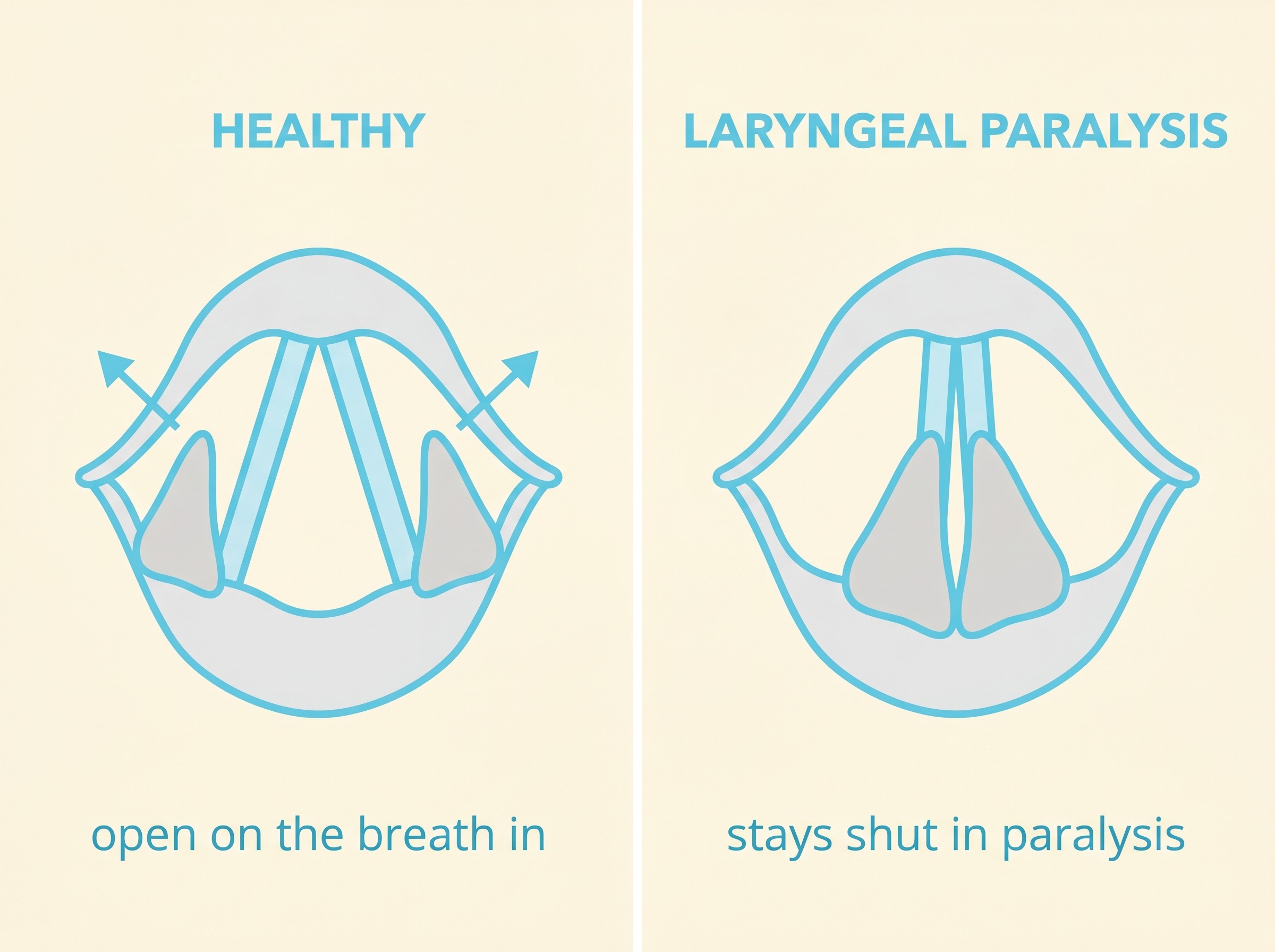
The larynx is your dog's voice box, sitting right at the top of the windpipe like a valve at the entrance to the lungs, and it is busier than it looks. On every breath in, small muscles pull two cartilages, the arytenoids, apart to open the airway wide so air flows in freely. During swallowing those same structures snap shut to keep food and water out of the lungs. And as air passes over them they vibrate to make sound, which is how your dog barks (Cornell Riney Canine Health Center, n.d.). All three jobs depend on one nerve on each side, the recurrent laryngeal nerve.
In laryngeal paralysis that nerve supply fails, so the muscle that should swing the cartilages open weakens. Instead of springing apart on the breath in, the arytenoids sit stranded in the middle of the airway, and air has to be forced past them through a gap that is far too small (Kitshoff et al., 2013; Kemp, 2022). A doorway that should open wide stays half shut, and breathing in becomes hard work. Everything you are hearing and seeing flows from that one mechanical fault: the noise, the effort, the changed bark, the tiring on walks.
Three signs that name it
Together, these three signs are what makes a vet reach for the word.
A changed or hoarse bark. Often the very first sign owners notice, and the easiest to dismiss. The bark goes weaker, lower, rougher or simply different, because the cartilages that make sound no longer move properly, almost as though the dog is losing its voice (Cornell Riney Canine Health Center, n.d.; MSD Veterinary Manual, 2022). Vets call this dysphonia, and a UK referral hospital lists this altered phonation as a classic early clue (North Downs Specialist Referrals, n.d.). People understandably put it down to age or a sore throat and carry on, but it is worth flagging rather than shrugging off.
A raspy, harsh noise on breathing in. This is the giveaway, and the one people really notice. As air is dragged past the stationary cartilages it makes a harsh, higher-pitched sound specifically on the in-breath, which vets call inspiratory stridor (Kitshoff et al., 2013). It is loudest when your dog is working hardest: after exercise, when excited, when hot, and it tends to grow over months. Laryngeal paralysis is the classic cause of this kind of noisy in-breath, though sorting one breathing noise from another is the job of our guide on when noisy breathing is dangerous. If you film one thing for your vet, film this.
Tiring on walks and heavier panting. A dog who used to manage their usual walk now flags partway round, pants harder than seems right and takes longer to settle, because every breath now costs more effort, often alongside reduced tolerance of heat, struggling on warm days that never used to bother them (Cornell Riney Canine Health Center, n.d.; North Downs Specialist Referrals, n.d.).
Around these three you will often see coughing or gagging, especially around food and water (Kemp, 2022). The pace is the giveaway: this progresses over months to years before it ever looks like a crisis, worsened by heat, excitement, exertion and extra weight (Kemp, 2022; Kitshoff et al., 2013). That slow build is why it is so easily put down to "just getting old", and why noticing is the kind thing to do. None of these signs alone proves laryngeal paralysis, but the more of them fit, the more the picture leans that way, and the more useful your first vet visit becomes.
The classic patient
There is a textbook dog here, and recognising the type helps you trust your instinct. Laryngeal paralysis turns up in middle-aged to older dogs, usually over about nine years, in the larger and giant breeds (Kitshoff et al., 2013; Kemp, 2022). The Labrador retriever is the textbook case, the breed every vet pictures first, so much so that a hoarse, raspy old Labrador should put laryngeal paralysis near the top of the list. Golden retrievers, Irish setters and Great Danes feature too (Kemp, 2022), and a UK referral hospital adds Weimaraners and Bernese mountain dogs to that list (North Downs Specialist Referrals, n.d.). For reasons we do not fully understand, male dogs are presented roughly twice as often as females (Kitshoff et al., 2013).
There is also a separate, much less common congenital form in young dogs of particular breeds, such as the Bouvier des Flandres, Siberian husky and Leonberger, worth a mention so an owner of a young husky with a strange bark knows to ask (Kemp, 2022; Kitshoff et al., 2013). Cats are affected only very rarely, so this is overwhelmingly a dog story (Kemp, 2022).
When slow turns into an emergency
The everyday picture is so slow that the danger can take owners by surprise. A paralysed larynx can tip into a genuine crisis, and fast. A hot, over-excited or over-exerted dog breathes harder, that effort swells the already-narrowed airway so breathing in gets harder still, the dog panics, and because it cools itself by moving air it cannot move, it overheats. Within minutes that can spiral into life-threatening respiratory distress and dangerous overheating (Cornell Riney Canine Health Center, n.d.; Kitshoff et al., 2013). The cues to act on are loud, laboured breathing, gums that look blue, grey or muddy rather than healthy pink (cyanosis), collapse, and a distressed dog that cannot settle (Cornell Riney Canine Health Center, n.d.; American College of Veterinary Surgeons, n.d.).
If you see that, the first moves buy time. Cool your dog with cool, not ice-cold, water, keep everything calm and quiet, and get to a vet now. Ice-cold water clamps down the surface blood vessels and slows the cooling you are after, so cool and steady wins. This anchor only names the crisis. The full prevention-and-response playbook lives in heat and exercise safety for dogs with laryngeal paralysis, and if you are ever unsure in the moment whether a breathing change is an emergency or something to book, our breathing triage tool helps you sort now from soon.
How a vet confirms it
You can recognise laryngeal paralysis at home, but you cannot diagnose it, and it helps to know why the vet visit looks the way it does. Laryngeal paralysis is confirmed by looking directly at the larynx, a laryngoscopy, under a light plane of sedation, while the vet watches whether the arytenoid cartilages actually move as your dog breathes in (Kitshoff et al., 2013; Kemp, 2022). In a healthy dog they swing open; in paralysis they stay still, or show paradoxical motion, sucked passively inwards on the in-breath, the exact opposite of what should happen, reported in up to about 45% of affected dogs (Kitshoff et al., 2013). It needs an experienced eye, because too deep an anaesthetic can make even a normal larynx look paralysed (Kitshoff et al., 2013).
Ordinary chest x-rays cannot diagnose laryngeal paralysis itself, though they are often taken to check the lungs (Kemp, 2022). A thyroid blood test is usually run too, because around 7 to 14% of these dogs turn out to be hypothyroid (Kitshoff et al., 2013), and a thorough work-up also includes bloods and a neurological check (American College of Veterinary Surgeons, n.d.).
The bigger picture: laryngeal paralysis is usually the first sign of GOLPP
Many pages stop at the larynx and leave owners with half the picture. What used to be filed as "idiopathic" laryngeal paralysis in older dogs is now understood as the earliest, loudest sign of a wider condition: geriatric onset laryngeal paralysis polyneuropathy, mercifully shortened to GOLPP (Michigan State University GOLPP Research Program, n.d.). It is a slowly progressive disease of the nerves, in which the laryngeal nerve fails first because it is one of the longest in the body and so among the most vulnerable, with other nerves following over time, gradually weakening the back legs and the gullet (North Downs Specialist Referrals, n.d.; Michigan State University GOLPP Research Program, n.d.).
The evidence is solid. In a landmark controlled study, 10 of 32 dogs (31%) with idiopathic laryngeal paralysis already showed wider neurological signs at diagnosis, and every single one went on to develop generalised neurological signs within a year (Stanley et al., 2010). An earlier, independent series found neurological deficits or electrical-test abnormalities in every case examined closely, and noted that dogs whose larynx was treated surgically still commonly went on showing weakness and reduced stamina (Jeffery et al., 2006). The larynx is the first thing you hear, but not the whole disease.
I am not telling you this to frighten you. Most of these dogs have good, comfortable time ahead and the progression is slow, but it changes two things: the breathing is one chapter of a longer story, and no treatment aimed at the airway can fix the nerves. The hind-leg weakness and swallowing changes, and how they tie into mobility, live in GOLPP as a whole-body condition, the right place to go next once you have caught your breath.
What lies ahead, in brief
You do not have to decide anything today, but it helps to know the shape of the road. Mild cases are managed conservatively, and much of that is in your hands: a harness rather than a collar so nothing presses on that already-struggling windpipe, keeping your dog lean because weight is the single biggest lever you control, and avoiding heat and over-exertion (Cornell Riney Canine Health Center, n.d.). Those small daily choices genuinely buy comfort and time, and our airway diary helps you and your vet see which way things are trending.
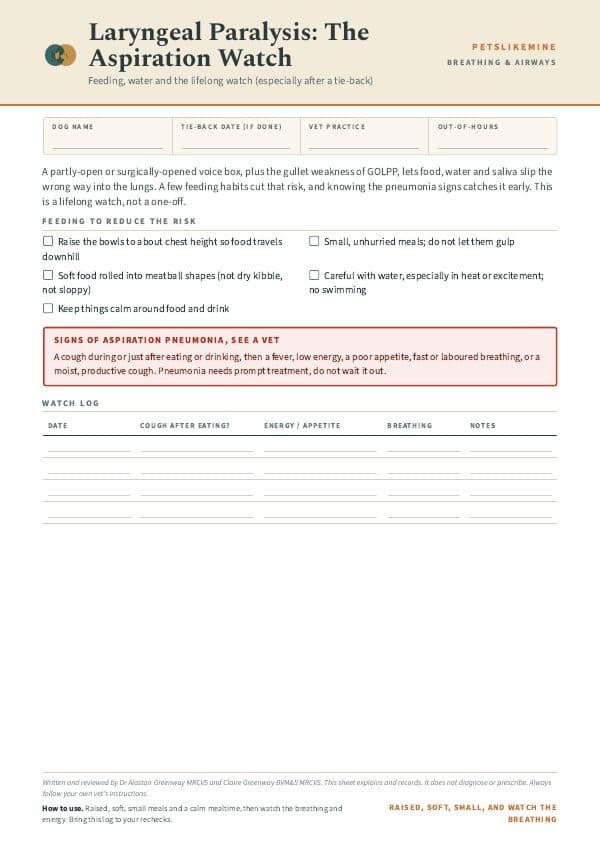
For moderate to severe breathing signs or repeated crises, the main operation is a "tie-back", properly a unilateral arytenoid lateralisation, which permanently holds one side of the voice box open so air can get in. It relieves the obstruction well, with around 88 to 90% of these dogs reported to have an improved quality of life afterwards (Kitshoff et al., 2013), but I will not pretend it is a cure. Holding the airway permanently open removes one of its protective jobs, raising the lifelong risk of food or water slipping into the lungs and causing aspiration pneumonia, reported in roughly 8 to 24% of dogs after surgery and climbing the longer they are followed, reaching around a third by three to four years out (Kitshoff et al., 2013; Wilson and Monnet, 2016). And it does nothing for the underlying GOLPP: the operation fixes the breathing, not the nerves. None of that makes surgery the wrong choice, for many dogs it is the right one, it just means going in with clear eyes. The operate-or-not decision and UK costs live in the tie-back surgery decision, the swallowing-and-feeding side has its own guide in managing aspiration pneumonia risk, and the tie-back and aspiration watch download gathers the warning signs onto one sheet.
So if you are at the very start of this, the useful things are gentle and immediate: switch to a harness today, keep walks short, cool and calm until you have been seen, and know you are not alone. You can walk in and say "his bark has gone hoarse over a few months, he tires fast, and there is a rasping noise when he breathes in, worse when it is warm", and that history points your vet straight at it. You have done the hard part already, which is noticing. A hoarse bark and a raspy breath in an old Labrador are easy to wave away, and you did not, which means your dog gets help sooner, when it works best.
References
- American College of Veterinary Surgeons. (n.d.). Laryngeal Paralysis. Small Animal Topics. Retrieved from
- Cornell Riney Canine Health Center. (n.d.). Laryngeal paralysis. Cornell University College of Veterinary Medicine. Retrieved from
- Jeffery, N. D., Talbot, C. E., Smith, P. M., and Bacon, N. J. (2006). Acquired idiopathic laryngeal paralysis as a prominent feature of generalised neuromuscular disease in 39 dogs. Veterinary Record, 158(1), 17.
- Kemp, M. H. (2022). Laryngeal Paralysis in Dogs and Cats. MSD Veterinary Manual (professional version). Retrieved from
- Kitshoff, A. M., Van Goethem, B., Stegen, L., Vandekerckhove, P., and de Rooster, H. (2013). Laryngeal paralysis in dogs: an update on recent knowledge. Journal of the South African Veterinary Association, 84(1), Art. #909.
- Michigan State University GOLPP Research Program. (n.d.). What is GOLPP? allaboutgolpp.com. Retrieved from
- MSD Veterinary Manual. (2022). Paralysis of the Larynx in Dogs. Pet owner version. Retrieved from
- North Downs Specialist Referrals. (n.d.). Laryngeal paralysis. Information sheets. Retrieved from
- Stanley, B. J., Hauptman, J. G., Fritz, M. C., Rosenstein, D. S., and Kinns, J. (2010). Esophageal dysfunction in dogs with idiopathic laryngeal paralysis: a controlled cohort study. Veterinary Surgery, 39(2), 139-149.
- Wilson, D., and Monnet, E. (2016). Risk factors for the development of aspiration pneumonia after unilateral arytenoid lateralization in dogs with laryngeal paralysis: 232 cases (1987-2012). Journal of the American Veterinary Medical Association, 248(2), 188-194.
Free downloads
Companion worksheets to put what you've read into practice. Free PDFs, print at home.
Keep track of how your pet is doing
The owners who cope best are the ones who notice changes early. A simple health log shows you what is working, and what is not, before the next vet visit.
Start tracking, freeYou're not doing this alone
Compare treatment journeys and talk to owners managing breathing & airways. Free to join.
Join PetsLikeMine