

Living With a Brachycephalic Dog: The Everyday Playbook
Alastair Greenway
BVM&S MRCVS
A good life for a flat-faced dog is built out of small, unglamorous, daily habits, and almost none of them cost anything. There's no lecture coming about whether you should own the breed, because you already do and you already love the dog. So let's talk instead about the everyday things that make the biggest difference to comfort and safety for a pug, a French bulldog, an English bulldog or any of the short-nosed breeds. Most of it is free, and taken together it adds up to a genuinely good life lived with a bit of attention rather than a lot of worry.
Start with the thing owners most often miss. In one study, 58% of owners of affected dogs did not recognise that their dog had a breathing problem at all, because the snoring and the snorting get filed away as "just the breed" (Packer et al., 2012). They aren't character quirks. They're the sound of an airway working harder than it should, and an owner who learns to read effort, noise and recovery time is doing the dog a real kindness. This piece is the everyday-management bundle: keep lean, harness not collar, keep cool, slow the food, mind the sleep, and track the right things. The emergency itself, heatstroke, has its own page, and I'll point you there rather than frighten you here.
Keep them lean: the single biggest lever
Weight is the most powerful thing you can change, and it changes more than you'd expect.
Excess weight makes breathing worse in a very physical way. Fat is laid down in and around the airway itself, in the tongue, the soft tissues of the throat and the neck, narrowing a passage that was already crowded in a short-skulled dog. The research bears this out plainly. In the Cambridge cohort, body condition score was an independent, easily applied predictor of brachycephalic obstructive airway syndrome (BOAS), and in bulldogs each single point of extra body condition raised the odds of being affected by around half again, an odds ratio of 1.56 (Liu et al., 2017). Obesity (a body condition score of about 7 out of 9 or higher) is significantly associated with BOAS, which is why both Cambridge and the Kennel Club put weight loss at the very front of management (University of Cambridge BOAS Research Group, n.d.; The Kennel Club, n.d.).
This part deserves saying gently, because it matters. Pugs in particular are the UK breed most predisposed to putting on weight: obesity is the single most common health problem recorded in pugs, and in Liu's study six in ten of the pugs were obese (Liu et al., 2017; O'Neill et al., 2022). So if your dog is carrying a bit too much, you are in enormous company, and it is not a moral failure. It is simply the highest-yield thing within your control. The practical levers are ordinary ones. Weigh out the daily food rather than eyeballing it, count treats into the daily ration instead of adding them on top, and ask your vet to set a target body condition and check it with you. The deep how-to-slim-a-dog programme lives in the Weight Management home, so head there for the method. The point to hold onto is that every kilo off is a little more air.
A harness, not a collar
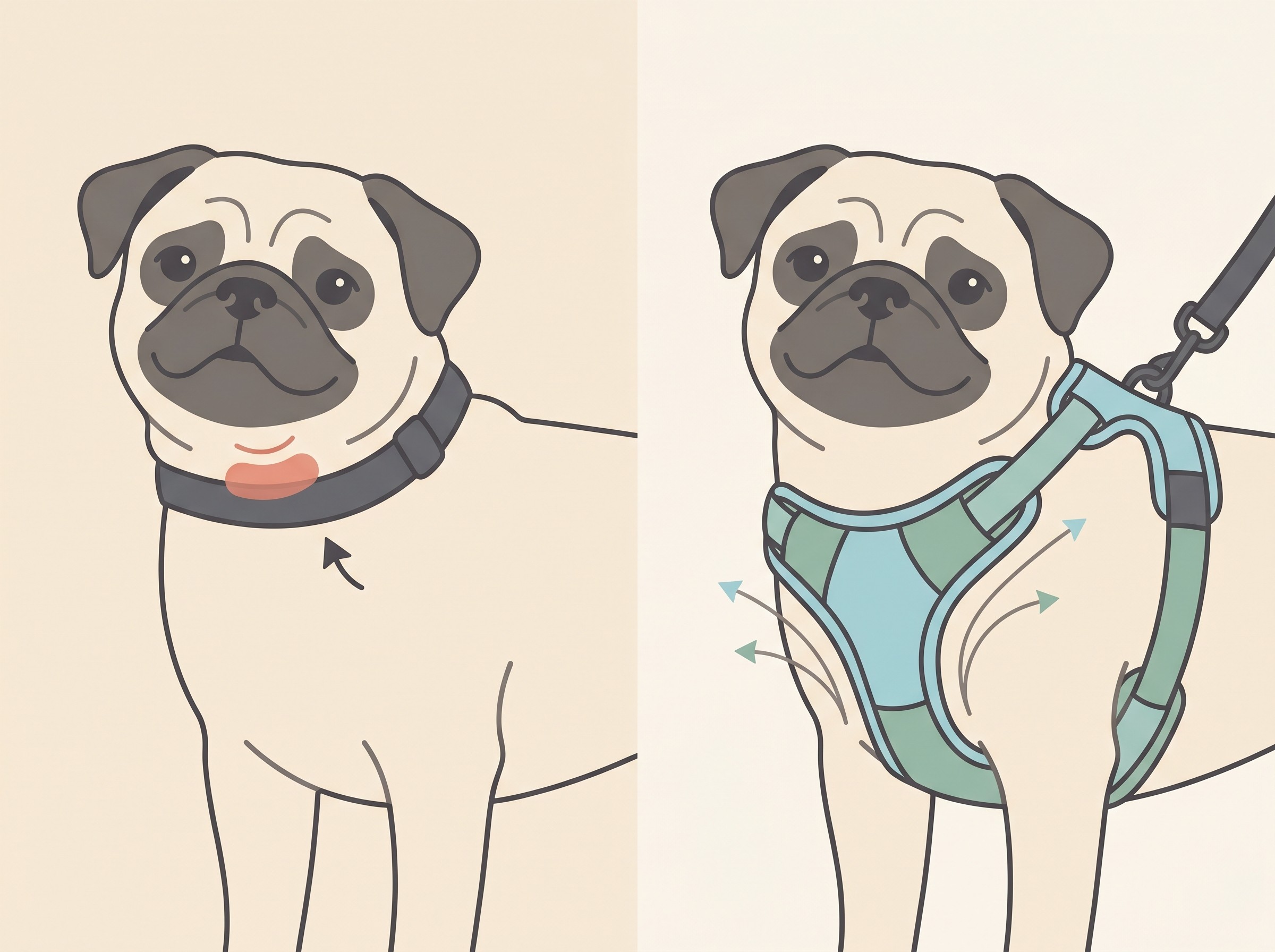
This is the one daily rule I'd tattoo on the lead if I could. A collar presses straight onto the windpipe, and an airway-compromised dog cannot afford that pressure.
The evidence here is sharper than people expect. A 2025 controlled study found that simply wearing a collar at rest raised the pressure inside the eye (the intraocular pressure) in brachycephalic dogs, though not in long-nosed dogs, and that exercising in a collar raised that pressure in every dog tested, whereas exercising in a harness raised it in none (Bailey et al., 2025). The same paper notes that neck collars have long been linked with respiratory problems such as tracheal collapse, which is commonly seen in small flat-faced breeds like pugs and Chihuahuas (Bailey et al., 2025). The Kennel Club's owner guidance is blunt and worth quoting: use "a harness instead of a collar to avoid putting pressure on their airway" (The Kennel Club, n.d.). A well-fitted Y-front harness spreads the load across the chest and leaves the throat alone. Keep the collar for the ID tag if you like, but walk on the harness.
Heat and pacing the day
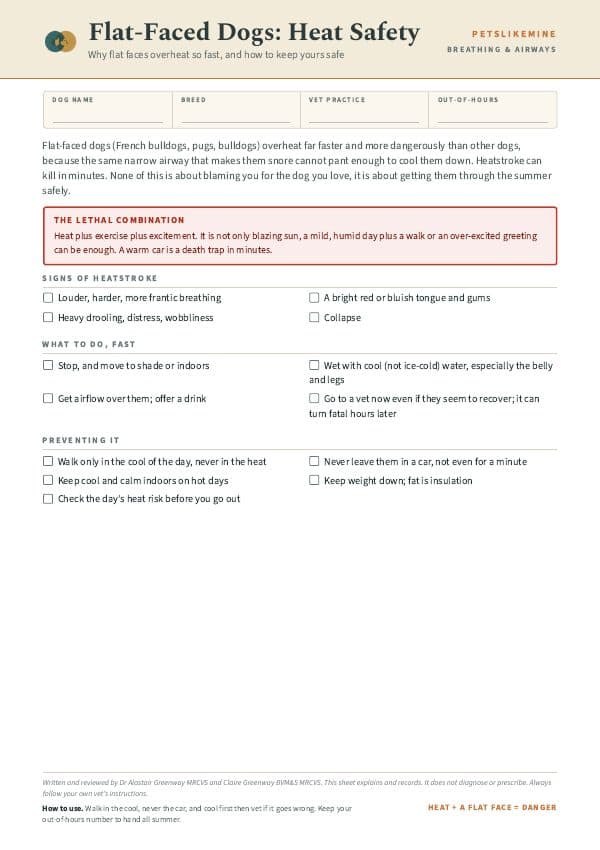
A flat-faced dog's panting is its air-conditioning, and an obstructed airway simply cannot move enough air to cool the body efficiently. Dogs shed almost all their heat by panting, and the brachycephalic airway partially blocks that mechanism, which is why these dogs overheat faster and more dangerously than long-nosed ones (Merck Veterinary Manual, n.d.). The numbers are stark: brachycephalic dogs carry roughly twice the odds of heat-related illness compared with medium-skulled breeds (an odds ratio of 2.10), and that is in a UK climate, not a tropical one (Hall et al., 2020). Even a mild, humid British day plus a walk can be enough.
The everyday levers are straightforward. Walk in the cool of the morning or the evening and skip the walk altogether on hot or humid days. Keep walks short, let the dog set the pace, and let it stop and rest when it wants to. Never leave the dog in a car or any warm, poorly ventilated space, not even for a couple of minutes. And manage excitement, because a thrilling doorbell, a frantic game or a stranger to greet drives exactly the same hard, hot breathing as a run does. Cambridge specifically advises avoiding excessive exercise and hot environments, and keeping the dog away from situations that may cause too much excitement or stress (University of Cambridge BOAS Research Group, n.d.).
I'm deliberately not writing the emergency here, because it deserves its own clear page. If you want the signs of an overheating crisis and exactly what to do in the moment, the cool-first first aid that can save a life, read flat-faced dog heatstroke and keep the flat-faced heat safety sheet somewhere handy. The airway diary also carries a real-time heat-risk indicator, so you can check the day's risk before you reach for the lead.
Keep them fit, not just thin
Pacing is not the same as prohibition, and this is a distinction worth holding. Exercise intolerance is one of the most common signs of BOAS: in one preoperative questionnaire, 88% of owners of severely affected dogs reported it, along with a long recovery time after exertion (Roedler et al., 2013). The answer to that is not a sofa-bound life, because inactivity feeds the very weight problem that makes the breathing worse. The Kennel Club frames the goal nicely as regular short walks to maintain fitness, accepting that an affected dog may need to stop and rest mid-walk (The Kennel Club, n.d.). Lean and fit beats sedentary and heavy. A reasonable level of fitness actually lowers the effort of breathing, so gentle, regular, low-heat exercise is part of the treatment, not a risk to it.
Sleep is where BOAS shows itself
Watch your dog sleep, because the airway tells the truth at night. Brachycephalic dogs commonly have sleep-disordered breathing, and in one cohort 56% of owners reported sleep problems (Roedler et al., 2013). Both brachycephaly itself and excess weight are confirmed risk factors, and in flat-faced dogs the more severe the BOAS, the higher the risk of disrupted sleep (Niinikoski et al., 2024).
You'll often see a flat-faced dog choose to sleep propped up, with the head and neck raised, or with a toy held in the mouth. That isn't a quirk. It splints the airway open, and you should let them do it. Give them a cool, quiet spot and a raised cushion or a bolster if they seem to want one. The signs worth flagging to your vet are worsening snoring, choking or waking through the night, restless or broken sleep, or a dog that needs to prop itself up more and more, because these track BOAS severity and are a fair reason to have the weight and the grade reviewed (Niinikoski et al., 2024). If you've never had your dog's breathing formally graded, knowing its RFGS grade gives you and your vet a baseline to measure change against.
Slow the food and watch for regurgitation
Many owners never connect the two, but a lot of flat-faced dogs have a gut problem riding along with the airway one. The same fierce negative pressure the dog generates to drag air past the obstruction also tugs the stomach and its acid the wrong way, so regurgitation, vomiting, gagging, excess swallowing and even a sliding hiatal hernia are over-represented in these breeds (Mitze et al., 2022). The overlap is large: in dogs presenting for BOAS, the reported prevalence of gastrointestinal signs runs very high (Mitze et al., 2022). A large UK primary-care study found respiratory and gastrointestinal disease sitting side by side across brachycephalic breeds, with French bulldogs carrying the highest odds of oesophageal, gastric and intestinal disease (Petchell et al., 2022).
The daily levers are simple. Feed smaller, more frequent meals rather than one big bowl. Slow a gulping eater with a slow-feeder bowl or a flat tray so they take in less air. And don't feed right before strenuous activity or a burst of excitement. There's one genuinely hopeful point here: airway surgery often eases the gut signs too. Owners report meaningful improvement in regurgitation after eating and after exercise once the airway is opened, because surgery lowers the resistance that drives the reflux, although the underlying reflux does not always disappear entirely (Mitze et al., 2022). So persistent regurgitation is worth raising with your vet rather than quietly accepting as normal, and surgery, if it's on the table, may help at both ends. That decision is covered in the BOAS surgery decision. The deep GI work-up, investigating oesophagitis or a hiatal hernia, belongs with the Digestive Health home; here the job is just the everyday feeding habits.
What to track at home
Give yourself a few concrete signals so that change stands out before it becomes a crisis. Watch how loud and how hard the breathing is, how quickly the dog recovers after gentle exercise, how exercise tolerance shifts over weeks and months, and the bodyweight or body condition. The airway diary is built for exactly this, logging effort, exercise tolerance and the heat-risk indicator in one place.
The most useful single habit is counting the resting breathing rate, taken while the dog is asleep and settled. The wording is worth getting right: normal is under about 30 breaths a minute at rest, 30 or more is worth watching, and 40 or more needs a call to the vet. Worth knowing that this threshold was validated for monitoring heart disease, where dogs and cats with well-controlled heart failure nearly all sleep at under 30 breaths a minute, and we use it here as a general resting-tachypnoea signal, so treat it as a sensitive early-warning number rather than a diagnosis (Porciello et al., 2016). The breathing rate tool turns it into a simple tap-to-count. A resting rate that climbs over several days, or rising effort or noise, is your cue to be seen.
A flat-faced dog managed like this, lean, on a harness, kept cool, fed slowly and watched at night, can have a full, happy, comfortable life. The breed asks a little more attention than most, and you're plainly willing to give it. For the levers that every airway-compromised dog shares, regardless of breed, the cross-condition daily playbook gathers them in one place. From here, the work is mostly the quiet, ordinary kind: the right harness on the hook, the food weighed out, the cool of the morning chosen for the walk. Small habits, big air.
References
- Bailey, M. E., Packer, M. J., & Wills, A. P. (2025). Effect of a collar and harness on intraocular pressure and respiration rate of brachycephalic and dolichocephalic dogs. Veterinary Medicine and Science, 11(3), e70384.
- Hall, E. J., Carter, A. J., & O'Neill, D. G. (2020). Incidence and risk factors for heat-related illness (heatstroke) in UK dogs under primary veterinary care in 2016. Scientific Reports, 10, 9128.
- Liu, N.-C., Troconis, E. L., Kalmar, L., Price, D. J., Wright, H. E., Adams, V. J., Sargan, D. R., & Ladlow, J. F. (2017). Conformational risk factors of brachycephalic obstructive airway syndrome (BOAS) in pugs, French bulldogs, and bulldogs. PLoS ONE, 12(8), e0181928.
- Merck Veterinary Manual. (n.d.). Heat-related illness and thermoregulation in dogs (panting as the primary route of heat loss; brachycephalic predisposition). Retrieved from
- Mitze, S., Barrs, V. R., Beatty, J. A., Hobi, S., & Bęczkowski, P. M. (2022). Brachycephalic obstructive airway syndrome: much more than a surgical problem. The Veterinary Quarterly, 42(1), 213-223.
- Niinikoski, I., Himanen, S.-L., Tenhunen, M., Aromaa, M., Lilja-Maula, L., & Rajamäki, M. M. (2024). Evaluation of risk factors for sleep-disordered breathing in dogs. Journal of Veterinary Internal Medicine, 38(2), 1135-1145.
- O'Neill, D. G., Sahota, J., Brodbelt, D. C., Church, D. B., Packer, R. M. A., & Pegram, C. (2022). Health of Pug dogs in the UK: disorder predispositions and protections. Canine Medicine and Genetics, 9, 4.
- Packer, R. M. A., Hendricks, A., & Burn, C. C. (2012). Do dog owners perceive the clinical signs related to conformational inherited disorders as 'normal' for the breed? A potential constraint to improving canine welfare. Animal Welfare, 21(S1), 81-93.
- Petchell, B., Killick, D. R., Pinchbeck, G., et al. (2022). Incidence of alimentary and respiratory disease in brachycephalic dogs presenting to primary care veterinary practices participating in the SAVSNET project. Veterinary Record, 191(7), e1685.
- Porciello, F., Rishniw, M., Ljungvall, I., Ferasin, L., Haggstrom, J., & Ohad, D. G. (2016). Sleeping and resting respiratory rates in dogs and cats with medically-controlled left-sided congestive heart failure. The Veterinary Journal, 207, 164-168.
- Roedler, F. S., Pohl, S., & Oechtering, G. U. (2013). How does severe brachycephaly affect dog's lives? Results of a structured preoperative owner questionnaire. The Veterinary Journal, 198(3), 606-610.
- The Kennel Club. (n.d.). Breathing problems in brachycephalic dogs. Retrieved from
- University of Cambridge BOAS Research Group. (n.d.). Management & treatment. Department of Veterinary Medicine. Retrieved from
Free downloads
Companion worksheets to put what you've read into practice. Free PDFs, print at home.
Keep track of how your pet is doing
The owners who cope best are the ones who notice changes early. A simple health log shows you what is working, and what is not, before the next vet visit.
Start tracking, freeYou're not doing this alone
Compare treatment journeys and talk to owners managing breathing & airways. Free to join.
Join PetsLikeMine