

BOAS Surgery: What It Involves and the Week-by-Week Recovery
Alastair Greenway
BVM&S MRCVS
Your flat-faced dog is booked in, or has just come home with a shaved patch on a leg and a slightly bewildered look. The practical questions follow quickly. What did the surgeon actually do in there? How worried should you be in these first couple of days, and when will you hear that easier breathing you were promised?
This article answers exactly those: what the operation involves, then recovery week by week, candid about the bits that are genuinely a little nerve-wracking and the bits that aren't. I won't re-argue whether surgery was the right call. If you're still weighing that up, the surgery decision guide is the place for it. Here I'm assuming you've decided, and you just need a clear picture of the road ahead.
What the surgeon does in there
BOAS surgery is rarely one cut. Several parts' worth of a normal dog's airway are crammed into a shortened skull, so the surgeon usually addresses more than one level in the same anaesthetic, tailored to your dog (Wallace, 2024). The narrowed nostrils, the stenotic nares, are widened, often by taking out a small wedge of tissue or reshaping the nostril opening so air can actually get in through the nose (Today's Veterinary Practice, 2021). The over-long soft palate, the flap at the back of the throat that flutters and obstructs, is trimmed and thinned back towards a more normal length, either by a cut-and-sew technique or a folded-flap palatoplasty (Today's Veterinary Practice, 2021; Cambridge BOAS Research Group, n.d.). And if the larynx has started to give way, the small pouches called laryngeal saccules may have turned inside out into the airway, and those everted saccules are removed (Today's Veterinary Practice, 2021).
That last point explains why outcomes vary so much from dog to dog. Everted saccules are the earliest, stage one form of laryngeal collapse (Today's Veterinary Practice, 2021). A surgeon can tidy those away, but cannot rebuild the skull or fully reverse an advanced laryngeal collapse once the cartilage framework has folded inwards (Cambridge BOAS Research Group, n.d.; Wallace, 2024). This is exactly why a dog operated on earlier, before those secondary changes set in, tends to get more back. The full anatomy behind all this lives in BOAS explained. For most dogs the operation itself is day surgery or a short stay, and it's the first day or two afterwards that matters most.
The critical first 24 to 48 hours
There's a slightly counterintuitive truth about BOAS surgery worth saying plainly: right after the operation, there's a window where your dog's breathing can briefly get worse before it gets better. That's not a complication, it's the expected swelling of freshly operated tissue inside an airway that was already tight (Cambridge BOAS Research Group, n.d.; Today's Veterinary Practice, 2021). The whole point of keeping your dog in hospital is to sit on that window safely until it settles.
So in a well-run team your dog may be given oxygen for roughly the first 12 to 24 hours, and watched with an hourly respiratory check, someone counting the breaths and the effort, through that same early period (Today's Veterinary Practice, 2021). An anti-inflammatory steroid, typically dexamethasone, is commonly given around the time of surgery to keep the swelling down (Today's Veterinary Practice, 2021). Most dogs stay in for at least 24 to 48 hours, and a gastro-protectant is usually given too, because the goal is to reduce post-operative regurgitation (Cambridge BOAS Research Group, n.d.; Today's Veterinary Practice, 2021). If your dog is kept in overnight, that isn't a bad sign, it's the system working as intended.
There's one more safety net, and I'll name it so the word doesn't frighten you if you hear it. If the swelling and obstruction don't settle with oxygen and steroids, the surgeon can place a temporary tracheostomy, a small breathing tube into the windpipe lower down, to bypass the swollen area until it calms. That tube is typically left in for two to three days while the swelling goes down, then removed (Cambridge BOAS Research Group, n.d.; Today's Veterinary Practice, 2021). It's a rescue used in a minority of dogs, not the norm, but it's precisely what an experienced centre is set up to do, and part of why a calm, elective operation in good hands is so much safer than operating on a dog already in a breathing crisis.
Bringing them home: the first two weeks
Once you're home, your job for roughly the first fortnight comes down to one unglamorous word: calm. The tissues in the throat and nose are healing, and the biggest single thing you can do is not let your dog blow that healing apart with excitement, heat or hard activity. In practice that means minimal activity, only short lead walks of perhaps ten to fifteen minutes for toilet breaks, with no running, jumping or stairs if you can possibly avoid them, on a Y-front harness rather than a collar so nothing presses on the throat (Filipas, n.d.). It means small, soft meals while the palate heals: soft food shaped into meatballs is the usual advice, with hard kibble, bones and chews off the menu for the first couple of weeks (Today's Veterinary Practice, 2021; Filipas, n.d.). And if the nostrils were operated on, an Elizabethan collar, the cone, is usually worn for around ten to fourteen days to stop your dog rubbing at the stitches (Today's Veterinary Practice, 2021; Filipas, n.d.).
One thing owners often don't expect: the hardest dogs to keep quiet are the ones who feel better fastest, wanting to celebrate easier breathing by tearing round the garden, which is the last thing the healing tissue needs. This is why a calming medication such as trazodone is commonly prescribed at home for the first ten to fourteen days, simply to make rest actually possible (Today's Veterinary Practice, 2021). It isn't a sign your dog is difficult. It's a sign the recovery is going well enough that they want to misbehave.
I won't turn this into the full lifelong-management talk, because keeping a flat-faced dog cool, lean and well-paced is a forever job and it has its own home in living with a brachycephalic dog. The heat side matters enormously too, especially in the early weeks when your dog can't pant as freely while tissues are swollen, which is why flat-faced dog heatstroke covers that danger and its prevention in full. For now, just hold the two-word principle: calm and cool.
How much better, and how soon
Most dogs are noticeably easier within the first week, with the swelling subsiding by around the two-week mark, and many are back to normal daily activity within about a month if recovery is uneventful (Filipas, n.d.). When it goes well, owners are genuinely delighted: in one large series of 423 dogs, respiratory signs improved in 72% and owner satisfaction was 97.1% (Carabalona et al., 2021). Those are good numbers to hold onto on a worried night.
There's a nuance, though: surgery improves the breathing, it does not cure BOAS. The Cambridge BOAS Research Group puts it about as plainly as it can be put: BOAS is not curable, but corrective surgery can provide a better quality of life (Cambridge BOAS Research Group, n.d.). When researchers measured this objectively rather than just asking owners, the picture was encouraging but real. In a Cambridge follow-up study, the average BOAS index (a measured score of airway obstruction) fell from around 72% before surgery to around 47% afterwards, and about 81% of dogs improved, yet a majority still had measurable signs persisting, with around 59% still scoring above the diagnostic cut-off long after surgery. Tellingly, just over half of owners felt the breathing problem had resolved completely, even when the measurements said some obstruction remained (Johnson et al., 2026). So your dog will very likely breathe better, perhaps a great deal better, but don't expect a completely different animal with no snore at all. And a dog with significant secondary laryngeal collapse has less to gain, because the surgeon can't undo that part (Wallace, 2024).
The reassuring flip side is that the gain lasts. In that same cohort, dogs reassessed a median of more than four years after surgery were still improved compared with before the operation, with no meaningful slipping back between the short-term and long-term measurements (Johnson et al., 2026). This was a small group followed for a long time, so read it as direction of travel rather than a precise promise: the early improvement is real, and it tends to hold.
Signs that mean phone the vet
Most recoveries are uneventful. But you're the one watching your dog through the period when complications, if they happen, tend to show, so you should know exactly what would make you pick up the phone. The main things that go wrong after BOAS surgery are airway swelling and obstruction and aspiration pneumonia, where food, fluid or saliva gets down into the lungs. Reported together, these affect up to around 23% of dogs in some cohorts, though most are not life-threatening and settle with care (Today's Veterinary Practice, 2021). A separate study of 199 dogs put the overall rate of a serious post-operative breathing complication at about 15%, made up of low blood oxygen, dogs needing re-intubation or a temporary tracheostomy, and aspiration pneumonia in roughly one in twenty (Filipas et al., 2024). Numbers vary between centres, but the shape is consistent: a real minority hit a bump, and most of those bumps are managed. Regurgitation can actually be a little worse just after surgery than it was before, and because it's the main route by which fluid reaches the lungs, it's watched carefully (Today's Veterinary Practice, 2021).
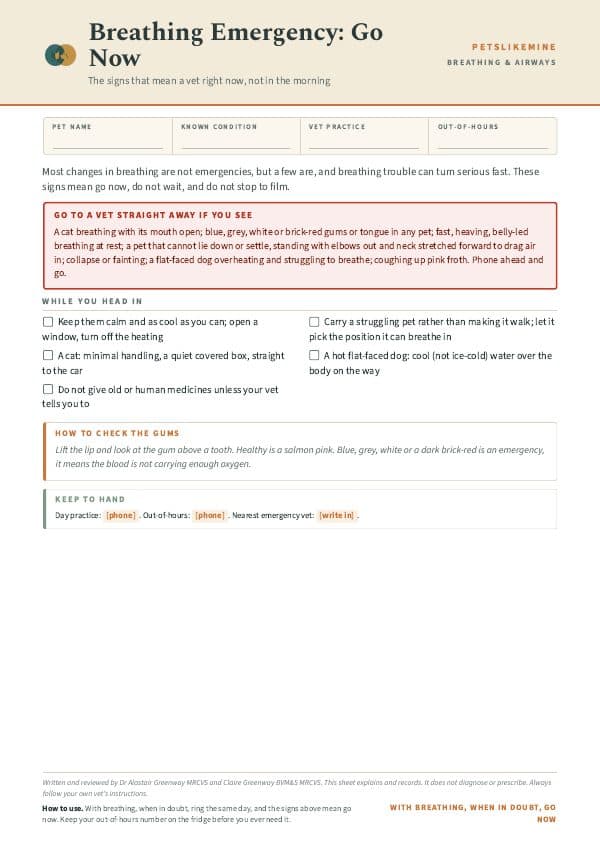
Call your vet, urgently, if you see laboured or distressed breathing, gums that look blue or grey, collapse, persistent regurgitation or vomiting, a dog that won't eat, or a cough with a fever or coloured discharge, any of which can point to aspiration pneumonia (Today's Veterinary Practice, 2021; Filipas, n.d.). Blue or grey gums or a collapse are a go-now emergency, not a wait-and-see. Keep the breathing emergency red flags card somewhere visible for the fortnight, so you're not trying to recall the list at two in the morning.
The wider risk picture reframes a lot of the worry, though. In that 423-dog series, overall mortality was 2.6%, and much of that risk was concentrated in older dogs and in emergencies: the risk of death rose by roughly 30% for each additional year of age (Carabalona et al., 2021), and respiratory complications run around thirty times higher when dogs are operated on mid-crisis rather than as a planned procedure (Today's Veterinary Practice, 2021). So if your dog was done as a calm, elective operation, you have already loaded the dice heavily in their favour. That single fact, elective beats emergency, is the strongest argument for not putting these operations off until a dog is in trouble.
Logging the recovery, and the longer view
One quietly useful habit for these weeks is to keep a simple record of how your dog is breathing, rather than relying on your memory of a stressful fortnight. The Airway Diary lets you log breathing, exertion and how they cope from day to day, and counting a calm resting rate with the breathing rate tracker or the Breath Camera gives you and your vet something concrete to compare against next month. A photo or a short clip of your dog breathing in week one, set beside one from week four, often shows the change better than memory ever could. This is also a good moment to gently start on any extra weight, because being overweight is strongly linked with BOAS and every kilo off is a little less load on an airway that has just been given more room (Cambridge BOAS Research Group, n.d.).
Surgery is a step, not a finish line. Your dog will, in all likelihood, breathe more easily for years to come, but a flat-faced dog stays a flat-faced dog, so the cool walks, the harness and the keeping them lean all carry on for life. That's the gentler job, though, and the harder part, the operation and that first watchful fortnight, is now behind you. What's ahead is the steady, manageable rhythm of looking after a dog who can finally get enough air, and living with a brachycephalic dog picks up exactly where this leaves off.
References
- Cambridge BOAS Research Group. (n.d.). Management & Treatment of BOAS. Department of Veterinary Medicine, University of Cambridge.
- Carabalona, J. P. R., Le Boedec, K., & Poncet, C. M. (2021). Complications, prognostic factors, and long-term outcomes for dogs with brachycephalic obstructive airway syndrome that underwent H-pharyngoplasty and ala-vestibuloplasty: 423 cases (2011-2017). Journal of the American Veterinary Medical Association, 260(S1), S65-S73.
- Filipas, F. (n.d.). Recovery and Lifestyle Changes After BOAS Surgery. Sustainable Vet.
- Filipas, M. C., et al. (2024). A retrospective observational cohort study on the postoperative respiratory complications and their risk factors in brachycephalic dogs undergoing BOAS surgery: 199 cases (2019-2021). Journal of Small Animal Practice, 65(5), 329-337.
- Johnson, D. A., Liu, N-C., & Ladlow, J. F. (2026). Comparison of short- and long-term objective respiratory outcomes after surgery for brachycephalic obstructive airway syndrome. Veterinary Surgery, 55(1), 59-68.
- Today's Veterinary Practice. (2021). A Guide to Brachycephalic Obstructive Airway Syndrome Surgery.
- Wallace, M. L. (2024). Surgical management of brachycephalic obstructive airway syndrome: An update on options and outcomes. Veterinary Surgery, 53(7), 1173-1184.
Free downloads
Companion worksheets to put what you've read into practice. Free PDFs, print at home.
Keep track of how your pet is doing
The owners who cope best are the ones who notice changes early. A simple health log shows you what is working, and what is not, before the next vet visit.
Start tracking, freeYou're not doing this alone
Compare treatment journeys and talk to owners managing breathing & airways. Free to join.
Join PetsLikeMine