

The Snotty Nose That Won't Clear: Causes, and When to Investigate
Alastair Greenway
BVM&S MRCVS
We're trained from childhood to wave a runny nose away. A sniffle, a sneeze or two, it'll pass. With pets, that instinct is usually right: a snotty nose is common, often harmless, and frequently something we can manage even when we can't make it vanish entirely. But "usually" is doing quiet work in that sentence, because a small handful of patterns turn a runny nose from a nuisance into something that genuinely needs looking at.
What follows is a straight map. Not the version that says it's nothing, and not the one that has you convinced your older dog has cancer by the second paragraph. Just the patterns we actually use as vets to decide whether a nose needs a wipe and a watch or a proper look.
One nostril, or both: the question that does the most work
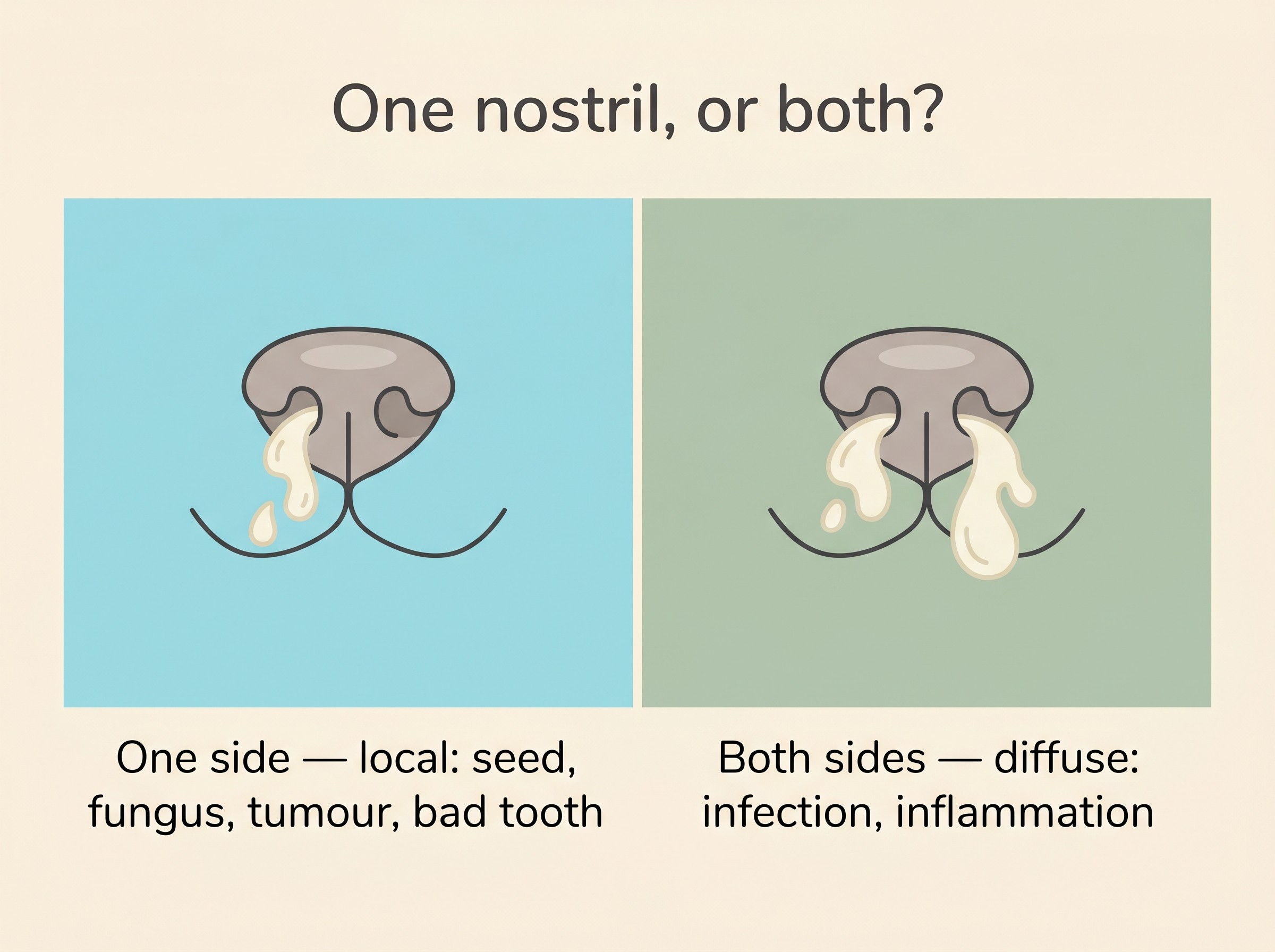
Whether the discharge comes from one nostril or both is the single most useful observation you can hand your vet, because it points us in very different directions (dvm360, 2010).
One side only (unilateral) tends to mean a local problem, something physically there in that one passage: a foreign body such as a grass seed, a fungal infection, a tumour, or an oronasal fistula, which is a hole that opens between the mouth and nose from a diseased tooth root (dvm360, 2010). Both sides (bilateral) tends to mean something more spread out: a viral or bacterial infection, allergic or inflammatory rhinitis, or disease that has become extensive (dvm360, 2010).
A catch is worth knowing, because it stops you over-reassuring yourself. Two of the more serious one-sided causes, fungal disease and tumours, often start on one side and become two-sided once they have destroyed the thin bony wall (the septum) between the passages (dvm360, 2010). So both-sided discharge is not automatically the harmless kind. The character of the discharge fills in the rest: clear and watery early or with simple irritation, thick and yellow-green with infection, and streaked with blood (or a frank nosebleed) when something is eroding tissue, which raises the question of a foreign body, fungal disease or a tumour (MSD Veterinary Manual, n.d.-a; dvm360, 2010). Your vet has a useful tell to check in the room: a tumour tends to block a nostril and reduce airflow on that side, whereas fungal disease actually destroys tissue and can leave the airway feeling more open, so airflow is often preserved (dvm360, 2010).
Cats: the post-cat-flu "snuffler"
A cat with a chronically snotty, sneezy, congested nose is very likely what vets affectionately call a snuffler, and the story usually begins years before you noticed anything.
Most cats with long-term idiopathic rhinitis are thought to have had a viral upper-respiratory infection earlier in life, the cat-flu viruses feline herpesvirus (FHV-1) or feline calicivirus (FCV) (Today's Veterinary Practice, 2012; Scherk, 2010). The trouble is what those viruses leave behind. They damage the delicate lining of the nose and the fine scrolls of bone inside it, the turbinates, and once those are scarred and eroded the nose can't defend itself the way it used to, leaving the cat prone to recurring inflammation and to secondary bacterial infection that settles deep in the damaged bone and sinuses, where it's genuinely hard to clear (Today's Veterinary Practice, 2012; MSD Veterinary Manual, n.d.-b; Scherk, 2010). We call it chronic rhinitis once the signs have lasted more than about a month (Today's Veterinary Practice, 2012). Herpesvirus also explains the flares: it establishes a lifelong, latent infection in up to around 80% of the cats it infects, and roughly 45% of those periodically reactivate and shed it when stressed (Cornell Feline Health Center, n.d.-a), which is why a cat settled for months can suddenly start snuffling again after a cattery stay, a house move or a new kitten arriving.
Here's the part I'd rather you heard warmly from me than discovered through frustration. In most of these cats there's no cure, unless we find a specific, fixable cause such as an abscessed tooth root (Today's Veterinary Practice, 2012; Scherk, 2010). The realistic goal is control rather than cure: keeping the inflammation and secondary infection down so your cat is comfortable and breathes and smells well enough to eat, and treating that secondary infection when it flares genuinely helps (Scherk, 2010; Today's Veterinary Practice, 2012). It isn't nothing, and it isn't a failure on your part. Managed well, most snufflers do just fine.
One feline cause bucks the "no cure" theme entirely: a nasopharyngeal polyp. This is a benign growth on a little stalk, seen most often in kittens and young cats, that sits at the back of the nose and causes noisy or snoring breathing, nasal discharge, sneezing and sometimes reverse sneezing (Cornell Feline Health Center, n.d.-b). It's usually cured simply by removing it, often by gentle traction (Cornell Feline Health Center, n.d.-b). So a young cat with these signs deserves a proper look, because the answer might be a genuinely fixable one.
Dogs: the grass seed that "stopped sneezing"
In dogs, the cause that catches the most owners out is the foreign body, and the classic culprit is a grass seed inhaled on a summer walk.
The hallmark is dramatic: a sudden, violent fit of paroxysmal sneezing, often with frantic pawing at the nose, coming on right after the dog has been snuffling through long grass, with a one-sided discharge that quickly turns blood-tinged (dvm360, 2010). So far, so obvious. Now the trap that costs dogs weeks of discomfort: that violent sneezing usually settles after a few days as the tissues calm down, and the dog slips into a quieter, persistent, one-sided discharge instead (dvm360, 2010). Owners read the calming-down as healing. It isn't. A grass seed's barbs only let it travel one way, inwards, so it can't work itself back out, and it needs removing by a vet, usually under sedation or anaesthetic (dvm360, 2010). If your dog had a sneezing storm that faded into a one-sided snotty nose, please don't file it under "better". That's exactly the pattern that means a seed may still be in there.
Dogs: a bad tooth that drips down the nose
This one surprises people. The roots of the upper canine teeth and the big upper chewing tooth (the fourth premolar, or carnassial) sit right up against the nasal cavity, so when advanced dental disease or a root abscess eats through the thin plate of bone between them, it can open an oronasal fistula, a direct channel from mouth into nose (dvm360, n.d.). The result is a one-sided discharge that sometimes contains food particles, sneezing that's worse while eating, and notably bad breath (dvm360, n.d.). I mention it with optimism, because it's one of the genuinely curable causes: treat or extract the tooth and it usually resolves. So a snotty nose that travels with halitosis and mealtime sneezing is well worth a dental examination.
Dogs: fungal disease, the serious cause that's also treatable
Sinonasal aspergillosis is a fungal infection, usually caused by Aspergillus fumigatus, and it's one of the more important chronic nasal diseases in dogs precisely because it's both serious and easy to under-rate. It tends to affect long-nosed (dolichocephalic) and medium-nosed (mesaticephalic) breeds, often dogs under about five (dvm360, 2010; Prior et al., 2024).
Its signature is distinctive once you know it: profuse, thick, pus-like discharge, marked pain around the nose, sneezing, nosebleeds, and, tellingly, depigmentation or ulceration of the nostrils and the nasal planum, the leathery pad itself (dvm360, 2010). That loss of pigment is thought to come from toxins in the discharge, and because it isn't typical of other nasal diseases, a sore, crusting, paling nose points strongly towards fungal disease (dvm360, 2010). This is a real, well-documented UK problem, not an exotic rarity: a recent British case series ran to 475 dogs diagnosed between 2011 and 2021, with a companion paper reporting treatment outcomes in a further 436 (Prior et al., 2024; Prior et al., 2025). Diagnosis takes more than a look up the nose, typically CT or other advanced imaging, rhinoscopy to find the fungal plaques and eroded turbinates, serology and samples for the lab (dvm360, 2010; Prior et al., 2024).
The reason I'd rather you knew about aspergillosis than feared the nose generally is that it can be treated, usually with antifungal medication delivered into the nose under anaesthetic at a referral centre (Prior et al., 2025; MSD Veterinary Manual, n.d.-c). The specifics are your vet's territory, but the headline matters: a sore, bleeding, depigmenting nose in a youngish long-nosed dog is not a lost cause. It's a reason to investigate, with a real prospect of helping.
Dogs: the nasal tumour, and keeping it in proportion
Now the one everybody worries about. Nasal tumours do happen, mostly in older pets, and in dogs they're nearly all malignant, with carcinomas (adenocarcinoma most commonly) the majority (MSD Veterinary Manual, n.d.-a). The average age at diagnosis is around nine and a half to ten in dogs and about twelve in cats, with tumours roughly twice as common in dogs as cats and a little more common in males (MSD Veterinary Manual, n.d.-a). The most common sign is exactly what brought you here: chronic discharge, mucoid, pus-like or blood-tinged, typically starting on one side and often becoming two-sided, alongside periodic sneezing, nosebleeds and noisy breathing (MSD Veterinary Manual, n.d.-a). As it destroys bone it can cause a visible swelling or deformity of the face, and imaging shows increased density and bone destruction in the nasal cavity and sinuses (MSD Veterinary Manual, n.d.-a).
A persistent one-sided discharge in an older dog absolutely earns an investigation, but the very same signs come from causes that are fully fixable (a seed, a tooth, a polyp) or genuinely treatable (fungal disease). So don't read a snotty nose as a diagnosis of the worst thing. Read it as a reason to get a proper answer, because finding out early gives your pet the best options either way.
One niche differential is worth a single mention for completeness: dogs can carry nasal mites (Pneumonyssoides caninum), microscopic mites in the back of the nasal cavity and frontal sinuses that cause bouts of reverse sneezing, sneezing, an itchy face, nosebleeds, head shaking and a reduced sense of smell (MSD Veterinary Manual, n.d.-d). They're under-diagnosed and uncommon in much of the world but more frequently found in Scandinavia, turning up more often in older, larger, long-nosed dogs (MSD Veterinary Manual, n.d.-d; Vetbook, n.d.). Well down the list, but worth your vet knowing about if the picture fits.
When reverse sneezing is more than reverse sneezing
A quick but important hand-off. A one-off fit of reverse sneezing, that sudden, honking, snorting-inwards spasm that looks alarming and stops on its own, is almost always harmless, and we cover what it is and how to help in the moment in reverse sneezing explained. I won't re-tread that here. What belongs on this page is the other end of it: when frequent reverse sneezing flags nasal disease.
The numbers make the case better than I can. In a study of 30 dogs investigated specifically for reverse sneezing, 57% turned out to have an inflammatory airway disorder, 10% had a foreign body, and only about 7% had no cause found at all (Talavera et al., 2022). Tellingly, 60% were reverse sneezing more than once a week, 63% had at least one other respiratory sign such as a cough, nasal discharge, noise or reduced exercise tolerance, and 61% kept reverse sneezing despite treatment (Talavera et al., 2022). The authors' conclusion is the line to carry away: reverse sneezing should be treated as a possible marker of nasopharyngeal irritation and always properly investigated when it's persistent (Talavera et al., 2022). So a single dramatic episode? Reassure yourself. Frequent fits, especially with any nasal discharge? That deserves a look.
Signs that mean "let's investigate"
Pulling the worrying patterns into one place, here is the short list that should move you from managing a snotty nose at home to asking your vet for a proper look:
- Discharge from one nostril only that persists
- Bleeding from the nose
- Swelling or a change in the shape of the face
- A nose that's losing its pigment, ulcerating or looks sore
- A side that seems blocked, with no airflow through that nostril
- Weight loss or a generally off-colour pet
- Any of the above in an older dog
These escalate things from "manageable runny nose" into imaging-and-biopsy territory, where we're thinking about a foreign body, fungal disease or a tumour (MSD Veterinary Manual, n.d.-a; dvm360, 2010). The investigation follows a fairly standard arc, worth knowing so it doesn't feel like a runaway: a thorough exam first, including a proper look in the mouth and at the teeth and a check of airflow through each nostril, then imaging with a strong steer towards CT, because plain radiographs genuinely under-call nasal disease, then rhinoscopy, passing a small camera up the nose to see plaques, foreign material or masses and take samples, and finally a biopsy for the lab to give a definitive answer (dvm360, 2010; MSD Veterinary Manual, n.d.-a; Prior et al., 2024).
One feline safety note sits apart from all of this: a snotty nose is an upper-airway problem, but if your cat is ever breathing with its mouth open, breathing hard from the belly, or its gums look blue or grey, that's a different and immediate emergency that needs a vet straight away, not a wait-and-see. The full triage of breathing emergencies lives in is my pet's breathing an emergency. (A snotty, congested nose is also not the crouched, dry, repeated cough of feline asthma, which is a lower-airway problem covered in the feline asthma complete guide.)
What to do next
If your pet has a snotty nose, the most useful things you can do before the appointment are small and concrete. Note which nostril it's coming from, or whether it's both, and the colour, and whether there's any blood. Take a short phone video of the sneezing or snuffling, because a runny nose has often dried up by the time you reach the consulting room and a clip tells us far more than a description. And jot down when it started and whether anything set it off: a walk through long grass, a stressful week, a dental smell that's been creeping in.
Then sort it by urgency. A both-sided, clear or mildly snotty nose in an otherwise bright, eating, comfortable pet is usually a routine booking, and our breathing triage tool can help you place it. The signs on the list above, a one-sided or bloody discharge, a sore or swollen face, a blocked side, especially in an older pet, deserve to move up the queue. And if there's ever genuine breathing distress alongside, that stops being a nose problem and becomes an emergency.
The hopeful headline to leave with is this: a great many snotty noses are either nothing much or genuinely fixable, a grass seed lifted out, a bad tooth treated, a polyp removed, a fungal infection cleared, a snuffler kept comfortable for years. The few that are more serious are exactly the ones where finding out early matters most. So the message was never "panic", and it was never "ignore it". It's simply this: watch which nostril, watch for blood and soreness, and when the pattern fits the list, get it looked at properly.
References
- Cornell Feline Health Center. (n.d.-a). Respiratory Infections. Retrieved from
- Cornell Feline Health Center. (n.d.-b). Nasopharyngeal Polyps. Retrieved from
- dvm360. (2010). Clinical approach to nasal discharge (Proceedings). Retrieved from
- dvm360. (n.d.). What are oronasal or oroantral fistulas? Retrieved from
- MSD Veterinary Manual. (n.d.-a). Neoplasia of the Respiratory System in Dogs and Cats. Retrieved from
- MSD Veterinary Manual. (n.d.-b). Feline Respiratory Disease Complex (Feline Viral Rhinotracheitis, Feline Calicivirus). Retrieved from
- MSD Veterinary Manual. (n.d.-c). Aspergillosis in Animals. Retrieved from
- MSD Veterinary Manual. (n.d.-d). Canine Nasal Mites. Retrieved from
- Prior, C., Swales, H., Sharman, M., et al. (2024). Diagnostic findings in sinonasal aspergillosis in dogs in the United Kingdom: 475 cases (2011-2021). Journal of Small Animal Practice, 65(8), 622-630.
- Prior, C., Swales, H., Sharman, M., et al. (2025). Treatment outcomes in sinonasal aspergillosis in dogs in the United Kingdom: 436 cases (2011-2021). Journal of Small Animal Practice.
- Scherk, M. A. (2010). Snots and snuffles: rational approach to chronic feline upper respiratory syndromes. Journal of Feline Medicine and Surgery, 12(7), 548-557.
- Talavera, J., Sebastián, P., Santarelli, G., et al. (2022). Reverse Sneezing in Dogs: Observational Study in 30 Cases. Veterinary Sciences, 9(12), 665.
- Today's Veterinary Practice. (2012). Feline Rhinitis and Upper Respiratory Disease. Retrieved from
- Vetbook. (n.d.). Pneumonyssoides spp. Retrieved from
Keep track of how your pet is doing
The owners who cope best are the ones who notice changes early. A simple health log shows you what is working, and what is not, before the next vet visit.
Start tracking, freeYou're not doing this alone
Compare treatment journeys and talk to owners managing breathing & airways. Free to join.
Join PetsLikeMine