

Cough Flare-Up: How to Settle It, and When to Act
Alastair Greenway
BVM&S MRCVS
There's a difference between the cough you've learned to live with and the one that arrives tonight. The familiar one is dry and honking, a note you recognise and mostly manage. Tonight the bouts are closer together, the sound is harsher, and the smallest thing sets them off. The question that actually matters in that moment is a simple one: can I settle this here, or do I need to be in the car right now?
That's what this page answers. I'm assuming your dog already has a chronic airway cough, most often from a collapsing trachea, though the same playbook holds for canine chronic bronchitis, the other long-term cough that flares (Tappin, 2016). I won't re-explain the condition itself, the companion piece on what collapsing trachea actually is does that. The job here is narrower and more useful in the moment: recognise a flare, settle it calmly at home, and know with confidence the line that turns a bad evening into a same-hour emergency.
What a flare actually is
A flare isn't a new disease. It's the same cough turned up. In tracheal collapse the clinical signs run in proportion to how much the windpipe is collapsing, from mild airway irritation and bouts of fit-like, paroxysmal coughing through to genuine respiratory distress and laboured breathing (Tappin, 2016). Cough is the dominant sign: in a 2024 study of 110 small-breed dogs, a chronic cough was present in 98.1% of cases (Kim et al., 2024). So a flare is that familiar cough behaving worse than its baseline: happening more often, sounding harsher, set off by less.
It can snowball, too, and understanding why takes the fear out of the moment. Coughing is irritating in itself, so each bout inflames an already-narrowed airway, which provokes more coughing, and round it goes. The whole aim of treatment, as Tappin puts it, is "to break the cycle in which inflammation triggers coughing which worsens inflammation" (Tappin, 2016). That is the logic behind everything you'll do at home and everything your vet does in a crisis. Your instinct to calm things down is exactly right.
What lights the fuse
Flares rarely come from nowhere. The cough in tracheal collapse is typically set off by excitement or exercise, and made worse by stress, heat and humidity, inhaled irritants such as smoke, and pressure on the neck (Cornell Riney Canine Health Center, n.d.). In practice the culprits are very ordinary: the doorbell frenzy after a knock at the door, being picked up, pulling against a collar, a gulp of water taken too fast, cigarette smoke or aerosols, irritants carried in on a coat, and a warm, muggy day (American College of Veterinary Surgeons, n.d.; The Animal Medical Center, n.d.). The original 100-case survey also flagged a smoker in the household, obesity and other chest disease among the aggravating factors (White & Williams, 1994). This is precisely why the home first-aid is calm, cool, clean air and a harness instead of a collar: you are removing the specific things feeding the fire.
Settling a flare at home
When a flare hits, stop whatever is going on and lower the energy in the room. Get your dog somewhere cool and quiet, in front of a fan or in air conditioning, and away from whatever lit the fuse, whether that's visitors, other pets or the heat of a sunny room. Take pressure off the neck: ease off any collar with a lead on it, and walk on a harness rather than letting them pull against the throat. In a small dog even a little less pulling means a little less coughing (The Animal Medical Center, n.d.).
If your vet has already given you a flare plan, follow it now. That plan is usually a cough suppressant, sometimes with a short anti-inflammatory course, prescribed in advance for exactly these occasions (Tappin, 2016; American College of Veterinary Surgeons, n.d.). The one firm rule: give only what your vet has prescribed, at the dose they set, and nothing from the human medicine cupboard. The sedation, oxygen and stronger anti-inflammatories that interrupt a severe bout are in-clinic tools (Tappin, 2016), not things to improvise at home. Settle and cool first, and if the red flags below appear, go, rather than waiting it out.
Heat and excitement: the two that tip a flare into a crisis
Most flares settle, but two triggers above all can push a coughing dog from a bad bout into a genuine breathing emergency: heat and excitement. The reason is mechanical. A narrowed windpipe can only move so much air, and a dog that is hot, frightened or worked up suddenly needs a great deal more. That mismatch is what tips coughing over into true respiratory distress, which is why heat, humidity and excitement appear again and again as the combination to fear most (White & Williams, 1994; Cornell Riney Canine Health Center, n.d.; American College of Veterinary Surgeons, n.d.). A dog that turns blue when excited is a recognised, serious presentation, not a freak event (American College of Veterinary Surgeons, n.d.).
One note on scope: if your dog is overheating in its own right, that is heatstroke, a separate emergency with its own first aid, and it is especially dangerous in a flat-faced breed. For the full protocol, see flat-faced dog heatstroke.
Red flags that mean go now
Read this part twice, because it's the whole reason the page exists. A flare you can settle and a flare that has become an emergency look different, and the difference is not subtle once you know what to watch for.
In severe cases the cough progresses to difficulty breathing, gums or tongue turning blue, or fainting, and these signal a respiratory emergency needing immediate veterinary attention (Cornell Riney Canine Health Center, n.d.). Blue, grey or dark-pink gums or tongue mean the blood isn't carrying enough oxygen. That sign, called cyanosis, together with heavy breathing effort and open-mouth distress, reflects major impairment of lung function and can precede respiratory arrest (MSD Veterinary Manual, n.d.). A dog standing with its elbows pushed out and its neck stretched forward, refusing to lie down, is showing a distress posture, not stubbornness, because it is bracing its body to keep the airway as open as possible (MSD Veterinary Manual, n.d.).
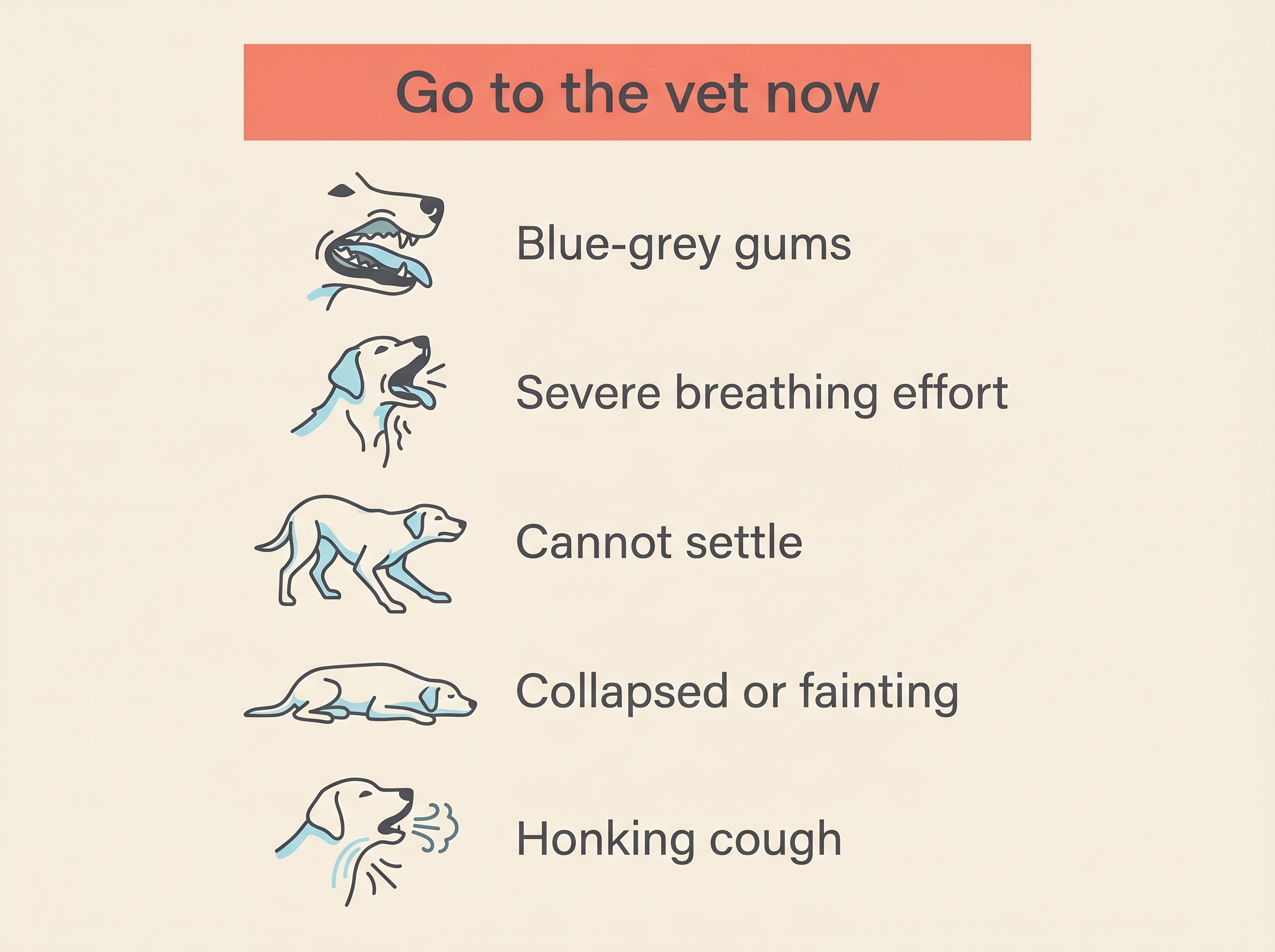
These are real events, not textbook curiosities: in that 2024 cohort, cyanosis was seen in 10.0%, difficulty breathing in 9.1% and fainting or collapse in 8.2% of cases (Kim et al., 2024). So the cardinal red flags for a coughing dog are worth committing to memory:
- Blue, grey or very dark gums or tongue.
- Severe or laboured breathing effort, or open-mouth gasping.
- A dog that cannot settle or lie down, standing with its elbows out and its neck extended.
- Collapse or fainting.
- A honking dog that cannot catch its breath between coughs.
Any one of these means you stop managing it at home and get to a vet now. If you'd value a clear yes-or-no in the moment, the breathing triage tool walks you through these same signs and tells you whether it's an emergency, a same-day call or something to settle and watch.
One quiet number can warn you a dog is labouring even between coughs. When your dog is asleep or resting calmly, count how many times the chest rises in a minute. Healthy dogs sit low, around 13 on average, with no healthy dog in one large study holding a sustained average above about 23 (Rishniw et al., 2012). A resting rate climbing over about 30, and especially over 40, warrants a vet call. One caveat worth knowing: that roughly 30-breaths threshold was validated in dogs with heart disease, not airway disease, where even dogs with well-controlled heart failure rarely sit above 30 at rest (Porciello et al., 2016). Treat it as a general resting-tachypnoea signal, not an airway-specific cut-off, because none exists. And don't let a "normal" number reassure you out of acting on the red flags, which always come first. The resting respiratory rate tracker makes the counting easy and keeps a record your vet can read.
Making the next one rarer
Once tonight has settled, the work shifts to making the next flare rarer and milder, and the biggest lever is weight, the most modifiable factor in the whole condition. The numbers are striking. In the original survey, conservative management built around weight loss, trigger control and cough suppressants resolved signs for over 12 months in 71% of cases (White & Williams, 1994). Tappin's review puts the wider picture at 71 to 93% of dogs responding well to medical management for more than a year (Tappin, 2016), and a 2024 cohort saw 86.6% improve on weight reduction, environmental changes and medication (Kim et al., 2024). In a small dog, even half a pound off can make a real difference (The Animal Medical Center, n.d.). So the large majority of dogs, around 70 to 90%, improve with good medical management (American College of Veterinary Surgeons, n.d.), and keeping your dog lean is the highest-yield thing you can do, said without a shred of judgement about how the weight got there.
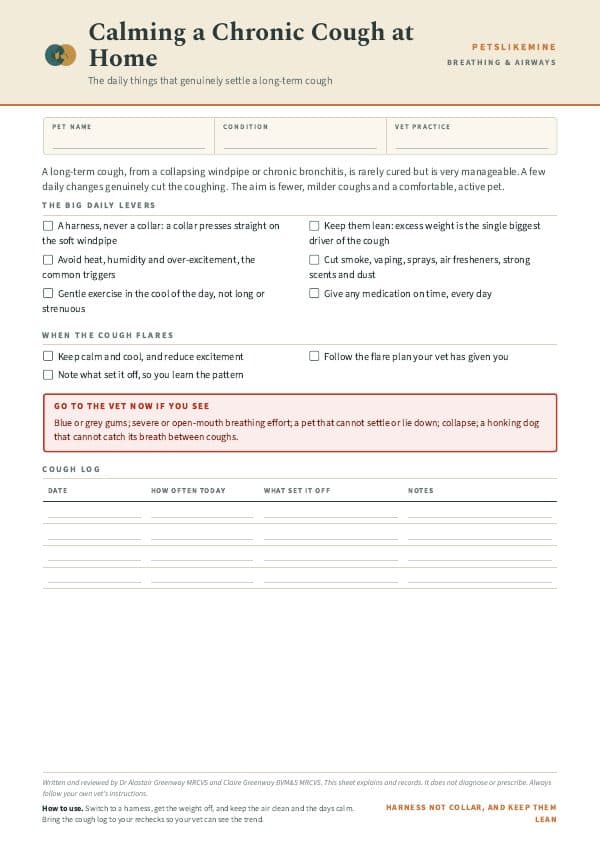
The other daily levers are the mirror image of the triggers: harness not collar, avoid heat and humidity and smoke, keep excitement manageable, keep the home cool and calm. When specialists were surveyed on how they manage the stable, coughing dog, this is exactly where they land too, on weight, trigger control and antitussives, while keeping an eye on the other conditions that travel with tracheal collapse (Carr et al., 2023). The everyday routine in detail lives in calming a chronic cough at home, and the chronic cough home-management download puts the whole lot on one sheet for the fridge.
Logging flares so the pattern speaks
One last habit that quietly changes outcomes. Write each flare down: the date, the trigger, how bad it got, how it settled, and any rescue medication. The airway diary is built for exactly this. A single flare tells you little, but a run of them tells you a great deal. If your log shows flares creeping closer together, hitting harder, or settling less readily, that is the signal the current plan needs revisiting, because tracheal collapse is a progressive condition (Tappin, 2016). It is also what, in a small number of dogs whose flares stay severe and uncontrolled despite good medical management, opens the question of a stent, which belongs to its sibling, collapsing trachea, stent or medication. Your diary is the evidence that lets you have that conversation at the right time rather than too late.
For tonight, though, the picture is more hopeful than it feels with a coughing dog on your lap. Most flares settle with the simple things: cool, calm, quiet, harness, and the medication your vet has already given you. You now know the handful of signs that change the plan from settle-and-watch to go-now, and that knowledge is what lets you stay calm the rest of the time. Keep the red-flag list somewhere you'll find it at 2am, keep your dog lean and cool, and let your flare log keep the next one smaller than the last.
References
- American College of Veterinary Surgeons. (n.d.). Tracheal Collapse. Retrieved from
- Carr, S. V., Reinero, C. R., Rishniw, M., & Pritchard, J. C. (2023). Specialists' approach to tracheal collapse: survey-based opinions on diagnostics, medical management, and comorbid diseases. Journal of the American Veterinary Medical Association, 261(1), 80-86.
- Cornell University College of Veterinary Medicine, Riney Canine Health Center. (n.d.). Tracheal Collapse. Retrieved from
- Kim, M.-R., Kim, S.-H., Ryu, M.-O., Youn, H.-Y., Choi, J.-H., & Seo, K.-W. (2024). A retrospective study of tracheal collapse in small-breed dogs: 110 cases (2022-2024). Frontiers in Veterinary Science, 11, 1448249.
- MSD Veterinary Manual. (n.d.). Clinical Signs of Respiratory Disease in Animals. Retrieved from
- Porciello, F., Rishniw, M., Ljungvall, I., Ferasin, L., Haggstrom, J., & Ohad, D. G. (2016). Sleeping and resting respiratory rates in dogs and cats with medically-controlled left-sided congestive heart failure. The Veterinary Journal, 207, 164-168.
- Rishniw, M., Ljungvall, I., Porciello, F., Haggstrom, J., & Ohad, D. G. (2012). Sleeping respiratory rates in apparently healthy adult dogs. Research in Veterinary Science, 93(2), 965-969.
- Tappin, S. W. (2016). Canine tracheal collapse. Journal of Small Animal Practice, 57(1), 9-17.
- The Animal Medical Center. (n.d.). Tracheal Collapse in Dogs. Retrieved from
- White, R. A. S., & Williams, J. M. (1994). Tracheal collapse in the dog - is there really a role for surgery? A survey of 100 cases. Journal of Small Animal Practice, 35(4), 191-196.
Free downloads
Companion worksheets to put what you've read into practice. Free PDFs, print at home.
Keep track of how your pet is doing
The owners who cope best are the ones who notice changes early. A simple health log shows you what is working, and what is not, before the next vet visit.
Start tracking, freeYou're not doing this alone
Compare treatment journeys and talk to owners managing breathing & airways. Free to join.
Join PetsLikeMine