


Canine Chronic Bronchitis: The Other Long-Term Cough
Alastair Greenway
BVM&S MRCVS
A small, greying dog who coughs most mornings, after a nap, the moment they get up to greet you at the door. Not a one-off, not a kennel-cough fortnight that came and went, but a cough that's become part of the furniture. If someone has said the words "chronic bronchitis" to you, maybe alongside "we've ruled the heart out", this is what that actually means and what happens next.
Here is the real shape of it up front. Chronic bronchitis is a long-standing inflammation of the airways that makes the lining swollen and the mucus excessive, so the dog coughs to clear airways that are permanently a bit irritated and a bit gummed up (Kumrow & Rozanski, 2012). It is not an infection you'll cure with a course of tablets, and it's not the heart. It's a condition we manage rather than fix, and the reassuring part is that a well-managed dog can stay comfortable and happy with it for years.

What it actually is
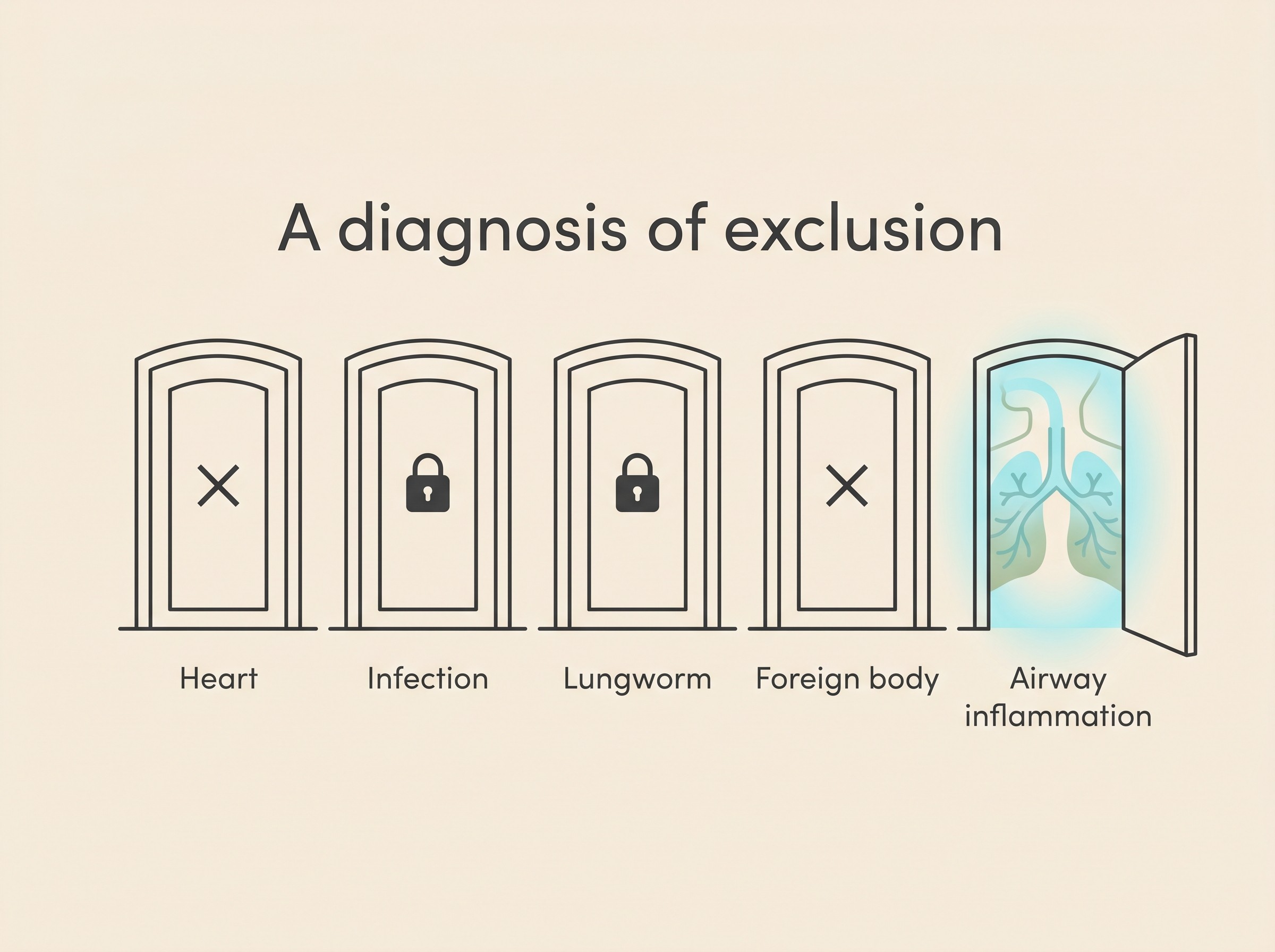
The formal definition is more useful than it sounds, because it tells you how vets think about this. Canine chronic bronchitis is "a cough that is present most days for a minimum duration of 2 months, without evidence of other underlying diseases that may cause cough" (Kumrow & Rozanski, 2012). That second half is the bit that matters: bronchitis is a diagnosis of exclusion. We don't reach it by finding a single positive test. We reach it by ruling the other causes of a chronic cough out, and what's left is airway inflammation.
Underneath the cough, the airway walls carry a non-infectious, mostly neutrophilic inflammation, paired with airways producing far more mucus than they should (Lyssens et al., 2025). That's the whole engine of the problem. The swelling narrows the tubes, the mucus clogs them, and the cough is the dog's attempt to shift it. Over enough time that constant irritation can leave permanent marks, things like bronchiectasis (airways stretched and bagged out of shape) and bronchomalacia (airways gone floppy and prone to collapsing), which is why getting on top of the inflammation early genuinely matters (Lyssens et al., 2025).
This is also where I have to level with you. By the time we're confident enough to call it chronic bronchitis, "in the majority of dogs, permanent changes are present in the airways at the time of diagnosis and the disease cannot be cured" (Kumrow & Rozanski, 2012). So the realistic goal is not a cure. It's to quieten the cough, slow the damage and keep your dog feeling well. That sounds like a downgrade until you watch it work, and most of these dogs do very well for a long time.
Which dogs get it, and the trachea question
There's a recognisable patient here. Chronic bronchitis turns up most in older, small-breed dogs, the terriers and toy breeds and their crosses, although larger dogs do get it too (Kumrow & Rozanski, 2012; MSD, n.d.). In a controlled study of dogs with chronic cough, the things that loaded the dice were "older age, smaller body weight, and being toy breed" (Hawkins et al., 2010). If you've got a thirteen-year-old Yorkie who coughs, you are squarely in the demographic.
And this cough is common. In a UK referral centre that worked up 329 chronically coughing dogs over nearly a decade, the two leading causes were airway collapse at 30.7% and chronic bronchitis at 24.3%, making bronchitis the second-commonest reason a dog ends up coughing for months (Blazquez et al., 2025). Those top two are not strangers to each other. Authoritative reviews go as far as describing tracheal collapse as best "considered an extension of chronic bronchitis rather than a specific entity localized only to the trachea" (Kumrow & Rozanski, 2012). In plain terms, the floppy windpipe and the inflamed lower airways are two ends of one spectrum, and in the same small old dog they very often travel together.
That overlap is exactly why so many of these dogs carry both labels, and it's why the day-to-day management looks so similar whichever one is leading. I'll not re-tread the goose-honk and the windpipe anatomy here, because the collapsing trachea explainer owns that story properly. If your dog's cough has that distinctive honking, party-horn quality, read that one alongside this.
Getting to the diagnosis
Because bronchitis is what's left after the alternatives are excluded, the work-up is mostly a process of ruling things out, and that's a feature, not vets being thorough for the sake of it. The big things we want off the table first are heart disease, an active infection, lungworm and an inhaled foreign body, because each of those needs completely different treatment (Kumrow & Rozanski, 2012). I won't reason through the "is it the heart or the lungs?" question here, because cough: heart or lungs? is built for exactly that fork and does it better than I could in a paragraph.
One caveat worth carrying: no cough sounds so distinctive that it diagnoses itself. The most prominent sign is spasms of coughing, often worse after rest, after a change of environment or at the start of exercise, and worse with a sudden change in the weather (MSD, n.d.; Hawkins et al., 2010). But "no historical description of cough was unique to a particular diagnosis" (Hawkins et al., 2010), which is precisely why we image rather than guess from the sound.
On chest X-rays we look for a bronchial pattern, the "donuts and tramlines" that thickened airway walls make on film (Kumrow & Rozanski, 2012). The definitive answer comes from bronchoscopy with a bronchoalveolar lavage, a wash of the lower airways, where the cells come back predominantly neutrophilic with excess mucus, and a culture or qPCR on the sample tells us whether any infection is in the mix (Kumrow & Rozanski, 2012; Lyssens et al., 2025). Not every dog needs the full scope, but knowing what it would show is what lets your vet treat the inflammation with confidence.
How it's managed
There is a lot we can do, and calming the inflammation is the backbone of it. "Glucocorticoids are the mainstay for treatment as they reduce inflammation, thereby reducing cough" (Kumrow & Rozanski, 2012). In the UK that usually means prednisolone, started in the region of 1 to 2 mg/kg a day and then tapered down to the lowest dose that keeps the cough quiet (Kumrow & Rozanski, 2012).
If long-term steroids worry you, you're in good company, and there's a modern answer that mirrors how we treat asthmatic cats: take the steroid straight to the airways and largely skip the rest of the body. The current steer for ongoing non-infectious bronchitis is inhaled glucocorticoid first-line, "fluticasone propionate by inhalation via a spacer, with a starting dose of 1 puff of 100 µg twice daily" for the smaller dogs this disease tends to affect (Lyssens et al., 2025). Plenty of small dogs take to a mask-and-spacer far better than owners expect, holding the chamber over the nose for several breaths after each puff.
A word on antibiotics, because owners often assume a chronic cough means a chronic course of them. It doesn't. Antibiotics are only warranted when infection is actually shown, typically intracellular bacteria sitting in the airway neutrophils on that lavage sample, and the first-line empirical choice is then doxycycline at 10 mg/kg once daily while culture comes back (Lyssens et al., 2025; MSD, n.d.). Reaching for them on spec doesn't help an inflammatory cough.
Cough suppressants and mucus-thinning drugs have a place, but it's a supporting one. A prescribed suppressant such as butorphanol or codeine can take the edge off a persistent, dry, non-productive cough, but the evidence for suppressants and mucolytics is "limited and inconclusive", so they sit as adjunctive, symptom-targeted treatments used case by case rather than the foundation (Lyssens et al., 2025; MSD, n.d.). And one firm safety line: never reach for a suppressant for a cough that's wet and productive, or one that might be infected, and never start one off your own bat. A productive cough is clearing the airway, and silencing it lets the gunk pool where you least want it.
Around the medication sit two daily levers that do real, measurable work. The first is weight. Carrying extra weight genuinely worsens how a dog breathes: obese dogs walk less far and hold lower blood-oxygen levels on exertion, and a controlled weight loss of around 20% measurably improved their exercise tolerance, restoring the distance they could comfortably walk in six minutes (Manens et al., 2014). Getting and keeping a coughing dog lean is one of the highest-yield things you can do, and I say that as a plain fact about airways, not a comment about you. The Weight Management home goes into the how. The second is keeping pressure off the throat: a harness, not a collar, because a collar presses straight on the windpipe of a dog whose airway is already touchy. We can even measure that pressure: pulling on a collar significantly raises the pressure inside the eye, where a harness does not, and exercising in a collar does the same, which tells you a collar puts real, avoidable load on the neck (Pauli et al., 2006; Bailey et al., 2025). Reducing smoke and other airway irritants is sensible too, framed as irritant control rather than proven cause, since the one study that looked hard at tobacco smoke couldn't statistically pin it as a risk factor (Hawkins et al., 2010). I'll leave the day-to-day detail of all this to calming a chronic cough at home, the proper home for the practical playbook.
Living with it, and what to watch
Chronic bronchitis is a slow, manageable condition, but it isn't a flat line. Flares happen, often when the weather turns or after a stressful change, and they tend to settle with a temporary bump in treatment under your vet's steer. If a cough that's been ticking along quietly suddenly gets dramatically worse, your dog tires fast, breathes hard at rest or the gums look blue or grey, that's no longer routine, and cough flare: when to act lays out exactly where the line is.
The single most useful habit between vet visits is counting the resting, sleeping breathing rate. Healthy dogs breathe at about 13 breaths a minute while they sleep and very rarely climb over 30, so a settled rate that creeps above 30, and especially one trending up over several days, earns a call (Rishniw et al., 2012). Be clear about what that number is: the threshold is best validated for heart failure, but it works well as a general "the airways are struggling more than usual" signal. The breathing rate tracker makes the counting easy, and pairing it with the Airway Diary to log how often and when your dog coughs turns a vague "I think he's worse" into a pattern your vet can use.
For the bigger picture of what the months and years ahead tend to look like, living with a long-term cough sets out what to expect.
References
- Bailey, M. E., Packer, M. J., & Wills, A. P. (2025). Effect of a collar and harness on intraocular pressure and respiration rate of brachycephalic and dolichocephalic dogs. Veterinary Medicine and Science, 11(3), e70384.
- Blazquez, C. A., Frahija, I. J., Smith, A., Miller, R., Seth, M., Garcia Manzanilla, E., & Valls Sanchez, F. (2025). Retrospective study of chronic coughing in dogs in a referral centre in the UK: 329 cases (2012–2021). Animals (Basel), 15(2), 254.
- Hawkins, E. C., Clay, L. D., Bradley, J. M., & Davidian, M. (2010). Demographic and historical findings, including exposure to environmental tobacco smoke, in dogs with chronic cough. Journal of Veterinary Internal Medicine, 24(4), 825–831.
- Kumrow, K. J., & Rozanski, E. A. (2012). Canine chronic bronchitis: A review and update. Today's Veterinary Practice, Nov/Dec 2012.
- Lyssens, A., Roels, E., Clercx, C., & Billen, F. (2025). Proposed treatment algorithms for dogs with chronic bronchitis associated with irreversible airway changes: Bronchiectasis and/or bronchomalacia. Frontiers in Veterinary Science, 12, 1686007.
- Manens, J., Ricci, R., Damoiseaux, C., Gault, S., Contiero, B., Diez, M., & Clercx, C. (2014). Effect of body weight loss on cardiopulmonary function assessed by 6-minute walk test and arterial blood gas analysis in obese dogs. Journal of Veterinary Internal Medicine, 28(2), 371–378.
- MSD Veterinary Manual. (n.d.). Tracheobronchitis (bronchitis) in dogs (Pet Owner version).
- Pauli, A. M., Bentley, E., Diehl, K. A., & Miller, P. E. (2006). Effects of the application of neck pressure by a collar or harness on intraocular pressure in dogs. Journal of the American Animal Hospital Association, 42(3), 207–211.
- Rishniw, M., Ljungvall, I., Porciello, F., Häggström, J., & Ohad, D. G. (2012). Sleeping respiratory rates in apparently healthy adult dogs. Research in Veterinary Science, 93(2), 965–969.
Keep track of how your pet is doing
The owners who cope best are the ones who notice changes early. A simple health log shows you what is working, and what is not, before the next vet visit.
Start tracking, freeYou're not doing this alone
Compare treatment journeys and talk to owners managing breathing & airways. Free to join.
Join PetsLikeMine