

Living With a Long-Term Cough: The Honest Long View
Alastair Greenway
BVM&S MRCVS
A long-term cough usually arrives with a name attached: collapsing trachea, or chronic bronchitis, or a bit of both. The diagnosis is in, the acute fright has passed, and your vet has started a plan. What the consult room rarely has time for is the question that comes next, once the dog is snoring beside you again and the immediate worry has settled. So what now? Is this the start of a long, slow goodbye, or a thing you simply live with? How many good years are you actually looking at?
That last question is what this page is for. Not what the condition is, not the daily routine, not the flare plan, but the long view: what the road ahead really looks like, what good control feels like when you get there, where the bumps come from, and how to tell a normal wobble from the trend genuinely shifting. A realistic picture is far kinder than either false cheer or quiet dread, and the headline, said plainly, is a good one.
A long road, not a countdown
Let me give you the reassurance most owners come here for, because you've earned it and the evidence supports it. With proper management, most dogs with chronic bronchitis enjoy a normal life expectancy and an excellent quality of life (VCA, n.d.). For collapsing trachea the picture is the same shape: it's a condition where the signs are proportional to the degree of collapse, ranging from mild airway irritation and a paroxysmal cough up to real distress, and most dogs respond well to medical management and to treating whatever else is going on alongside it (Tappin, 2016).
The numbers behind that are genuinely encouraging. In a modern cohort of small-breed dogs with tracheal collapse, clinical signs improved in 86.6% of them once weight reduction, environmental changes and medication were in place (Kim et al., 2024). The foundational UK survey, going right back, found that conservative medical management gave long-term resolution of signs, lasting beyond twelve months, in 71% of cases (White and Williams, 1994). So when I say good control is the normal outcome and not the lucky exception, I'm not softening anything. That really is the typical story.
I'll be straight about the other half too, because it's the half that lets the reassurance mean something. This is usually a slowly progressive condition, and the changes are permanent. For chronic bronchitis, in most dogs some lasting damage to the airways has already happened by the time we diagnose it, and the disease can't be cured, but with proper management the signs can usually be controlled and further damage can be slowed or stopped (VCA, n.d.; Kumrow and Rozanski, 2012). A collapsing windpipe is a structural change in the cartilage of the trachea, and medication calms it rather than rebuilds it (Tappin, 2016). So the goal is not a normal windpipe and not a cough-free dog. It's a comfortable, active dog whose cough is quieter, less frequent and held steady for years. Naming that plainly, early, is the kind thing, because it stops you measuring success against a finish line that was never on the table.
What good control actually looks like
Here's something I wish every owner heard on day one, because it saves so much needless worry: good control is not silence. It's fewer coughs and milder ones, and a dog who is getting on with life around them.
The modern data put real shape on this. After treatment in that cohort of small-breed dogs, the cough disappeared completely in only 10.0%, reduced but didn't vanish in 76.7%, and stayed similar or got worse in 13.3% (Kim et al., 2024). The great majority sit in that middle band, where the cough is still there but has been turned down. That's the realistic target, and it's a good one. A dog who gives the odd honk after an exciting visitor, or a little splutter on a frosty morning, but who eats, plays, sleeps soundly and trots about happily the rest of the time, is a well-managed dog, not a failing one.
So once you and your vet have settled into a plan, try to stop reading every single cough as a verdict. A cough here and there is the background hum of the condition, not an alarm. What matters is the pattern over weeks and months, and I'll come to how you actually see that pattern shortly.
Expect flares, and ride them out
You should expect flares. A relapsing course is completely normal and it does not mean the treatment has failed. Periodic relapses of coughing are common and are often triggered by a change of season or by poor air quality (VCA, n.d.; Kumrow and Rozanski, 2012). A muggy August week, the first cold snap, a bonfire down the road, any of these can stir things up for a few days.
The thing to hold onto is that a bad week is not the disease taking a step down. It's a bump on a long road, and the road carries on much the same on the other side. When a flare hits, you ride it out with the plan your vet has given you for exactly this. I'm deliberately not writing that flare playbook here, or listing the breathing-crisis red flags, because it's done properly in cough flare: when to act, which tells you what to do in the moment and where the line sits between a flare you manage at home and a breathing emergency that needs a vet now. Read it, keep it handy, and let it take the panic out of the bad days.
Weight creep: the quiet way the road gets steeper
If there's one thing within your control that decides how good the long view stays, it's your dog's weight, and it's worth saying clearly because it tends to happen invisibly.
Most of these dogs are already carrying too much. In that 2024 cohort, 97.2% had a body condition score of 4 or more out of 9, and a higher score was linked to worse collapse inside the chest (Kim et al., 2024). And weight isn't just a bystander, it actively makes the breathing harder: in obese dogs, losing weight measurably improved how far they could walk before tiring and how well they kept their blood oxygen up under exertion, where the heavier, obese dogs dropped their oxygen levels and ran a higher heart rate (Manens et al., 2014). In plain terms, a lean dog has more breathing room to spare, and that margin is exactly what a narrowed or inflamed airway is short of.
The trap over months and years is the slow creep: a little less exercise because the cough makes you cautious, the odd extra treat, and the weight drifts back up so gradually that nobody notices until the breathing is worse and the cause isn't obvious. So the single highest-yield thing you can do to keep the long view good is to stop the weight creeping back on. None of this is a criticism, weight is genuinely hard, and a coughing dog who can't exercise freely makes it harder. The how-to of getting and keeping a dog lean lives with calming a chronic cough at home and, for the proper structured programme, the Weight Management area. My job on this page is just to name weight creep as the thing to keep half an eye on for the rest of your dog's life.
Tracking the trend is how you see the long view
Here's the practical heart of living well with this, and it's the part most owners are never told. The cough waxes and wanes, and the x-ray grade doesn't actually predict how bad the cough is, in that cohort the location and grade of collapse didn't correlate with cough severity at all (Kim et al., 2024). So memory alone can't tell you whether things are holding steady or slowly drifting. "Is he about the same as last spring, or a bit worse?" is almost impossible to answer from recollection, because the day-to-day noise drowns out the slow signal.
So measure it. Logging your dog's cough over time, how often, how bad, what set it off, how they cope with exertion and what medication they're on, turns a vague worry into something you and your vet can actually look at and reason about. The Airway Episode and Exertion Diary is built for exactly this: it tracks the cough, the triggers, the exercise tolerance and the medication, with a heat-risk indicator for the warm days that hit these dogs hardest. As a quiet background companion, counting your dog's resting breathing rate now and then is worth doing too. The figure to keep in mind is that under about 30 breaths a minute at rest is normal, 30 or more is worth watching, and 40 or more warrants a call to the vet. Be realistic about that number, though: it's properly validated as a warning sign for heart disease rather than for airway disease (Porciello et al., 2016), so here it's a general background trend habit, not a diagnostic test. To understand what a rising rate might mean, and how to weigh heart versus airway, that question belongs to cough: heart or lungs?. A few months of diary entries is the difference between guessing at the trend and seeing it.
When to go back: a drift, not a single bad day
This is where tracking earns its keep, because it gives you a clear, calm trigger for a vet review rather than a hundred small panics.
The signal that it's time to step things up is a shift in the baseline, not one isolated cough. Go back when the normal-day picture has moved: more coughing on an ordinary day, less tolerance for the exercise your dog used to manage, needing the cough medicine more often, or new effort or noise when your dog is simply resting. That sustained drift is what earns a recheck and possibly a change of plan. It matters because a small minority of dogs do develop more severe, irreversible change over time, in chronic bronchitis this can mean bronchiectasis or bronchomalacia, and dogs whose airways become permanently dilated this way are left more prone to recurrent chest infections (Lyssens et al., 2025; Kumrow and Rozanski, 2012). Catching a genuine drift early gives the best chance of staying ahead of it. A single bad cough on a bad-air day is just the road being bumpy. A new, settled, lower baseline is the trend moving, and that's the one worth a phone call.
More than one thing going on at once
It helps to hold the demographic picture in your head, because it's realistic rather than gloomy. Chronic cough is largely a condition of older small-breed dogs, in the UK referral series the mean age was 8.4 years (Blazquez et al., 2025), and dogs this age commonly have more than one thing going on at once. Heart disease is the classic companion, sharing both the cough and a lot of the management (Carr et al., 2023). No single description of a cough is unique to one diagnosis, which is part of why tracking and regular vet review do real work over the years (Hawkins et al., 2010).
So the truthful long view often includes the sentence "we're looking after an older dog with a couple of things going on", and that's normal, not a crisis. It does mean the heart-or-lungs question can resurface as your dog ages, and when it does, cough: heart or lungs? is the place that untangles it. And if the day ever comes when the road genuinely turns, when management stops holding and the question becomes comfort and quality of life rather than control, that's its own conversation, handled gently in when breathing gets harder. I flag it only so you know it's there, not because it's where you are. Where you are, far more likely, is at the start of a long manageable stretch.
The road ahead
It's worth remembering, on the harder days, just how much time these diagnoses can buy. Even in the dogs that needed surgery, the group you'd expect to do worst, the outlook is long: in one series, dogs treated surgically for tracheal collapse had a median survival of 1,680 days, about four and a half years, after the operation, and for dogs with collapse confined to the neck the median wasn't even reached beyond 2,500 days (Becker et al., 2012). A separate group treated with an external support reported 86% still alive at 36 months (Suematsu et al., 2019). Those are surgical cohorts, the dogs whose breathing had got bad enough to need an operation, so they aren't a promise about every medically managed dog. But they tell you something true and steadying: this diagnosis is not a short clock.
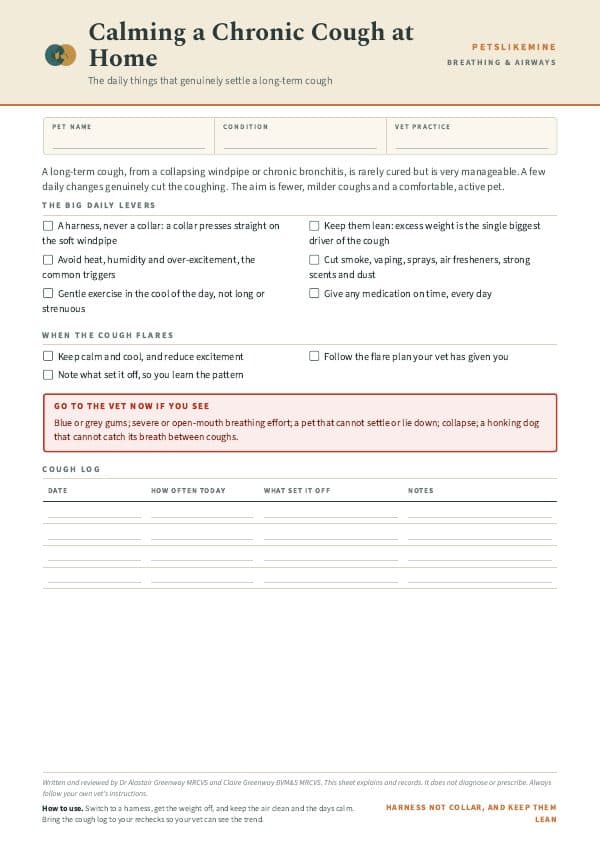
So picture the realistic version of the next few years. A harness instead of a collar, a lean and comfortable dog, a calm cool home, the vet's medication doing its job, and a cough that's quieter and less frequent than the one that frightened you into reading this. Flares come and go with the seasons and you ride them out. The job, your job, is simply to keep the trend steady and to notice, calmly, if it ever starts to drift. For the daily levers that hold all that in place, calming a chronic cough at home and the cross-condition living with a breathing condition are your companions, along with the practical chronic cough home management sheet. Start the diary today, even with one entry, so that next spring you can see the answer instead of guessing it.
This is a condition you live with and stay ahead of. It isn't one you count down.
References
- Becker, W. M., Beal, M., Stanley, B. J., and Hauptman, J. G. (2012). Survival after surgery for tracheal collapse and the effect of intrathoracic collapse on survival. Veterinary Surgery, 41(4), 501-506.
- Blazquez, C. A., Frahija, I. J., Smith, A., Miller, R., Seth, M., Garcia Manzanilla, E., and Valls Sanchez, F. (2025). Retrospective study of chronic coughing in dogs in a referral centre in the UK: 329 cases (2012-2021). Animals (Basel), 15(2), 254.
- Carr, S. V., Reinero, C., Rishniw, M., and Pritchard, J. C. (2023). Specialists' approach to tracheal collapse: survey-based opinions on diagnostics, medical management, and comorbid diseases. Journal of the American Veterinary Medical Association, 261(1), 80-86.
- Hawkins, E. C., Clay, L. D., Bradley, J. M., and Davidian, M. (2010). Demographic and historical findings, including exposure to environmental tobacco smoke, in dogs with chronic cough. Journal of Veterinary Internal Medicine, 24(4), 825-831.
- Kim, M-R., Kim, S-H., Ryu, M-O., Youn, H-Y., Choi, J-H., and Seo, K-W. (2024). A retrospective study of tracheal collapse in small-breed dogs: 110 cases (2022-2024). Frontiers in Veterinary Science, 11, 1448249.
- Kumrow, K. J., and Rozanski, E. A. (2012). Canine chronic bronchitis: a review and update. Today's Veterinary Practice, Nov/Dec 2012.
- Lyssens, A., Roels, E., Clercx, C., and Billen, F. (2025). Proposed treatment algorithms for dogs with chronic bronchitis associated with irreversible airway changes: bronchiectasis and/or bronchomalacia. Frontiers in Veterinary Science, 12, 1686007.
- Manens, J., Ricci, R., Damoiseaux, C., et al. (2014). Effect of body weight loss on cardiopulmonary function assessed by 6-minute walk test and arterial blood gas analysis in obese dogs. Journal of Veterinary Internal Medicine, 28(2), 371-378.
- Porciello, F., Rishniw, M., Ljungvall, I., Ferasin, L., Haggstrom, J., and Ohad, D. G. (2016). Sleeping and resting respiratory rates in dogs and cats with medically-controlled left-sided congestive heart failure. The Veterinary Journal, 207, 164-168.
- Suematsu, M., Suematsu, H., Minamoto, T., Machida, N., Hirao, D., and Fujiki, M. (2019). Long-term outcomes of 54 dogs with tracheal collapse treated with a continuous extraluminal tracheal prosthesis. Veterinary Surgery, 48(5), 825-834.
- Tappin, S. W. (2016). Canine tracheal collapse. Journal of Small Animal Practice, 57(1), 9-17.
- VCA Animal Hospitals. (n.d.). Chronic bronchitis / chronic obstructive pulmonary disease (COPD) in dogs. Retrieved June 2026 from
- White, R. A. S., and Williams, J. M. (1994). Tracheal collapse in the dog - is there really a role for surgery? A survey of 100 cases. Journal of Small Animal Practice, 35(4), 191-196.
Free downloads
Companion worksheets to put what you've read into practice. Free PDFs, print at home.
Keep track of how your pet is doing
The owners who cope best are the ones who notice changes early. A simple health log shows you what is working, and what is not, before the next vet visit.
Start tracking, freeYou're not doing this alone
Compare treatment journeys and talk to owners managing breathing & airways. Free to join.
Join PetsLikeMine