

Relapse: the signs, the timing, and what to do
Alastair Greenway
BVM&S MRCVS
If you're reading this while your cat is well, doing the daily checks and quietly terrified that the disease is going to come back, I want to start with the thing that matters most. Relapse is a real possibility, but it is not the likely outcome, and when it does happen it is very often treatable again. Knowing what to watch for is not a way of expecting the worst. It is the opposite. It lets you stop scanning your cat every hour, because you'll know what a genuine red flag actually looks like, and you'll know that most of the small wobbles you're worrying about are not it.
So let's take the fear and turn it into something useful: a clear picture of what a real relapse looks like, when it tends to happen, and exactly what to do if you see one.
How likely is relapse, really?
The honest number first, because a vague answer helps no one. In the largest UK real-world study of cats treated for FIP with legally sourced antivirals, 33 of 307 cats relapsed, which is 10.8% (Taylor et al., 2023). The current ISFM treatment update puts it the same way in plain terms: relapse is uncommon, under 10%, and tends to happen in the first few weeks after stopping treatment (ISFM, 2024).
Read those numbers the right way round. Roughly nine cats in ten who complete a proper course do not relapse at all. And of the small number who do, the great majority can be treated again. In that same UK study, most relapsing cats were re-treated and responded, either with an increased dose while still on treatment or with a fresh course afterwards (Taylor et al., 2023). Relapse is a setback, not a verdict.
There is one thing that genuinely reduces the risk, and it's worth saying here even though it belongs to the treatment phase: giving the full course, at a dose that kept pace with your cat's weight as they grew. Under-dosing, often because the dose was never raised as a growing kitten gained weight, is one of the things that lets the virus survive to come back later. If you're still in treatment, the weigh weekly, re-dose weekly habit is your single best insurance against ever needing this article.
It helps, too, to understand why relapse happens at all, because the reasons are mostly reassuring. A relapse usually means a pocket of virus was never fully cleared during the first course, whether because the dose ran a little behind the cat's growth, because the course was cut short, or because the virus had sheltered somewhere the medicine reaches less easily, like the brain or the eyes. None of those are "the treatment doesn't work". They're the reasons a completed, correctly dosed, full-length course matters so much, and they're also why re-treatment so often succeeds: a second, well-judged course gets the ground the first one missed.
When relapse tends to happen
Timing is what turns permanent dread into proportionate vigilance, so let's be specific.
Relapses cluster around the end of treatment and the weeks just after it. In the UK study, of the cats who relapsed after finishing their course, 15 of 18 (just over 83%) did so within 60 days of stopping the drug. A handful relapsed much later, at 90, 390 and even 450 days, but those late cases were rare (Taylor et al., 2023). The pattern the specialists describe is the same: the first few weeks off treatment are when the risk is highest (ISFM, 2024).
This is exactly why the 84-day observation window exists. Finishing the daily medicine isn't the finish line. The watching period afterwards is how a cat is shown to be truly clear rather than just held quiet by the drug, and it's front-loaded onto the very weeks when relapse is most likely. Your vigilance can be highest early and can ease as the weeks pass without incident. It does not have to stay at maximum for the rest of your cat's life.
The real red flags
A relapse tends to look like FIP announcing itself again, though not always in the same form it first took. The ISFM update makes the point that the signs of relapse can differ from the signs at first diagnosis. A cat who started with a swollen belly might relapse with neurological signs instead (ISFM, 2024). So watch the whole picture, not just a repeat of the original problem.
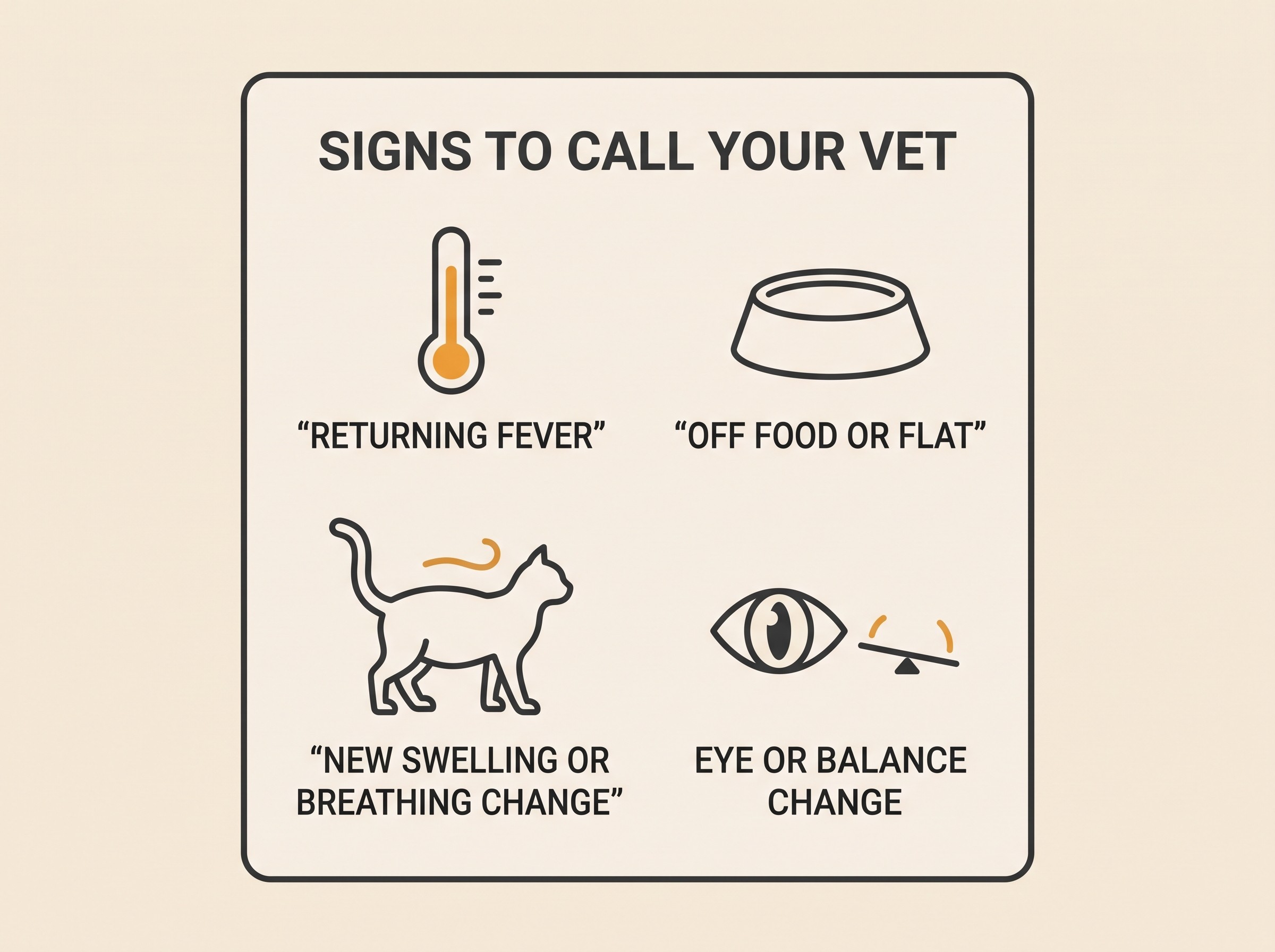
These are the signs that warrant a call to your vet:
- A returning fever. A temperature that climbs again, or a cat who feels hot, listless and "off" in the way they did before treatment worked.
- Dropping appetite or energy. Not one skipped meal, but a genuine, sustained fall in eating, or a cat who has quietly stopped being themselves for more than a day.
- Weight loss. Weight that starts to slide after it had been holding or climbing. This is one reason the weekly weigh-in stays useful into the observation window.
- New swelling. A belly that looks or feels distended again, or laboured breathing that could mean fluid in the chest. Fluid coming back is a clear reason to be seen.
- New eye or balance changes. A change in the colour or clarity of an eye, a cat who seems to have lost some vision, or any wobble, stumble, tremor, seizure, or sudden change in behaviour or personality.
That last group matters most, and it gets its own attention. Neurological and ocular relapse can happen even when the rest of the body looks well, because those parts of the body are harder for the medicine to reach. If you see anything neurological or a changed eye, treat it as urgent and contact your vet the same day. There's more on why these forms are different in neuro and ocular relapse: the barrier problem.
What is not a relapse
This half is just as important, because most of the frightening moments in the observation window turn out to be ordinary life.
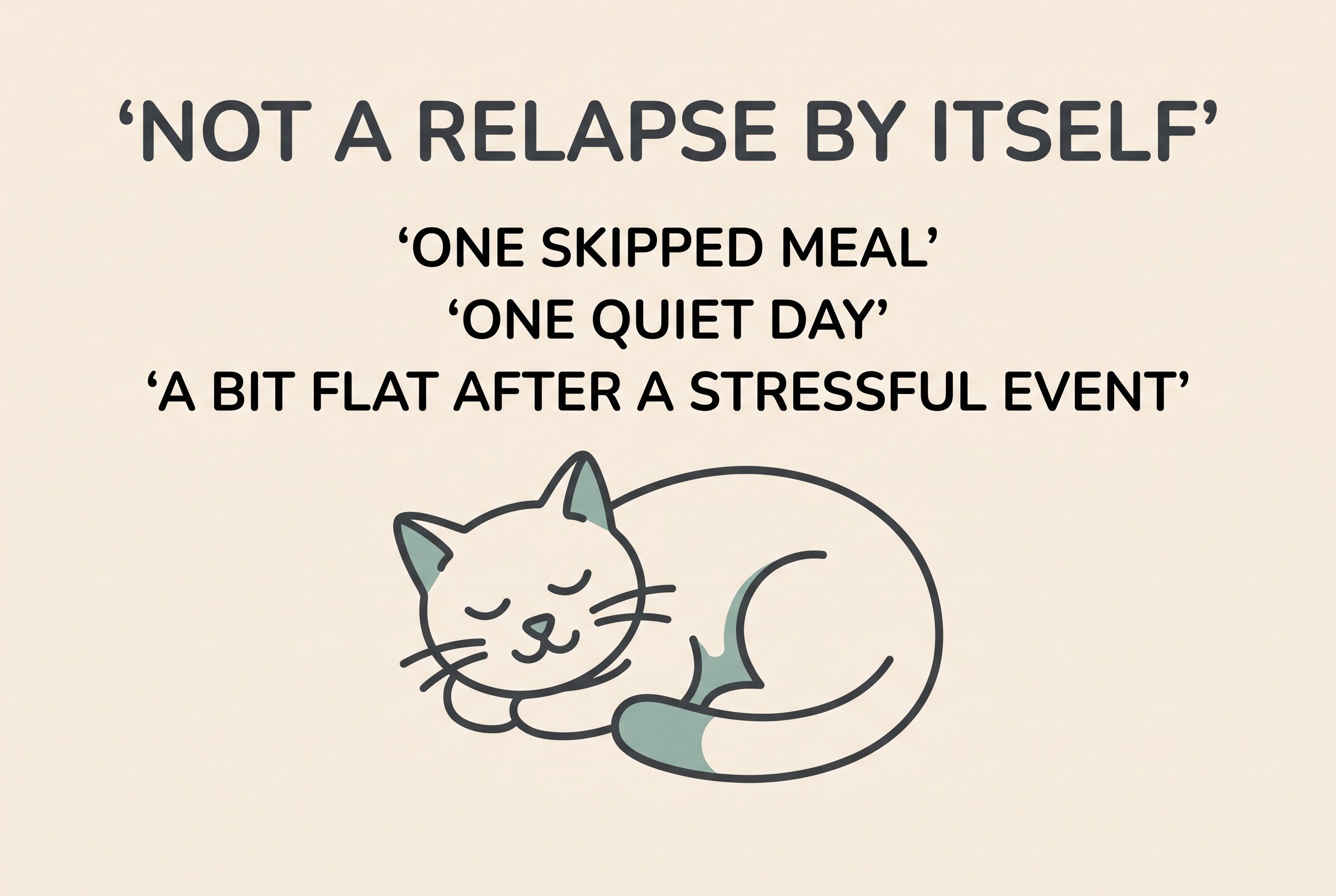
A single skipped meal is not a relapse. One quiet, sleepy day is not a relapse. A cat who is a bit subdued after a stressful car trip, a house move, or a vaccination is not relapsing. The ISFM update even notes that mild, temporary blips can occur after treatment ends without signifying relapse, as long as everything else stays normal (ISFM, 2024). Cats have off days for the same dull reasons we do.
The rule that will save your sanity is this: watch the pattern, not the moment. One data point is noise. A trend is a signal. A cat who eats a little less at breakfast but is bright, playful and eating normally by teatime is telling you nothing worrying. A cat whose appetite has genuinely fallen and stayed down for a couple of days, or who is losing weight, or who has developed any of the red flags above, is telling you something. This is exactly what the FIP Treatment Companion's observation-mode checklist is built to do: hold the record for you so you can see the trend clearly instead of trying to hold every anxious observation in your head.
What to do if you see a red flag
If something on the red-flag list appears, the plan is simple and calm.
Contact your vet. For most signs, promptly, within a day. For anything neurological or a changed eye, urgently, the same day, because the barrier forms respond best when caught early. You are not being a nuisance. Early contact is exactly what makes relapse treatable.
Log what you've seen. When it started, what changed, your cat's weight, appetite and demeanour over the last few days. If you've been using the Treatment Companion, that record is already there and it's genuinely useful to your vet.
Let your vet assess it properly. Confirming a relapse usually means repeating some of the steps from diagnosis: bloods to look at the markers that shifted before, sampling any new fluid, and imaging if needed (you may recognise these from reading the bloodwork and the bloodwork checkpoints). This is how your vet tells a true relapse from an unrelated illness that happens to look similar.
Do not adjust the dose yourself. This is the hard line. If your cat needs re-treatment, that is your vet's call, and the plan may involve a higher dose than before, splitting it into twice-daily doses, or a longer course, especially for neurological or ocular relapse (ISFM, 2024). There is real evidence behind this: in the UK study, most re-treated cats responded, and dose increases were a common and effective part of that (Taylor et al., 2023). But the right adjustment depends on which drug your cat is on, what dose they were at, and the nature of the relapse. It is not something to work out at the kitchen table. Never source medicine yourself or improvise a catch-up dose. The path is the same as it always was: your vet prescribes, through the legal UK route, and monitors.
It's worth knowing what those re-treatment odds actually look like, because they're better than most owners fear. In the UK study, of the cats who relapsed while still on treatment, most who had their dose increased responded well. Of those who relapsed after finishing, the majority who were given a fresh course responded too, with only a small number failing or relapsing again (Taylor et al., 2023). A relapse asks for a second effort, not a surrender. The cats it defeats are the exception, not the rule.
One more practical note, because it saves heartache: if your cat needs a repeat course, the weigh weekly discipline matters even more the second time around, and so does completing the full length your vet sets. The temptation, once a cat looks well again, is to stop early. Stopping early is exactly how a relapse becomes a second relapse. See it through.
The two things to hold onto
There are really only two jobs here. Know the red flags, so a real one gets caught early. Tell your vet promptly when you see one, so it can be treated while it's still eminently treatable.
Everything else is permission to breathe. The odds are with your cat. The window that worries you most is also the one your watching covers most closely. And catching a relapse early is not a failure on your part. It is the single thing that most makes a relapse survivable, and it's a thing you are already doing simply by reading this.
If you want to understand what "cured" will finally mean at the end of all this watching, is my cat cured? sets out the honest definition of remission and the day you get to stop counting.
References
- Taylor SS, Coggins S, Barker EN, et al. Retrospective study and outcome of 307 cats with feline infectious peritonitis treated with legally sourced veterinary compounded preparations of remdesivir and GS-441524 (2020–2022). Journal of Feline Medicine and Surgery 2023; 25(9). doi:10.1177/1098612X231194460
- Taylor S, Tasker S, Barker E, et al. An update on treatment of FIP using antiviral drugs in 2024 (living ISFM document, editions 2023/2024/2025). International Society of Feline Medicine / International Cat Care.
- Thayer V, Gogolski S, Felten S, et al. 2022 AAFP/EveryCat Feline Infectious Peritonitis Diagnosis Guidelines. Journal of Feline Medicine and Surgery 2022; 24(9): 905–933. doi:10.1177/1098612X221118761
Free downloads
Companion worksheets to put what you've read into practice. Free PDFs, print at home.
Keep track of how your pet is doing
The owners who cope best are the ones who notice changes early. A simple health log shows you what is working, and what is not, before the next vet visit.
Start tracking, freeYou're not doing this alone
Compare treatment journeys and talk to owners managing feline infectious peritonitis (fip). Free to join.
Join PetsLikeMine