

"Is my cat cured?" What remission really means
Alastair Greenway
BVM&S MRCVS
You have almost certainly been waiting a long time to ask this question out loud, half afraid that saying it will jinx it. After 84 days of daily medicine and weeks more of watching an apparently-well cat like a hawk, you want someone to look you in the eye and say the word. Cured. So let me give you the straightest answer I can, which is warmer than the caution around it might first suggest: the great majority of cats who complete a full course and come through the observation window go on to live normal, healthy lives, and at the end of this process your vet can tell you your cat is very likely one of them.
What I can't do is hand you a single lab test that flashes "cured" like a green light. That's not because the news is bad. It's because "cured" in FIP is something a cat earns over time, by staying well, rather than something a machine declares in a moment. Let me explain what your vet is actually looking for, and when you get to stop counting.
Why there's no "cured" test
FIP was never confirmed by one tidy test, and the same is true at the other end of the journey. There's no blood result that reads "virus gone, all clear". Instead, remission is a picture built from several pieces all pointing the same way, held steady over time.
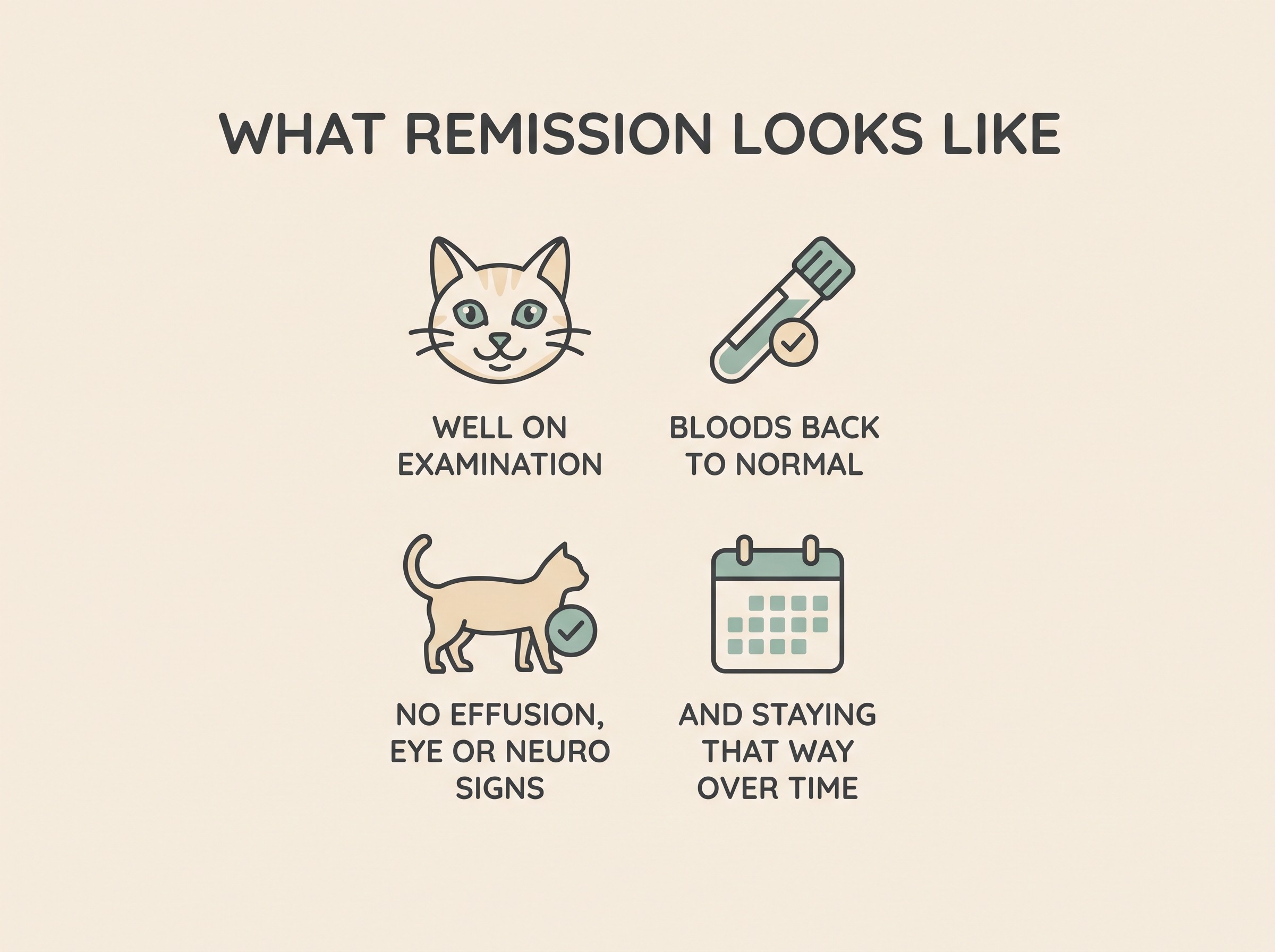
In the research that has followed treated cats most carefully, successful treatment is defined as a cat with unremarkable clinical and neurological examinations, blood counts and biochemistry mostly back in the normal range, no sign of effusion or ocular or nervous-system disease, and no detectable viral genetic material in the blood (Zwicklbauer et al., 2023). Read that back and you'll notice what it is: not one dramatic result, but the quiet absence of everything that was wrong, confirmed across the whole cat, and then confirmed again later.
That "and then again later" is the heart of it. A cat can look well on any given day. Remission is looking well and staying well, which is exactly why the 84-day observation window after treatment exists. It isn't bureaucratic caution. It's the test itself. Time is the instrument.
If it feels frustrating that medicine can't just scan your cat and pronounce them clear, you're not wrong to want that, and researchers want it too. There's ongoing work on markers that might one day give a cleaner signal of remission, such as tracking specific inflammatory proteins in the blood as they normalise (ISFM, 2024). But for now the most reliable readout we have is your cat's own body over time: bloods returning to normal and staying there, weight held, energy back, and no return of the disease across the weeks of watching. It's a slower answer than a single test, but it's a trustworthy one, and it's the same evidence your vet is weighing.
What "in remission" actually means
When your vet uses the word remission, they mean your cat's FIP is inactive and there is no evidence of the disease. It is the right and accurate word, and it is very good news. It's worth understanding why vets tend to say "remission" rather than leap straight to "cured", because the distinction is precise rather than gloomy.
"Cured" implies we can promise the disease will never return, for the rest of your cat's life. "In remission" says the disease is beaten and gone quiet, with no sign of it, which is what we can actually see and stand behind. In practice, for a cat who completes the observation window well, the two are almost the same thing, and many vets and owners will happily use "cured" once enough clear time has passed. The specialists put it plainly: because these drugs have only been available since late 2021, we don't yet have decades of data to say for certain that every cat who appears cured stays that way lifelong, but the results so far are very encouraging (ISFM, 2024).
I want you to hear the balance in that sentence, not just the caution. "We don't have decades of data yet" is not a warning that your cat is likely to relapse. It's simply an honest statement that this treatment is young. The cats followed most closely have done remarkably well.
What the follow-up data actually shows
This is where I can give you real reassurance with real numbers behind it.
In a study that followed cats in complete remission for up to a year after treatment, with repeat examinations, blood tests and viral testing along the way, not a single confirmed relapse occurred during that year. Blood viral loads stayed undetectable in all but one cat on one single occasion, laboratory results stayed stable, and the cats kept their normal weight and quality of life throughout (Zwicklbauer et al., 2023). These were cats living ordinary cat lives.
That sits alongside the wider picture. In the largest UK real-world study, around 84% of treated cats were alive at final follow-up, and relapse across the whole group was under 11%, most of it clustered in the weeks right after treatment stopped rather than spread across the years afterwards (Taylor et al., 2023). A systematic review pooling many studies put overall treatment success around 85% (Gokalsing et al., 2025). Put those together and the shape is clear: get through the course and the observation window, and the odds that your cat stays well are strongly in your favour.
One small footnote from that follow-up study, because you may hear about it and worry: a few cats started shedding feline coronavirus in their faeces again during the year. That sounds alarming, but it almost certainly reflects ordinary reinfection from other cats in the household with the common gut coronavirus, not FIP coming back (Zwicklbauer et al., 2023). Nearly all cats carry that harmless gut virus. It is not the same thing as active FIP, and it is covered more fully in can you prevent FIP?.
When do you get to stop counting?
The standard path is 84 days of treatment followed by 84 days of observation, and it's at the end of that observation window, with your cat well and their final checks clear, that your vet will most confidently talk about remission (ISFM, 2024). That's the day most owners let out the breath they've been holding for six months.
A word on duration, because it's changing and you deserve the current picture. The "84 plus 84" arc is the established standard, but it isn't a law of nature. UK and European researchers are actively studying shorter treatment courses, around 42 days, for some cats with effusive FIP, and early results are being examined closely (ISFM, 2024). What this means for you is simple: follow the plan your vet has set for your cat, and don't measure your cat's progress against someone else's day count online, because the protocols are genuinely in flux and your vet's plan reflects your cat's specific case.
There's no single national certificate or universal "all clear" appointment. What there is, is a conversation with your vet at the end of the observation window, looking at your cat and their final results together, where they tell you the disease is in remission and it's reasonable to start letting your cat just be a cat again.
Questions worth asking at that final check
Because there's no ceremony to it, some owners leave that appointment still unsure what they've actually been told, and the fog of relief doesn't help. It's worth going in with a few plain questions so you come away clear.
Ask your vet whether they're satisfied the observation window is complete and clear, and whether any final bloods or checks are still outstanding. Ask what, specifically, they'd want you to keep half an eye on, and for how long, so your watching can wind down rather than stop dead or drag on forever. Ask whether your cat needs any catch-up on routine care that was paused during treatment, like vaccination or neutering, and when. And ask the question you actually came for: in their view, is my cat in remission, and can I start treating them as a well cat? Hearing the answer said out loud, in response to your own question, tends to land in a way that a results printout never quite does.
If it helps, jot the answers down. In the weeks afterwards, on a wobbly day, being able to reread "my vet said she's in remission and I only need to watch for X" is genuinely steadying.
Living with "very likely" instead of "guaranteed"
I won't pretend the small residual uncertainty vanishes overnight. Plenty of owners find that even after the all-clear, they still flinch at a skipped meal for a while. That's normal, and it fades. The way through it is the same discipline that got you here: know the genuine signs of relapse so you can recognise a real one, and then trust yourself to stop scanning for it every hour. Watching the true red flags is what earns you permission to relax between them. Most owners find that a few months of steady wellness quietly does what no lab test could, and one day they realise they haven't worried in weeks.
There's a particular grief-shaped anxiety that can catch people off guard here, and it's worth naming so you don't think something is wrong with you. You spent months braced for bad news, and being braced becomes a habit. When the danger recedes, some owners feel not relief but a strange guilt for relaxing, as if lowering their guard might invite disaster back. It won't. Your vigilance never held the cure together; the treatment did that, and your cat's own recovery is doing the rest. Letting yourself enjoy your cat isn't tempting fate. It's the reward you both worked for, and it's safe to take it.
If a relapse ever does come, it's usually treatable again, often with a higher dose or a fresh course, and catching it early is exactly what makes it so (Taylor et al., 2023). So the vigilance you keep isn't a sign the cure is fragile. It's the insurance policy that lets you enjoy the cure.
The day your vet says remission, the honest, evidence-backed truth is this: your cat has beaten a disease that used to be a death sentence, the odds of them staying well are strongly in their favour, and it is entirely reasonable to plan a long, ordinary life together. What that life looks like, and the few small things worth knowing about a cured cat's future, is exactly what life after FIP is for.
References
- Zwicklbauer K, Krentz D, Bergmann M, et al. Long-term follow-up of cats in complete remission after treatment of feline infectious peritonitis with oral GS-441524. Journal of Feline Medicine and Surgery 2023; 25(8). doi:10.1177/1098612X231183250
- Taylor SS, Coggins S, Barker EN, et al. Retrospective study and outcome of 307 cats with feline infectious peritonitis treated with legally sourced veterinary compounded preparations of remdesivir and GS-441524 (2020–2022). Journal of Feline Medicine and Surgery 2023; 25(9). doi:10.1177/1098612X231194460
- Taylor S, Tasker S, Barker E, et al. An update on treatment of FIP using antiviral drugs in 2024 (living ISFM document, editions 2023/2024/2025). International Society of Feline Medicine / International Cat Care.
- Gokalsing E, Ferrolho J, Gibson MS, Vilhena H, Anastácio S. Efficacy of GS-441524 for Feline Infectious Peritonitis: A Systematic Review (2018–2024). Pathogens 2025; 14(7): 717. doi:10.3390/pathogens14070717
Free downloads
Companion worksheets to put what you've read into practice. Free PDFs, print at home.
Keep track of how your pet is doing
The owners who cope best are the ones who notice changes early. A simple health log shows you what is working, and what is not, before the next vet visit.
Start tracking, freeYou're not doing this alone
Compare treatment journeys and talk to owners managing feline infectious peritonitis (fip). Free to join.
Join PetsLikeMine