

Can you prevent FIP? The coronavirus-is-everywhere reality
Alastair Greenway
BVM&S MRCVS
If you are reading this, there is a fair chance you have already lived through an FIP diagnosis, and the question you are really asking is "how do I make sure this never happens again", either to the cat you have or to the next one. It is a completely natural thing to want, and you deserve a straight answer rather than either false comfort or a shrug.
So here is the honest shape of it. You cannot reliably prevent FIP, and no one can promise you a cat that will never develop it. What you can do is meaningfully lower the odds, and understanding why the guarantees stop where they do is genuinely freeing rather than defeating. Let us go through both halves properly.
Why there is no simple prevention: the virus is everywhere
To see why prevention has limits, you have to start with the virus. FIP does not spread from cat to cat as FIP. It develops when a common gut virus, feline coronavirus (FCoV), mutates inside an individual cat and changes its behaviour (Thayer et al., 2022). That common virus is extraordinarily widespread. In multi-cat households, catteries and shelters, somewhere between roughly half and nine in ten cats show evidence of having met it, and even many single, indoor cats have encountered it at some point (Thayer et al., 2022).
This is the "coronavirus is everywhere" reality, and it matters for two reasons. First, you cannot realistically keep a cat away from a virus this common, especially if it has ever lived with other cats. Second, and this is the crucial part, the harmful mutation that turns ordinary coronavirus into FIP happens spontaneously inside the cat. It is not something you can see coming, test for in advance, or block once a cat carries the virus (Thayer et al., 2022; Pedersen, 2019). There is no switch you can reach.
That is why prevention here is not like preventing a disease you can vaccinate away or keep out with a closed door. It is about reducing exposure and lowering risk, in a world where zero risk is not on offer. Accepting that honestly is the first step, because it stops you chasing a guarantee that does not exist and lets you focus on what actually helps.
Is there an FIP vaccine?
The short answer for UK owners is no, not in any useful sense. There is one FIP vaccine (an intranasal product, originally sold as Primucell), and it is not available or routinely used here. Even where it is available, it is considered non-core and is generally not recommended, for a very practical reason. It appears to be ineffective in cats that have already been exposed to feline coronavirus, and since most cats meet the virus young, especially in multi-cat settings, the window in which it might do anything is largely gone by the time you would use it (Addie et al., 2009; ABCD, 2022).
So if you were hoping the answer was "just vaccinate the next kitten", it isn't, and a vet not offering it is not withholding something useful. The real levers are elsewhere.
What genuinely lowers the risk
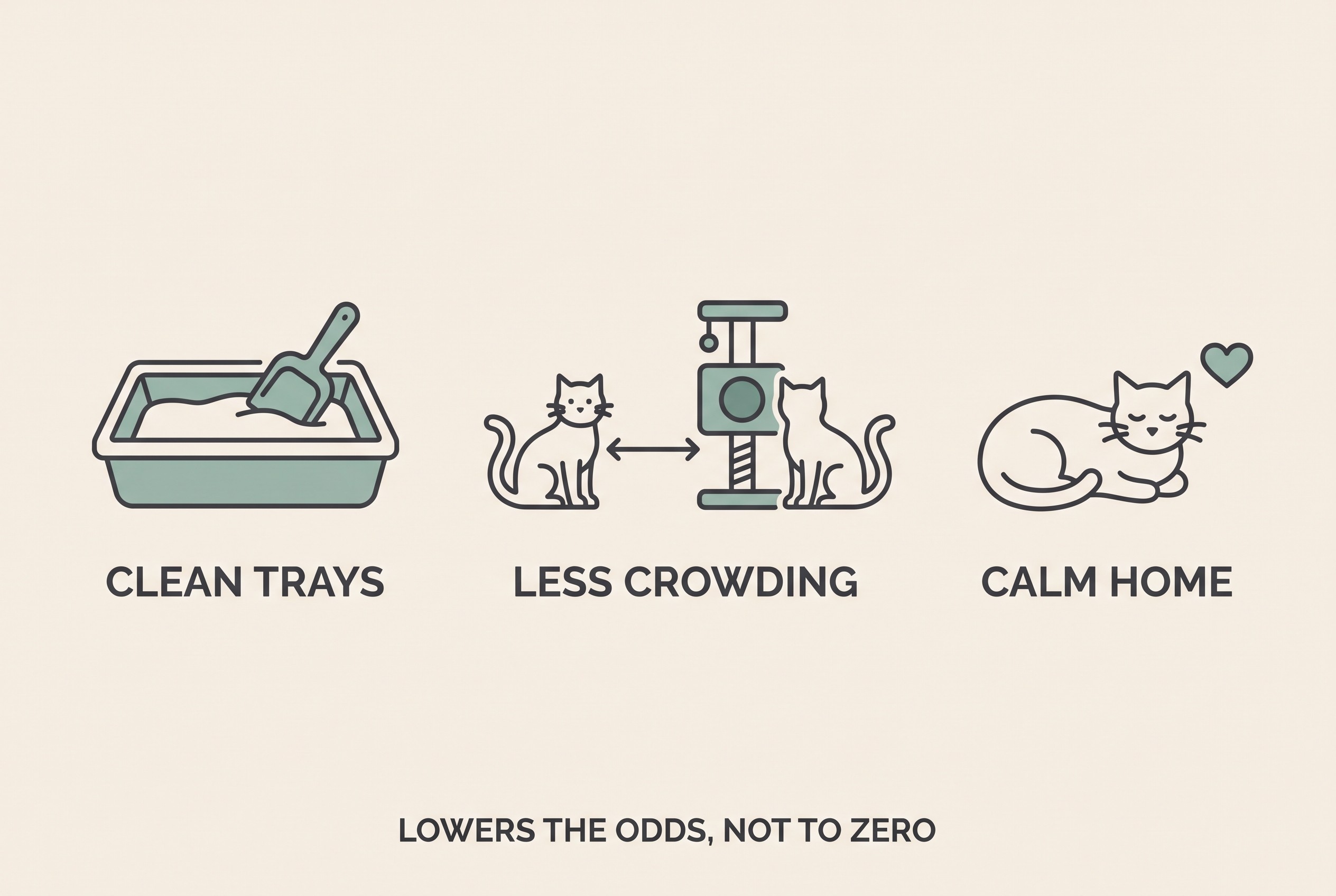
Now the encouraging half. While you cannot eliminate FIP, the same measures that keep the common coronavirus load down and keep cats calm do measurably reduce risk, and there is real evidence behind them (Thayer et al., 2022; Addie et al., 2009). These are worth doing, both for the cat you have and for any future cat.
- Litter tray hygiene, taken seriously. The virus travels the faecal-oral route, so trays are the front line. Provide one tray per cat, ideally one for every one or two cats, plus a spare. Scoop at least once a day, disinfect weekly, and keep trays well away from food and water. Vacuum around them, because tracked litter carries the virus.
- Avoid overcrowding. Fewer cats per household, with plenty of space, hiding places and vertical territory, means less virus circulating and less stress. If you are choosing how many cats to keep, this genuinely matters.
- Keep stress low. Stress seems to favour the harmful mutation, so a calm, predictable home with steady routines, gentle handling and quiet retreats is protective, not just pleasant (Addie et al., 2009).
- Introduce new cats slowly and thoughtfully. Sudden additions raise both stress and viral exposure. Take introductions at the cats' pace.
- Choose kittens with care. From the litter side, kittens from smaller groups, from breeders with good hygiene and honest records, and from lines without a heavy FIP history carry a lower background risk. There is more on this in Breeders and FIP: what responsible breeders do.
There is also encouraging research showing that where a cattery or household manages to interrupt coronavirus shedding entirely, FIP can be prevented in that group, which underlines that the virus really is the lever (Addie et al., 2023). That level of control is hard to achieve in an ordinary home, but it tells you the direction of travel: less virus, less risk.
Does keeping a cat indoors prevent FIP?
This is a common hope, and it deserves a clear answer. Keeping a cat indoors does not, on its own, prevent FIP. The reason is that the virus behind it is not something a cat catches from the wider world so much as something it usually picks up early, in the litter tray, from its mother or from other cats it has lived with (Thayer et al., 2022; Addie et al., 2009). An indoor-only cat who has ever lived with other cats, or who came from a cattery, rescue or multi-cat home, has very likely already met the coronavirus, and a wall between it and the outdoors does nothing about that.
Where "indoors" does help is indirectly. A single, indoor cat in a settled home has a much lower background rate of carrying the virus, around one in seven, compared with the higher rates in group settings (Thayer et al., 2022), simply because it is not sharing litter trays and close quarters with a rotating cast of other cats. So fewer cats and a calm home matter far more than the front door itself. If you have one relaxed cat, you are already in the lower-risk group, not because it stays inside but because it is not part of a crowd.
The reassurance hiding inside the honest limits
It is easy to finish a piece like this feeling defeated, so hold the other half of the truth firmly. FIP is a rare outcome. Estimates put it at only around 0.3 to 1.4% of feline deaths, which means the overwhelming majority of cats, including the ones carrying coronavirus right now, never develop it at all. The picture you should carry is not of a lurking danger you failed to lock out, but of a rare event you can make a little rarer with ordinary good care.
And even the worst case is not what it was. If FIP ever did occur despite everything, the outlook has been transformed. It has gone from almost always fatal to usually treatable, legally and through your own vet, with roughly eight to nine in ten treated cats coming through in recent UK studies (Taylor et al., 2023). Prevention is worth doing, and it is no longer the only thing standing between your cat and the disease. That is a genuinely different world from the one the old internet describes.
After a case: should I do anything differently before the next cat?
If you have just lost a cat to FIP, or are treating one, and are thinking about the future, a few honest points help.
You do not need to strip and bleach your entire home before another cat arrives. Feline coronavirus does not survive well for long in the environment, and ordinary thorough cleaning plus good litter hygiene handles the meaningful risk (Addie et al., 2009). A sensible gap before introducing a new cat, along with a good general clean, is reasonable, and the timing is worth discussing with your vet rather than following a fixed internet rule.
It is also worth saying clearly, because the guilt runs deep here: a previous case of FIP does not mean you did something that needs fixing before you can safely have another cat. You can absolutely have another cat. The background risk for a new, unrelated cat in a well-run home is low, and the steps above are about nudging it lower, not atoning for the last one.
Where honesty and hope meet
Here is the balance to hold. Preventing FIP with certainty is not possible, because the virus is common and the mutation that causes the disease happens unpredictably inside the cat. That is not a failure on your part, and it is not something to keep hunting for a workaround to. At the same time, FIP is rare as an outcome, the sensible measures above genuinely lower the odds, and, if it ever does happen again, the picture is nothing like it used to be. FIP has gone from almost always fatal to usually treatable, legally and through your own vet, in the space of a few years.
So prevention is worth doing, and it is not the only line of defence anymore. If forum posts and half-remembered old advice are muddying all of this for you, sort the truth from the myths here: FIP myths vs facts in 2026. If your worry is really about the other cats in your home, read FIP and your other cats: is it contagious?. And to understand why busy homes and shelters see more of it, without the guilt, see Multi-cat homes, shelters and stress as a trigger.
The one concrete thing to do today is the least dramatic: sort out your litter trays, calm your household, and give yourself permission to stop searching for a guarantee that was never available. That is prevention done honestly, and it is enough.
References
- ABCD (2022). Feline Coronavirus and Feline Infectious Peritonitis: ABCD Guidelines. European Advisory Board on Cat Diseases.
- Addie, D. et al. (2009). Feline infectious peritonitis: ABCD guidelines on prevention and management. Journal of Feline Medicine and Surgery, 11(7), 594-604.
- Addie, D.D. et al. (2023). Stopping feline coronavirus shedding prevented feline infectious peritonitis. Viruses, 15(4), 818.
- Pedersen, N.C. (2019). A review of feline infectious peritonitis virus infection: 1963-2008 and updates on diagnosis and treatment. UC Davis.
- Taylor, S.S. et al. (2023). Retrospective study and outcome of 307 cats with feline infectious peritonitis treated with legally sourced veterinary compounded preparations of remdesivir and GS-441524 (2020-2022). Journal of Feline Medicine and Surgery, 25(9).
- Thayer, V., Gogolski, S., Felten, S., Hartmann, K., Kennedy, M. and Olah, G.A. (2022). 2022 AAFP/EveryCat Feline Infectious Peritonitis Diagnosis Guidelines. Journal of Feline Medicine and Surgery, 24(9), 905-933.
Keep track of how your pet is doing
The owners who cope best are the ones who notice changes early. A simple health log shows you what is working, and what is not, before the next vet visit.
Start tracking, freeYou're not doing this alone
Compare treatment journeys and talk to owners managing feline infectious peritonitis (fip). Free to join.
Join PetsLikeMine