


FIP myths vs facts in 2026
Alastair Greenway
BVM&S MRCVS
FIP has one of the worst information problems in all of cat medicine, and it is not your fault that you feel lost. The disease was a near-certain death sentence for decades, then it changed almost overnight, and the internet has not caught up with itself. So you can search for two hours and come away with three different stories: that your cat will definitely die, that the only cure is illegal and comes from a stranger on Facebook, and that you must isolate or even put down your other cats. Frightened people at 2am absorb all of it at once.
Let us clear the fog. Below are the myths that do the most harm right now, each answered with the current veterinary line and, where it matters, a citation you can take to your own vet. Nothing here is a lecture, and there is no judgement in it. If you have been reading the black-market forums, you were doing exactly what a desperate, loving owner does. The point is simply to get you onto the ground that is true.
Myth: "FIP is always fatal. There's nothing you can do."
Fact: FIP is now usually treatable, and most treated cats survive.
This is the single most damaging out-of-date belief, and it is the one keeping people from even trying. Until a few years ago it was true, which is why almost everything written before about 2020 is so bleak. It is no longer true. Antiviral treatment based on GS-441524 changed FIP from almost always fatal to usually curable.
The real-world figures are genuinely encouraging. In a UK study of 307 cats treated with legally sourced antivirals, around 84% were alive at the longest follow-up point (Taylor et al., 2023). A systematic review of studies from 2018 to 2024 found pooled survival of roughly 85% (Yin et al., 2025). In prose, it is fair to say that with treatment, roughly eight to nine in ten cats come through. That is not a promise for any one cat, and it is not cheerleading, it is what the evidence now shows. If someone tells you FIP is a death sentence, they are describing a world that ended a few years ago.
Myth: "The treatment is illegal. You have to buy it on the black market."
Fact: FIP treatment is legal in the UK, and your own vet can prescribe it.
This myth is the direct fossil of the recent past, and it is the one we most want to correct. In the years before legal access, owners genuinely did have to source unlicensed medicine themselves, which is why the forums, the "brands" and the informal groups exist. That era shaped everything you are reading, and it is over.
In the UK, vets have been able to prescribe antiviral treatment for FIP legally since around 2020 to 2021, using compounded remdesivir (injectable) and GS-441524 (oral), supplied through the veterinary compounding pharmacy Bova, under the prescribing cascade for unlicensed medicines (Taylor et al., 2023; Bova, 2023). This is not a specialist-only route and it is not a grey area. Any vet can prescribe it.
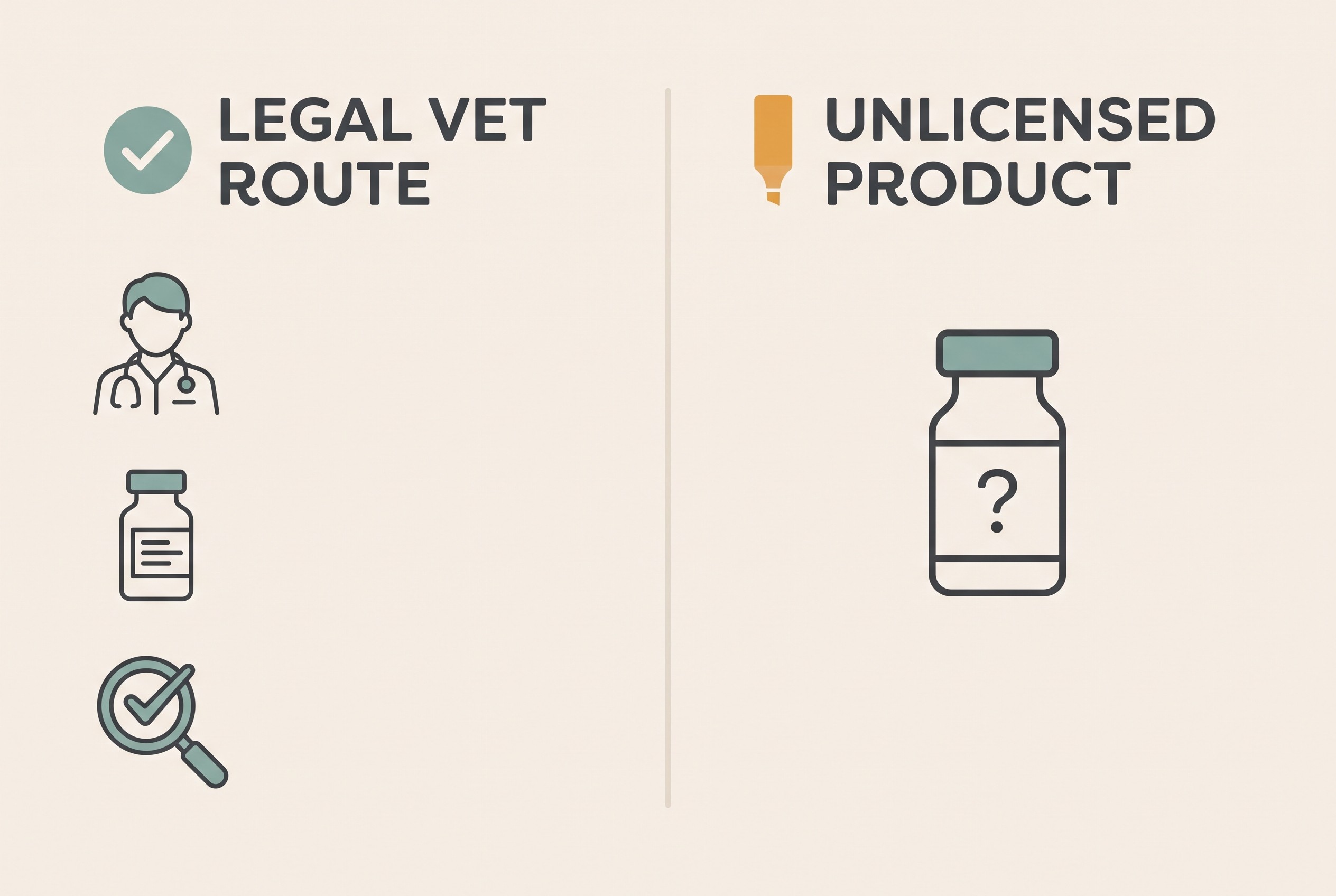
Your path is simple and entirely legal: your vet diagnoses, your vet prescribes, the medicine is dispensed through the legal supply chain, and your vet monitors your cat through treatment. There is no need to break any law, and no need to trust a stranger, to save your cat. The full explainer is here: FIP is treatable now: the legal UK route.
Myth: "The Facebook-group medicine is the same thing and cheaper, so it's fine."
Fact: unlicensed product is unregulated, and there is real evidence it often is not what it claims to be.
We are going to be straight with you here, and kind, because this is where fear and money collide. When people talk about "brands" of GS-441524 sold through online groups, they are describing unlicensed, unregulated product with no independent guarantee of what is in the vial. That is not a moral judgement of the owners who used it in the past, who often had no legal option. It is a factual point about the product.
And the facts are not reassuring. When researchers tested unlicensed products sold for home treatment of FIP, they found the amount of GS-441524 in them differed significantly from what was advertised, sometimes markedly (Coggins et al., 2024; Roy et al., 2024). In a disease where getting the dose right is the whole game, a vial that contains more or less than the label says is a genuine hazard, not a bargain. Legally prescribed product is made to a known standard, and your vet can dose and adjust it with confidence.
If cost is the reason the black market is tempting, please do not carry that alone. The legal route has real costs, and they can be frightening, but there are better routes through it than an unregulated vial. Talk to your vet frankly, check your insurance, and read our honest cost pieces: What FIP treatment costs in the UK and Does pet insurance cover FIP antivirals?. Cost being hard is not a moral failing, and it is not a reason to gamble on a vial no one has checked.
Myth: "FIP is contagious. I'll have to isolate or put down my other cats."
Fact: FIP is not passed from cat to cat, and your other cats do not need to be put down.
This myth causes real, needless heartbreak. FIP itself does not spread between cats. It develops when a common, usually harmless gut virus (feline coronavirus) mutates inside one individual cat (Thayer et al., 2022). Your other cats will not catch FIP from the cat who is unwell. They may already carry the ordinary coronavirus, as most cats in multi-cat homes do, but carrying it is normal and only a small minority of cats who carry it ever develop FIP (Thayer et al., 2022).
There is no basis for putting down healthy cats because one has FIP, and usually no need to isolate the sick cat away from its family for fear of contagion, though a quiet space to recover can help for other reasons. The full, reassuring detail is in FIP and your other cats: is it contagious?. If anyone has told you the rest of your household is doomed, that is simply not how this disease works.
Myth: "There's a vaccine, so I should just get my next cat jabbed."
Fact: there is no useful FIP vaccine in the UK.
There is a single FIP vaccine in existence (an intranasal product), and it is not available or routinely used here. Even where it exists it is considered non-core and generally not recommended, because it appears ineffective in cats that have already met feline coronavirus, which is most cats by the time you would use it (Addie et al., 2009; ABCD, 2022). So a vet not offering an FIP vaccine is following mainstream advice, not neglecting your cat. Prevention that genuinely helps is about hygiene, space and calm, covered in Can you prevent FIP?.
Myth: "One blood test can confirm FIP" (or "a swollen belly means it's definitely FIP").
Fact: there is no single test that confirms FIP, and the signs overlap with other illnesses.
FIP is diagnosed by building a picture from several pieces, the cat's age and story, bloodwork patterns, sampling any fluid, imaging and sometimes PCR, weighed together by your vet (Thayer et al., 2022). No single blood test says "yes, FIP", and a swollen abdomen, while a classic sign, can have other causes. This cuts both ways: it means "consistent with FIP" is how a careful vet honestly talks, and it means you should be wary of anyone, online or otherwise, who diagnoses your cat with certainty from a photo or a single number. There is more on this in Is it FIP? Why there's no single test.
Myth: "Dry FIP and neuro FIP can't be treated."
Fact: the non-effusive, ocular and neurological forms are treatable too.
Older information often wrote off the "dry", ocular and neurological forms as hopeless. They are harder, because the virus can hide in the eye and nervous system behind barriers that medicine has to work harder to cross, and they often need a higher dose set by your vet (Taylor et al., 2023). But treatable they are, and cats with these forms do recover. If your cat has a dry, ocular or neurological presentation, that is a reason to work closely with your vet on the plan, not a reason to give up.
Myth: "Once the 84 days of treatment are done, my cat is cured."
Fact: finishing treatment is not the same as being cured, and that waiting period is doing a job.
The standard course is around 84 days of daily treatment followed by roughly 84 days of observation off the medicine, and it is that observation window, not the last dose, that shows a cat is truly clear rather than merely suppressed (Taylor et al., 2023). Duration is under active study and may change, so your vet's plan is the one to follow. Believing the cat is cured at day 84 leads people to relax too early. Understanding the window lets you finish the job calmly. When you get there, The 84-day observation window walks through it.
A last word, without judgement
If several of these myths were things you believed an hour ago, you are in completely normal company, and it says nothing bad about you. This is a disease whose whole reality flipped in a few short years, and the old story is louder online than the new one purely because it has been there longer. Every owner who ever turned to a forum or a group did so out of love and a lack of options, and none of that is a thing to be ashamed of.
What has changed is that you now have a better option, and it is the calm, legal, vet-led one. So the single next step is not to keep reading conflicting posts. It is to speak to your own vet about legal treatment, and if you are worried they may not yet be familiar with it, we will help you raise it well in How to talk to your vet about FIP treatment. The facts are steadier than the noise, and they are on your cat's side.
References
- ABCD (2022). Feline Coronavirus and Feline Infectious Peritonitis: ABCD Guidelines. European Advisory Board on Cat Diseases.
- Addie, D. et al. (2009). Feline infectious peritonitis: ABCD guidelines on prevention and management. Journal of Feline Medicine and Surgery, 11(7), 594-604.
- Bova UK (2023). The treatment of feline infectious peritonitis (FIP) in the UK. Bova.
- Coggins, S.J. et al. (2024). Unlicensed antiviral products used for the at-home treatment of FIP contain GS-441524 at significantly different amounts than advertised. Journal of the American Veterinary Medical Association, 262(4).
- Taylor, S.S. et al. (2023). Retrospective study and outcome of 307 cats with feline infectious peritonitis treated with legally sourced veterinary compounded preparations of remdesivir and GS-441524 (2020-2022). Journal of Feline Medicine and Surgery, 25(9).
- Thayer, V., Gogolski, S., Felten, S., Hartmann, K., Kennedy, M. and Olah, G.A. (2022). 2022 AAFP/EveryCat Feline Infectious Peritonitis Diagnosis Guidelines. Journal of Feline Medicine and Surgery, 24(9), 905-933.
- Yin, Y. et al. (2025). Efficacy of GS-441524 for feline infectious peritonitis: a systematic review (2018-2024).
Keep track of how your pet is doing
The owners who cope best are the ones who notice changes early. A simple health log shows you what is working, and what is not, before the next vet visit.
Start tracking, freeYou're not doing this alone
Compare treatment journeys and talk to owners managing feline infectious peritonitis (fip). Free to join.
Join PetsLikeMine