

FIP and your other cats: is it contagious?
Alastair Greenway
BVM&S MRCVS
If you have just been told one of your cats has FIP, and you have others at home, there is a very good chance the first thing you did was look at the rest of them and feel your stomach drop. You are not being paranoid. It is the question almost every owner in a multi-cat home asks in the consult room, and it deserves a proper, calm answer rather than a rushed reassurance on the way out of the door.
So here is the short version, and then we will unpack it slowly. FIP itself is not spread from cat to cat like a cold. Your other cats will not "catch FIP" from the cat who is unwell. What they may already share is the common, usually harmless virus that sits behind it. That distinction is the whole story, and once it makes sense, most of the fear about your other cats becomes something you can actually manage.
The one thing to hold onto: FIP is not FIP-contagious
Nearly all cats, especially cats who live with other cats, carry a bug called feline coronavirus, usually written FCoV. This is not the same coronavirus that made headlines in people, and it is worth saying plainly that it does not spread to you or your family. In most cats it lives quietly in the gut and causes nothing worse than a bout of mild diarrhoea, or very often nothing you would ever notice (Thayer et al., 2022).
FIP happens when, inside one particular cat, that ordinary gut virus mutates and changes its behaviour. Instead of staying in the intestine, the changed virus gets inside the cat's own immune cells and spreads through the body. That mutation is an event that takes place inside the individual cat. It is not a new, more dangerous germ that then floats across the room to the cat on the next cushion (Thayer et al., 2022).
This is why two cats can sleep nose to tail for years, and if one develops FIP, the other does not develop FIP by having been near them. The illness is not passed between them. What can pass between them is the ordinary coronavirus that came first, and that is a much smaller worry than it sounds. Hold that line in your head, because everything else follows from it.
What can actually pass between your cats
The common feline coronavirus does move from cat to cat, and it does it in a very ordinary way. It is shed in the faeces and picked up by mouth, usually through shared litter trays, grooming and close contact (Thayer et al., 2022; Addie et al., 2009). In a home with more than one cat, it is genuinely normal for the virus to circulate. In fact, in multi-cat households, catteries and shelters, somewhere between roughly half and nine in ten cats show signs of having met the virus, compared with only around one in seven cats who live alone (Thayer et al., 2022).
Read that again, because it is reassuring rather than alarming. If your cats have been living together, the odds are that some or all of them have already encountered feline coronavirus long before FIP was ever mentioned. The exposure you are dreading may well have happened months or years ago, and they are fine. The virus being present is the normal background state of multi-cat life, not a countdown.
The step that turns that common virus into FIP is rare. Across multi-cat environments, only a small proportion of cats who carry the coronavirus ever go on to develop FIP, in the region of one in ten or fewer (Thayer et al., 2022; Cornell Feline Health Center, 2022). The mutation has to happen, in that cat, at that time, and most cats' bodies simply clear or contain the virus without any drama at all.
So what is the real risk to my other cats?
Let us be straight, because you deserve the true picture, not a pat on the head. Your other cats are not at risk of catching FIP. They may already carry, or may be exposed to, the underlying coronavirus, and a small number of cats who carry it can go on to develop FIP independently (Cornell Feline Health Center, 2022). That risk is not zero, but it is low, and importantly it is not raised by the sick cat "giving them FIP". It is the ordinary background risk that exists in any home where the common virus circulates.
There are a few things that nudge that background risk one way or the other, and knowing them helps you feel less helpless:
- Age. FIP most often strikes kittens and young cats, whose immune systems are still developing. An older, settled adult cat is at lower risk (Thayer et al., 2022).
- Stress and viral load. Crowding, big changes and a heavy amount of virus circulating seem to raise the odds of the mutation happening in a susceptible cat (Thayer et al., 2022; Addie et al., 2009). This is why the practical steps below focus on keeping the amount of virus down and life calm.
- Genetics and family. Cats closely related to an affected cat, particularly within some pedigree lines, may share a higher susceptibility. We cover this in more depth in Breeders and FIP: what responsible breeders do.
None of these turns a low risk into a high one on its own. They are the dials, not the switch.
Should I separate my cats?
This is where a lot of well-meaning internet advice goes wrong and leaves owners heartbroken, isolating a frightened, unwell cat away from its companions in its hardest weeks for no real benefit.
Here is the reasoning. By the time one cat has been diagnosed with FIP, the common coronavirus behind it has usually already had every chance to circulate through your household. Slamming the door between them now does not un-ring that bell, and it does not stop FIP, because FIP is not being handed from cat to cat in the first place (Thayer et al., 2022). Separating a sick cat who takes comfort from its family, purely out of fear of contagion that does not work the way it feels like it does, often costs more in welfare than it ever buys in safety.
There are sensible exceptions where a little separation helps, and they are practical rather than about FIP itself:
- A cat on treatment often needs quiet, warmth and undisturbed rest, and a calm space away from a boisterous housemate can genuinely help recovery.
- Keeping litter trays separate and scrupulously clean is worth doing to keep the general coronavirus load down for everyone (more on that below).
- If you are bringing a brand new kitten into a home that has just had a case of FIP, that is a conversation to have with your vet before you commit, not a decision to rush.
For the cats already living together, the usual answer is that they can stay together, with sensible hygiene, unless your own vet advises otherwise for a specific reason. Ask them. This is exactly the kind of judgement call your vet knows your household well enough to make with you.
Practical steps that genuinely help
If you want something to do with your hands while you worry, these are the measures that actually reduce how much of the common virus is circulating. They will not guarantee no other cat ever develops FIP, because nothing can, but they are sensible, kind and evidence-based (Thayer et al., 2022; Addie et al., 2009).
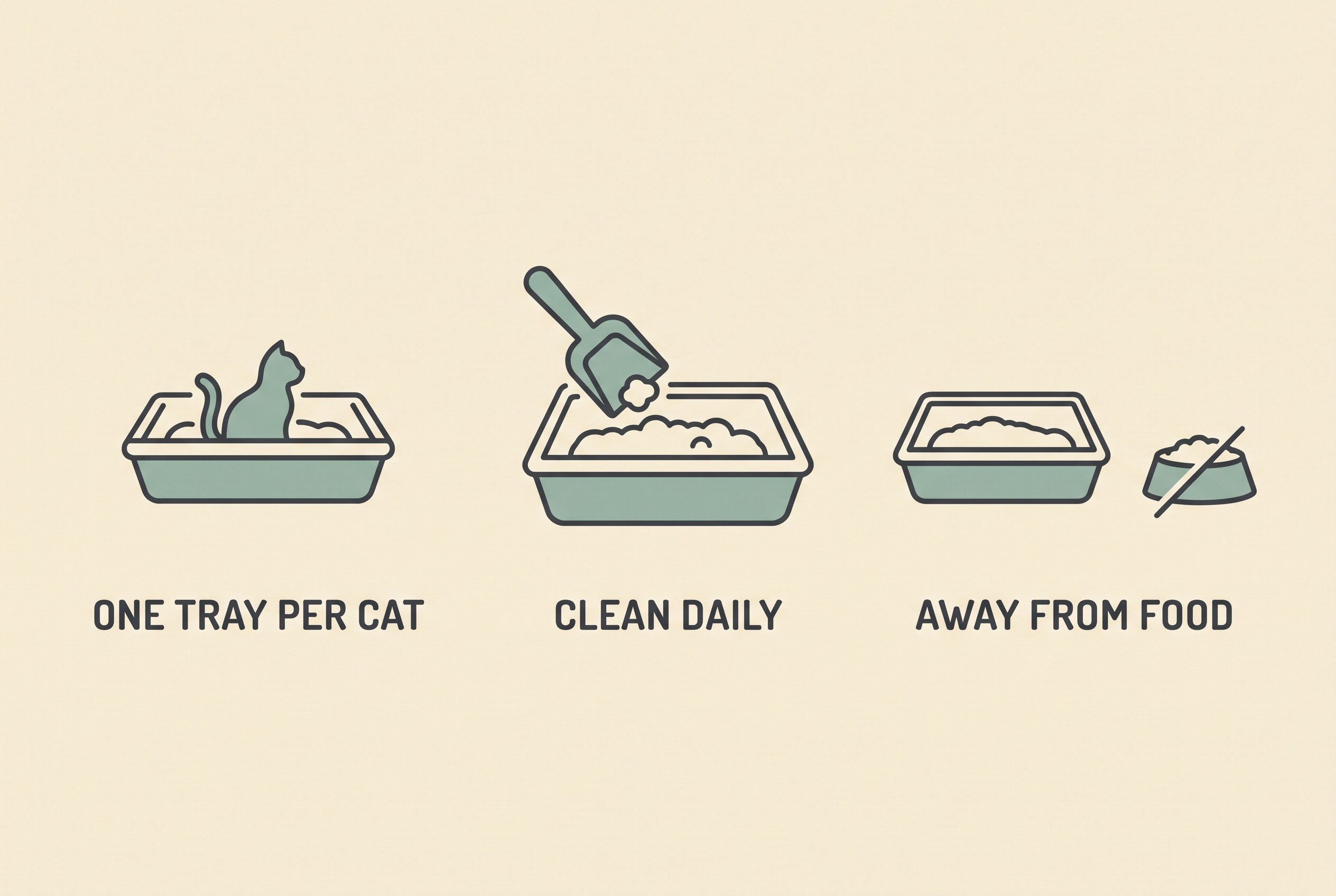
- Provide enough litter trays. The usual steer is one tray per cat, plus a spare, so ideally one for every one or two cats. Scoop at least once daily and disinfect the trays weekly.
- Keep litter well away from food and water. The virus travels the faecal-oral route, so trays near feeding stations make it easy for the virus to move around.
- Vacuum and wipe around trays. Litter tracked across floors carries virus with it.
- Keep the household calm. Stress matters here. A settled, unhurried home with hiding spots, vertical space and predictable routines is genuinely protective, not just nice to have.
- Do not rush a new arrival. If you were planning to add a cat, pause and talk it through with your vet first.
You do not need to bleach your entire house or throw out every soft furnishing. Feline coronavirus does not survive well for long in the environment, and ordinary household cleaning plus the litter measures above do the meaningful work (Addie et al., 2009).
What about testing my other cats?
Owners often ask whether they should have the rest of the household tested. It is a fair thought, and the honest answer is that it is more complicated than it looks. A blood test can tell you whether a cat has met feline coronavirus, but a positive result is common, expected in a multi-cat home, and does not predict which cat, if any, will ever develop FIP (Thayer et al., 2022). A cat can carry the virus, test positive and live a long, entirely healthy life.
For that reason, routine testing of your well cats is not usually recommended just because one cat has FIP. It rarely changes what you would do, and it can generate a frightening-looking result that means far less than it seems. Where testing does earn its place, for instance in a breeding cattery working to reduce the virus, your vet will guide a specific plan (Thayer et al., 2022). If a second cat in your home actually becomes unwell, that is a different situation and a reason to go back to your vet promptly, not a reason to test everyone today.
Where this leaves you
The picture is calmer than the one you probably arrived with. The cat who is unwell is not a danger to your other cats in the way you feared. FIP is not passed between them. The common virus behind it has usually already done its quiet rounds, most cats who carry it are entirely fine, and the sensible hygiene above keeps the odds where you want them.
So you can give your unwell cat the closeness and comfort it needs during treatment without feeling you are gambling with the others. If you want to understand why multi-cat homes and shelters see more of this common virus, and whether any of it was your fault (it almost certainly was not), read Multi-cat homes, shelters and stress as a trigger. And if your question is really "can I stop this happening again", that honest conversation is here: Can you prevent FIP?.
The next thing to do is simple. If any of your other cats seems off colour over the coming weeks, ring your vet rather than watching and worrying alone. For the cat in front of you, the job now is treatment and comfort, and you can give both without fear for the rest of your household.
References
- Addie, D. et al. (2009). Feline infectious peritonitis: ABCD guidelines on prevention and management. Journal of Feline Medicine and Surgery, 11(7), 594-604.
- Cornell Feline Health Center (2022). Feline Infectious Peritonitis. Cornell University College of Veterinary Medicine.
- Thayer, V., Gogolski, S., Felten, S., Hartmann, K., Kennedy, M. and Olah, G.A. (2022). 2022 AAFP/EveryCat Feline Infectious Peritonitis Diagnosis Guidelines. Journal of Feline Medicine and Surgery, 24(9), 905-933.
Keep track of how your pet is doing
The owners who cope best are the ones who notice changes early. A simple health log shows you what is working, and what is not, before the next vet visit.
Start tracking, freeYou're not doing this alone
Compare treatment journeys and talk to owners managing feline infectious peritonitis (fip). Free to join.
Join PetsLikeMine