

Breeders and FIP: what responsible breeders do
Alastair Greenway
BVM&S MRCVS
Whether you are a breeder who has just lost a kitten, or an owner whose beloved pedigree cat has been diagnosed and you are now wondering hard about where they came from, this is a fraught subject. There is loss on one side and suspicion on the other, and a lot of heat in between. It helps enormously to separate what a good breeder can reasonably control from what no one can, because the honest answer sits squarely between "breeders are to blame" and "there was nothing anyone could do".
We will walk through why FIP clusters in certain lines and litters, what genuinely responsible breeders do to reduce the risk, and how an owner can ask about it without accusation. Nobody chooses FIP. But the setting a kitten is born into does shift the odds, and that is worth understanding calmly.
Why FIP clusters in lines and litters
Two things concentrate FIP in breeding cats, and they work together.
The first is the ordinary virus. Feline coronavirus, or FCoV, spreads by the faecal-oral route through shared litter trays and close contact, and catteries are exactly the kind of high-density, young-cat environment where it circulates freely (Thayer et al., 2022; Addie et al., 2009). In group-housed breeding cats, it is normal for at least one cat to be shedding the virus at any given time, and seroprevalence in catteries runs high, often between roughly half and nine in ten cats (Thayer et al., 2022). Kittens are especially exposed, because they meet the virus early, around the time the antibodies they got from their mother are fading (Addie et al., 2009).
The second is genetics, and this is the part that surprises owners. Susceptibility to FIP after coronavirus exposure appears to be substantially heritable. Work in pedigree cats has estimated the heritability of developing FIP at around half, with figures near 54% reported in Persians and 52% in Birmans, suggesting that roughly half or more of the risk, once a cat has met the virus, is written into the family lines rather than the environment (Foley et al., 1997; Pedersen, 2019). It is thought to be a complex, multi-gene trait rather than a single switch, which is why it runs in bloodlines and matings rather than following a tidy pattern (Pedersen, 2019).
Put those together and you get the well-known pattern breeders dread. FIP tends to appear among closely related cats and to be linked to particular matings, so a line can look entirely healthy until a certain pairing brings susceptibility and virus together in the same vulnerable kittens (Pedersen, 2019).
What responsible breeders actually do
A good breeder cannot promise no kitten will ever develop FIP, because no one can screen out a mutation that has not happened yet and there is no reliable test that predicts it. What they can do is work on both levers above, the virus and the genetics, and the measures below are what that looks like in practice (Addie et al., 2009; Thayer et al., 2022; Pedersen, 2019).
Keeping the coronavirus load down
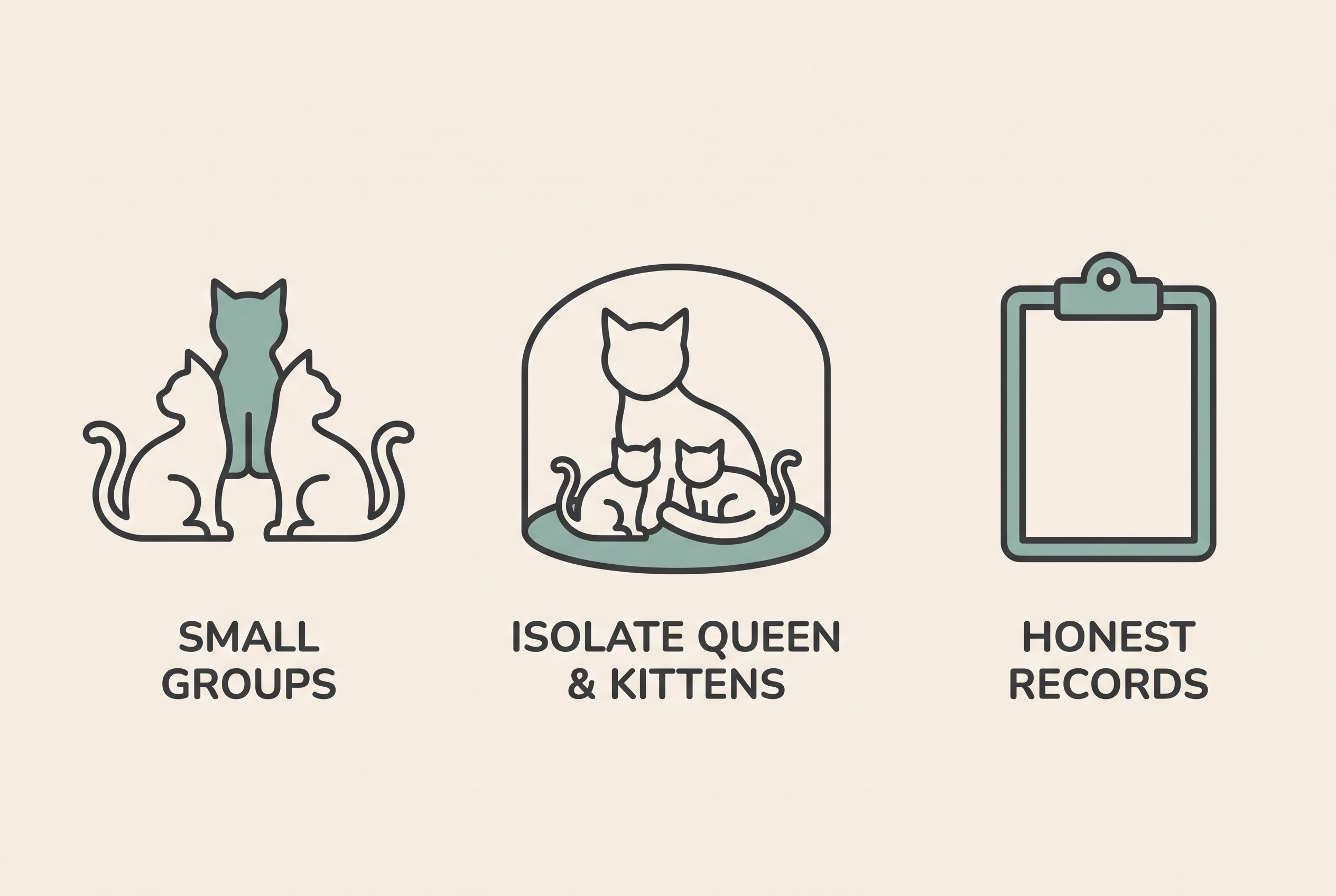
- Small groups. Keeping cats in small, stable groups of ideally no more than three or four rather than large mixed colonies limits how much virus circulates.
- Litter tray hygiene. One tray per cat, ideally one for every one or two cats, scooped daily, disinfected weekly, and kept well away from food and water. Litter is the main highway for this virus.
- Isolating the queen around birth. Housing a pregnant queen away from the main group before she gives birth, and keeping her and her kittens separate afterwards, reduces the virus the kittens meet in their most vulnerable weeks.
- Early weaning and isolation, where appropriate. Some catteries wean kittens early, around five to six weeks, and keep them isolated from other cats so that maternal antibodies fade before the kittens are re-exposed, aiming to keep them coronavirus-free (Addie et al., 2009). This is demanding to do well and is not right for every cattery, but it is a recognised approach.
- Managing stress. Calm, uncrowded, predictable housing lowers both viral spread and the stress that seems to favour the harmful mutation.
Working with the genetics
- Honest record-keeping. Tracking which cats and matings have produced FIP cases is the only way to see a pattern.
- Removing implicated breeding cats. The long-standing advice is that the parents of a cat that developed FIP, and ideally full siblings and offspring of repeated cases, should be taken out of the breeding programme, because the susceptibility travels with the family (Pedersen, 2019).
- Not repeating a mating that produced FIP. A pairing that has already produced an affected kitten should not be repeated.
None of this is glamorous and none of it is a guarantee. It is patient, unshowy work, and the breeders who do it are quietly reducing risk in a way that never shows up as a certificate.
What no test can tell a breeder yet
A fair question, from breeders and buyers alike, is why breeders cannot simply test their way out of this. The honest answer is that the tests available do not do the job people wish they did.
A coronavirus antibody test tells you whether a cat has met feline coronavirus, but in a cattery a positive result is expected and normal, and it does not predict which cat will ever develop FIP (Thayer et al., 2022). A faecal test can identify cats who are actively shedding the virus, which is genuinely useful for reducing spread, and detecting persistent shedders usually takes a series of at least three faecal tests over weeks rather than a single sample (Thayer et al., 2022). But even removing the biggest shedders lowers the circulating virus, it does not screen out the mutation that causes FIP, because that mutation has not happened yet and cannot be seen in advance (Pedersen, 2019).
There is no genetic test a breeder can run to guarantee a kitten will never develop FIP. Susceptibility is polygenic and only partly understood, so the best tool remains the unglamorous one, honest records of which cats and matings have produced cases, used to make breeding decisions over time (Pedersen, 2019). A breeder who says they "test for FIP" and therefore guarantee FIP-free kittens is, gently, overpromising something no test currently delivers.
A word on the FIP vaccine
Owners sometimes ask whether a responsible breeder should be vaccinating against FIP. It is a reasonable question with a clear answer. There is one FIP vaccine (an intranasal product, first sold as Primucell), and it is not available or routinely used in the UK. Even where it exists, it is considered non-core and is not generally recommended, because it appears ineffective in cats that have already met feline coronavirus, which describes most cats in a cattery, and it has not proven especially useful in high-risk group settings (Addie et al., 2009; ABCD, 2022). So a UK breeder not vaccinating against FIP is following mainstream veterinary advice, not cutting a corner. The meaningful prevention in a cattery is hygiene, group size and line management, not a jab.
If you bought a kitten that developed FIP
This is a painful place to be, and it is worth being clear and fair. A kitten developing FIP does not by itself prove the breeder was negligent. Coronavirus is near-universal in group-housed cats, susceptibility is partly genetic and largely invisible in advance, and the mutation to FIP cannot be predicted or screened out (Thayer et al., 2022; Pedersen, 2019). Good breeders lose kittens to FIP too, and many are devastated by it.
That said, you are entitled to a calm, honest conversation. Reasonable, non-accusatory questions to ask a breeder include:
- Have you had FIP in your lines or this mating before?
- What are your litter tray and housing arrangements, and how large are your groups?
- Do you isolate queens and kittens, and do you wean early?
- Would you repeat this pairing?
A responsible breeder will not be thrown by these questions. They may be grieving alongside you, and a shared, blame-free conversation often serves both of you far better than an accusation. If a breeder is evasive, dismissive of the illness, or clearly running large crowded groups with poor hygiene, that is more telling than the single fact of an FIP case. If you are weighing up a breeder for a future kitten, the same questions, asked before you commit, tell you a great deal about how they work.
Where this leaves you
FIP in breeding cats sits at the meeting point of a common virus and inherited susceptibility, and a responsible breeder works patiently on both without ever being able to promise a clean sheet. Knowing that lets you judge a breeder on their practices rather than on the cruel luck of a single diagnosis, and it lets a grieving breeder see their loss for what it usually is, misfortune rather than failure.
If you want to understand how the wider setting, crowding and stress feed into all of this, read Multi-cat homes, shelters and stress as a trigger. If you are worried about the other cats you have at home right now, the reassuring detail is in FIP and your other cats: is it contagious?. And for the honest limits of what any of us can do to stop it, see Can you prevent FIP?.
The next practical step, whether you are a breeder or an owner, is a straight conversation rather than a search for fault. Ask the questions above, calmly, and let the answers, not the diagnosis alone, guide what you think.
References
- ABCD (2022). Feline Coronavirus and Feline Infectious Peritonitis: ABCD Guidelines. European Advisory Board on Cat Diseases.
- Addie, D. et al. (2009). Feline infectious peritonitis: ABCD guidelines on prevention and management. Journal of Feline Medicine and Surgery, 11(7), 594-604.
- Foley, J.E., Poland, A., Carlson, J. and Pedersen, N.C. (1997). Risk factors for feline infectious peritonitis among cats in multiple-cat environments with endemic feline enteric coronavirus. Journal of the American Veterinary Medical Association, 210(9), 1313-1318.
- Pedersen, N.C. (2019). A review of feline infectious peritonitis virus infection: 1963-2008 and updates on diagnosis and treatment. UC Davis.
- Thayer, V., Gogolski, S., Felten, S., Hartmann, K., Kennedy, M. and Olah, G.A. (2022). 2022 AAFP/EveryCat Feline Infectious Peritonitis Diagnosis Guidelines. Journal of Feline Medicine and Surgery, 24(9), 905-933.
Keep track of how your pet is doing
The owners who cope best are the ones who notice changes early. A simple health log shows you what is working, and what is not, before the next vet visit.
Start tracking, freeYou're not doing this alone
Compare treatment journeys and talk to owners managing feline infectious peritonitis (fip). Free to join.
Join PetsLikeMine