

Multi-cat homes, shelters and stress as a trigger
Alastair Greenway
BVM&S MRCVS
There is a particular guilt that comes with an FIP diagnosis in a busy household. You start turning it over. Was it the number of cats? Was it the rescue you took in? Was it the move, the new baby, the building work, the boarding cattery? Somewhere in the small hours, the thought arrives that if you had done something differently, your cat would be well.
Let us take that on directly, because it is the wrong thing to be carrying. FIP is more common in multi-cat homes and shelters, and stress does play a part, but understanding why is not the same as finding someone to blame. By the end of this you should have the real picture of how the setting matters, and, just as importantly, why this is not a verdict on you as an owner.
Why more cats means more of the common virus
To understand why multi-cat homes see more FIP, you have to start one step back, with the ordinary virus behind it. Feline coronavirus, or FCoV, is a common gut bug that most cats meet at some point. It spreads by the faecal-oral route, mainly through shared litter trays, mutual grooming and close living (Thayer et al., 2022; Addie et al., 2009). None of that is exotic. It is simply what cats living together do.
The more cats share a space and a litter tray, the more the virus circulates, and the higher the chance that any given cat is carrying it at any given moment. The numbers bear this out plainly. In high-density settings, meaning multi-cat households, breeding catteries, shelters and rescues, somewhere between roughly half and nine in ten cats show evidence of having met feline coronavirus. In single-cat homes and free-roaming cats, that figure is only around one in seven (Thayer et al., 2022). In catteries and busy multi-cat groups, it is normal for at least one cat to be shedding the virus at any one time (Thayer et al., 2022).
So the first link is simple. More cats, more virus in circulation, more exposure. That part is just arithmetic, not neglect.
From common virus to FIP: the step that is rare
Here is the reassuring part that gets lost in the worry. Carrying feline coronavirus is common. Developing FIP is not. The virus has to mutate, inside one individual cat, into the form that causes FIP, and most cats never experience that. Across multi-cat environments, only a small minority of cats who carry the coronavirus, in the region of one in ten or fewer, go on to develop FIP (Thayer et al., 2022; Cornell Feline Health Center, 2022).
Two things push that small chance a little higher in a busy or shelter setting, and they are worth naming because they are the honest mechanism, not a character judgement:
- A heavier viral load. The more virus a cat is exposed to and carries, the more opportunities there are for the mutation to occur. Crowding raises the load (Thayer et al., 2022; Addie et al., 2009).
- Youth. Multi-cat homes and shelters simply have more kittens and young cats passing through, and FIP most often strikes the young, whose immune systems are still developing (Thayer et al., 2022).
Put together, this is why a shelter or a household with several young cats sees more FIP than a quiet home with one older cat. It is not that anyone was careless. It is that the setting brings more virus and more susceptible young cats into the same space.
Stress: real, but not a stick to beat yourself with
Stress genuinely does matter in FIP, and this is where owners can be hardest on themselves. A cat's immune response is bound up with how safe and settled it feels, and periods of stress seem to raise the chance that the coronavirus takes the harmful turn (Addie et al., 2009; Thayer et al., 2022). The classic pressure points line up almost too neatly with an FIP timeline:
- rehoming or adoption from a shelter or rescue
- a house move, or building and renovation work
- neutering surgery and the recovery around it
- a new pet, a new person or a new baby in the home
- boarding, catteries and other spells away
- overcrowding and tension between cats
If you look at that list and recognise your own recent months, it is very easy to conclude that you caused this. Please do not. Every one of those events is a normal part of ordinary, responsible cat ownership. You neutered your cat because that is the right thing to do. You adopted from a rescue because you gave a cat a home. You moved house because life required it. Stress being a contributing factor is not the same as you having done something wrong, and no vet would frame it that way.
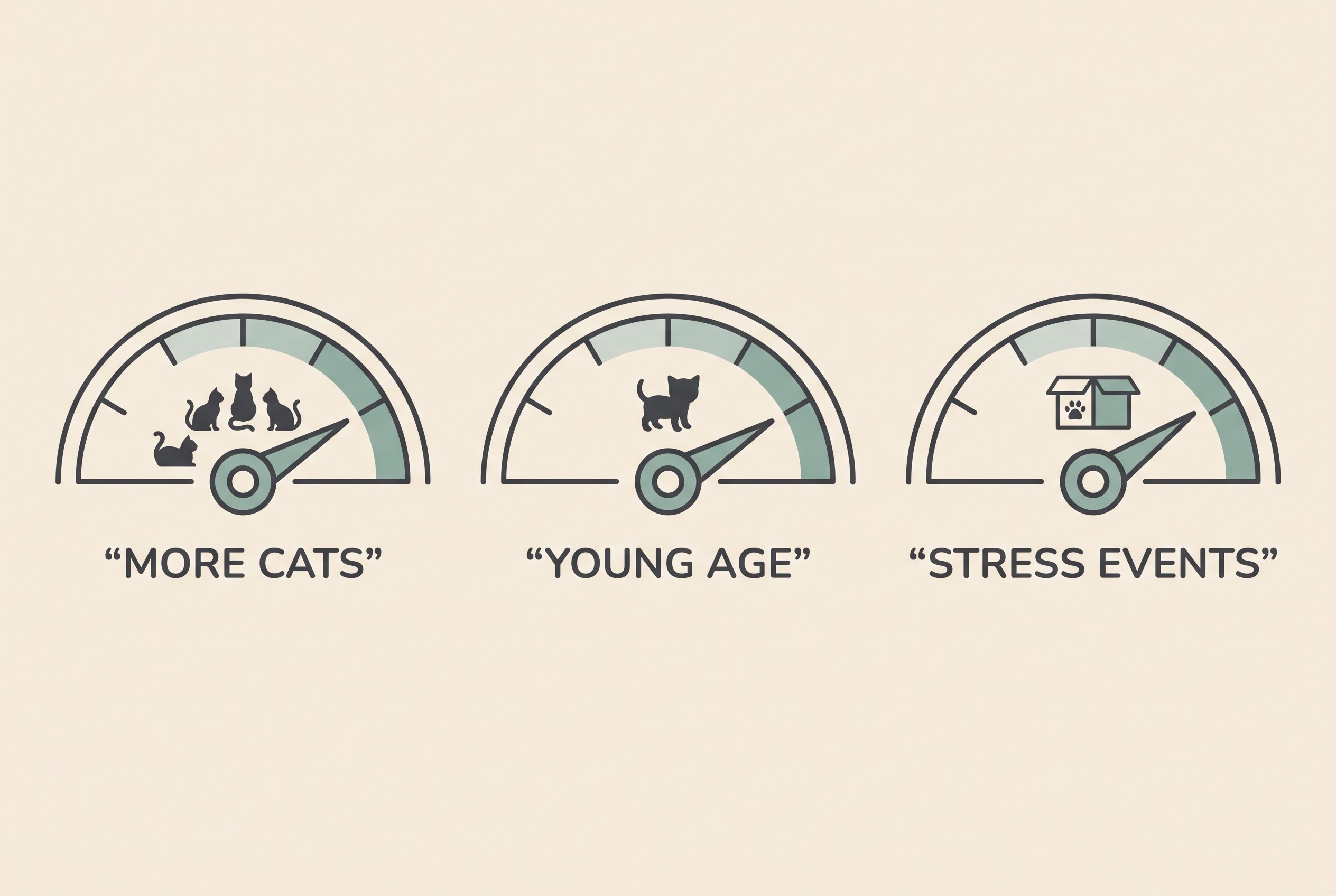
It is also worth being clear about what stress does and does not do. Stress does not create FIP out of nothing. It is one dial among several, alongside the amount of virus present, the cat's age and its genetics (Thayer et al., 2022). A calm home lowers the odds a little. A stressful spell raises them a little. Neither is a guarantee in either direction, which is exactly why plenty of cats sail through big upheavals untouched and, occasionally, a cat in the most settled home still develops FIP.
Shelters and rescues: a specific, non-judgemental word
If your cat came from a shelter or rescue, or if you work in one, this section is for you. Shelters combine everything that raises the background risk, many cats, high turnover, lots of kittens, shared trays and the unavoidable stress of unfamiliar cats in an unfamiliar place. It is genuinely harder to keep coronavirus loads low in that environment, and good shelters know it and work at it constantly (Addie et al., 2009).
This does not mean a rescue cat is a bad choice, and it does not mean a shelter failed your cat. Coronavirus is near-universal in group-housed cats, and the mutation to FIP is not something a shelter can screen out or predict. Taking on a rescue cat remains one of the kindest things a person can do. If you are grieving or frightened over a rescue cat with FIP, the setting explains the higher background rate, it does not indict the choice you made to give that cat a home.
Why the timing feels like proof, and why it isn't
One reason owners are so certain they caused this is timing. FIP often appears in the weeks or months after a big change, and when an illness follows an event closely, our minds join the two into a chain of cause and effect. You moved house, and six weeks later your cat was diagnosed, so the move must have done it.
The timing is real, but it is looser and more innocent than it feels. Stress is only one contributor, and it works by nudging a susceptible cat's odds, not by reliably converting a healthy cat into a sick one within a set number of weeks (Thayer et al., 2022; Addie et al., 2009). Plenty of cats go through the identical upheaval untouched. The event you keep returning to did not "give" your cat FIP in the way a knock gives a bruise. It sat alongside the virus, the cat's age and its genetics, and in this one cat the odds fell the wrong way. That is a very different thing from a mistake you can trace and undo.
It is also worth turning one common fear around. Owners in multi-cat homes sometimes decide the other cats must have "given" the sick cat FIP by passing the virus around. Even that framing is off. The common coronavirus does circulate between housemates, but developing FIP is a private event inside the affected cat, not something the others did to it (Thayer et al., 2022). No cat in your home is the culprit, and neither are you.
What actually helps in a multi-cat home
If you want to lower the background risk for the cats you still have, the useful measures are practical and calm rather than drastic (Thayer et al., 2022; Addie et al., 2009). None of them promises FIP will never happen again, because nothing can, but they genuinely reduce how much virus circulates and how stressed your cats feel.
- Enough litter trays, cleaned often. Aim for one tray per cat, ideally one for every one or two cats, plus a spare. Scoop daily, disinfect weekly, and keep trays well away from food and water.
- Reduce crowding where you can. More space, more hiding spots and vertical territory (shelves, cat trees) let cats keep their distance when they want to, which lowers both stress and viral spread.
- Keep life predictable. Cats settle on routine. Steady feeding times, calm handling and a quiet retreat during upheavals all help.
- Manage introductions slowly. New cats should be brought in gradually, and if you have just had a case of FIP, talk to your vet before adding another cat.
- Support the anxious cats. Pheromone diffusers, resource spreading (multiple feeding and water stations) and reducing conflict between cats all take pressure off.
These are the same measures that make for a happier multi-cat household anyway, which is a small comfort. You are not being asked to run a laboratory. You are being asked to keep things clean, spacious and calm, which is well within reach.
Where this leaves you
The higher rate of FIP in multi-cat homes and shelters is real, and now you know why. More cats mean more of a common virus, more young cats mean more susceptible immune systems, and stress nudges the odds. What it is not is evidence that you failed your cat. The setting shapes the background risk. It does not hand out blame.
If your worry now turns to the other cats under your roof, the honest and reassuring detail is here: FIP and your other cats: is it contagious?. If your cat came from a breeder, or you are a breeder yourself trying to understand the lines and litters, read Breeders and FIP: what responsible breeders do. And if the question underneath all of this is "can I stop it happening again", the straight answer, limits and all, is in Can you prevent FIP?.
For now, the single thing worth doing is to stop auditing the past. The stress, the move, the rescue, the surgery, none of it was a mistake. Turn your energy toward the cat in front of you and the calm, clean home you can offer the rest.
References
- Addie, D. et al. (2009). Feline infectious peritonitis: ABCD guidelines on prevention and management. Journal of Feline Medicine and Surgery, 11(7), 594-604.
- Cornell Feline Health Center (2022). Feline Infectious Peritonitis. Cornell University College of Veterinary Medicine.
- Thayer, V., Gogolski, S., Felten, S., Hartmann, K., Kennedy, M. and Olah, G.A. (2022). 2022 AAFP/EveryCat Feline Infectious Peritonitis Diagnosis Guidelines. Journal of Feline Medicine and Surgery, 24(9), 905-933.
Keep track of how your pet is doing
The owners who cope best are the ones who notice changes early. A simple health log shows you what is working, and what is not, before the next vet visit.
Start tracking, freeYou're not doing this alone
Compare treatment journeys and talk to owners managing feline infectious peritonitis (fip). Free to join.
Join PetsLikeMine