

FIP is treatable now: the legal UK route via your vet and Bova
Alastair Greenway
BVM&S MRCVS
If you have just been told your cat has FIP, and you have spent the last few hours reading that the only cure is something you have to smuggle in from abroad or buy from a stranger in a Facebook group, please take a breath. That is not the situation in the UK, and it has not been for several years.
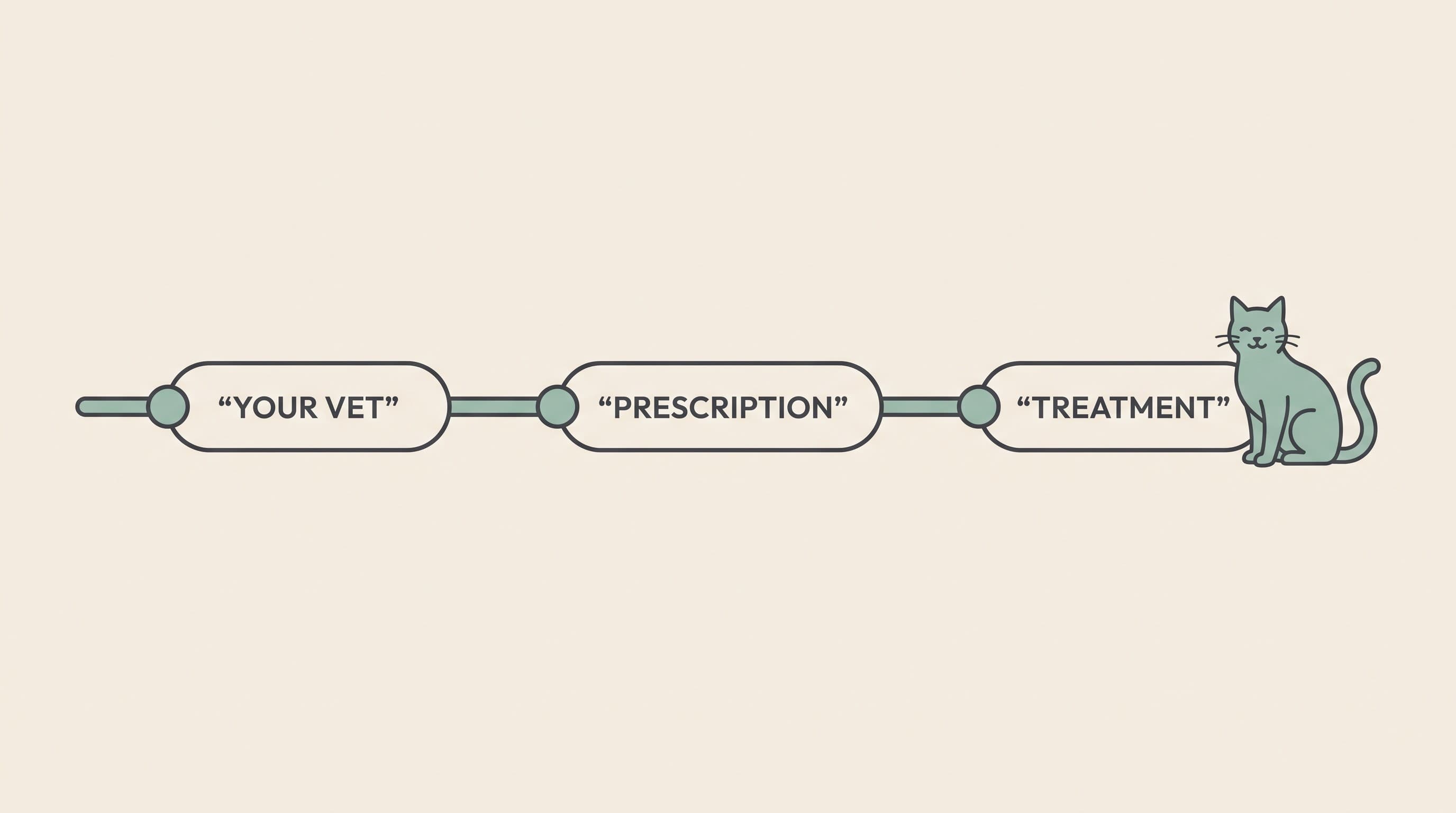
Here is the plain truth, and it is the whole reason this article exists: FIP treatment is legal in the UK, and your own vet can prescribe it. Not a specialist two hours away. Not a grey area you have to tiptoe around. Your ordinary, local practice can write the prescription, and the medicine comes from a licensed UK pharmacy through the normal, legal supply chain.
Most of what you will find online was written for a different world. Until 2021, there genuinely was no legal way to get these drugs for a cat in this country, so owners did extraordinary and risky things to save their cats, and every forum, every calculator and every bit of "brand" lore you might stumble across grew out of that era. The internet has a long memory and a short attention span, so the old story is still the loudest one. It is out of date. Let me walk you through what is actually true now.
FIP went from almost always fatal to usually treatable
For most of veterinary history, FIP was a death sentence. That is the hard fact behind all the fear. It is also the fact that changed. A group of antiviral drugs, the same family that gave human medicine its COVID treatments, turned out to work against the feline coronavirus that causes FIP. In the years since, the picture has shifted from "there is nothing we can do" to "most treated cats survive". Across the studies gathered so far, more than 85% of cats respond to antiviral treatment (Taylor et al., 2025). That is roughly eight to nine cats in every ten, and it is why the tone of this whole space is different from the internet you have been reading.
That does not make FIP a small thing. It is still a serious illness, treatment is a real commitment of time and money, and not every cat comes through. But the starting point is no longer despair. It is a plan.
What the medicine actually is
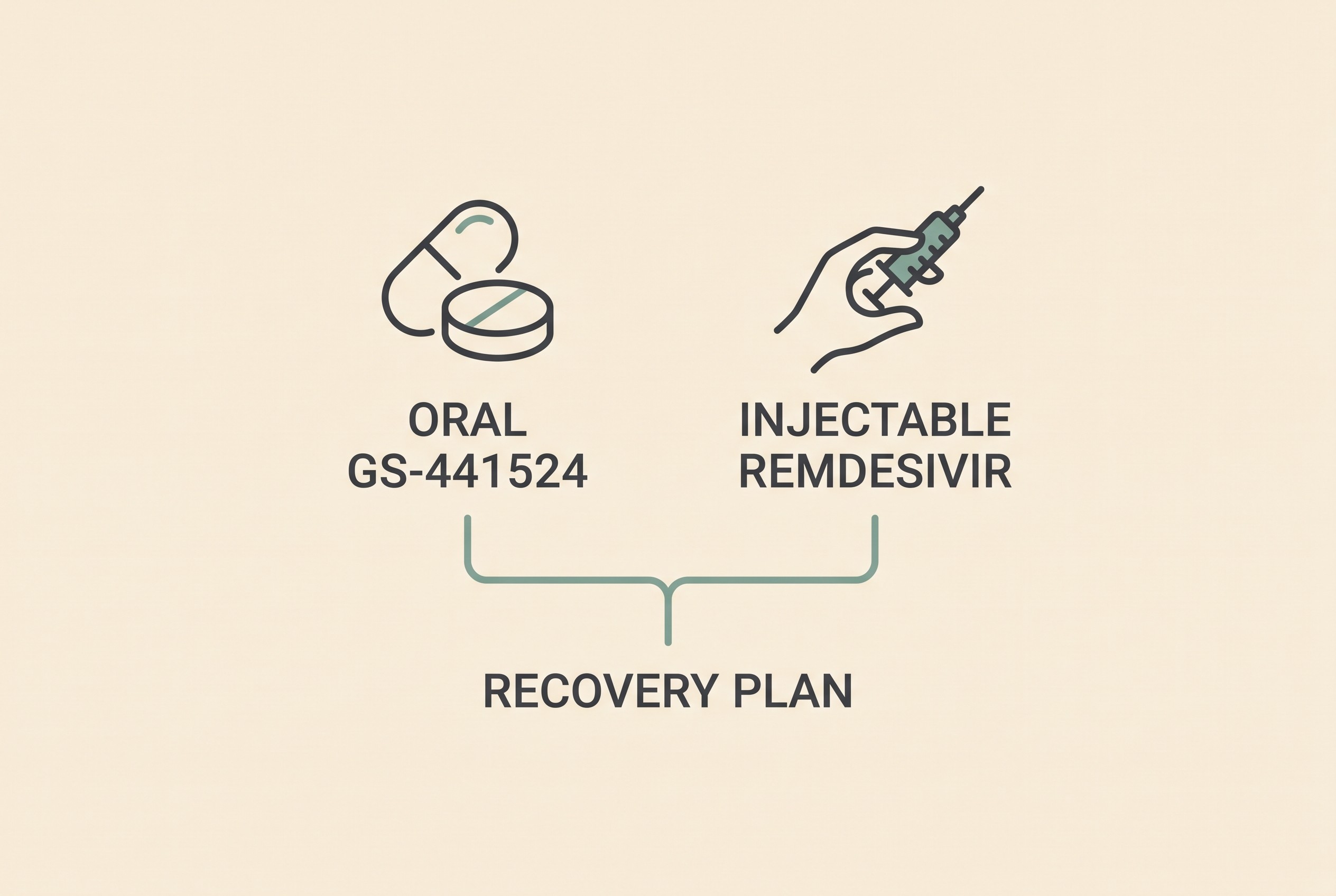
The treatment is antiviral. In the UK it comes in two main forms, and your vet will choose based on your cat.
Oral GS-441524 is the tablet or liquid most cats now take. It is given by mouth, once a day for most cases, for the whole course. It comes as 50 mg tablets and as a 50 mg/ml oral suspension for cats who will not take a tablet (Bova, 2023).
Injectable remdesivir is the injected form. Some cats, particularly those who are very unwell at the start or who cannot keep tablets down, begin on injections and then move across to the oral tablets once they are stable. Remdesivir is the drug you may have heard of from human COVID treatment, and GS-441524 is closely related to it. Your vet may use one, the other, or a sequence of both.
You do not need to become an expert in the pharmacology. What matters is that both are real, prescribable medicines, and your vet decides which suits your cat's form of FIP and how poorly they are.
What "legal via the cascade and Specials" actually means
This is the part that trips everyone up, so let me explain it in plain terms.
Some medicines have a full UK licence for a specific animal and a specific illness. There is no licensed FIP drug for cats, because no company has taken these antivirals through the full veterinary licensing process yet. When there is no licensed option, UK law gives vets a legal, structured way to reach for the next best thing. It is called the prescribing cascade, and it is set out in the Veterinary Medicines Regulations 2013 (Veterinary Prescriber, 2022). It is a risk-based ladder: your vet works down it to the most appropriate available medicine when nothing is licensed for the exact job.
For FIP, that legal option is a "Special". A Special is an unlicensed medicine that is manufactured or compounded for an individual patient by a company the Veterinary Medicines Directorate has authorised to make them (Veterinary Prescriber, 2022). In the UK, Bova UK is the authorised specials manufacturer supplying compounded remdesivir and oral GS-441524 to vets, and it has done so since August 2021 (Bova, 2023).
So the chain is completely above board. A UK-authorised pharmacy makes the medicine, your vet prescribes it under a legal framework written into UK regulations, and it reaches your cat through the same route as any other prescription-only veterinary medicine. There is nothing to hide and nothing to import yourself.
One honest caveat, because you deserve the full picture: a "Special" is unlicensed, which means it has not been through the full efficacy and safety testing a licensed product would (Veterinary Prescriber, 2022). That sounds alarming, but it is the standard way UK vets legally treat many conditions that have no licensed drug, and the real-world evidence behind these particular antivirals is now substantial. Your vet prescribing this way is normal, appropriate practice, not a shortcut.
Any vet can prescribe it, not only specialists
This surprises a lot of owners, so it is worth stating clearly. The prescribing decision sits with the attending veterinary surgeon, which means your own vet, the one who knows your cat, is allowed to prescribe FIP treatment (Bova, 2023). You do not legally need a referral to a feline specialist or a university hospital to start.
That said, FIP treatment is recent enough that not every vet has prescribed it before. If yours is cautious, that is understandable and it is not a red flag. It is reasonable and legal for them to prescribe, and often a quick look at the current UK guidance is all a vet needs to feel confident. We have written a companion piece on how to raise FIP treatment with your vet if you are worried about that conversation. Some practices will also happily talk to Bova's veterinary support or refer you on if they would rather someone with more FIP experience leads. All of those routes are legal and normal.
The path from here, step by step
The route we describe is always the same shape, and it never leaves the veterinary system.
- Diagnosis. FIP has no single confirming test, so your vet builds the picture from your cat's history, signs, bloodwork and sometimes fluid samples (here is why there is no single test). They decide there is enough to treat.
- Prescription. Your vet prescribes oral GS-441524, injectable remdesivir, or a sequence, at a dose set for your cat's weight and form of FIP.
- Dispensing. The medicine is supplied through the legal chain, from an authorised UK specials manufacturer to your vet or a linked pharmacy.
- Treatment and monitoring. You give the medicine daily, usually across a course of around 84 days, though shorter courses are now being studied for some cats (Taylor et al., 2025). Your vet monitors with rechecks and repeat bloods, and after treatment there is an observation window before your cat is spoken of as cured.
That is the entire journey. There is no step where you have to source anything yourself, and there is no version of this where breaking the law is the only way to save your cat.
Why the internet still says "illegal"
Because for a long time it genuinely was. Before 2021, there was no UK legal supply, and cats were dying, so owners turned to unlicensed product bought online and dosed with the help of volunteer groups. That entire ecosystem, the brands, the vial sizes, the mg-per-ml calculators, the group admins, all of it grew in the gap where legal treatment did not exist. It saved cats, and it also carried real risks, because nobody could be sure what was in the vial.
That gap is now closed in the UK. If you are weighing the old route against your vet, we have written honestly about the black market question and why the legal route is the safer one, without naming suppliers or telling anyone how to use them. The short version: when your vet prescribes, you know exactly what the medicine is, what strength it is, and you have a professional guiding and monitoring the whole way. That safety net is the thing the old route could never offer.
What this changes for you today
If you take one thing from this article, take this: your next move is not to open a marketplace or a Facebook group. It is to speak to your vet. If they have already diagnosed FIP, ask them about starting antiviral treatment. If you are still in the diagnostic stage, that is the first conversation.
Two things will be on your mind straight after this, and both are real. The first is money, because this treatment is not cheap, and you deserve a straight answer rather than a scare figure, so we have laid out what FIP treatment costs in the UK. The second is whether your insurance will help, which we cover in does pet insurance cover FIP antivirals. And once treatment starts, the daily dosing routine will walk you through giving the medicine with confidence.
You have found the legal route. That is the hard part of the search over. The rest is a plan you and your vet build together.
References
- Taylor S, Tasker S, Barker E, Gunn-Moore D, Sorrell S, Cerna P, Coggins S. An update on treatment of FIP using antiviral drugs in 2025: growing experience but more to learn. ISFM/UK, 2025.
- Bova UK. The treatment of feline infectious peritonitis (FIP) in the UK: an update, and FAQs about treating FIP. 2023.
- Veterinary Prescriber. Remdesivir, cats and the cascade. 2022.
- Thayer V, Gogolski S, Felten S, Hartmann K, Kennedy M, Olah GA. 2022 AAFP/EveryCat Feline Infectious Peritonitis Diagnosis Guidelines. Journal of Feline Medicine and Surgery, 2022.
- Taylor S, et al. UK retrospective of FIP treatment outcomes (307 cats). Journal of Feline Medicine and Surgery, 2023. Every legal, regulatory and survival line in this article is -flagged and gated on Claire Greenway's sign-off before publish. The cascade and Specials wording in particular must be confirmed against current RCVS and VMD guidance at the time of publication.
Free downloads
Companion worksheets to put what you've read into practice. Free PDFs, print at home.
Keep track of how your pet is doing
The owners who cope best are the ones who notice changes early. A simple health log shows you what is working, and what is not, before the next vet visit.
Start tracking, freeYou're not doing this alone
Compare treatment journeys and talk to owners managing feline infectious peritonitis (fip). Free to join.
Join PetsLikeMine