

The daily dosing routine: pills, injections, timing, missed doses
Alastair Greenway
BVM&S MRCVS
The medicine is on the kitchen counter. Your vet has explained it, you nodded along, and now it is just you, a small cat, and eighty-four days stretching ahead of you. If your hands are shaking a little and your head is full of "what if I get this wrong", you are exactly where almost every FIP owner starts. That feeling is not a sign you can't do this. It is a sign you understand it matters, and you are going to be fine at it faster than you think.
So let's build you a routine you can lean on. Not a test to pass, a rhythm to settle into. By the end of the first week most owners are doing this half-asleep before the kettle has boiled.
First, the mindset that makes the whole thing easier
You are not deciding the dose. You are not adjusting the dose. You are delivering a dose your vet has already worked out for your cat, and you are watching how your cat responds so you can tell your vet about it. That is the whole job, and it is a job you can absolutely do.
Everything below is here so you understand what your vet has prescribed and why, so it makes sense in your hands rather than feeling like a set of instructions you are following blind. Nowhere in this article, or anywhere on this site, will we tell you to work out or change a dose yourself. When a dosing question comes up, the answer is always the same reassuring thing: log it, and message your vet.
The other thing that helps enormously is letting the FIP Treatment Companion carry the remembering. It holds the daily reminder, the weekly reweigh prompt and the log, so your tired brain does not have to. You bring the love and the steady hands. Let the tool hold the calendar.
The golden rules of the daily dose
A handful of habits do most of the work. Get these right and the rest is detail.
Same time, every day. Antivirals for FIP work by keeping a steady level of drug in the body, day after day, so the virus never gets a window to recover. Pick a time you can genuinely hit every single day, morning or evening, and anchor it to something you already do, like the first coffee or the evening feed. Consistency matters more than which hour you choose.
Understand what your vet set, and don't touch it. Your prescription is built around your cat's current weight and the form of FIP they have. As a rough guide to what the current UK guidance describes, oral GS-441524 is often prescribed in the region of around 15 mg/kg once a day for the wet and dry forms, rising towards about 20 mg/kg a day (frequently split into two doses twelve hours apart) for cats with eye or neurological signs, because the drug has to reach past the blood-eye and blood-brain barriers (ISFM/Taylor et al., 2024). Injectable remdesivir is dosed differently again. Please read those as background only. Your cat's actual dose is on the label your vet gave you, and that is the only number you follow.
The dose will change, and that is normal. Because the dose is worked out per kilogram, a growing kitten needs the amount recalculated as it puts on weight. This is so important it has its own article: weigh weekly, re-dose weekly. For now, just hold the idea that a dose is not "set for the whole course", and expect your vet to adjust it.
Timing around food: the empty-stomach question
For oral GS-441524, current guidance is to give the dose on an empty stomach, or tucked into a very small treat, and then leave a gap of an hour or more before a larger meal (ISFM/Taylor et al., 2024). The thinking is that a full stomach can blunt how well the drug is absorbed, and absorption is precisely what you are trying to protect.
In practice this is easier than it sounds. Many owners dose first thing, before breakfast is served, then feed properly an hour later, which also turns the meal into a small reward for sitting through the medicine. If your cat is the type who is only reliably tempted by food and simply will not take the tablet without something around it, a tiny amount of a strong-smelling treat is a reasonable compromise, and it is far better than a dose that ends up on the floor. If you are wrestling with this daily, tell your vet, because a dose that consistently goes in beats a perfect empty-stomach dose that consistently doesn't.
Pills or injections: what each is actually like
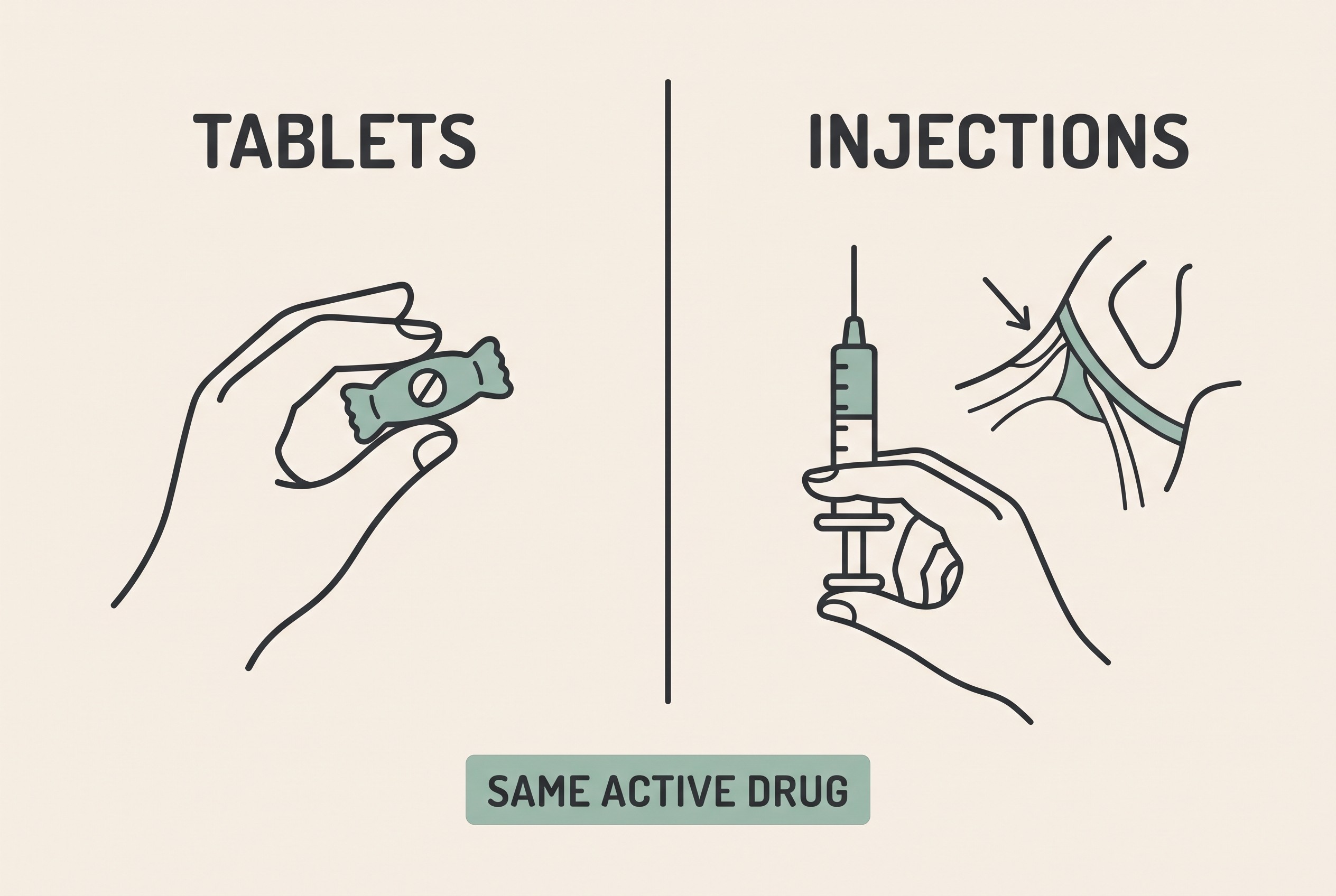
Most cats in the UK now take, or move onto, oral tablets, and many owners are quietly relieved to hear it. But some cats start on injectable remdesivir, and there are good reasons for that, so neither is a "worse" path.
Tablets are, for most families, the calmer daily experience once you find your technique: into a small treat, a pill pocket, or given directly with a pet piller if your cat is amenable. The knack is speed and confidence, and it comes quickly. If tablet-giving is new to you, the reliable method is to have everything ready before you pick your cat up, work calmly and quickly rather than hesitantly, and follow the dose with something nice so your cat comes to associate the ritual with a reward rather than a wrestle. Ask your vet or a nurse to show you once in person; two minutes of hands-on coaching saves a fortnight of guesswork. If your cat reliably spits the tablet out or you can see it stuck to the roof of the mouth, that is a lost dose, so it is worth getting the technique solid early rather than assuming it went down.
Injections (subcutaneous remdesivir under the skin at the scruff) tend to be used when a cat is very unwell, off food, or being sick, when getting a tablet in reliably is hardest. The honest downside is that these injections can sting: injection-site pain was the single most common side effect in the large UK study, reported in 47.8% of cats given subcutaneous remdesivir, thought to be linked to the acidity of the solution (Taylor et al., 2023). That soreness is a real reason many cats move onto tablets as soon as they are well enough. If your cat is on injections, do not muddle through dreading it. There are ways to make it far less stressful for both of you, walked through in giving injections at home without the stress.
Missed doses and vomited doses: the calm what-to-do
This is the part that keeps owners awake, so let's take the fear out of it. A single wobble in an 84-day course is not a catastrophe. Panic is more dangerous than the missed dose, because panic is what leads people to improvise.
Here is the safe, simple frame, and it is deliberately not a set of catch-up sums:
If you miss a dose, do not double up to "make up" for it. Note the time you missed it, give the next scheduled dose as normal unless your vet has told you otherwise, and message your vet with what happened so they can advise on whether the course needs anything adjusting. Never stack two doses together to compensate.
If your cat is sick shortly after a dose, you often cannot tell how much drug went down before it came back up, which is exactly why this is a conversation with your vet and not a guess. Log the time, log how soon after the dose it happened, and contact your vet for the plan. Do not automatically re-dose on your own judgement, and never give extra "to be safe".
If your cat is repeatedly refusing or bringing up doses, that is a flag to raise promptly rather than battle alone. Your vet may switch the form (tablet to injectable or back), change the timing around food, or check whether something else is making your cat feel rough. A pattern of lost doses is a solvable problem, not a failure.
The reason we will not hand you a "give another half if it happens within an hour" rule is simple: those rules float around the internet, they vary, and getting them wrong risks under-dosing or over-dosing the very drug your cat's recovery depends on. Your vet knows your cat's dose, form and progress, and can give you a plan that fits. Logging every wobble in the Treatment Companion means that when you do message your vet, you can tell them exactly what happened and when.
Building the routine that carries you to day 84
A few practical things make the difference between eighty-four days of dread and eighty-four days of quiet competence.
Set the reminder before you need it, and set a backup for the person who covers when you can't. Keep the medicine, the treats and the log in one spot so dosing is a single reach, not a hunt. Weigh your cat weekly on the same scales and write it down, because that weight is what keeps the dose right (again, weigh weekly, re-dose weekly). And keep a short daily note of the ordinary things: did they eat, how was their energy, any sickness, any lump at an injection site. Those notes are what turn a worried "I think she's a bit quieter?" into something your vet can actually use.
Plan for the days that do not go to schedule, because there will be some. A weekend away, a shift that runs late, a cat who suddenly decides today is the day to hide behind the washing machine. Line up a second person who can dose confidently, ideally after watching you do it a few times, and make sure they know the golden rules too: same time, don't double up, log everything. Store the medicine as your vet directs, and keep an eye on how much you have left so a repeat prescription is sorted before you run out rather than in a panic on a Sunday. None of this needs to be elaborate. A little forward planning is simply the difference between eighty-four smooth days and a handful of avoidable scrambles.
If a day goes sideways despite all of it, forgive yourself quickly and get back on schedule. Consistency over the whole course is what matters, and one imperfect day inside a well-kept routine does not undo the work. The owners whose cats come through this are not the ones who never had a wobble. They are the ones who kept going, kept logging, and kept talking to their vet.
Above all, keep the line to your vet open. A dosing question is never a bother, and it is never a sign you are failing at this. It is exactly what the vet is there for across these twelve weeks. If something feels off, or new, or you simply are not sure, that is your cue to message them, not to solve it alone on the kitchen floor at midnight.
You are giving your cat the best shot there has ever been at coming through FIP. One steady dose at a time is how it gets done.
References
- Taylor S, Tasker S, Barker EN, Gunn-Moore D, et al. An update on treatment of FIP using antiviral drugs (ISFM/UK living document, 2024 edition).
- Taylor S, Coggins S, Barker EN, et al. Retrospective study and outcome of 307 cats with feline infectious peritonitis treated with legally sourced veterinary compounded preparations of remdesivir and GS-441524 (2020-2022). Journal of Feline Medicine and Surgery 2023;25(9).
- Thayer V, Gogolski S, Felten S, et al. 2022 AAFP/EveryCat Feline Infectious Peritonitis Diagnosis Guidelines. Journal of Feline Medicine and Surgery 2022;24(9):905-933.
Free downloads
Companion worksheets to put what you've read into practice. Free PDFs, print at home.
Keep track of how your pet is doing
The owners who cope best are the ones who notice changes early. A simple health log shows you what is working, and what is not, before the next vet visit.
Start tracking, freeYou're not doing this alone
Compare treatment journeys and talk to owners managing feline infectious peritonitis (fip). Free to join.
Join PetsLikeMine