

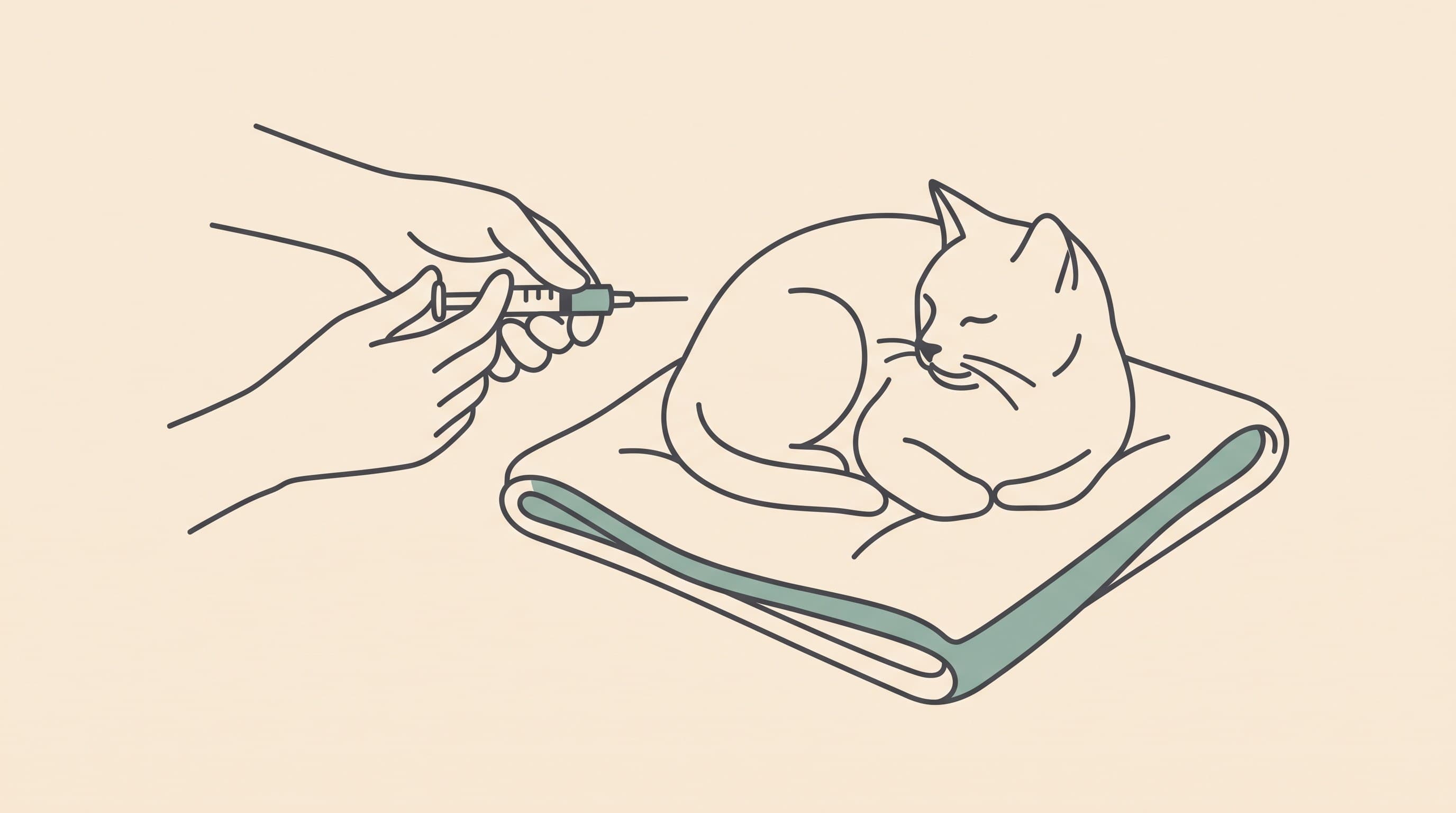
Giving FIP injections at home without the stress
Alastair Greenway
BVM&S MRCVS
There's a particular kind of dread that comes with a box of syringes and the knowledge that you'll be reaching for it every day, sometimes for weeks. You love this cat. The whole point is to make her better. And here you are, being asked to be the person who causes her a small daily hurt. If you've cried before an injection, or sat on the bathroom floor psyching yourself up, or felt like a terrible owner because your kitten flinched, you're in good company. Nearly every owner who's done this has felt exactly that.
So let's take some of the weight off. This article is about making each injection as calm and as gentle as it can be, and about being honest with you that there may be a kinder route altogether.
First, the question worth asking: does it have to be injections?
Before we talk technique, it's worth knowing that for many cats, the injectable isn't the only option, and often isn't the preferred one anymore.
The soreness you're worried about is real and it's common. Pain on the subcutaneous injection is seen in around half of cats on the injectable remdesivir, and the largest UK study put localised pain or discomfort at 47.8% (Taylor et al., 2023; Taylor et al., 2024). Because of that, and because the oral medicine can now be used from the very first day, the current guidance reserves the injectable for specific situations: cats with severe neurological signs or who can't swallow, cats who are very dehydrated or unwell, and cats who can't be medicated by mouth for other reasons (Taylor et al., 2024). Moving to oral GS-441524 "avoids pain on injections and reduces the costs of the treatment" (Taylor et al., 2024).
That means if your cat is on injections mainly because that's how treatment started, it's entirely reasonable to ask your vet: is she now well enough to switch to tablets? The transition from injectable to oral can be immediate, from one treatment straight to the next (Taylor et al., 2024). This is your vet's clinical call, not something to change yourself, but it's a fair and common question, and for a lot of cats the answer is yes. Our guide on the daily dosing routine covers what the oral option is like day to day.
If injections are the right route for your cat right now, the rest of this article is for you.
What the injection actually is, and why it can sting
It helps to understand what you're giving, because knowing the "why" takes some of the fear out of the "how". The injectable is compounded remdesivir, a liquid antiviral, given as a small volume under the skin (Taylor et al., 2024). The reason it can sting is simply the nature of the solution rather than anything you're doing wrong, which is worth holding onto on the days it goes less smoothly. It isn't that you've botched it. It's that the medicine itself can be uncomfortable going in, and that's true for careful vets and nurses too.
There's one important exception to the daily-at-home picture. Occasionally, a cat who's very unwell and can't be medicated by mouth is given remdesivir intravenously in the practice for a short spell, sometimes around 48 hours, to get treatment moving before switching to oral GS-441524 at home (Taylor et al., 2024). If that's your cat, the hospital handles those doses, and your at-home job may turn out to be tablets rather than injections after all.
Setting the scene so it goes well
Cats read the room. If you're tense, fumbling and dreading it, your cat knows, and the whole thing becomes a battle. A calm setup does more than any single technique.
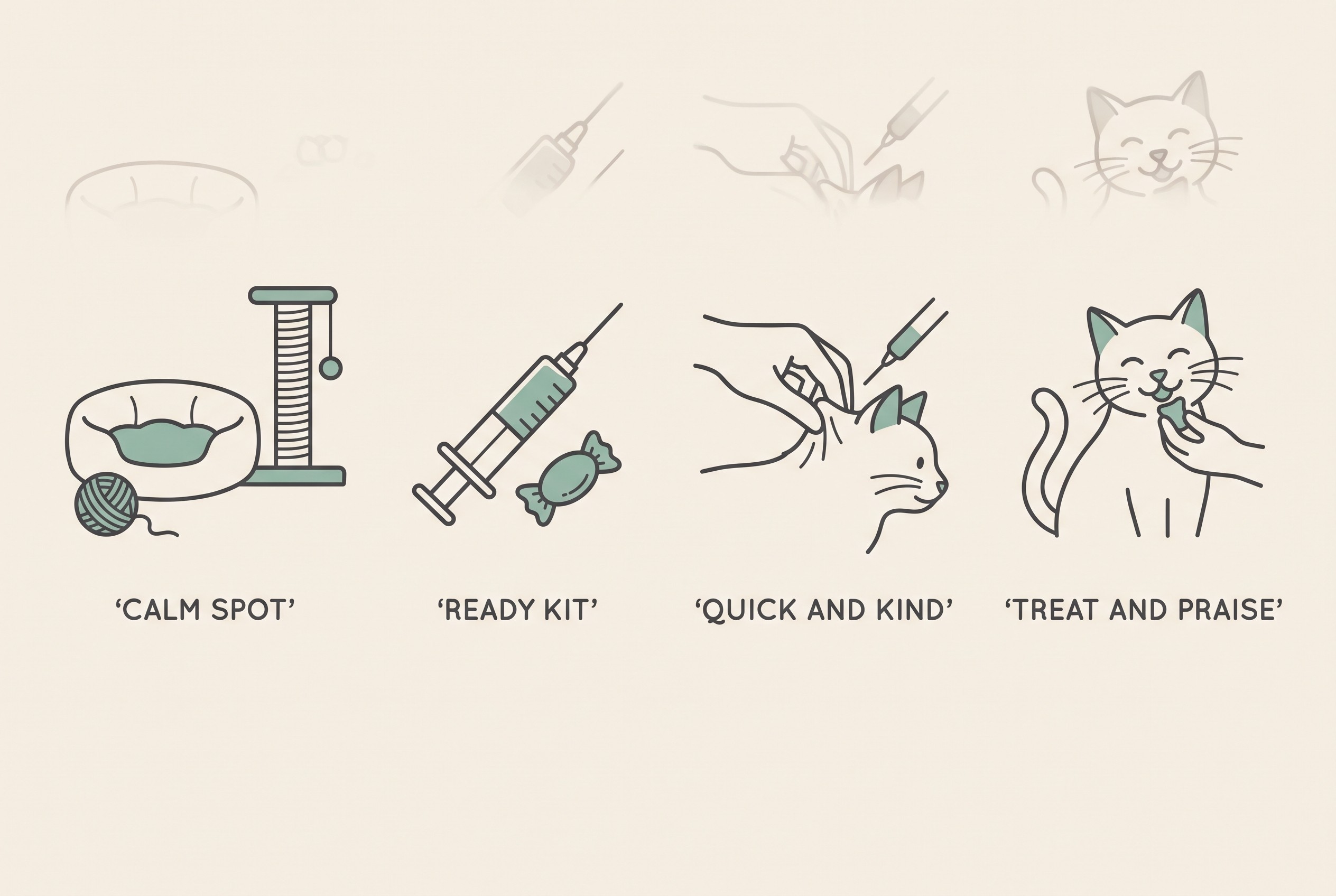
- Pick a quiet, warm spot with good light and no other pets barging in. The same place each day helps, because routine is soothing for cats.
- Have everything ready before you fetch your cat: the prepared syringe (drawn up exactly as your vet has directed), a treat she loves, and a soft towel. You never want to be preparing kit with a wriggling cat on your lap.
- Time it around a positive. Many owners give the injection just before a favourite meal or a treat, so there's an immediate good thing on the other side of it.
- Enlist a second pair of hands if you can. One person to gently steady and reassure, one to give the injection, splits the job and halves the stress for everyone.
Making the injection itself gentler
Your vet or a nurse should show you the technique in person and watch you do it, ideally more than once. Nothing written can replace that. What follows are the things that most often make it kinder, to raise with them and practise together.
- Ask about the sting. The injectable can sting going in. It's worth asking your vet whether anything can be done to soften it, whether that's the way it's given, or whether pain relief such as buprenorphine has a place if your cat is finding the daily injections hard (Taylor et al., 2024). Don't suffer in silence, or let your cat.
- Use the scruff area, and rotate sites. The loose skin over the shoulders and along the back is the usual spot. Move the site a little each day rather than using the same patch, which gives sore areas time to recover.
- Tent the skin, go in confidently. A quick, committed motion is kinder than a slow, hesitant one. Hesitation is what drags the moment out.
- Keep it short and don't linger afterwards. Give the injection, release, treat, praise, done. The faster you return to normal, the faster your cat learns it's survivable.
- Warm and calm counts. A cold cat and a cold syringe both make things harder. Ask your vet whether letting the medicine come up from fridge-cold is appropriate for your preparation.
If a particular injection goes badly, some do, don't spiral. One difficult session doesn't undo the treatment. Reset, try again next time, and tell your vet if you're consistently struggling, because that's exactly when a switch to oral is worth revisiting.
Handling a small or squirmy cat kindly
FIP most often strikes young cats, so many owners are injecting a small, fast, frightened kitten rather than a placid adult, and that brings its own challenges. The guiding principle is the one good practices use themselves: less restraint, not more. Pinning a cat down tends to escalate the panic. Gentle, confident support, letting her keep her feet under her, and working quickly usually goes far better.
Some cats settle best wrapped loosely in a towel with just the injection area exposed, so-called "purrito" style, which some find comforting rather than restraining. Others do better simply being fussed and fed while a second person gives the injection. There's no single right way, so it's worth trying a couple of approaches early on to find what suits your cat, and asking your vet's nurses for their tips, since reducing stress and handling gently is exactly the kind of thing a Cat Friendly practice is trained in (Taylor et al., 2024). And keep a short daily record as you go, noting which leg, how it went, and any sore spot, so you can rotate sites sensibly and spot a pattern. A simple log like the one in the FIP Treatment Companion does this for you.
Looking after the injection sites
A firm, tender lump where an injection went in is common and usually settles on its own. What you're watching for is the smaller number of sites that don't behave. In the UK study, around 3.5% of cats developed sores or thickened skin at injection sites over their course (Taylor et al., 2023).
Rotating sites is your best prevention. Beyond that, keep a quiet eye on each spot for a day or two. A site that's simply firm and a bit sore is fine to watch. A site that becomes hot, is spreading, is weeping, is clearly painful, or breaks the skin is one to show your vet rather than to manage at home. Cats' skin can be more delicate than you'd expect, and it's always better to have a nurse glance at a doubtful patch than to hope it settles.
When an injection doesn't go to plan
Sooner or later, one won't go smoothly. Your cat twists at the wrong moment, some of the liquid ends up on her fur instead of under her skin, or you're simply not sure the whole dose went in. This is one of the most common panics owners message about, and the answer is reassuringly consistent: don't guess, and don't give a second "top-up" injection to make up for it. Working out whether and how to replace a partial dose depends on how much was lost and what your cat is on, and that's a judgement for your vet, not a sum to do at the syringe. Note what happened as best you can, and contact your vet for the plan. One imperfect injection in a long course is very unlikely to undo anything, and the calm, correct move is always to ask rather than to improvise.
The part nobody warns you about: how hard this is on you
The physical technique is genuinely the smaller half. The harder half is the daily emotional cost of being the one who does it, especially to a small kitten who doesn't understand why. Please hear this: the flinch does not mean you're hurting your cat in any way that matters against what you're saving her from. A few seconds of soreness, given by hands that love her, is the price of a real chance at a cure, and it is a price worth paying.
Be kind to yourself in the practical ways too. Share the job if you have anyone to share it with. Keep a simple daily log so a bad session becomes one line in a mostly-fine record rather than the thing you carry all day, which is exactly what the FIP Treatment Companion is built to hold for you. And remember that this phase very often ends: for many cats, the injections are a bridge to the oral medicine, not the whole road.
If you take one thing from this, let it be that you're allowed to ask for it to be easier. Ask whether she can move to tablets. Ask about pain relief. Ask a nurse to watch your technique again. None of that is a failure. It's you doing this properly, which is exactly what your cat needs. If a new sore, a wobble or an off day worries you between injections, our guide on side effects and what's normal will help you tell the ordinary from the worth-a-call, and your vet is always the right person to ask when you're not sure.
References
- Taylor, S. S., Coggins, S., Barker, E. N., Gunn-Moore, D., et al. (2023). Retrospective study and outcome of 307 cats with feline infectious peritonitis treated with legally sourced veterinary compounded preparations of remdesivir and GS-441524 (2020–2022). Journal of Feline Medicine and Surgery, 25(9).
- Taylor, S., Tasker, S., Gunn-Moore, D., Barker, E., Sorrell, S. (2024). An update on treatment of FIP using antiviral drugs in 2024: growing experience but more to learn. ISFM / Bova UK (updated February 2024).
Keep track of how your pet is doing
The owners who cope best are the ones who notice changes early. A simple health log shows you what is working, and what is not, before the next vet visit.
Start tracking, freeYou're not doing this alone
Compare treatment journeys and talk to owners managing feline infectious peritonitis (fip). Free to join.
Join PetsLikeMine