

Side effects and what's normal on FIP treatment
Alastair Greenway
BVM&S MRCVS
You've started treatment, you're watching your cat like a hawk, and now something has changed. Maybe there's a firm little lump where the last injection went in. Maybe she's had a quiet day, or a soft stool, or she turned her nose up at breakfast when she wolfed it down yesterday. Your stomach drops, because the question underneath every one of those small changes is the same one: is the treatment failing?
Most of the time, the answer is no. The antivirals used to treat feline infectious peritonitis are, by the standards of most medicines, remarkably well tolerated. The largest UK study of legally treated cats reported no life-threatening drug reactions, and a 2025 systematic review pooling 650 treated cats across eleven studies found the same, noting "no life-threatening adverse effects of GS-441524 were noted in any study" (GS-441524 systematic review, 2025). That doesn't mean nothing happens along the way. It means that most of what you'll see is either an expected part of the medicine working, or a nuisance rather than a danger. This article is here so you can tell the two apart, and know the small handful of things that genuinely warrant a phone call.
The first few days can look worse before they look better
This one catches almost everyone off guard, so it's worth saying plainly. In the first few days of treatment, before the drug has had time to take hold, your cat can actually show more signs of FIP, not fewer. The ISFM treatment update notes that new or recurring pleural fluid, and sometimes new neurological or eye signs, can appear in this early window "before the medication has had time to take effect" (Taylor et al., 2024).
It's a horrible feeling to start a treatment and watch your cat seem to get worse. But this early wobble is recognised, and it is not the same as the treatment failing. What your vet is looking for is the turn: most cats show a clear improvement in mood, appetite and temperature within two to five days (Taylor et al., 2024). A small number take a little longer, up to around ten days, but there are usually some positive signs before then. If your cat develops laboured breathing or a suddenly swollen belly in these early days, that's still a same-day call to your vet, because fluid can need draining. But the general principle holds: judge the first week by the trend, not by a single frightening morning.
The injection-site reality
If your cat is on the injectable form (compounded remdesivir), the single most common side effect is pain and soreness at the injection site. In the 307-cat UK study, localised pain or discomfort with the subcutaneous injection was reported in almost half the cats that received it, 47.8% (Taylor et al., 2023). A smaller number, around 3.5%, developed sores or thickened skin at the injection sites over the course (Taylor et al., 2023).
This is exactly why treatment has shifted. Oral GS-441524 can now be used from the very first day for most cats, which avoids the injections altogether, and it's part of why many cats who start on injections are moved onto tablets as soon as they're stable enough (Taylor et al., 2024). If your cat is still on injections and finding them hard, that's a conversation worth having with your vet, and our guide on giving injections at home covers the practical ways to make each one gentler. A firm, sore spot after an injection is common and usually settles. A patch that's hot, spreading, weeping or clearly infected is one to show your vet.
The blood results that look alarming and usually aren't
When your cat has recheck bloods, some numbers may move in directions that sound frightening if you read them cold on a results printout. Here's what a few of them actually mean in this context.
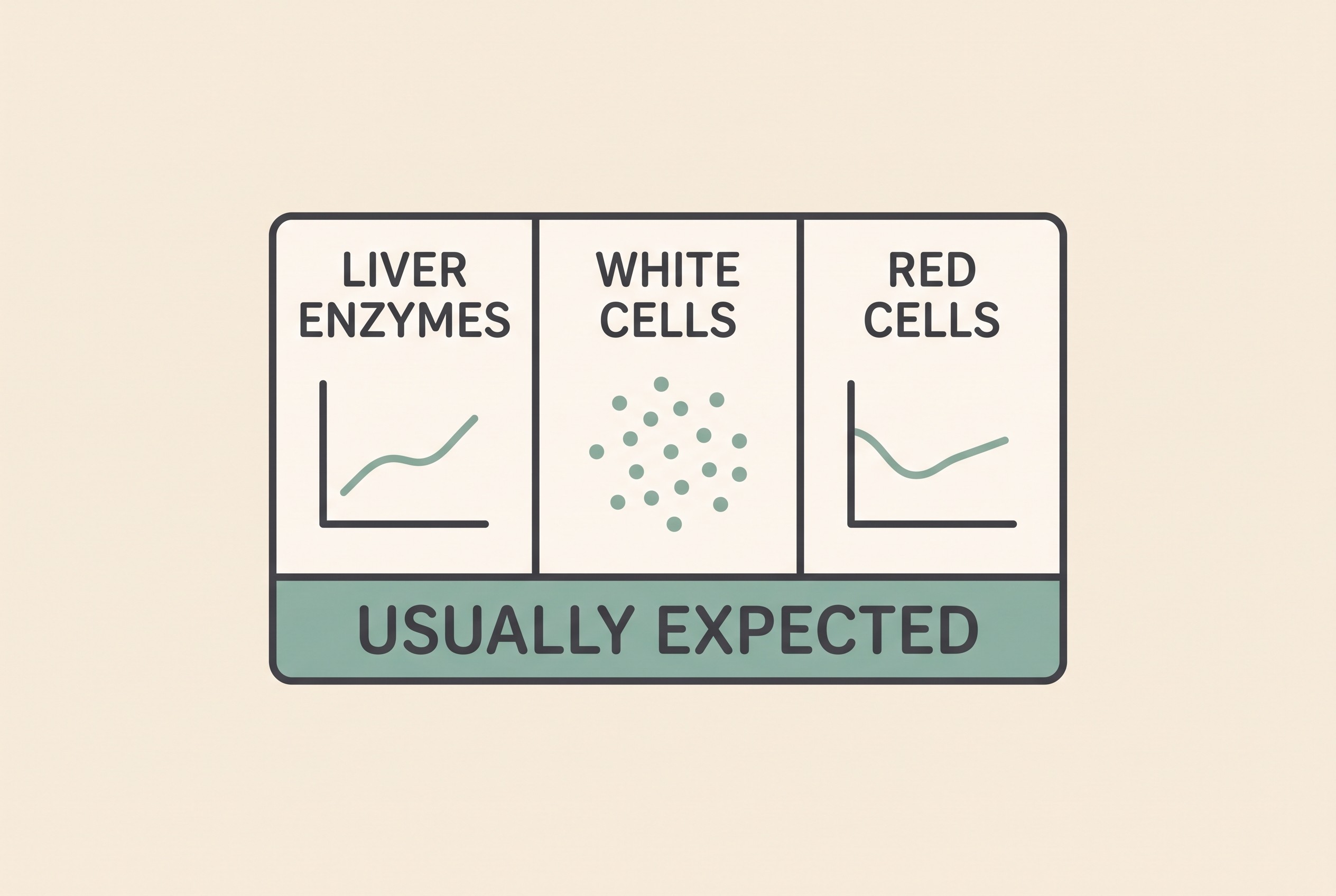
A rise in liver enzymes (ALT) turned up in 28.4% of cats in the UK study (Taylor et al., 2023). That looks like the drug is hurting the liver, and it's a reasonable thing to worry about. In practice, these rises are usually mild and don't require treatment. The ISFM update is explicit that liver protectants such as SAMe "are not usually required, even in cats with ALT enzyme activity increases" (Taylor et al., 2024). Your vet will keep an eye on the trend, but a modest ALT bump on its own is not a reason to stop.
Two other changes, a rise in one type of white cell (lymphocytosis, seen in 10.7% of cats) and in another (eosinophilia, 15.0%), can actually appear during successful treatment (Taylor et al., 2023; Taylor et al., 2024). In other words, they can be a sign of the immune system settling back down, not a sign of trouble.
Some numbers take their time to recover, and that slowness is normal too. A low red cell count (anaemia) and a low lymphocyte count can take up to around ten weeks to resolve (Taylor et al., 2024). And a raised globulin, one of the values that helped point towards FIP in the first place, can stay mildly high even at the end of a full course without meaning the cat isn't cured, as long as everything else has come right (Taylor et al., 2024). None of this is something you need to interpret yourself. It's here so that a single "abnormal" flag on a report doesn't send you into a spin before your vet has put it in context.
Things that recover slowly, and that's normal too
Not everything comes right at the same pace, and some of the slowest changes are the ones that worry owners most because they seem to drag on. It helps to know in advance which things simply take their time.
Effusions, the fluid in the belly or chest that often prompted the diagnosis, usually resolve by around two weeks (Taylor et al., 2024). Enlarged lymph nodes can be slower still, sometimes not returning fully to normal size even by the end of treatment, and yet, when everything else has come right, this doesn't signify that the FIP is coming back (Taylor et al., 2024). The proteins in the blood follow their own timetable: albumin and globulin can take several weeks to normalise, and a mildly raised globulin can linger to the very end of a course without meaning the cat isn't cured (Taylor et al., 2024). Your vet may also track a marker called AGP, which can be reassuring when it settles back to normal.
None of this slowness is a sign the medicine isn't working. FIP recovery is measured in weeks and months, not days, and the values that lag are simply the last to catch up.
The supportive extras your vet can offer
The antiviral does the heavy lifting, but a cat recovering from FIP sometimes needs a bit of help around the edges, and it's worth knowing these options exist so you can ask rather than watch your cat struggle.
If your cat is uncomfortable or in pain, from inflammation or from the disease itself, your vet can offer pain relief such as buprenorphine as part of a considered plan (Taylor et al., 2024). If she's nauseous or reluctant to eat, appetite stimulants such as mirtazapine and anti-sickness medicines such as maropitant genuinely help, and a cat who's eating well recovers more smoothly (Taylor et al., 2024). A very dehydrated or unwell cat may need fluids, sometimes in the practice for a short spell. What your vet will generally steer clear of is steroids: corticosteroids are usually avoided during FIP antiviral treatment, because they can work against what the medicine is trying to do, with only a few specific exceptions your vet will weigh case by case (Taylor et al., 2024). The point is that you don't have to simply tolerate a cat who's flat, sore or off her food. Much of that is fixable, and your vet would far rather you asked.
The everyday wobbles: appetite, stools, mood
Day to day, you'll see small fluctuations, and they're a normal part of any recovering cat's life rather than a special feature of FIP. A single skipped meal, one quieter day, a slightly softer stool: these happen, and on their own they don't mean the treatment has stopped working.
The oral medicine is best given on a fairly empty stomach, with a gap of an hour or so before a larger meal (Taylor et al., 2024), and getting a tablet into a cat who's still building her appetite can be a fiddle. If mild nausea is putting your cat off her food, your vet has genuinely helpful options, including appetite stimulants such as mirtazapine and anti-sickness medicines such as maropitant (Taylor et al., 2024). You don't have to just tolerate a cat who's off her food. That's a fixable problem, and a quick message to your vet often sorts it.
The rule that keeps most owners sane through the 84 days is this: watch the pattern, not the moment. One off-meal is a data point. Three days of steadily dropping appetite, falling energy or losing weight is a pattern, and that's the kind of thing that earns a call.
What actually warrants a call
Most of this article is permission to breathe. But there's a short list of things that do warrant picking up the phone, and knowing them lets you relax about everything else:
- Laboured or fast breathing, or a belly that's swelling up again. Fluid can need attention, sometimes urgently.
- Any new neurological or eye sign: wobbliness, a seizure, a change in behaviour, or a visible change in the eye such as a colour change in the iris. New signs like these are always worth a prompt call, because they can mean the dose needs reviewing (Taylor et al., 2024).
- A steady, several-day decline in appetite, energy or weight, rather than a single off day.
- An injection site that looks infected: hot, spreading, weeping or increasingly painful.
- Yellowing of the gums, ears or the whites of the eyes, marked lethargy, or anything that simply frightens you.
If you're ever unsure, err towards asking. No good vet minds a "probably nothing" message about a cat on FIP treatment, and the reassurance is usually worth the text.
Two things this article deliberately isn't. It isn't a guide to what to do if the treatment genuinely seems to be stalling, because that has its own careful answer, and our piece on when treatment stalls walks through what your vet weighs up when a cat isn't turning the corner on schedule. And it isn't a reason to change a dose yourself. If a side effect ever seems serious enough to make you wonder whether to skip or reduce a dose, that's the moment to ring your vet, not to adjust anything on your own.
The next new thing you spot doesn't have to mean the worst. Keep a short daily note of appetite, energy, breathing and anything that's changed, bring it to your rechecks, and let your vet hold the interpreting. That's exactly what the FIP Treatment Companion is built to help you record, so the picture you hand your vet is a real one rather than a panicked memory of a single hard morning.
References
- Taylor, S. S., Coggins, S., Barker, E. N., Gunn-Moore, D., et al. (2023). Retrospective study and outcome of 307 cats with feline infectious peritonitis treated with legally sourced veterinary compounded preparations of remdesivir and GS-441524 (2020–2022). Journal of Feline Medicine and Surgery, 25(9).
- Taylor, S., Tasker, S., Gunn-Moore, D., Barker, E., Sorrell, S. (2024). An update on treatment of FIP using antiviral drugs in 2024: growing experience but more to learn. ISFM / Bova UK (updated February 2024).
- Systematic review of GS-441524 efficacy for FIP (2018–2024), Pathogens (2025).
Keep track of how your pet is doing
The owners who cope best are the ones who notice changes early. A simple health log shows you what is working, and what is not, before the next vet visit.
Start tracking, freeYou're not doing this alone
Compare treatment journeys and talk to owners managing feline infectious peritonitis (fip). Free to join.
Join PetsLikeMine