

When FIP treatment stalls: "if in doubt, increase the dose"
Alastair Greenway
BVM&S MRCVS
You started treatment expecting a clear line: sick cat, then medicine, then better. And for a lot of cats it really is close to that. But your cat is a few days or a couple of weeks in and she isn't bouncing back the way the stories online said she would. The fever hasn't fully gone. She's eating, but not enthusiastically. The belly hasn't flattened as fast as you hoped. And the fear that's been sitting in your chest is starting to speak up: what if it isn't working?
Take a breath, because "slower than I hoped" and "not working" are two very different things, and most cats who feel like the first are not the second. This article is about what a genuine stall looks like, what your vet does about it, and why the guiding instinct in FIP treatment, when a cat isn't responding, is not to give up but to lean in.
What normal recovery actually looks like
Before you decide your cat is behind, it helps to know the real timeline, because it's slower and bumpier than the highlight reel suggests.
Most cats show a clear improvement in demeanour, appetite and temperature within two to five days, and a small number take up to around ten days, though there are usually some early positive signs before then (Taylor et al., 2024). So a cat who's still a bit flat on day three is not a cat who's failing. Fluid takes longer: effusions in the belly or chest usually resolve by around two weeks (Taylor et al., 2024). And some blood values are slow by nature. A low red cell count and a low lymphocyte count can take up to ten weeks to come right, and a raised globulin can stay mildly high even at the end of a full course without meaning anything is wrong (Taylor et al., 2024).
There's also the wrinkle that catches many owners in week one: a cat can look a little worse before better, with new or recurring fluid or even new signs appearing in the first few days before the drug takes hold (Taylor et al., 2024). All of which is to say: judge recovery by the trend over days and weeks, not by a single disappointing morning. A short daily note of appetite, energy, breathing and weight, the kind the FIP Treatment Companion is built to hold, is worth far more to your vet than a worried memory.
When it's a genuine stall
So what does an actual stall look like? It's the absence of the turn. A cat who two weeks in still has fever, still has an effusion that isn't shrinking, or simply isn't improving on the blood values and the clinical picture together, may be a cat who needs something changed. As the ISFM guidance puts it, "if progress is not as expected, consider reviewing the diagnosis and/or increasing the dosage," and "clinical response is most important to monitor; a failure to improve may necessitate an increase in dosage" (Taylor et al., 2024).
Notice what that guidance does and doesn't say. It doesn't say "it's failed, stop". It says: look again, and consider more medicine. That's the mindset that has changed FIP from a near-certain death sentence into a disease most cats survive, and it's worth understanding why.
Why the instinct is to increase, not to abandon
There are two common, fixable reasons a cat is slow to respond, and both point the same way.
The first is absorption. Cats vary a lot in how much of the oral medicine actually gets into their system. Emerging therapeutic drug monitoring (TDM) work shows that individual cats absorb oral GS-441524 differently, and those who absorb it poorly need higher doses to reach the levels that clear the disease (Taylor et al., 2024). A cat can be taking her tablets perfectly and still, through no one's fault, not be getting enough drug into her blood. The answer to that isn't to stop. It's to give more.
The second is the growing kitten. FIP most often strikes young, growing cats, and the dose is worked out per kilogram of body weight. A dose that was right in week one is quietly an under-dose by week six if it wasn't raised as the kitten put on weight. Not increasing the dose as the kitten grows is described as one of the most common causes of a poor response and treatment failure (Taylor et al., 2024). If your cat is stalling, the very first thing to check is whether the dose has kept pace with the scales, which is the whole subject of our guide on weighing weekly and re-dosing.
Both of these are why the working steer in FIP treatment, associated with the UK specialists who lead this field, is essentially "if in doubt, increase the dose" (Taylor, 2022). Under-dosing is the bigger danger, and the medicine is well tolerated at higher doses, so when a case is uncertain the safer error is upward, not downward.
A stall is not a relapse
It's worth separating two words that get tangled together in the small hours. A stall is when a cat doesn't turn the corner properly in the first place, still carrying fever or fluid or flatness that hasn't lifted. A relapse is different: it's when a cat who genuinely got better later slips back, usually after treatment has finished. They can feel identical from the sofa at 2am, but clinically they're handled at different points in the journey, and if your cat is still on treatment and simply slow to respond, a stall is the more likely picture. Either way, the response is the same first move, contact your vet, and the same reassurance, that both are usually workable. Relapse has its own guide, on the signs of relapse, for the observation weeks after treatment ends.
What your vet is checking at each stage
Some of what looks like a stall to you is picked up, or ruled out, at the routine checkpoints your vet builds into the course. Knowing roughly what happens when can settle the sense that no one's watching. In the first 48 hours, your vet expects to hear that your cat's mood and temperature are improving, and will often ask you for exactly that report (Taylor et al., 2024). At around two weeks, weight, demeanour and any effusion are reviewed, sometimes with bloods, and this is a common point to adjust the dose if fluid is lingering (Taylor et al., 2024). Further rechecks around six and twelve weeks track the fuller recovery, with a careful examination before treatment is stopped (Taylor et al., 2024). If your cat seems to be stalling between these points, you don't have to wait for the next scheduled visit, a phone call is always reasonable, but it helps to know the plan already has watchpoints built into it.
The crucial part: this is your vet's call, not yours
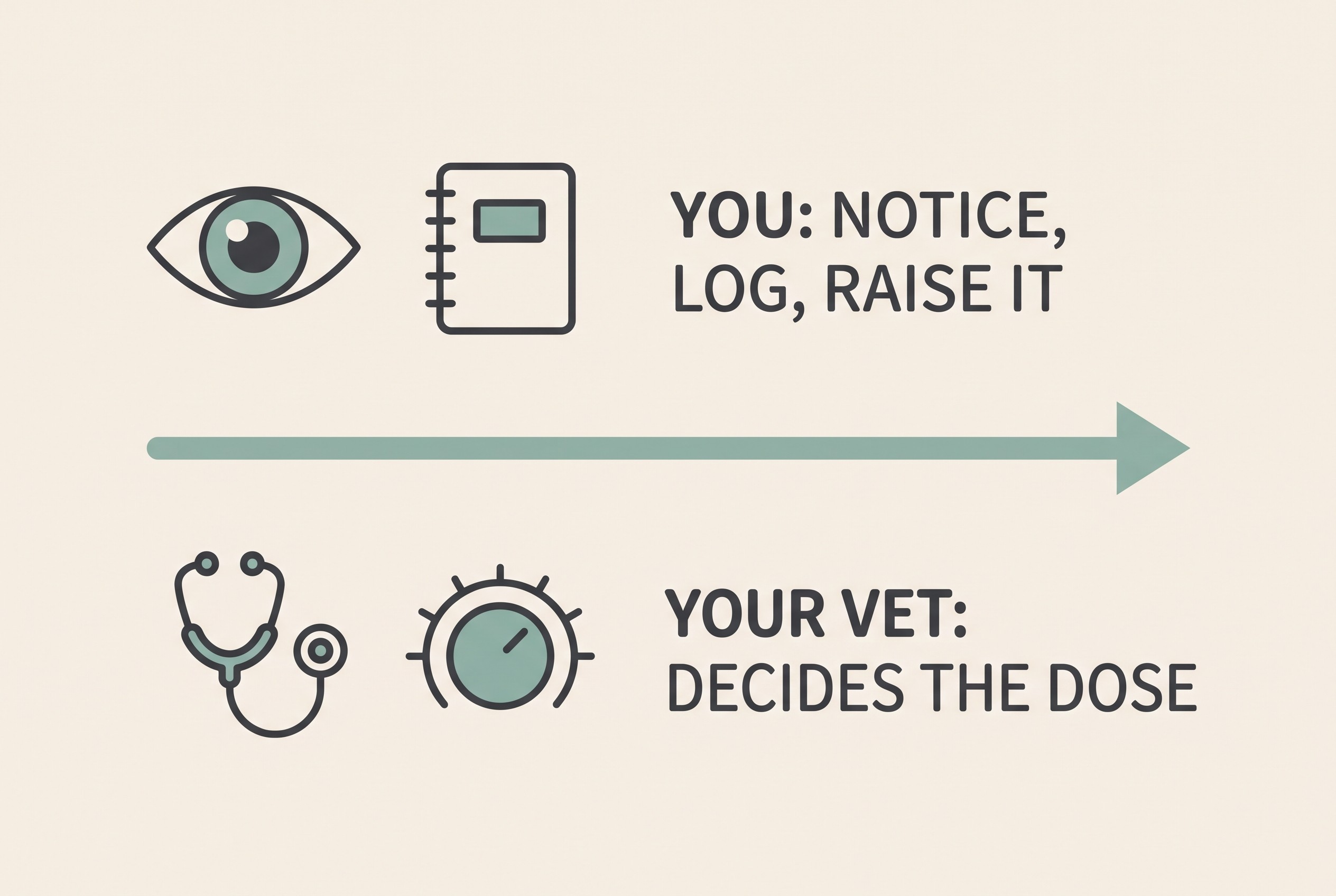
Here is the line that everything above hangs on, and it matters enormously. "Increase the dose" is a clinical decision your vet makes, weighing your cat's weight, response, blood results and, where available, drug levels. It is not something for you to do at home.
That distinction isn't red tape. Getting a dose change right depends on the current weight, the form of FIP, the results in front of the vet and the exact preparation your cat is on, and it's exactly the kind of judgement that goes wrong when it's guessed. So the "if in doubt, increase" instinct is a reason to talk to your vet promptly when your cat is stalling, not a reason to reach for a bigger dose yourself. Your job is to notice, to log, and to raise it. Your vet's job is to decide by how much and when.
What your vet actually does when a cat stalls
If your vet agrees your cat is behind, there's a clear, considered sequence they work through rather than simply reaching for a bigger syringe:
- They re-check that it's really FIP. A cat who isn't responding to an adequate dose prompts a look for another explanation, sometimes with repeat sampling or further tests (Taylor et al., 2024). This is good medicine, not backtracking.
- They consider drug levels. Where TDM is available, checking the level of GS-441524 in the blood can show whether the dose is actually reaching the target, and guide how much to raise it (Taylor et al., 2024).
- They increase the dose thoughtfully. If a cat with an effusion still has fluid at two weeks, the guidance is to consider increasing the dose (Taylor et al., 2024). Dose figures are given as ranges in the current ISFM update, are being refined as evidence grows, and are set by your vet for your individual cat, so this article deliberately doesn't print a number for you to work from.
- They keep treatment going. A stall is a reason to adjust, not to stop early. Treatment is generally sustained until the cat has been clinically normal and stable for a good stretch (Taylor et al., 2024).
The encouraging truth underneath all of this is that a stall is usually a solvable problem. Higher doses can overcome poor absorption and give a better chance of clearing the disease, including reaching the harder parts of the body such as the brain and the eye (Taylor et al., 2024). A cat who's slow to respond is not a cat who's out of options. Very often, she just needs more of the same medicine, given at the right level for her.
What to do this week
If your cat feels like she's stalling, the steps are simple and they're all about getting your vet the right information quickly:
- Keep giving the medicine exactly as prescribed. Don't stop, don't skip, and don't adjust the dose yourself.
- Weigh her and check that the dose has been updated for her current weight, and if you're not certain it has, flag it.
- Write down the specifics: what's not improving, since when, and what her appetite, energy, breathing and weight are doing day to day.
- Contact your vet, share that picture, and ask directly whether a dose review or further testing is the next step.
Slow is frightening, but slow is workable. The cats this treatment struggles with most are not the ones who take their time, they're the ones whose owners lose heart and stop, or whose dose never quite catches up with them. Staying the course, weighing weekly, and keeping an open line to your vet is, more often than not, exactly what gets a stalling cat over the line.
References
- Taylor, S., Tasker, S., Gunn-Moore, D., Barker, E., Sorrell, S. (2024). An update on treatment of FIP using antiviral drugs in 2024: growing experience but more to learn. ISFM / Bova UK (updated February 2024).
- Taylor, S. S., et al. (2023). Retrospective study and outcome of 307 cats with feline infectious peritonitis treated with legally sourced veterinary compounded preparations of remdesivir and GS-441524 (2020–2022). Journal of Feline Medicine and Surgery, 25(9).
- Taylor, S. (2022). "If in doubt, increase the dose" steer, attributed to UK ISFM FIP specialists (webinar/expert guidance).
Keep track of how your pet is doing
The owners who cope best are the ones who notice changes early. A simple health log shows you what is working, and what is not, before the next vet visit.
Start tracking, freeYou're not doing this alone
Compare treatment journeys and talk to owners managing feline infectious peritonitis (fip). Free to join.
Join PetsLikeMine